IRS Compliance for Charitable Impact Reporting
If your donation records do not match IRS rules, your deduction can be denied - even when the gift was real.
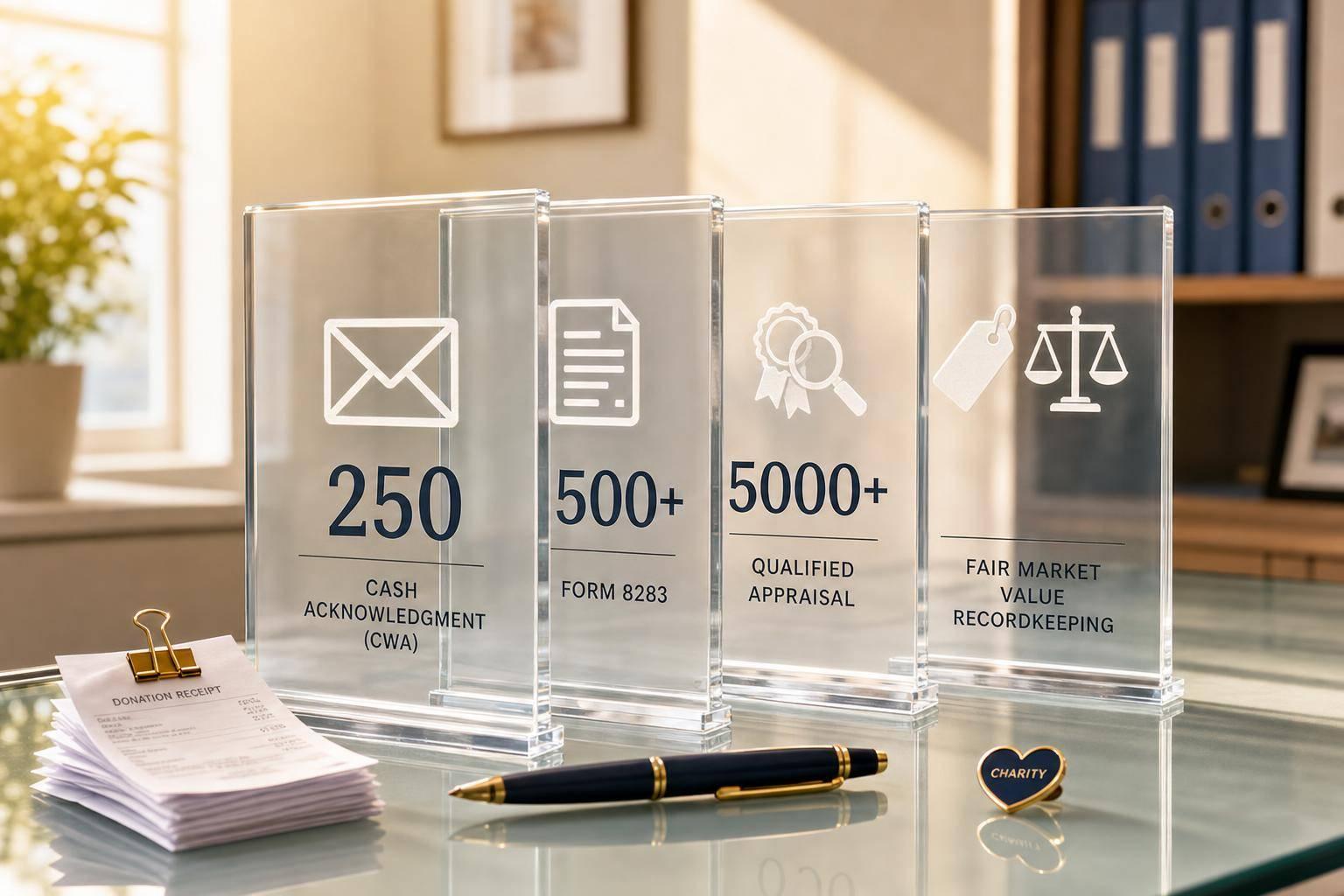
I’d sum up the article like this: impact tracking helps me see what my gift did, but tax records prove I gave it. For U.S. donors, the main cutoff points are $250, $500, and $5,000. At each level, the IRS asks for more proof.
Here’s the short version:
- Cash gifts under $250: I usually need a bank record or receipt
- Cash gifts of $250 or more: I need a contemporaneous written acknowledgment (CWA) from the charity
- Noncash gifts over $500 total for the year: I need Form 8283
- Noncash gifts over $5,000: I usually need a qualified appraisal and Form 8283 Section B
- Impact reports are not enough: they show results, but not the IRS details tied to my gift
- Fair market value (FMV) is based on resale value: not original purchase price
- Blank or vague receipts can kill a deduction: a 2025 Tax Court case denied a $6,760 noncash deduction for that reason
What matters most is simple: keep one record for the tax side and one for the impact side, or combine both in one ledger. I’d make sure each gift has the date, organization name, amount or item description, FMV support, and the goods-or-services statement when required.
| Donation level | Main IRS proof |
|---|---|
| Under $250 | Bank record or receipt |
| $250+ | CWA |
| Over $500 noncash | Form 8283 |
| Over $5,000 noncash | Appraisal + Form 8283 Section B |
If I had to boil the whole piece down to one line, it would be this: good intentions do not protect a deduction - records do.
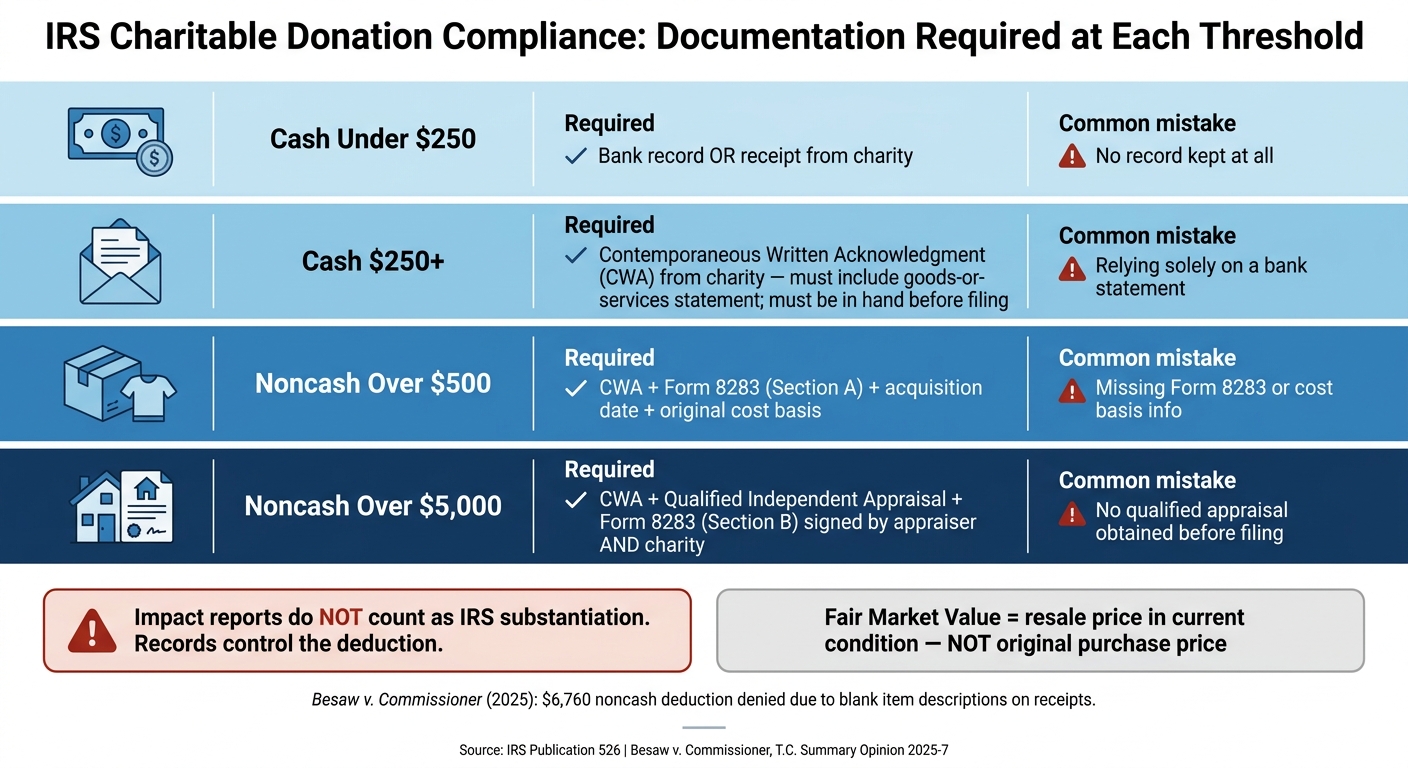
IRS Charitable Donation Compliance: Documentation Requirements by Threshold
The Tax Documentation You Need for Charitable Donations
sbb-itb-e723420
Common IRS compliance problems donors run into
The most common breakdowns happen in receipts, item descriptions, and valuations.
Cash donations missing the required acknowledgment
Cash gifts often go sideways when donors rely on bank records when the IRS wants something else. For a single cash gift under $250, a bank record or canceled check is usually enough. But for any single cash gift of $250 or more, the IRS requires a Contemporaneous Written Acknowledgment (CWA) from the charity. A bank record by itself does not meet the rule [4][1].
That acknowledgment also has to say whether you received any goods or services in return. If that statement is missing, the deduction can fail. And timing matters: you must have the CWA before you file your return or by the return due date, including extensions, whichever comes first [5].
Noncash gifts are even trickier because the IRS also looks at whether your records match the item descriptions and the value you claimed.
Noncash donations with weak descriptions or incomplete Form 8283 details
Noncash deductions often fail because of paperwork, not because the donor didn’t give anything. As the dollar amount goes up, the IRS asks for more support [1][7].
| Donation Value | Required Documentation | Common Gap |
|---|---|---|
| Under $250 | Receipt or bank record, plus your own record of the item and FMV | Generic or blank receipts |
| $250 or more | CWA | Missing goods-and-services statement |
| Over $500 total for the year | CWA + Form 8283, Section A | Missing acquisition date, manner of acquisition, or cost basis |
| Over $5,000 | CWA + qualified appraisal + Form 8283, Section B | Missing appraisal or appraiser signature |
A court case shows how strict this can get. In Besaw v. Commissioner (T.C. Summary Opinion 2025-7), the Tax Court disallowed a $6,760 noncash deduction because the charity receipts had blank item description sections. The taxpayer later tried to rebuild the records during the IRS exam, but the court didn’t accept them. Judge Diana Leyden said:
"None of the receipts he provided from the charitable organizations for his donations included any descriptions of the donated items; therefore, petitioner is not entitled to deduct noncash charitable contributions." [6][8]
That’s the kind of detail that trips people up. If you lump electronics, clothing, and furniture into one fuzzy label like “household goods,” you’re asking for trouble. Each type of item needs its own description and condition record. And for clothing and household items, they should be in good used condition or better.
Fair market value and impact records that do not line up
Another common mistake: using the purchase price as fair market value. That’s not how the IRS sees it. Fair market value (FMV) is what a willing buyer would pay a willing seller in the current market. It’s not what you paid when the item was new, and it’s not replacement cost.
Impact records often sound nice but leave out the details the IRS cares about, like item descriptions, condition ratings, and how the value was figured out. On top of that, charities often leave the value line blank on receipts because the burden of proving FMV falls on the donor, not the organization [8][5].
A good rule of thumb is simple: keep your impact records and tax records together. That way, the story of the donation and the numbers behind it can be checked side by side. When it comes to value, market evidence beats memory every time.
How to fix IRS-compliant charitable impact reporting
Build a receipt checklist for every donation
You can avoid most deduction problems by saving the right records when you make the gift. That's much easier than trying to piece everything together at tax time.
For each donation, keep the organization's full legal name, the date of the contribution, the cash amount or a description of the item donated, and a note about any goods or services you received in return.
For noncash gifts, save more than the bare minimum. Take photos of the items and note their condition. Keep receipts, photos, and value notes together in one file for each donation. It also helps to track the acknowledgment deadline with the rest of your tax records.
Use a tiered process for noncash gifts based on dollar value
The higher the value, the more paperwork you need. The key is to match your records to the IRS threshold, not just whatever receipt the charity gives you.
| Donation Value | What to Gather | Form Required |
|---|---|---|
| Under $250 | Receipt or bank record; for noncash gifts, item description and FMV | None |
| $250–$500 | CWA from the charity, including goods-or-services statement | None |
| Over $500 (total noncash gifts) | CWA + acquisition date + original cost basis | Form 8283, Section A |
| Over $5,000 (single item or group) | CWA + qualified independent appraisal + appraiser and charity signatures | Form 8283, Section B |
If your total noncash gifts go over $500, Form 8283 also asks for the acquisition date and cost basis [3][2].
Support fair market value with comparable sales
Once your paperwork is set, the next issue is value. FMV should come from comparable resale prices and item condition, not what you paid for the item or what you think it's worth from memory.
Look up what similar items are actually selling for. Then adjust for condition and use that proof to back up the value you claim. A simple recordkeeping tool can help you keep receipts, photos, and value notes in one place.
Build a recordkeeping system that tracks both tax data and giving impact
Set up a dual-track charitable giving ledger
Once you know the receipt rules, the next move is simple: keep one ledger that tracks both tax proof and giving results.
A dual-track ledger puts deduction data and impact data in the same record. The tax side supports the deduction. The impact side shows what the gift actually did.
| IRS-Required Field (Tax Track) | Impact Field (Impact Track) |
|---|---|
| Organization Name & EIN | Program/Project Supported |
| Date of Contribution | Beneficiary Group |
| Amount (Cash) or FMV (Noncash) | Annual giving goal |
| Property Description & Condition | Link to Annual Report/Update |
| Valuation Method | Reason for giving |
| Goods or Services Received? (Y/N) | Impact Metric (e.g., meals provided) |
| Acknowledgment on File? (Y/N) | Next Steps/Follow-up Date |
This setup also makes year-end review much faster.
Log each donation the same day you make it. A five-minute entry is a lot easier than trying to rebuild records later - or losing a deduction you already earned. It also helps to add alerts at $500 and $5,000 so your ledger tells you when Form 8283 or a qualified appraisal is needed [1]. Tools like Deductible.me can store receipts, photos, and IRS-compliant reports in one place.
Review your donations each year before filing
At year-end, use the ledger to spot missing acknowledgment letters, valuation holes, and threshold issues before you file.
Start with your noncash total. If it goes over $500, Form 8283 is required. If any single item or group of similar items goes over $5,000, you need a qualified appraisal [4][1]. Then confirm that every acknowledgment letter is actually in hand before you file - not just requested.
If a letter for a gift over $250 still hasn’t shown up by mid-January, contact the charity directly. The deduction can be lost if the letter is not in your possession by the filing date or due date, whichever comes first [1]. Use your annual summary to review totals, missing acknowledgments, and any valuation support that still needs work before filing.
Summary and key takeaways
Your tax-and-impact ledger should end with one plain question: Can each gift hold up if the IRS takes a look? Charitable giving and IRS compliance go hand in hand. A gift can be legitimate and still lose the deduction if the paperwork is weak. Use the table below as a final filing check.
Comparison table: donation type, compliance problem, required documents, and solution
| Donation Type | Typical Compliance Problem | IRS-Required Documentation | Practical Solution |
|---|---|---|---|
| Cash under $250 | Missing bank record or receipt | Bank record (check/statement) or receipt from charity | Save a digital copy of your bank statement or receipt |
| Cash $250 or more | Relying solely on a bank statement | Contemporaneous Written Acknowledgment (CWA) from charity | Ask for the CWA at the time of donation - don't wait |
| Noncash under $250 | Vague item descriptions | Receipt or donor record with charity name, date, item description, and FMV note | Photograph items and use specific labels (e.g., "men's wool coat") |
| Noncash $250 to $500 | Missing CWA or condition notes | CWA + property description + FMV records | Use recent comparable resale prices and condition notes for FMV |
| Noncash $500 to $5,000 | Missing Form 8283 Section A; no cost basis | CWA + Form 8283 (Section A) + records of acquisition/cost | Keep original purchase receipts for items you plan to donate |
| Noncash over $5,000 | No qualified appraisal; missing signatures | CWA + Qualified Appraisal + Form 8283 (Section B) signed by appraiser and charity | Obtain the qualified appraisal before filing |
Key points for donors and small business owners
Once you've checked the table, give your return one more pass with these rules in mind.
Impact reports do not replace IRS substantiation, and records control the deduction. A charity's annual report or program update may help you understand where the money went, but it does not count as a tax record. The IRS wants specific documents tied to specific gifts. And the paperwork gets stricter as gift size goes up: from a receipt, to a CWA, to Form 8283, to a qualified appraisal.
Fair market value must come from resale evidence, not original cost. The IRS cares about what a willing buyer would pay for the item in its current condition. That's resale value, not what you paid when you bought it. Photos, condition notes, and comparable resale prices are what make an FMV claim easier to defend.
Deductible.me keeps receipts, photos, valuation notes, and annual summaries in one place.
FAQs
What counts as a contemporaneous written acknowledgment?
A contemporaneous written acknowledgment is required to support charitable contributions of $250 or more.
You need to receive this acknowledgment by the earlier of:
- The date you file your federal income tax return for the year you made the contribution
- The due date of that return, including extensions
The acknowledgment must include:
- The organization’s name
- The date of the contribution
- The cash amount, or a description of any non-cash property
It also must state whether you received any goods or services in return. If you did, the acknowledgment needs to include a good faith estimate of their value.
How do I prove fair market value for donated items?
To prove fair market value, estimate what the item would sell for as-is on the open market, like a thrift store or resale site. The IRS puts the value call on the donor, so keep an itemized list, receipts, and notes showing how you came up with the number.
For common household goods, Deductible.me can help by reviewing photos and live resale data to suggest a defensible FMV. For items over $5,000, you generally need a qualified appraisal.
When do I need Form 8283 or a qualified appraisal?
File IRS Form 8283 if your total annual noncash charitable deductions are more than $500. If your deduction is $5,000 or less, you’ll usually fill out Section A.
If you claim more than $5,000 for one item, or for a group of similar items, fill out Section B and get a qualified appraisal. The IRS counts similar items together across all recipients when it applies the $5,000 threshold.