Non-Cash Donations: IRS Documentation Rules
Donating non-cash items like clothing, furniture, or vehicles can qualify you for tax deductions - but only if you follow IRS documentation rules. Here's what you need to know:
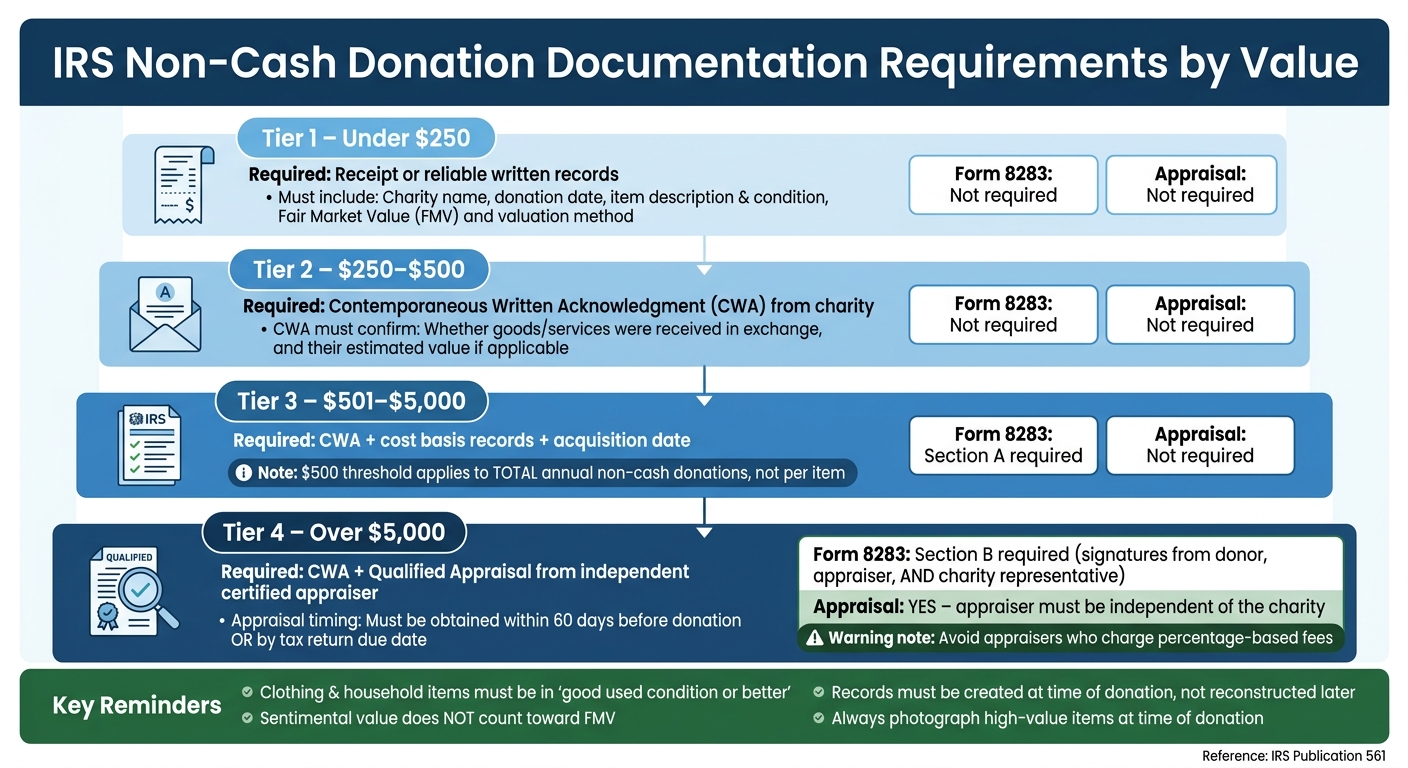
- Under $250: A receipt or written records with the charity's name, donation date, item description, and fair market value (FMV) are required.
- $250–$500: You need a Contemporaneous Written Acknowledgment (CWA) from the charity, confirming if any goods or services were received.
- $501–$5,000: File Form 8283 (Section A) with your tax return. Include the CWA, cost basis, and acquisition date.
- Over $5,000: Add a qualified appraisal and complete Section B of Form 8283. The appraiser must be independent of the charity.
Key Tip: Always document FMV and item condition. For higher-value items, photos and detailed records can prevent issues during audits. Remember, incomplete paperwork - like in the Besaw v. Commissioner case - can lead to denied deductions.
To simplify tracking, consider tools like Deductible.me, which helps organize records and estimate FMV. Proper documentation ensures you claim every deduction you're eligible for.
How Do I Deduct Non-cash Charitable Donations? - Tax and Accounting Coach
sbb-itb-e723420
IRS Documentation Requirements by Donation Value
IRS Non-Cash Donation Documentation Requirements by Value
When it comes to non-cash donations, the IRS has a tiered system for documentation. The higher the donation value, the more detailed your records need to be. Here's a breakdown of what’s required at each level.
Non-Cash Donations Under $250
For donations under $250, you’ll need a receipt or reliable written records. If you’re donating to an unattended bin and can’t get a receipt, make sure to document the following:
- Charity's name
- Donation date
- Item description and condition
- Fair market value (FMV) and how you determined it
Timeliness matters here. The IRS gives more weight to records created close to the donation date. Also, keep in mind that clothing and household items must be in at least good used condition to qualify for any deduction.
Let’s move on to donations between $250 and $500, which require additional documentation.
Donations Between $250 and $500
Once a donation hits $250, a simple receipt won’t cut it. You’ll need a Contemporaneous Written Acknowledgment (CWA) from the charity. This acknowledgment must confirm whether you received any goods, services, or benefits in return. If you did, it should describe them and provide an estimated value. Missing this detail could result in non-compliance with IRS standards.
For donations exceeding $500, the requirements become even more detailed.
Donations Over $500
If your total non-cash donations for the year exceed $500, you’ll need to file Form 8283 with your tax return. Specifically, Section A of the form applies to donations valued between $501 and $5,000. In addition to the CWA, you’ll need to provide records of the property’s cost basis and acquisition date.
It’s important to note that the $500 threshold applies to your total annual non-cash donations, not individual contributions.
High-Value Donations Over $5,000
For donations over $5,000, the documentation requirements become much stricter. In most cases (excluding publicly traded securities), you’ll need a qualified appraisal from a certified appraiser. The appraiser cannot be affiliated with the charity. Additionally, you must complete Section B of Form 8283, which requires signatures from:
- You
- The appraiser
- An authorized representative of the charity
The appraisal must be obtained within 60 days prior to the donation or by the time your tax return is due. Be cautious about appraisers who charge fees based on a percentage of the appraised value - this can raise red flags with the IRS.
Here’s a quick summary of the requirements at each donation level:
| Donation Value | Documentation Required | Form 8283? | Appraisal Required? |
|---|---|---|---|
| Under $250 | Receipt or reliable written records | - | - |
| $250–$500 | Contemporaneous Written Acknowledgment (CWA) | - | - |
| $501–$5,000 | CWA + cost basis and acquisition date records | Section A | - |
| Over $5,000 | CWA + Qualified Appraisal | Section B | Yes |
Valuing Non-Cash Donations and Proving Fair Market Value
Getting the value of your donations right is a must - not just for staying on the IRS's good side but also to make sure you claim the tax benefits you deserve. Overestimating could lead to an audit, while undervaluing means leaving money on the table. The IRS has a clear definition of fair market value (FMV):
"FMV is the price that property would sell for on the open market. It is the price that would be agreed on between a willing buyer and a willing seller, with neither being required to act, and both having reasonable knowledge of the relevant facts." - IRS Publication 561 [1]
One key thing to note: sentimental value doesn’t count. The IRS doesn’t care how much an item means to you personally - it’s all about its actual market value [3].
How to Determine Fair Market Value
FMV is based on the item's worth on the day you donate it - not its original price or the cost to replace it with something new [1]. To estimate FMV, you can use thrift store pricing guides, resale platforms, or consignment shop prices for similar items.
Documenting how you arrived at your valuation is crucial. For example, you might note, "Value determined using comparable eBay listings for the same model and condition" or reference a guide like the Salvation Army Valuation Guide. This step helps ensure your reasoning is clear if the IRS ever questions your return [1].
For more complex items, the valuation process changes. Publicly traded stocks, for instance, are valued by averaging the high and low prices on the donation date [1][5]. Donated vehicles are typically valued based on the gross proceeds the charity receives from selling the car, as reported on IRS Form 1098-C [4][5]. Art and collectibles often require a professional appraisal, supported by comparable sales data from auctions or galleries [1].
If you’re managing multiple donations throughout the year, tools like Deductible.me can simplify the process. These tools let you log each item's estimated value and the method you used, keeping everything organized and ready for tax season.
After determining FMV, make sure the item’s condition meets IRS requirements.
Item Condition Requirements for Donations
The condition of your donated items plays a big role in whether they qualify for a deduction. The IRS generally requires clothing and household goods - such as furniture, electronics, and linens - to be in "good used condition or better" [1][6]. Items in poor condition are usually not eligible.
There’s an exception to this rule: if an item is valued at more than $500 but doesn’t meet the "good" condition standard, you can still claim it as long as you include a qualified appraisal with your tax return [1][4].
For higher-value items, especially those nearing $500 or $5,000 thresholds, it’s smart to take photos at the time of donation. Pair these with a written description that notes any wear, damage, or missing parts. This is particularly important for art donations valued at $20,000 or more, as thorough documentation strengthens your case [1].
Accurate FMV and clear condition records can make all the difference in securing your deduction.
Organizing Records to Meet IRS Rules
Keeping accurate records isn’t just a good habit - it’s essential for staying on the IRS’s good side. Proper documentation supports your tax claims and protects you during audits. On the flip side, incomplete records could mean losing out on deductions because the responsibility to prove your claims falls entirely on you.
Records You Need to Keep
The type of documentation you need depends on how much you’ve donated. Here’s a quick guide:
| Donation Value | Required Documentation | IRS Form Needed |
|---|---|---|
| Under $250 | Receipt with the charity's name, date, and item description | None |
| $250–$500 | Contemporaneous Written Acknowledgment (CWA) stating whether any goods or services were received | None |
| $501–$5,000 | CWA, plus records of the acquisition date, cost basis, and your valuation method | Form 8283, Section A |
| Over $5,000 | All of the above, plus a qualified appraisal; the charity must sign Form 8283 | Form 8283, Section B |
A few tips to make record-keeping easier:
- Be thorough with receipts: Ensure your receipt includes the charity’s name, the donation date, and a detailed item description. If the description field is blank at a drop-off center, fill it in before leaving.
- Keep acknowledgments handy: For donations of $250 or more, you need a written acknowledgment in your possession before filing your tax return.
- Document acquisition details: For items valued over $500, note how you acquired them (e.g., purchase, gift, or inheritance) and include the cost basis.
Once you’ve gathered the right records, setting up a simple system can save you time and stress.
Building a Simple Documentation Workflow
The IRS emphasizes that records must be created at the time of donation - not pieced together later.
"The word contemporaneous comes up in other places in tax law as well... You're not supposed to look back at the prior year and try to reconstruct that from memory." - Jeremy Wells, CPA/EA, Steadfast Bookkeeping [3]
To make this process easier, take these steps:
- Photograph donated items immediately.
- Double-check receipt details before leaving the donation site.
- Digitally store receipts and photos, organized by tax year.
If you donate frequently, tools like Deductible.me can simplify things even more. This app uses AI to estimate fair market value, logs your valuation method, and stores receipts digitally. When tax season rolls around, it generates Form 8283-ready reports, so you’re not scrambling to find paperwork. Their free plan tracks up to $500 in annual donations, while the Premium plan ($2/month) offers unlimited tracking, advanced receipt management, and analytics for multiple charities.
Conclusion: Staying Compliant and Getting the Most from Your Deductions
When it comes to charitable deductions, the IRS has one non-negotiable rule: proof is everything. In fact, the most common reason deductions get denied is poor documentation [7]. That’s an expensive mistake for something as simple as keeping the right records.
The requirements for documentation depend on the size of your donation. For contributions under $250, you’ll need a receipt. Donations of $250 or more require a written acknowledgment, while gifts exceeding $500 mean filing Form 8283. If your donation is over $5,000, a qualified appraisal is also necessary. The key is having a system to track all this consistently.
Jeremy Wells, EA, CPA, puts it plainly:
"Deductions are a matter of legislative grace... You can't just say you made a contribution and expect the benefit. The law sets rules for how taxpayers claim and prove deductions." [3]
Waiting until tax season to gather your records is a gamble. The Besaw v. Commissioner case is a reminder that even legitimate donations can be denied without proper, timely paperwork [2]. If you donate frequently, tools like Deductible.me can simplify the process. They offer a free plan for up to $500 in annual donations and a Premium option at just $2/month for unlimited tracking and advanced receipt management.
To stay compliant, make documentation a habit. Check that your chosen charity is a qualified 501(c)(3), and ensure your receipts include the charity’s name, the date, and a description of your donation. By keeping detailed records throughout the year, you’ll be ready to claim every deduction you’re entitled to - without the stress.
FAQs
Does the $500 threshold apply per donation or for the whole year?
The $500 threshold for filing Form 8283 is based on the total value of all your non-cash donations throughout the year. If the total claimed deductions for your non-cash property go beyond $500, you’ll need to file this form. This rule also applies to groups of similar items - if their combined deduction surpasses $500, Form 8283 is required. Tools like Deductible.me can make it easier to track your donations and ensure you stay compliant with IRS rules.
What if I donated items but didn’t get a receipt or acknowledgment?
If you’ve donated items but don’t have a receipt, the IRS lets you rely on detailed written records instead. These records should include key information like the date of donation, location, and a description of the items. However, for donations valued at $250 or more, you’ll need a written acknowledgment from the charity to claim the deduction. Tools such as Deductible.me can make it easier to stay compliant with IRS requirements and keep track of your contributions seamlessly.
How do I prove fair market value if the IRS questions my deduction?
To establish fair market value (FMV), you need to show what a willing buyer would pay a willing seller on the specific date of the gift. Be sure to keep thorough documentation, including:
- A detailed description of the item
- Its current condition
- The method used to determine its value
For items valued over $5,000, you'll need a qualified appraisal from an independent professional. Supporting your claim with comparable sales or industry pricing guides can also strengthen your case.