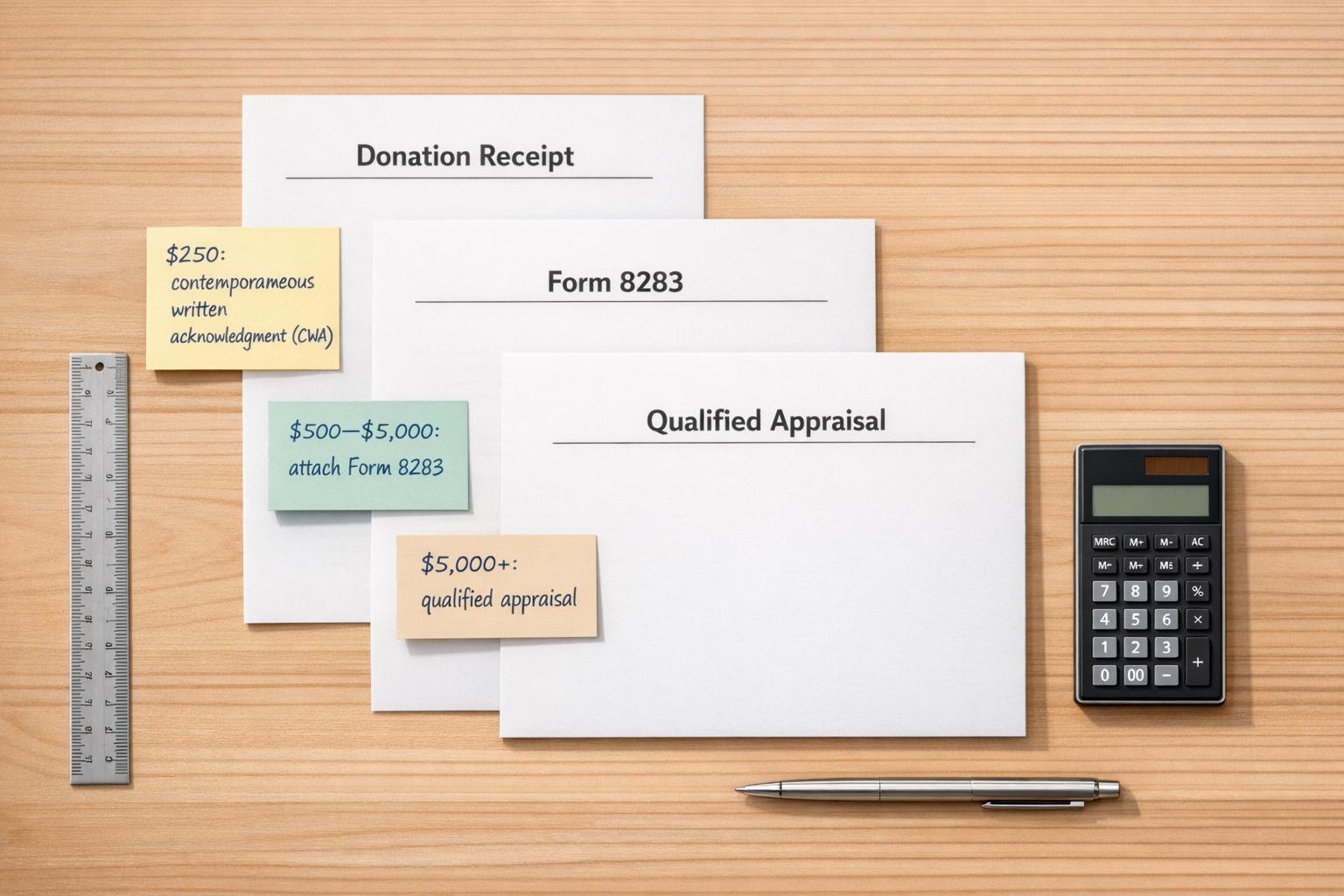
Substantiation Rules for Donations
Donating to charity? Make sure your tax deduction qualifies. The IRS has strict rules for documenting charitable contributions, and without the right records, your deduction could be denied. Here's what you need to know:
-
Cash Donations:
- Under $250: A bank record or receipt from the charity is enough.
- $250 or more: You also need a Contemporaneous Written Acknowledgment (CWA) from the charity confirming the donation amount and any goods/services received.
-
Noncash Donations:
- Under $250: A simple receipt with the charity's name, date, and item descriptions will do.
- $250–$500: Add a CWA.
- $501–$5,000: File Form 8283 (Section A) and document how/when you got the items.
- Over $5,000: A qualified appraisal is required, along with Form 8283 (Section B) signed by the appraiser and charity.
Key thresholds to remember: $75, $250, $500, $5,000, and $500,000. Missing documentation is the top reason deductions are denied. Tools like Deductible.me can help you stay organized and avoid issues.
Proper documentation ensures your donations count - don't risk losing your deduction!
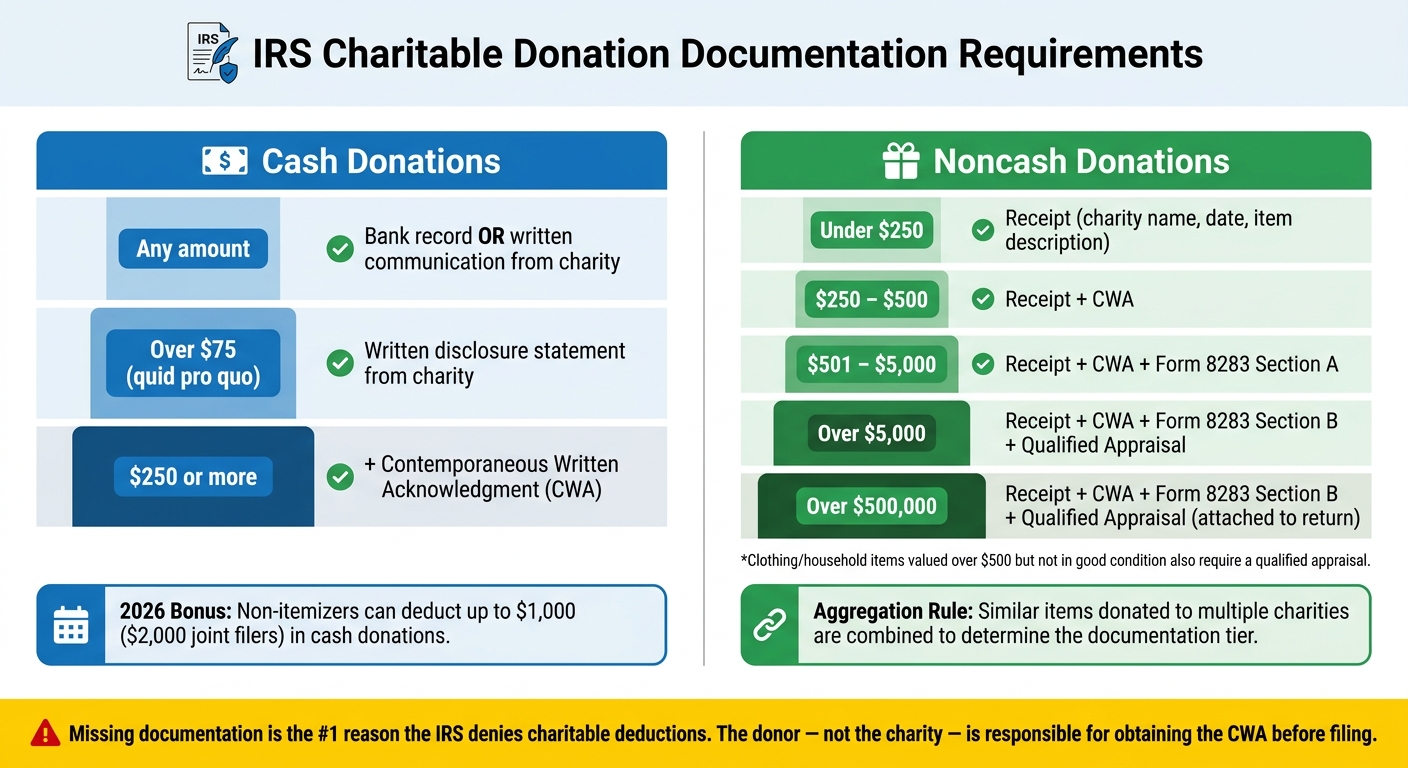
IRS Charitable Donation Documentation Requirements: Cash vs. Noncash
QUICK TIP: How to Maximize Your Charitable Deductions
sbb-itb-e723420
1. Cash Donations
Cash donations cover more than just handing over physical money. According to the IRS, a monetary gift includes contributions made via cash, check, credit card, electronic fund transfer (EFT), or even gift cards that can be redeemed for cash [1]. To claim these donations, proper documentation is essential - personal notes or check registers won’t cut it. Instead, you’ll need official records like bank statements or written acknowledgments from the charity. Let’s break down the documentation requirements based on the donation amount.
For donations under $250, acceptable records include a bank statement, canceled check, credit card statement, or an email receipt. These documents must clearly display the charity’s name, the donation date, and the amount.
If you contribute $250 or more in a single donation, a bank record alone isn’t enough. You’ll also need a Contemporaneous Written Acknowledgment (CWA) from the charity. This acknowledgment should confirm the donation amount and specify whether any goods or services were received in return. If you did receive something, the acknowledgment must state its fair market value. Make sure to secure this document before filing your taxes, as the charity won’t send it directly to the IRS.
"A donor claiming a deduction of $250 or more is also required to obtain and keep a contemporaneous written acknowledgment for a charitable contribution." - Internal Revenue Service [1]
For donations involving quid pro quo benefits - where you receive something in return, like a gala ticket or auction item - different rules apply. If your payment exceeds $75, the charity must provide a written disclosure estimating the fair market value of the benefit. You can only deduct the portion of your payment that exceeds this value.
Looking ahead to tax year 2026, there’s good news for taxpayers who don’t itemize. You’ll be able to deduct up to $1,000 (or $2,000 for joint filers) in cash contributions to qualified organizations [2].
Here’s a quick reference for the required documentation:
| Donation Amount | Required Documentation |
|---|---|
| Any amount | Bank record or written communication from the charity |
| Over $75 (quid pro quo) | Written disclosure statement from the charity |
| $250 or more | Contemporaneous Written Acknowledgment (CWA) |
To keep your donation records organized and ensure compliance with IRS rules, you might find tools like Deductible.me helpful.
2. Noncash Donations
Noncash donations, like clothing, furniture, artwork, or vehicles, come with their own set of documentation rules. These requirements depend on the value of the items donated, creating a tiered system designed to match the level of documentation with the donation's worth.
For donations valued under $250, a simple receipt that includes the charity's name, the date of the donation, and a description of the items is enough. Contributions of $250 or more require a contemporaneous written acknowledgment (CWA) from the charity.
If your donation is valued between $501 and $5,000, you’ll need to file Form 8283 (Section A) with your tax return. Additionally, you must keep records detailing when and how you obtained the property, along with its original cost basis.
For donations exceeding $5,000, a qualified appraisal is mandatory. You’ll also need to complete Form 8283 (Section B), which must be signed by both the appraiser and the charity. It’s worth noting that the charity’s signature only confirms receipt of the property - it does not indicate agreement with the appraised value:
"The signature of the donee on Form 8283 (Section B) does not represent concurrence in the appraised value of the contributed property. Rather, it represents acknowledgment of receipt of the property." - 26 CFR § 1.170A-16 [3]
One critical rule to keep in mind is the aggregation rule. If you donate similar items to multiple charities during the year, the IRS requires you to combine their total value to determine which documentation tier applies. For example, donating $3,000 worth of furniture to one charity and $2,500 worth to another crosses the $5,000 threshold, meaning you’ll need a qualified appraisal.
For clothing and household items, the IRS requires that they be in at least "good used condition." If such items are valued over $500 but don’t meet this standard, a qualified appraisal is required. To support your deduction, it’s a good idea to document the condition of these items with photographs [1][4].
Here’s a quick reference guide for the documentation requirements based on the donation’s value:
| Contribution Value | Receipt | CWA | Form 8283 | Qualified Appraisal |
|---|---|---|---|---|
| Less than $250 | Yes | No | No | No |
| $250 – $500 | Yes | Yes | No | No |
| $501 – $5,000 | Yes | Yes | Section A | No* |
| Over $5,000 | Yes | Yes | Section B | Yes |
| Over $500,000 | Yes | Yes | Section B | Yes (attach to return) |
*Exception: A qualified appraisal is required for clothing or household items not in good condition if valued over $500 [1][4].
Maintaining thorough records for noncash donations is just as important as it is for cash contributions. To simplify the process, tools like Deductible.me can help. Their AI-powered platform provides item valuations and generates IRS-compliant Form 8283 reports, making it easier to stay organized and ready for tax season.
Pros and Cons
When it comes to documenting charitable donations, cash and noncash contributions differ significantly in terms of complexity and audit risk. Cash donations are relatively straightforward because they rely on objective, third-party records like bank statements, credit card records, or canceled checks. Noncash donations, however, demand more detailed documentation, with requirements becoming more intricate as the value of the donation increases. These differences are key to understanding the risks and benefits associated with each type of donation.
Here’s a comparison of the main advantages and disadvantages of cash versus noncash donations:
| Factor | Cash Donations | Noncash Donations |
|---|---|---|
| Ease of documentation | High – bank records usually suffice | Moderate to Low – requires detailed receipts and item descriptions |
| Complexity at higher thresholds | Low – a CWA (contemporaneous written acknowledgment) is enough for donations of $250 or more | High – additional forms and appraisals are often needed |
| Audit-readiness | High – backed by objective, third-party verification | Lower – subjective valuations increase the chance of errors |
| 2026 nonitemizer deduction | Eligible (up to $1,000; $2,000 for joint filers) | Not eligible |
| Appraisal required | Never | Yes, for contributions over $5,000 |
For cash donations, the process is simpler: a CWA is the only requirement for amounts above $250. Noncash donations, on the other hand, require more effort, such as completing Form 8283 and obtaining appraisals for contributions exceeding $5,000.
The reliance on third-party documentation for cash donations makes them less risky during audits. Noncash donations, however, often involve subjective valuations, which can lead to errors or disallowed deductions. A notable example is the case of Besaw v. Commissioner (T.C. Summary Opinion 2025-7, July 2025), where the Tax Court rejected a $6,760 noncash deduction because the receipts lacked item descriptions. Attempts to recreate documentation during the audit were unsuccessful[5]:
"None of the receipts he provided from the charitable organizations included any descriptions of the donated items. This failure alone was fatal to the deduction." - Tax Court Summary Opinion 2025-7[5]
To ease the process and reduce audit risks, tools like Deductible.me can help manage noncash donation records. These tools generate IRS-compliant reports and organize receipts, simplifying documentation for both cash and noncash contributions.
Conclusion
When it comes to charitable donations, proper documentation is key to ensuring your deductions are accepted by the IRS. For cash contributions under $250, a bank record is sufficient, but for amounts of $250 or more, you’ll need a contemporaneous written acknowledgment (CWA). Noncash donations have their own set of requirements: a receipt for low-value items, IRS Form 8283 for donations exceeding $500, and a qualified appraisal for items valued over $5,000. Failing to meet these standards can result in denied deductions.
Importantly, it’s up to donors - not charities - to request and secure the CWA. The IRS makes this clear:
"The donor is responsible for requesting and obtaining the written acknowledgement from the donee." - Internal Revenue Service [1]
Timing also matters. You must have the acknowledgment in hand before filing your tax return. Missing this step is one of the most common reasons legitimate deductions are disallowed.
Drew Giddings, Founder & Principal Consultant at Giddings Consulting Group, emphasizes this point:
"Documentation failures are the number one reason the IRS disallows charitable deductions." [6]
For noncash donations, staying organized throughout the year - rather than scrambling at tax time - can make a big difference. Tools like Deductible.me can help simplify this process. With features like AI-powered item valuation from photos, automated Form 8283 exports, and centralized receipt tracking, it’s designed to keep your records audit-ready. The free tier supports donation values up to $500 annually, while the Premium plan, at just $24 a year, offers unlimited tracking and enhanced management options, making it easier to stay compliant and maximize your deductions.
FAQs
What counts as a “contemporaneous” written acknowledgment?
A contemporaneous written acknowledgment is a document you need from a charity when you donate $250 or more. To qualify for a tax deduction, you must have this acknowledgment by the earlier of two dates: when you file your tax return or the return's due date (including any extensions). The document should include the donation amount, whether you received any goods or services in return, and, if applicable, a description of any donated property. Tools like Deductible.me make it easier to track donations and ensure your records meet IRS requirements.
How do I apply the aggregation rule for similar noncash items?
The IRS has a rule: if the combined value of similar property items exceeds $500, you’ll need to file Form 8283. This applies even when individual items are worth less than $500, but their total as a group crosses that threshold. That’s where Deductible.me comes in - it makes tracking, categorizing, and reporting your donations straightforward and accurate. Just remember to account for any required value reductions before calculating the total deduction.
What records should I keep to support the value of noncash donations?
To document noncash donations, make sure to keep a receipt from the organization. This receipt should include the organization’s name, the date and location of the donation, and a clear description of the items you donated. For donations valued at $250 or more, you'll need a written acknowledgment from the organization that is issued around the time of the donation.
If your total noncash contributions add up to more than $500, you’ll also need to file IRS Form 8283. This form requires details about the property, such as its description, when you acquired it, its cost basis, and its fair market value.