IRS Appraisal Rules for Non-Cash Donations
Donating non-cash items like clothing, furniture, or art can offer tax benefits, but the IRS has strict rules for valuation and documentation. Here's what you need to know:
- Donations over $500: Require Form 8283.
- Donations above $5,000: Need a qualified appraisal and signatures from the appraiser and charity.
- Art over $20,000: Must include a signed appraisal copy.
- Donations exceeding $500,000: Require the full appraisal report.
Missteps in valuation or paperwork can result in penalties - 20% for substantial errors and 40% for gross misstatements. Publicly traded securities and certain vehicles are exceptions to appraisal requirements. Keep detailed records, and ensure appraisals are completed within 60 days of the donation and before filing your tax return. Use tools like Deductible.me to simplify compliance and maintain accurate records.
IRS Thresholds for Appraisals and Documentation
Dollar Thresholds That Trigger Appraisal Requirements
The IRS uses a tiered approach to determine what documentation is required for non-cash donations, based on their value. Each level comes with its own set of requirements, so it's important to know where your donation fits to ensure compliance.
| Donation Value | Documentation Required | Appraisal Required? |
|---|---|---|
| $250 – $500 | Written acknowledgment from the charity | No |
| $501 – $5,000 | Form 8283, Section A | No (unless items are not in good used condition) |
| Over $5,000 | Form 8283, Section B | Yes - qualified appraisal |
| Over $20,000 (art) | Form 8283, Section B (attach a copy of the signed appraisal) | Yes - qualified appraisal |
| Over $500,000 | Form 8283, Section B (attach full appraisal report) | Yes - qualified appraisal |
The IRS also applies an aggregation rule: donations of similar items made to multiple charities are combined. For instance, donating $3,000 worth of clothing to one charity and $2,500 worth to another is treated as a $5,500 donation. This would require completing Section B of Form 8283 and obtaining a qualified appraisal[3].
Now, let’s look at exceptions that might simplify this process.
Exceptions and Exemptions
Certain non-cash donations are exempt from appraisal requirements, even if their value exceeds $5,000. For example, publicly traded securities don’t need an appraisal since their value can be verified through established market prices[4][2].
Qualified vehicle donations are another exception if your deduction is based on the charity’s gross sale proceeds as reported on Form 1098-C. Additionally, donations of inventory, intellectual property, and most clothing or household items in good used condition valued at $500 or less are exempt from appraisal requirements[3]. These exceptions can streamline your documentation process, allowing you to focus on completing Form 8283 accurately.
Form 8283: Sections A and B Explained
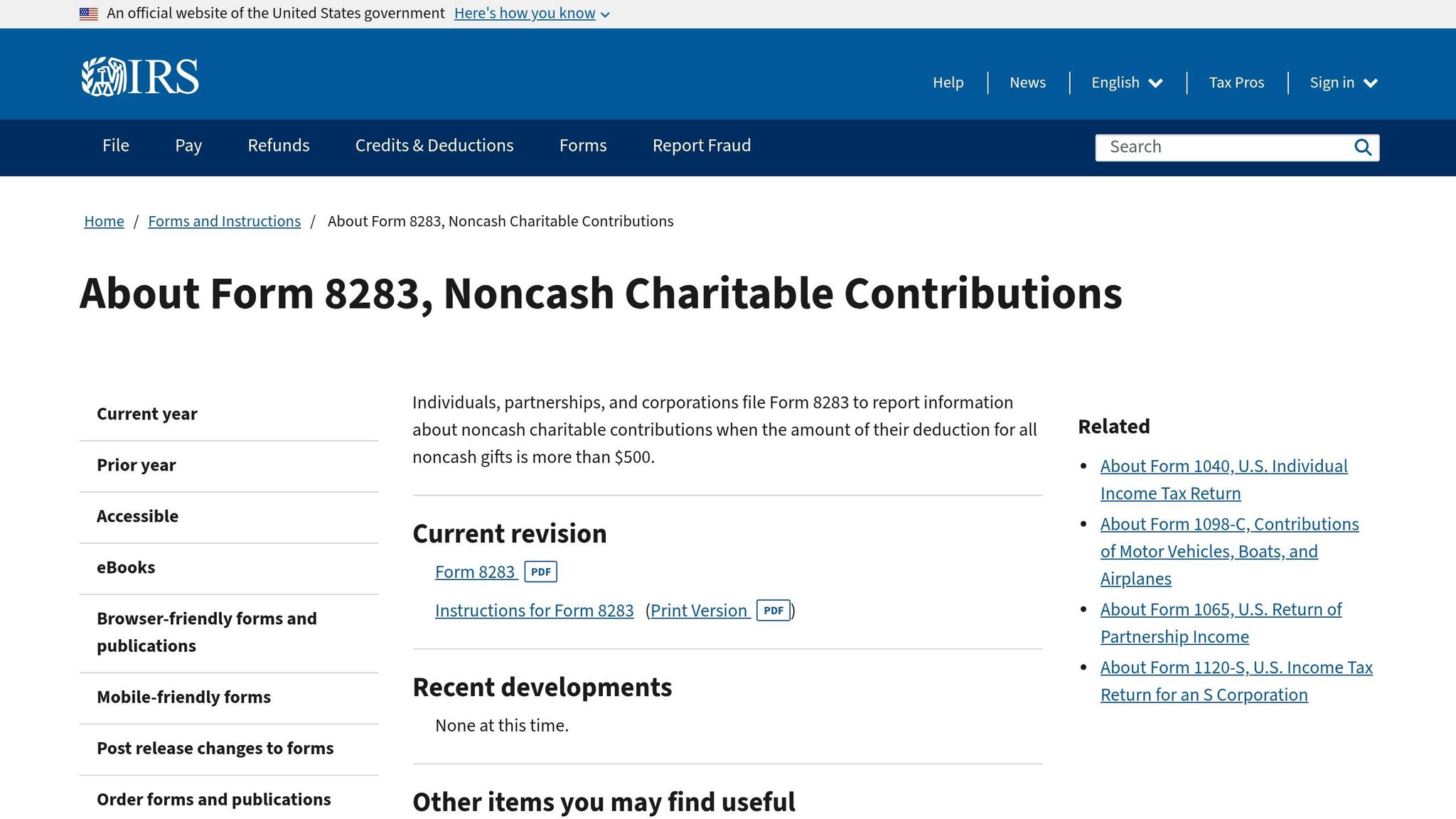
Form 8283 is essential for documenting non-cash donations when total deductions exceed $500. The section you need to complete depends on the value of your donation.
- Section A: This section is for donations of similar items valued between $501 and $5,000. You’ll need to include details like a description of the property, the acquisition date, its cost basis, fair market value, and the method used to determine that value. Publicly traded securities, intellectual property, and qualified vehicles (where the deduction is limited to gross sales proceeds) also fall under Section A, no matter their value[5].
- Section B: Donations exceeding $5,000 require this section. A qualified appraisal is mandatory, along with signatures from both the appraiser (Part IV) and a representative from the charity (Part V). Missing either signature is a common reason for deduction denials[3].
"Think of Form 8283 as your proof of value, timing, and support for noncash gifts. When it is complete and consistent, reviews move faster and deductions hold up." - Accountably.com[3]
If you’re donating art worth more than $20,000, you’ll need to attach a signed copy of the appraisal to your tax return. For donations over $500,000, the full appraisal report must be included[4][3]. Additionally, if you’re donating art valued at $50,000 or more, you can request a formal Statement of Value from the IRS before filing. This provides extra assurance about your valuation[1].
sbb-itb-e723420
Qualified Appraisals and Appraisers: IRS Standards
What Counts as a Qualified Appraisal
A qualified appraisal is a formal valuation that meets IRS standards and aligns with the Uniform Standards of Professional Appraisal Practice (USPAP) [6]. It should include:
- A detailed description of the property and its condition
- The fair market value (FMV) as of the valuation date
- The date (or expected date) of the contribution
- The specific valuation method used
- The appraiser's name, address, taxpayer identification number (TIN), qualifications, and a statement confirming the appraisal was prepared for income tax purposes [6][7]
The appraisal must also explain the basis for the valuation, such as comparable sales data. A valuation without proper support won't pass IRS scrutiny. Their reviewers assess the methodology, the appraiser's qualifications, and the factual evidence provided. The more thorough and precise the documentation, the better [6].
Understanding these requirements is just the first step. It's equally important to ensure the appraiser meets IRS standards.
Who Qualifies as a Qualified Appraiser
The IRS has strict guidelines for who can provide a qualified appraisal. At minimum, the appraiser must have formal education and experience in valuing the specific type of property being donated - not just general appraisal knowledge [6]. For instance, an appraiser with expertise in real estate wouldn't be suitable to appraise a collection of antique jewelry.
To qualify, an appraiser must hold a recognized professional designation or complete college-level coursework with at least two years of relevant experience [6][7]. Additionally, they must regularly perform appraisals for compensation, not as an occasional activity.
Certain individuals are specifically disqualified by the IRS, including the donor, the charity receiving the donation, the person who sold the property to the donor, and anyone related to or employed by these parties [6]. Appraisers who have been barred by the IRS within the last three years are also excluded [6]. Donors should carefully check credentials and ensure there’s no conflict of interest before hiring an appraiser.
A qualified appraisal must include a signed declaration from the appraiser, which states:
"I understand that my appraisal will be used in connection with a return or claim for refund. I also understand that, if there is a substantial or gross valuation misstatement of the value of the property claimed on the return or claim for refund that is based on my appraisal, I may be subject to a penalty under section 6695A..." - Required Appraiser Declaration [6]
This declaration emphasizes the importance of accuracy and accountability when selecting a professional appraiser.
Appraisal Timing Rules
Beyond ensuring the appraisal and appraiser meet IRS standards, timing is critical. The appraisal must be signed and dated no earlier than 60 days before the donation date, and the donor must have it in hand by the tax return due date (including extensions) for the year the deduction is claimed [6][7].
"A qualified appraisal is an appraisal document that... Is issued no earlier than 60 days before the date of the contribution and no later than the date the tax return is due, including extensions." - Internal Revenue Service [7]
The effective date of the valuation is another key detail. If the appraisal is completed after the donation, the effective date must match the actual date of the contribution. If it’s done beforehand (within the 60-day window), the effective date should reflect the anticipated donation date [6][7]. Missteps here are a common reason for IRS rejections.
For amended returns, the appraisal must be obtained before filing [7].
IRS Form 8283 walkthrough (Noncash Charitable Contributions)
Step-by-Step Compliance Workflow
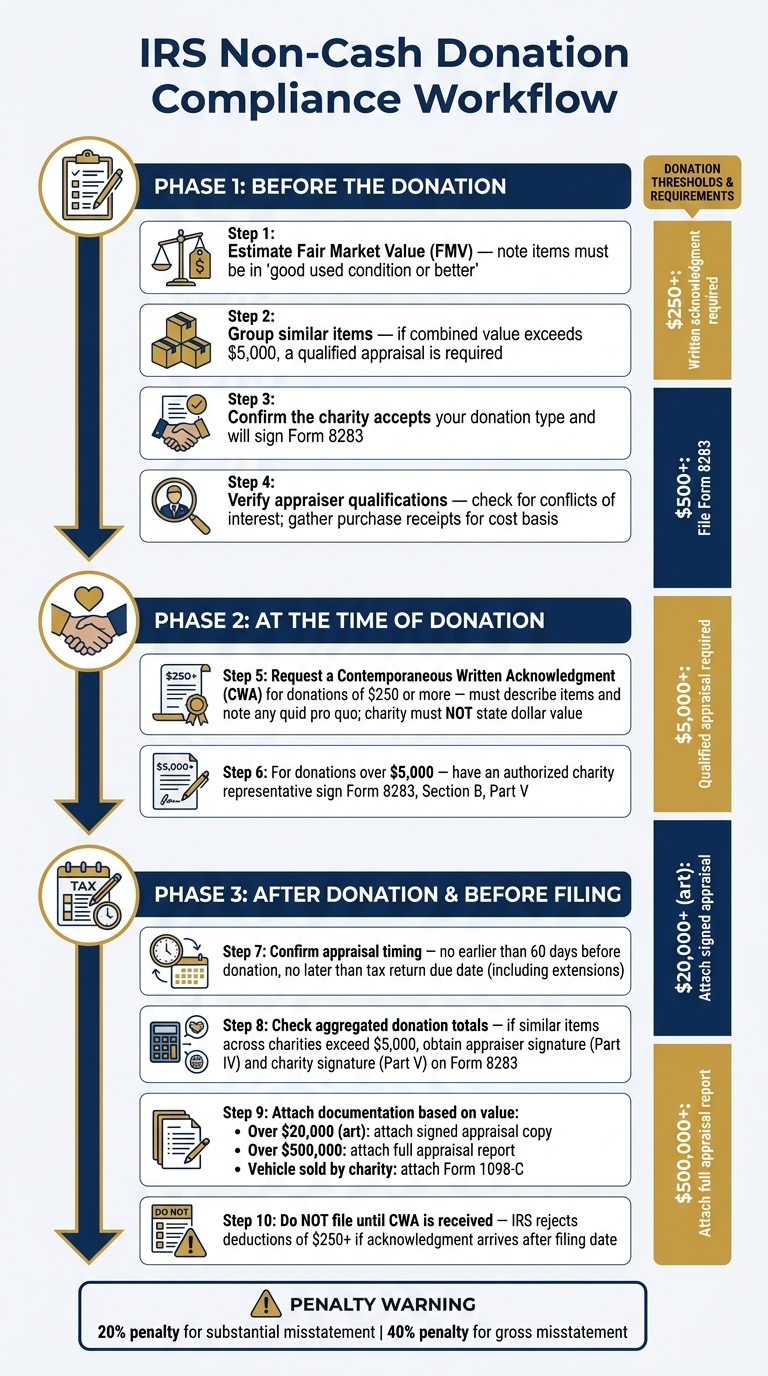
IRS Non-Cash Donation Compliance: Step-by-Step Workflow
Before Making a Donation
Start by estimating the Fair Market Value (FMV) of your donation. FMV represents the price a willing buyer and seller would agree upon. For items like clothing and household goods, the IRS expects them to be in good used condition or better to qualify for a deduction.
Next, think about grouping similar items together. If their combined value exceeds $5,000, you'll need a qualified appraisal. Also, confirm that the charity accepts the type of donation you're offering and is willing to sign Form 8283.
"A professional appraisal isn't just a formality - it's your best defense against IRS scrutiny and the key to ensuring your generosity pays off the way you planned." - Raven A. Herron & Company
If an appraisal is required, double-check the appraiser's qualifications and ensure there are no conflicts of interest. Keep any purchase receipts handy, as you'll need them to document the cost basis on Form 8283.
At the Time of Donation
When you're ready to donate, make sure to document everything properly. For non-cash donations worth $250 or more, request a Contemporaneous Written Acknowledgment (CWA) from the charity.
The CWA should describe the donated items and indicate whether the charity gave you anything in return (a quid pro quo). One key point to note:
"The nonprofit should NEVER state the value of a non-cash donation in the acknowledgment letter. Valuation is the donor's responsibility." - Drew Giddings, Founder & Principal Consultant, Giddings Consulting Group
For donations valued over $5,000, ensure an authorized representative from the charity signs Part V of Section B on Form 8283 to confirm receipt of the items.
After the Donation and Before Filing Taxes
After making your donation, take a few final steps to stay compliant before filing your taxes. First, confirm that any required appraisal was completed within the correct time frame - no earlier than 60 days before the donation and no later than your tax return due date (including extensions). Check if your aggregated donations exceed $5,000, as this will require signatures from both the appraiser (Part IV) and the charity (Part V) on Form 8283.
If you donated art valued at $20,000 or more, attach a copy of the appraisal. For donations exceeding $500,000, include the full appraisal report. If you donated a vehicle and the charity sold it, attach Form 1098-C.
Finally, don't file your tax return until you’ve received your CWA. The IRS will reject deductions of $250 or more if the acknowledgment arrives after your filing date. To keep everything organized, consider using tools like Deductible.me, which can track donations, generate IRS-compliant Form 8283 reports, and store all your records in one place. These steps, combined with earlier requirements, ensure you're fully prepared when tax season arrives.
Recordkeeping and Digital Tools for Non-Cash Donations
Records You Need to Keep
The records you need depend on the value of your donation. For contributions under $500, a simple charity receipt with the organization's name, the date of the donation, and a description of the item is enough. However, when your total non-cash donations exceed $500, you'll need to file Form 8283 with your tax return. If the value of similar donated items surpasses $5,000, a qualified appraisal is required.
Here’s a breakdown of IRS requirements based on donation value:
| Donation Value | Required Records |
|---|---|
| Under $500 | Charity receipt with name, date, and item description |
| $500–$5,000 | Contemporaneous Written Acknowledgment (CWA) and records of cost/basis and FMV method (Form 8283, Section A) |
| Over $5,000 | CWA, qualified appraisal, plus signatures from both the appraiser and the charity (Form 8283, Section B) |
| Over $20,000 (art) | All of the above, plus high-resolution photos if requested |
| Over $500,000 | Full appraisal report attached to your tax return |
Unused deductions can be carried forward for up to five years, but you’ll need to keep all supporting records during that time.
"A small investment in file hygiene saves time in review." - Accountably.com [3]
How Digital Tools Can Help
Now that you know the recordkeeping requirements, digital tools can make the process much easier. Keeping track of everything manually can lead to mistakes, and physical receipts can fade or get lost, making it harder to track your donation thresholds.
Apps like Deductible.me simplify this process. Using AI-powered photo scanning, the app identifies donated items and estimates a fair market value by comparing live resale data with IRS guidelines. It even groups similar items automatically and alerts you when you’re nearing the $5,000 appraisal threshold. If your non-cash donations exceed $500, the app generates an IRS-compliant Form 8283 PDF, ready to share with your CPA or attach to your tax return.
- Free Tier: Tracks up to $500 in donations annually, perfect for occasional donors.
- Premium Plan: For $24/year, you get unlimited tracking, advanced receipt management, and tools to monitor your annual giving goals.
"The word contemporaneous comes up in other places in tax law as well... You're not supposed to look back at the prior year and try to reconstruct that from memory." - Jeremy Wells, CPA [8]
This advice highlights the importance of recording donations as they happen. In the 2025 Besaw v. Commissioner case, a $6,760 deduction was denied because the records were created years after the fact rather than contemporaneously [8]. Using an app to log donations in real time - by snapping a quick photo - can help avoid this issue.
Tracking Your Annual Giving Goals
Beyond accurate recordkeeping, digital tools can also help you stay on top of your overall donation strategy. Tracking your contributions throughout the year supports better tax planning. Deductible.me’s Premium plan includes a feature for setting and monitoring annual giving goals. This lets you set a target at the start of the year and track your progress in real time. If you plan to itemize deductions, this proactive approach ensures you have time to make additional donations before December 31 if needed for your tax strategy.
Key Takeaways for IRS Appraisal Compliance
Understanding IRS appraisal rules is crucial for ensuring compliance when claiming deductions for charitable donations. Here's a quick rundown of the requirements:
- Donations of $250 or more: Require a written acknowledgment from the charity.
- Donations over $500: Require filing Form 8283.
- Similar items exceeding $5,000: Need a qualified appraisal.
- Donations above $500,000: Demand a full appraisal report.
Choosing the Right Appraiser
When selecting an appraiser, make sure they have proven education and experience in valuing the specific type of property you're donating. The appraisal must be completed within a specific time frame - no earlier than 60 days before the donation and no later than your tax return due date. Importantly, the IRS prohibits appraisal fees based on a percentage of the appraised value, so ensure your appraiser follows this rule [6].
The Stakes of Valuation Accuracy
Accurate valuations are non-negotiable. Mistakes can lead to hefty penalties:
- A substantial misstatement results in a 20% penalty.
- A gross misstatement triggers a 40% penalty [1][4].
For high-value art donations of $50,000 or more, donors have the option to request an IRS Statement of Value before filing. This service, priced at $8,400 for one to three items starting in 2026, provides clarity and certainty on the deduction.
The Aggregation Rule
The IRS applies an aggregation rule for similar items donated to multiple organizations. This means that even if donations are made to different charities, the combined value of similar items could push you over the $5,000 threshold, requiring a qualified appraisal.
Simplifying Compliance
Managing these requirements can be overwhelming, but tools like Deductible.me make the process easier. Their platform uses AI to group similar donations, track threshold limits, and generate IRS-compliant Form 8283 exports. Whether you're a casual donor using the free plan or someone who makes frequent contributions, the $24/year Premium plan allows you to track unlimited donations with ease.
FAQs
How does the IRS aggregation rule work for similar items donated to different charities?
The IRS categorizes "similar items" as property that shares the same general type - think clothing, books, or paintings. When determining if your total deduction surpasses the $5,000 threshold for Form 8283 Section B, you need to add up the value of all similar items donated throughout the year, even if they were given to multiple charities. If the combined total goes over $5,000, you'll need to fill out a separate Section B for each charity.
What’s the difference between Form 8283 Section A and Section B?
Form 8283 is divided into two sections, each tailored to different types and values of donated property:
- Section A: This section covers single items or groups of similar items worth $5,000 or less. It also applies to publicly traded securities, certain vehicles, and intellectual property.
- Section B: This is for items valued over $5,000. It requires more documentation, including a qualified appraisal, the appraiser’s signature, and acknowledgment from the recipient of the donation.
What happens if my appraisal is dated outside the IRS 60-day window?
If your appraisal falls outside the IRS's 60-day window, your charitable deduction could be rejected. To comply with IRS guidelines, the appraisal must be signed and dated within a specific timeframe: no earlier than 60 days before the donation and no later than the tax return due date for the applicable year. Tools like Deductible.me can assist in staying aligned with these rules.