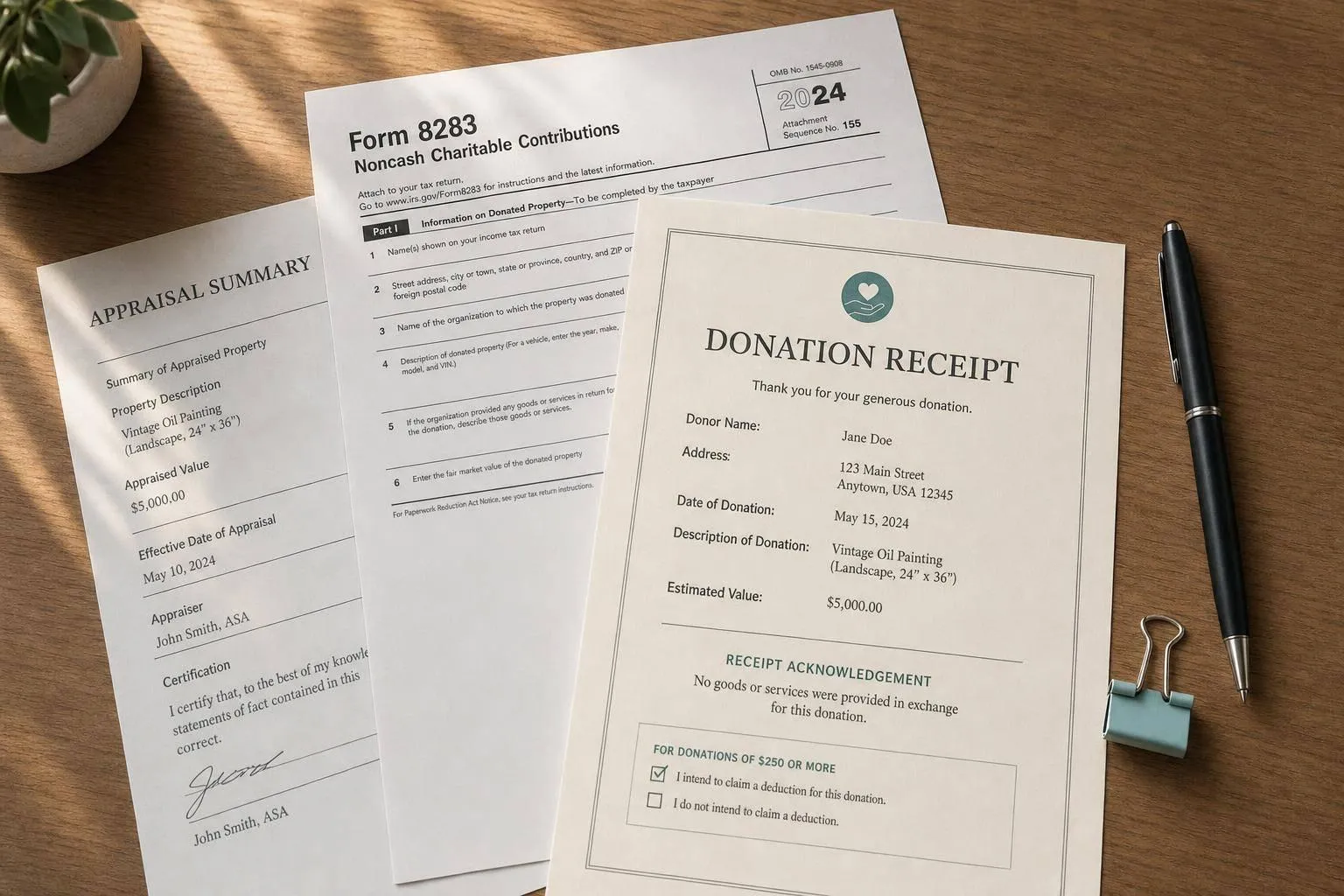
If you claim a noncash donation, one document does not cover everything. I need a charity receipt or written acknowledgment to prove the gift happened, and I need Form 8283 when my total noncash deductions for the year are more than $500.
Here’s the short version:
- For any single gift of $250 or more: I need the charity’s written acknowledgment.
- When total noncash deductions go over $500: I file Form 8283 with my tax return.
- When one item or a group of similar items is worth more than $5,000: I usually need a qualified appraisal and Section B on Form 8283.
- For deductions over $500,000: I usually must attach the appraisal to the return.
- Record rule: The receipt proves transfer. Form 8283 reports tax details. Neither replaces the other.
A common mistake is thinking a donation receipt is enough. It isn’t. Another mistake is thinking Form 8283 replaces the charity letter. It doesn’t. The IRS looks for both when the rules apply.
Form 8283: Noncash Charitable Contributions: Overview, FAQ
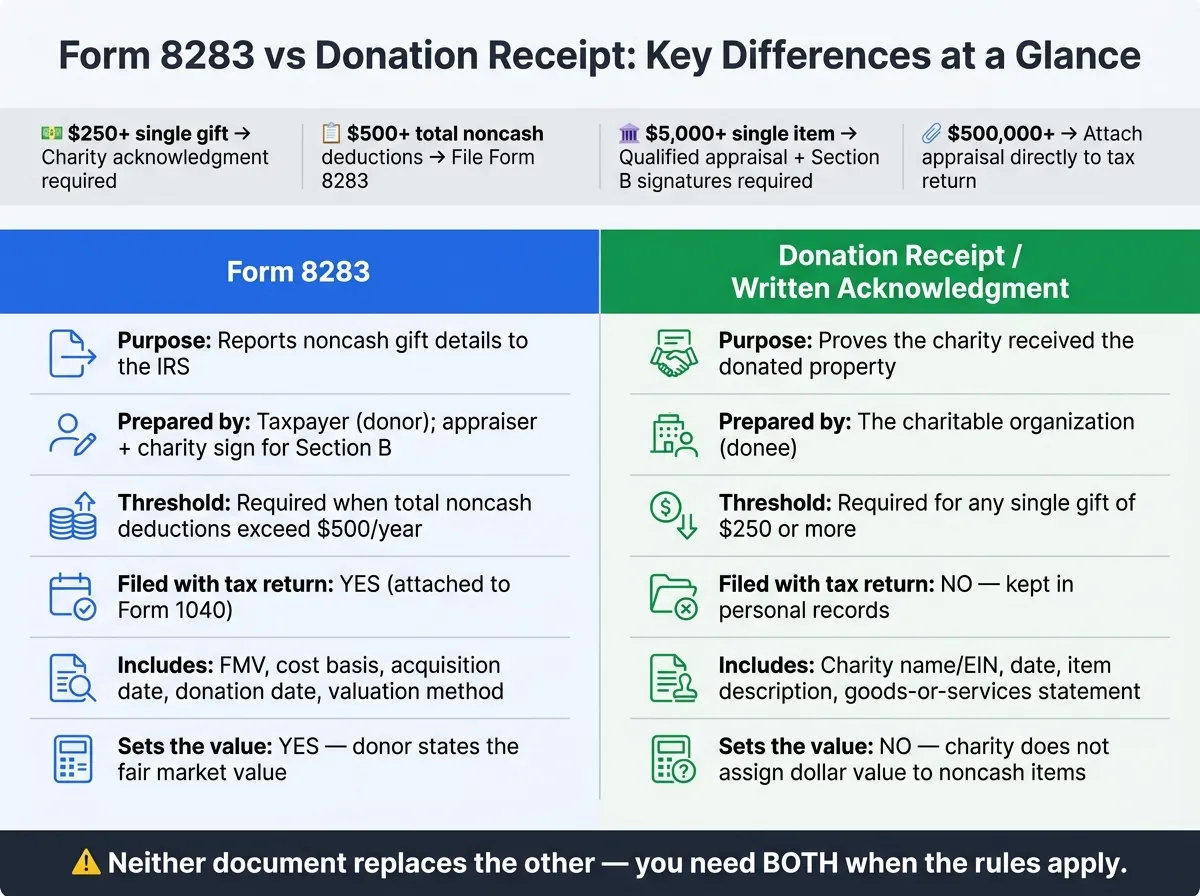
Quick Comparison
| Item | Form 8283 | Donation Receipt / Written Acknowledgment |
|---|---|---|
| Main job | Reports the noncash deduction to the IRS | Shows the charity received the property |
| Who prepares it | I do, with extra signatures for some gifts | The charity does |
| When it applies | Over $500 in total annual noncash deductions | $250+ single donation |
| What it includes | FMV, cost basis, date acquired, date donated, how acquired | Charity name, date, item description, goods/services statement |
| Filed with return | Yes | No |
| Can it replace the other? | No | No |
So if I’m building a clean donation file, I want the acknowledgment, Form 8283, value support, and appraisal papers when required - all in one place.
What each document does for a noncash deduction
Form 8283: The IRS form for noncash gifts over $500
Form 8283 is the IRS document used to report noncash gifts on your federal tax return. You generally need it when your total noncash deductions for the year go over $500[3].
The form tracks the key facts behind the donation, including:
- The charity’s name and address
- A description of the property
- The date you donated it
- The date you got it and how you got it
- Your cost basis
- The fair market value you’re claiming[3]
That’s the main job of Form 8283: reporting the deduction to the IRS. It works alongside the charity’s receipt, not in place of it.
Section A vs. Section B: When higher-value property
Form 8283 has two parts, and the one you use depends on the value of the property you gave.
Section A is for items, or groups of similar items, worth $5,000 or less. Publicly traded securities always go in Section A[3]. The donor completes and signs this part.
Section B is for any single item, or group of similar items, worth more than $5,000, other than publicly traded securities. When you hit that level, the IRS requires a qualified appraisal. The form also needs signatures from both the qualified appraiser and the donee organization[3]. This often comes up with property like real estate, jewelry, and art.
Donation receipt or written acknowledgment: Proof the charity received the property
If Form 8283 is about IRS reporting, the receipt is about proving the transfer happened. The charity provides a contemporaneous written acknowledgment, often called a donation receipt.
It should include the charity’s name, the contribution date, the donated items, and whether you received any goods or services in return[1]. One point trips people up: the donor sets the fair market value claim, not the charity[1].
“Contemporaneous” has a very specific meaning here. You must receive the acknowledgment by the time you file your return, or by the tax return due date, whichever comes first[1].
Form 8283 vs. donation receipt: A side-by-side comparison
Form 8283 tells the IRS about the gift. The receipt shows that the charity got it. That’s the core difference.
Differences in purpose, threshold, and who prepares each record
Form 8283 is prepared by the donor. The receipt comes from the charity.
| Feature | Form 8283 | Donation Receipt |
|---|---|---|
| Purpose | Reports noncash gift details to the IRS | Proves the charity received the donation |
| Prepared by | Taxpayer (donor), with appraiser and charity signatures for Section B | Charitable organization (donee) |
| When used | Total noncash deductions over $500 [3] | Any deductible gift of $250 or more [1] |
| Information Supplied | FMV, cost basis, acquisition date, valuation method | Charity name/EIN, date, item description, goods-or-services statement |
| Filed with | Attached to Form 1040 | Not filed; kept in personal records |
| Valuation | Lists the donor’s calculated FMV | Should not list a dollar value for noncash items |
Here’s the plain-English version: the charity confirms what it received, but the donor states the value on Form 8283. One record shows receipt. The other handles tax reporting.
That split matters. A donation receipt usually includes the charity’s name and EIN, the date of the gift, a description of the donated item, and a statement about whether any goods or services were provided in return. Form 8283, by contrast, asks for facts the charity usually won’t supply, like your cost basis, acquisition date, FMV, and the method used to value the property.
Why one document cannot replace the other
A receipt by itself isn’t enough because it doesn’t give the IRS the reporting details that Form 8283 includes, such as cost basis, how you got the property, and how you arrived at its value.
But the reverse is also true. Form 8283 does not replace the receipt. If you don’t have the receipt, the IRS can disallow the deduction even if you made the gift.
So think of these records as a pair: one proves the donation happened, and the other reports the tax details tied to that donation.
The next step is knowing which extra records belong in the file.
Appraisals, signatures, and the records to keep
When a qualified appraisal and charity signature are required
For higher-value donations, Form 8283 doesn’t stand on its own. You also need records that show both value and transfer.
For Section B gifts over $5,000, you generally need a qualified appraisal before filing Form 8283.[4][5] That appraisal needs to identify the property, state its fair market value as of the contribution date, and explain the valuation method used. It also must include the appraiser’s name, qualifications, taxpayer identification number, signature, and the date signed.[4]
Some types of property don’t follow this rule. The main exceptions include certain publicly traded securities, certain qualified vehicles backed by the required written acknowledgment, certain inventory, and certain intellectual property.[4]
Section B also calls for two signatures: the appraiser’s signed declaration and the charity’s signature. The charity’s signature only confirms receipt of the donation. It does not mean the charity agrees with your valuation or your deduction amount.[5]
What to keep in a complete substantiation file
It’s smart to keep one file that shows what you donated, when you transferred it, how you valued it, and what you filed. Think of it like a paper trail that tells the whole story. The receipt shows the transfer, Form 8283 reports the gift, and the appraisal backs up the value.
Once Section B applies, your file should clearly show three things: what was given, who received it, and how the value was determined. At a minimum, keep:
- Filed Form 8283 and a copy of the filed federal return
- Charity acknowledgment
- Qualified appraisal when required, including the appraiser’s credentials, valuation report, signature, and date
- Purchase invoices, inheritance documents, or other records that establish your cost basis
- Delivery, transfer, or pickup records showing the property changed hands
If your deduction is more than $500,000 for a single item or a group of noncash property, the qualified appraisal usually must also be attached directly to your tax return.[8] For most donations below that amount, keep the appraisal in your records instead of attaching it.[5]
How long to keep donation tax records
The general federal rule is to keep your donation file for at least three years after the return is filed or its due date, whichever is later.[6][7]
If the deduction carries forward, hold onto the file until the carryforward period ends and any IRS review period has also passed. You may also want to keep the records longer if basis affects later tax reporting, you amend the return, or the IRS reviews the claim.[2]
Conclusion: Building a clean noncash donation record
In practice, a complete noncash donation record should include a few core pieces. For gifts of $250 or more, keep the charity’s contemporaneous written acknowledgment. You should also keep a list of each donated item, its condition, and its fair market value, along with the records you used to support that value. If your total annual noncash deductions go over $500, file Form 8283. If any single item or group of similar items goes over $5,000, include a qualified appraisal and the required Section B signatures.
Put simply, the receipt shows that the charity received the property. Form 8283 tells the IRS about the donation. You’ll want both in the same file, along with your valuation support.
If you want to get that file in order with less hassle, Deductible.me can help. It can organize records and generate Form 8283 reports, but it does not replace the charity’s acknowledgment or a qualified appraisal when one is required.
When all of that sits in one place, your records clearly show what you donated, how you valued it, and which documents back up the deduction.
FAQs
Do I need both Form 8283 and a donation receipt?
Usually, yes. For most charitable gifts, you need a donation receipt or other proof, such as a bank record or a written receipt from the charity.
If your donation is $250 or more, the IRS also requires a contemporaneous written acknowledgment from the charity. That means you should have the charity’s written confirmation by the time you file your return.
You need Form 8283 only if your total noncash donations for the tax year are more than $500. Keep the form and all donation records with your tax files.
What counts as similar items for the $5,000 rule?
For the $5,000 rule, similar items are pieces of property that fall into the same general category or are the same kind of thing, like books, furniture, or clothing donated as one group.
If the total fair market value of that group is more than $5,000, the IRS treats those items as a single unit. That means you need a qualified appraisal and Section B of Form 8283.
What happens if I file without the written acknowledgment?
The IRS may deny your deduction if the donation required a written acknowledgment and you didn’t get one.
For noncash donations worth $250 to $500, you generally can’t deduct the gift unless you have a contemporaneous written acknowledgment from the charity.
For noncash donations over $500, there’s one more step: you must attach Form 8283 to your tax return. If that form is missing, the IRS may deny the deduction too.