If your donation receipt is missing, your tax write-off may fail. For any single gift of $250 or more, I need a written acknowledgment from the charity by the time I file my return, or by the filing due date, including extensions - whichever comes first.
Here’s the short version:
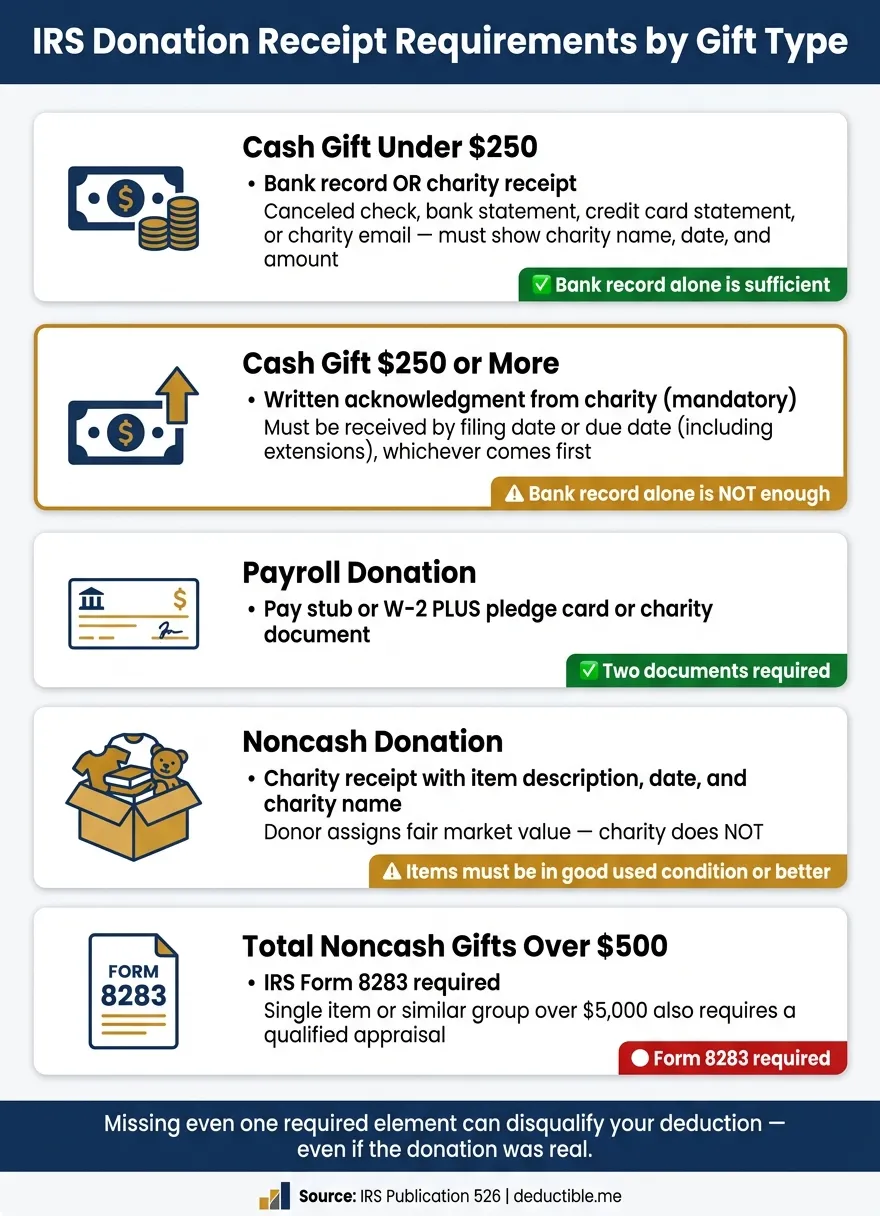
- Under $250: a bank record, credit card statement, canceled check, or charity receipt is often enough
- $250 or more: a bank record alone is not enough
- Noncash gifts: I need a receipt with the charity name, date, and item description
- Over $500 in noncash donations for the year: I must file Form 8283
- Over $5,000 for a single item or similar group: I may also need a qualified appraisal
If a receipt is wrong, I should ask the charity to fix it before filing. If the charity does not reply, I should keep all backup records and, if the rules are not met, not claim the deduction.
Quick check:
| Donation type | What I need |
|---|---|
| Cash gift under $250 | Bank record or charity receipt |
| Cash gift $250+ | Written acknowledgment from charity |
| Payroll donation | Pay stub or W-2 plus pledge card or charity document |
| Noncash donation | Charity receipt with item description |
| Total noncash gifts over $500 | Form 8283 |
This article explains how I fix missing receipts, what backup proof the IRS accepts, and how I keep donation records in order for tax time.
The Donation Write off IRS is Denying
What the IRS Accepts as Proof of a Charitable Donation
When a receipt is missing or has errors, the first move is simple: match the donation to the kind of proof the IRS accepts. Your own notes, spreadsheet, or personal log do not count on their own. The IRS wants records from the charity or your financial institution [1][2]. And the rule changes based on the gift. Cash gifts, payroll gifts, and donations of $250 or more each have their own standard.
Start with the records the IRS already accepts.
Accepted Records for Cash, Check, Card, and Electronic Gifts
For donations under $250, the IRS accepts either a bank record or a written receipt from the charity [2]. That can be a canceled check, bank statement, credit card statement, or a charity email or digital receipt, as long as it shows the charity’s name, the date, and the amount [2][4].
For payroll deductions, keep:
- A pay stub or W-2 that shows the amount withheld
- A pledge card or other document from the charity [2]
These records can help fill a gap, but only if they match the donation date, amount, and charity exactly. Close isn’t enough here.
Why Gifts of $250 or More Require a Written Acknowledgment
Once a gift hits $250 or more, the standard gets tighter.
For any single contribution of $250 or more, a bank record by itself does not work [1][2]. You need a timely written acknowledgment from the charity. And timing matters: you must have that acknowledgment in hand by the date you file your return or the due date, including extensions, whichever comes first [1].
What a Valid Acknowledgment Must Include
A valid receipt is more than a quick thank-you. It needs to include all of the items below [1]:
| Required Element | Required content |
|---|---|
| Charity’s legal name | The organization’s legal name |
| Donor’s name | Your full name as the contributor |
| Date of the contribution | The actual date the gift was made, not when the receipt was issued |
| Cash amount or noncash property description | The amount for cash gifts, or a description of the noncash property |
| Goods or services provided statement | A statement saying whether anything was provided in return |
If you got nothing in return, the receipt must say that. If the charity gave you something in return, the acknowledgment must describe it and include a good-faith estimate of its value [1]. Miss that statement, and the acknowledgment does not meet IRS rules.
If even one required item is missing, ask for a corrected receipt before you file.
How to Fix Missing or Incorrect Donation Receipts
Start with the IRS checklist above, then fix the record itself. The simplest path is to handle the gap in this order: ask the charity, verify the details, then use backup records if you need to.
Request a Replacement or Corrected Receipt from the Charity
Reach out to the charity and ask for a replacement or corrected receipt. Share your full name, mailing address, the exact date of the contribution, and either the cash amount or a description of the noncash items so the charity can locate the gift fast [1].
For noncash gifts, ask the charity to describe the items only. Do not ask them to assign a value - you need to do that yourself [1].
If your gift was $250 or more, make sure you get the corrected acknowledgment before you file your return or before the due date, including extensions, whichever comes first [1].
Compare the Receipt Against Your Own Records Before Filing
Once the charity sends the receipt, check it line by line against your own records before you rely on it. Match the receipt to your bank records, card statements, check records, and donation records [1][2].
A couple of things often trip people up:
- Year-end processing delays
- Name mismatches on shared accounts
Those can make a receipt look wrong even when the donation went through. If anything doesn’t match, ask for a corrected receipt before you file [1][2].
What to Do If the Charity Does Not Reply
If the charity doesn’t respond, move to backup records and document each follow-up attempt. Write down the date, contact method, and who you tried to reach. Then pull together any records you still have, such as bank statements, email confirmations, check images, or photos of donated items.
If the receipt never shows up, skip the deduction rather than file without support [1].
Backup Proof to Use When Paperwork Is Lost
If the charity never sends a corrected receipt, you may still be able to keep your deduction. The key is having other records that fill in the missing paper trail.
Bank and Payment Records That Can Fill a Documentation Gap
For cash gifts under $250, bank records can be enough by themselves. That includes bank statements, canceled checks, card statements, and transfer confirmations.
Those records need to show:
- The charity’s name
- The date
- The amount
If those three details are there, you’re usually on solid ground for a monetary gift under $250.
Why Noncash Donations Follow Different Rules
Noncash gifts work differently because there isn’t a payment record to point to. So instead, you need a receipt from the charity that shows the charity’s name, the date, and a description of what you donated.
You’re also the one responsible for figuring out fair market value.
Clothing and household goods usually must be in good used condition or better. If you don’t have the original receipt, build your own backup file: keep a detailed itemized list with descriptions, quantities, and notes on condition, then add drop-off photos. If your total noncash donations for the year go over $500, you also need to file IRS Form 8283.
For noncash gifts, the best fallback proof is your own itemized record plus photos.
Comparison Table: Backup Records and When They Are Enough
| Backup Record Type | Details It Must Show | Sufficient for Under $250? | Sufficient for $250 or More? |
|---|---|---|---|
| Bank Statement | Charity name, date, and amount | Yes | No - written acknowledgment required |
| Canceled Check / Scanned Image | Charity name, date, and amount | Yes | No - written acknowledgment required |
| Credit Card Statement | Charity name, transaction date, and amount | Yes | No - written acknowledgment required |
| Electronic Transfer Confirmation | Charity name, date, and amount | Yes | No - written acknowledgment required |
| Written Acknowledgment (Noncash) | Charity name, date, item description, and goods or services statement | Yes | Yes - mandatory |
| Itemized List + Photos | Item description, quantity, condition, and FMV | Supporting only | Supporting only |
| IRS Form 8283 | Acquisition info, cost basis, FMV method | Not applicable | Required when total noncash gifts exceed $500 |
Put these records in one place now. It saves you from scrambling later if the IRS ever asks you to prove the donation.
How to Prevent Receipt Gaps and Keep Records Tax-Ready
Once you fix a missing or incorrect receipt, set up a simple routine so the same issue doesn’t come back next year. For charitable gifts, you need records that prove each donation. If your proof doesn’t meet the rules, the deduction can be denied even if you did make the donation [1]. That’s why a simple, year-round system matters.
Build a Simple Capture-and-Match Habit After Every Donation
Right after you donate, save the receipt and match it to the right entry in your records. For cash and card gifts, tie the receipt to the bank or card transaction as soon as you can.
For noncash drop-offs like clothing, furniture, or household goods, take a photo of the items before you hand them over. It sounds small, but it helps a lot. You get a clear record of condition and quantity while everything is still in front of you.
In December, review every donation of $250 or more. For gifts at that level, ask for the charity’s written acknowledgment right away. If one is missing, December is the time to chase it down.
A routine like this works best when everything is stored in one spot.
Keep All Donation Records in One Place
Keep every receipt, statement, and item list in a single folder, spreadsheet, or app. When tax time rolls around, you don’t want to dig through email, desk drawers, and old photos on your phone.
Deductible.me lets you store receipts, track donated items, and generate IRS-compliant reports, including Form 8283 exports.
Final Checklist Before You File
Use this short check before you file:
- Every donation has either a bank record or a receipt from the charity
- All $250+ gifts have the required written acknowledgment [1]
- IRS Form 8283 is completed if your total noncash gifts for the year exceed $500 [3]
- Any single noncash item or group of similar items valued over $5,000 has a qualified appraisal and Form 8283 Section B [3]
Catching a missing acknowledgment in December is a lot easier than trying to fix it after you’ve already filed.
FAQs
Can I claim a donation without a receipt?
No. To claim a donation, you need a bank record, credit card statement, or a written receipt from the charity.
For donations of $250 or more, the IRS requires a contemporaneous written acknowledgment from the charity. In plain English, that means you need the charity’s written confirmation by the time you file. Without it, the donation isn’t deductible, even if you did make the gift.
What if my donation receipt has the wrong details?
Contact the charity right away and ask for a corrected receipt.
A proper receipt should include:
- The charity’s legal name
- The donation date
- A description of the item
- Whether you received any goods or services in return
For donations of $250 or more, the IRS also requires a contemporaneous written acknowledgment that includes your name and address.
You can store the corrected records in Deductible.me so your documentation stays accurate and ready if the IRS ever asks for it.
When do I need Form 8283 or an appraisal?
You must file IRS Form 8283 if your total non-cash charitable donations for the tax year are more than $500.
If any single item, or group of similar items, is worth more than $5,000, you need a qualified appraisal. The main exception is publicly traded securities.
When an appraisal is needed, fill out Section B of Form 8283 and get signatures from both:
- the appraiser
- the charitable organization