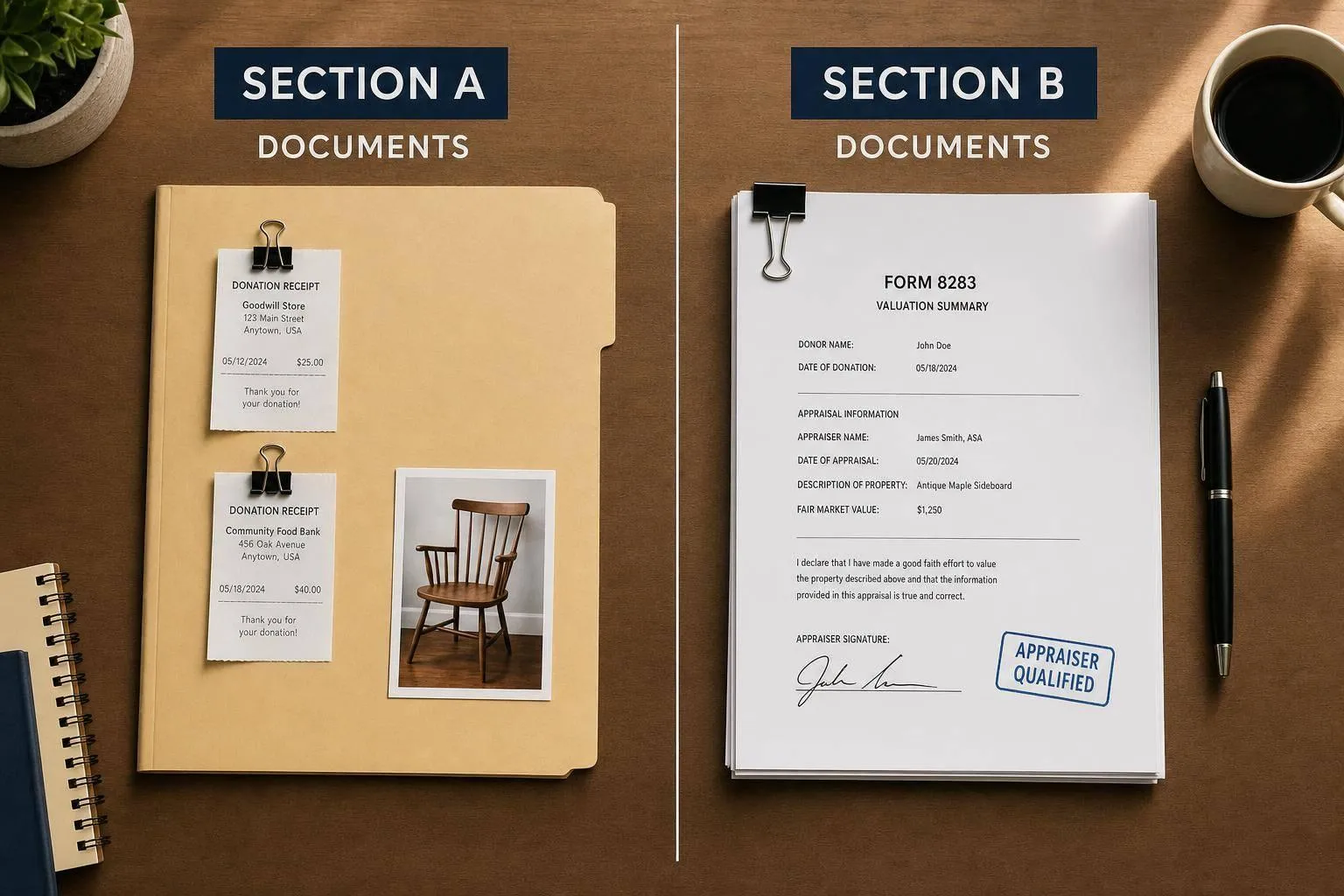
_If your noncash donation total is over _$500_, you may need Form 8283. The big split is simple: Section A is usually for items worth $5,000 or less, and Section B is usually for items worth more than $5,000._*
I’d boil it down like this: Section A means basic records. Section B means more proof. That usually includes a qualified appraisal, an appraiser signature, and a charity signature on the form. One big rule to remember: publicly traded securities stay in Section A no matter the dollar amount.
Before filing, I’d make sure you have:
- The charity’s name and address
- A clear item description
- The donation date
- The date and method of acquisition
- Fair market value and how you figured it out
- A written acknowledgment for any gift of $250 or more
- A qualified appraisal if Section B applies
Watch the grouping rule. The IRS can combine similar items. So several separate donations can still push you over the $5,000 line and move you into Section B.
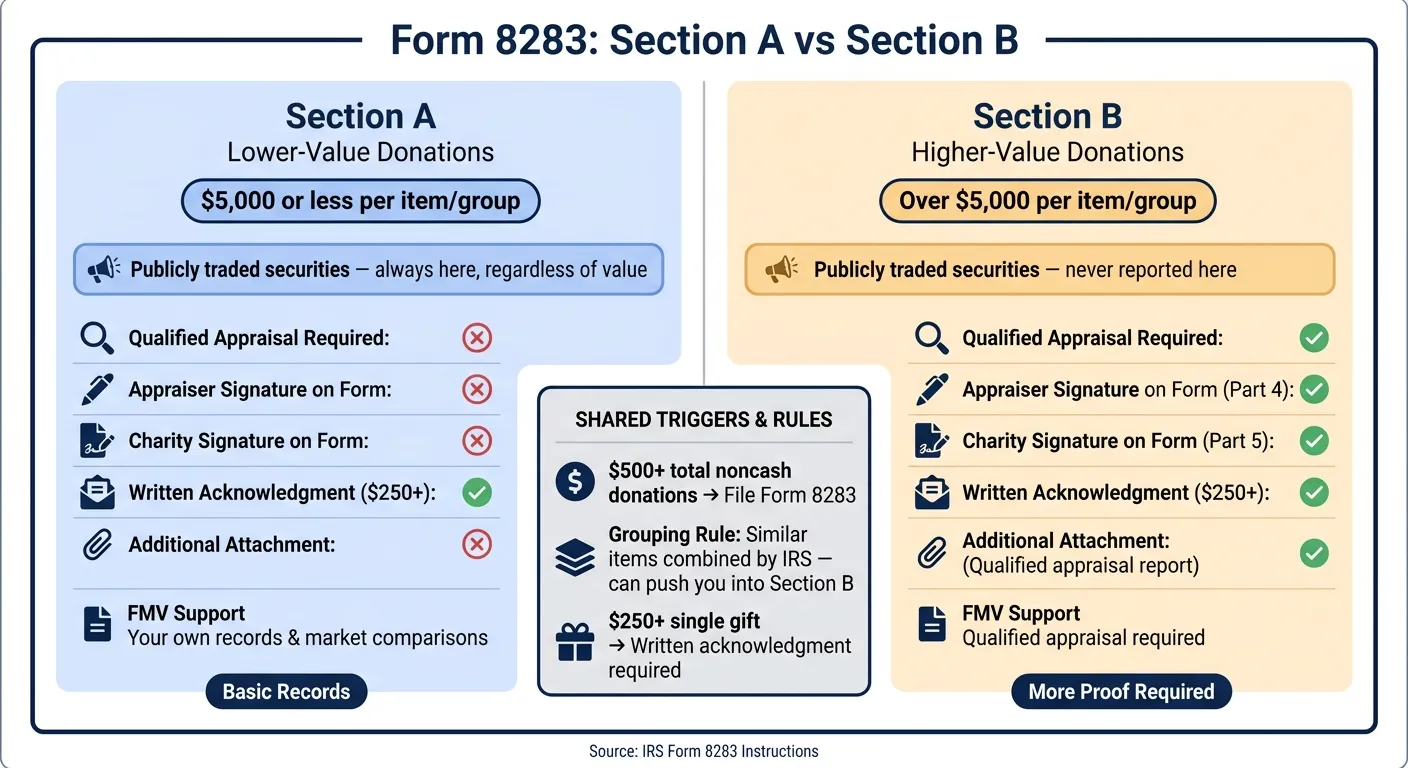
How Do I Fill Out IRS Form 8283? - Tax and Accounting Coach
Quick Comparison
| Item | Section A | Section B |
|---|---|---|
| Value rule | $5,000 or less per item or similar-item group | Over $5,000 per item or similar-item group |
| Publicly traded securities | Yes, always here | No |
| Qualified appraisal | No | Yes |
| Appraiser signature | No | Yes |
| Charity signature on Form 8283 | No | Yes |
| $250+ written acknowledgment | Yes | Yes |
In other words: if you know the $500 filing trigger, the $5,000 section split, and the $250 acknowledgment rule, you understand most of what matters before you start the form.
Section A Documents: What You Need for Donations Up to $5,000
For Section A, keep records for the charity’s identifying details, the donation itself, and the value you claimed for each item - or each group of similar items - worth $5,000 or less. That lighter paperwork can change fast once your donation goes over the Section A limit.
Required Records for Section A Entries
For each Section A entry, include:
- The charity’s legal name and address
- A description of the donated item
- The donation date and the date you got the item
- How you got it
- The item’s fair market value
- How you figured out that value
Include your cost basis when it’s required, especially if you held the property for less than one year.
Receipts, Written Acknowledgments, and Vehicle Forms
Keep a receipt or bank record for gifts under $250, and a contemporaneous written acknowledgment for any single gift of $250 or more. [2][3] The acknowledgment must describe the property and state whether you received goods or services. [3]
For vehicle donations, keep Form 1098-C or the charity’s acknowledgment, and attach it when required. [2]
When Section A Still Needs Strong Valuation Support
Section A does not call for a charity signature or a qualified appraisal, but you still need records that back up the amount you claimed. [1] In plain English: lighter paperwork doesn’t mean loose paperwork.
Keep photos and condition notes for clothing and household goods, especially for items valued over $50. [4]
Once the donation goes past $5,000, the paperwork changes. Section B adds appraisal rules, donee acknowledgment, and more formal signatures.
Section B Documents: Appraisals, Charity Signatures, and Extra Attachments
Items, or groups of similar items, worth more than $5,000 belong in Section B. [1] This section comes with more paperwork because the IRS wants stronger proof of value and added signature checks. So Section B is about more than just assigning a number.
What Additional Information Section B Requires
Section B adds appraisal and signature rules for higher-value gifts. Assets like art, collectibles, closely held stock, and real estate fall into Section B because their values are harder to confirm without formal records. Each of these categories needs a qualified appraisal and an appraiser sign-off that Section A does not require. [1]
For household goods and clothing, the IRS generally says items must be in “good used condition or better”. If an item is in poor condition and valued over $500, you may need extra substantiation. [2]
Qualified Appraisal Rules and When Appraisal Documents Must Be Attached
A qualified appraisal is required for property reported in Section B. The appraisal must follow the IRS timing rules tied to the donation date, and the appraiser must sign the appraisal declaration on Form 8283. [1] Keep the full written appraisal report with your tax records. After that, you’ll need the charity’s signature too.
Donee Signature Rules in Part 5
The receiving charity must sign Part 5 of Section B to confirm receipt of the donated property. [1] That signature is separate from the $250 acknowledgment. Since Section B calls for signatures from both the appraiser and the charity, make sure you get both before you file.
Use the comparison below to see exactly how Section A and Section B differ.
Section A vs Section B: Side-by-Side Document Comparison
Here’s the split in plain English: Section A is for lower-value noncash donations, while Section B comes into play when the claimed value for an item or group goes over $5,000. Once you cross that line, the paperwork gets more serious. You’ll need an appraisal, plus signatures from both the appraiser and the charity.[1]
Comparison Table: Thresholds, Appraisals, and Signatures
The table below lays out the filing differences side by side. After that, the checklist shows what to gather before you file.
| Feature | Section A | Section B |
|---|---|---|
| Claimed Value Threshold | $5,000 or less per item/group | Over $5,000 per item/group |
| Publicly Traded Securities | Always reported here, regardless of value | Not reported here |
| Qualified Appraisal Required | No | Yes [1] |
| Appraiser Signature on Form | No | Yes - Part 4 (Declaration of Appraiser) [1] |
| Charity Signature on Form | No | Yes - Part 5 (Donee Acknowledgment) [1] |
| Additional Attachment | Generally none | Qualified appraisal report [1] |
Document Checklist Table: What to Gather Before Filing
This checklist makes the prep work a lot easier. If you’re filing Section A, you can usually rely on your own records and market comparisons. If you’re filing Section B, you’ll need more backup on paper.[1]
| Document or Information | Section A | Section B |
|---|---|---|
| Donee Name and Address | ✓ | ✓ |
| Description of Property | ✓ | ✓ |
| Date of Contribution | ✓ | ✓ |
| Date and Manner of Acquisition | ✓ | ✓ |
| Cost or adjusted basis | ✓ (when required) | ✓ |
| Fair Market Value (FMV) | ✓ | ✓ |
| FMV support | your own records and market comparisons | qualified appraisal |
| Written Acknowledgment ($250+) | ✓ | ✓ |
| Appraisal summary / required appraisal documents | - | ✓ [1] |
| Appraiser Declaration Signature | - | ✓ [1] |
| Donee (Charity) Signature | - | ✓ [1] |
Thresholds, Common Mistakes, and Key Takeaways
How Similar Items Can Push a Donation Into Section B
The filing mistake people make most often is getting tripped up by how the IRS groups similar donations. The $5,000 threshold doesn’t just apply to one item by itself. It can also apply to a group of similar items donated during the year. If the total value of that group goes over $5,000, you need to report it in Section B. Publicly traded securities are the exception. Those stay in Section A no matter the value.[1]
That rule can catch people off guard. A few separate donations may seem small on their own, but once the IRS treats them as similar items, they can cross the line into Section B. After that, the next trouble spot is plain old paperwork.
Common Documentation Errors to Avoid
A lot of filing issues come down to missing details. Here are the ones that show up most often:
- Missing $250+ written acknowledgment: You need it from the charity before you file.[3]
- Vague property descriptions: Be specific instead of using broad labels. Write “7 ft sofa, good condition” or “Apple MacBook Pro 2021.”
- Skipping acquisition details: Keep records of when and how you got the property, your cost basis, the fair market value, and the method you used to figure it out.[1]
- No qualified appraisal for Section B: If a donation belongs in Section B, a qualified appraisal is required.[1]
- Missing appraiser and charity signatures in Part 5: Section B needs signed declarations from both the qualified appraiser and an authorized charity representative.[1]
The easiest fix? Keep records when each donation happens, not months later when you’re staring at tax forms.
What to Remember Before You File
Most of these mistakes are easy to avoid with basic recordkeeping. Track donations as you go so your item descriptions, dates, and values are ready before filing. It also helps to take photos of items valued over $50 so you have backup for condition and value.[4]
If you want a simpler system, Deductible.me can help value items, store receipts, and generate IRS-compliant Form 8283 reports.[5]
FAQs
How does the IRS define similar items?
The IRS applies this rule to similar items when deciding whether a donation passes the $5,000 mark for the stricter appraisal and reporting rules in Section B of Form 8283.
The source material doesn’t lay out the exact grouping test. But it does make one point clear: you must add together the values of items treated as similar.
That matters because the threshold isn’t based only on a single item. If one item is worth more than $5,000, Section B and a qualified appraisal are required. The same applies when a group of similar items has a total fair market value above $5,000.
Do I need Section B if I donated items on different dates?
Section B is based on the value of the item or group of similar items. The donation date doesn’t change that.
You need to file Section B for any single item, or group of similar items, valued at more than $5,000. That rule still applies even if you gave the items on different dates during the year.
For these items, you also need:
- a qualified appraisal
- the appraiser’s signature
- the charity’s signature
That $5,000 line is the key trigger here. Once an item or similar group goes over it, Section B comes into play.
What is a qualified appraisal for Form 8283?
For Form 8283, you usually need a qualified appraisal for any single non-cash item, or a group of similar items, worth more than $5,000. The main exception is publicly traded securities.
That appraisal must be completed by a qualified appraiser. It also needs to be dated no earlier than 60 days before the contribution date.
Section B must include hand-signed declarations from:
- the appraiser
- the receiving charity