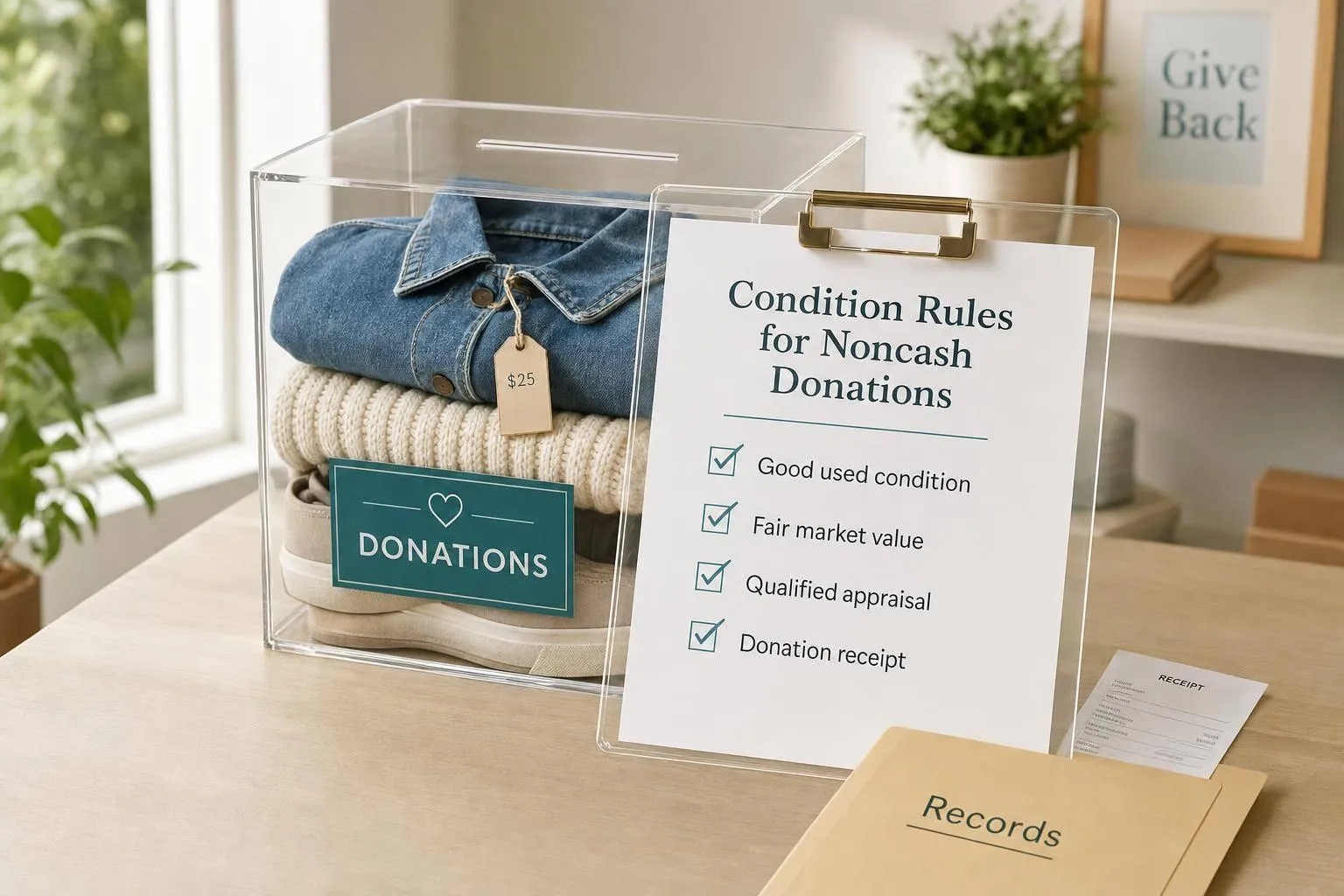
Most noncash donations are deductible only if the item is in good used condition or better. If it’s stained, torn, broken, missing parts, or doesn’t work, I generally should not claim it. My deduction is based on fair market value on the donation date, not the original purchase price.
Here’s the short version:
- Condition comes first: clothing and household goods must usually be in good used condition or better
- Value comes next: I use used-item resale value, not retail price
- Poor-condition items usually fail: the main narrow carveout is one item worth over $500 with a qualified appraisal and Form 8283, Section B
- Cars follow different rules: in many cases, the deduction is tied to what the charity gets when it sells the vehicle
- Records matter: photos, item details, donation date, charity name, fair market value support, and the charity receipt all help back up the claim
- $250+ donations need a written acknowledgment from the charity
- $5,000+ items may need an appraisal under separate IRS filing rules
A simple way I think about it: if a thrift store would put the item on the sales floor, it will often pass the IRS condition test. If not, I should pause before claiming any deduction.
| Topic | What I need to know |
|---|---|
| Condition rule | Usually good used condition or better |
| Value rule | Use FMV, not original cost |
| Broken or damaged items | Usually not deductible |
| One poor-condition item over $500 | May still qualify with appraisal + Form 8283 Section B |
| Vehicle donations | Often limited to the charity’s sale proceeds |
| Records | Photos, item list, FMV support, acknowledgment |
If I want to avoid trouble at tax time, I should check the item’s condition first, price it like a used item, and keep proof before I donate it.
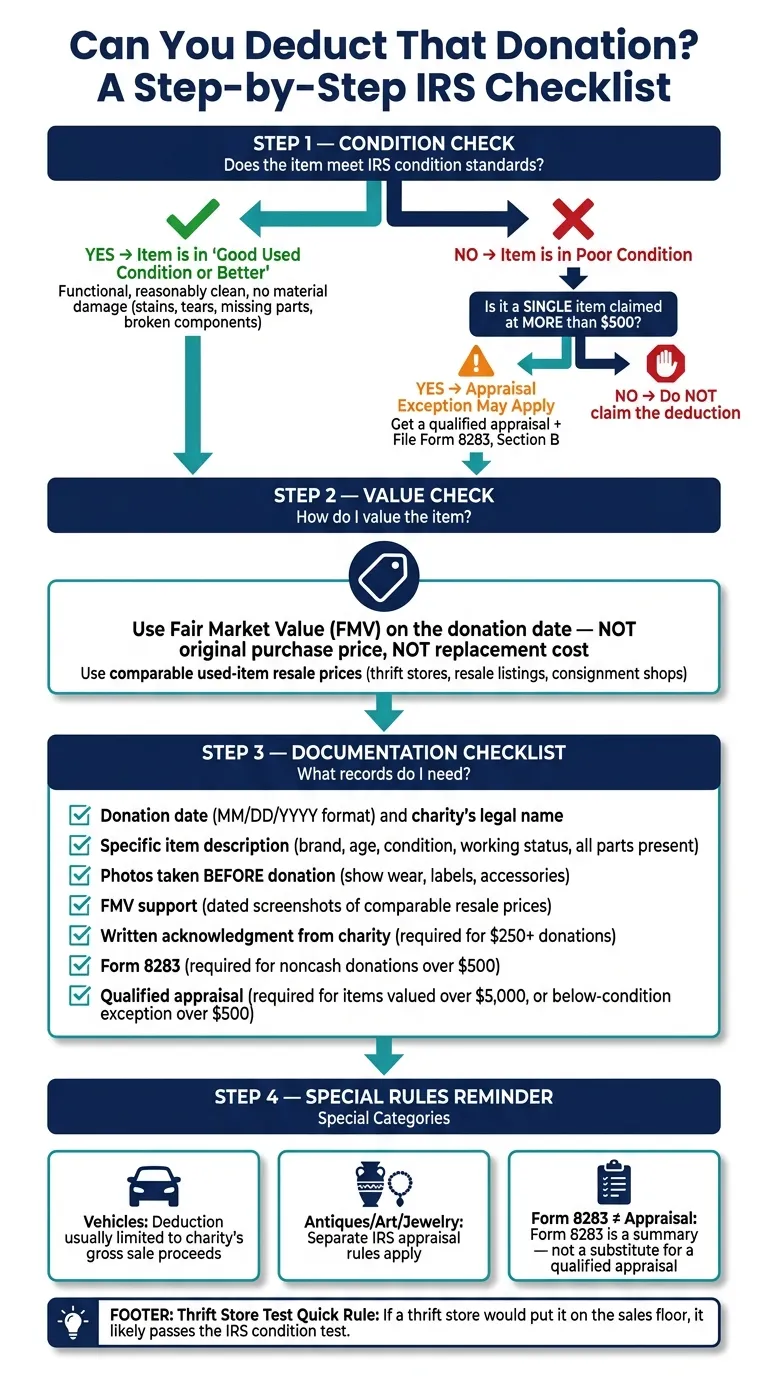
IRS Form 8283 walkthrough (Noncash Charitable Contributions)
How to Apply the IRS Condition Standard
A simple way to judge an item is the thrift store test: if a charity would reasonably put it out for sale, it likely meets the IRS condition standard. That rule gets easier to use when you look at a few basic condition levels.
Good Used Condition vs. Better Condition: What Each Means
Good used condition means the item works, is reasonably clean, and doesn’t have visible damage like stains, tears, or missing parts. Better condition - close to new, with little visible wear - isn’t a separate IRS standard. It just helps support a higher fair market value.
For electronics and appliances, the item needs to work. For furniture, look at structural integrity. Minor surface wear is usually fine, but broken or wobbly pieces don’t qualify.
For a fast reference, use this condition summary.
Comparison Table: Qualifying Condition vs. Below-Good Condition
| Condition Category | Typical Characteristics | Ordinary Deduction Treatment | Documentation Focus |
|---|---|---|---|
| Better / Excellent | Like new; little or no visible wear; strong resale appeal | Usually at the higher end of fair market value | Photos showing condition |
| Good Used Condition | Functional, reasonably clean, light wear, no material damage | Deductible at fair market value | Photos showing functionality |
| Poor Condition | Stains, tears, missing parts, odors, broken components, or non-working | Generally not deductible; a single item may still qualify with a qualified appraisal if it is valued at more than $500 [3][5] | Appraisal and condition records |
Take photos before donation, especially for items valued over $50. And note that some item types come with special rules.
Clothing, Household Goods, and Property Types That Cause Confusion
Clothing, furniture, linens, appliances, and electronics are the items most likely to fail the IRS condition test. For most donations, the main issue is simple: does the item meet the good used condition standard? Before you put a dollar amount on anything, check the item closely.
What to Check Before Donating Clothing and Household Goods
With clothing, start with the obvious stuff. Look for stains, holes, tears, odors, heavy fading, broken zippers, and missing buttons. If you’d hesitate to hand it to a friend, that’s usually a sign it may not meet the IRS standard.
For furniture, check whether it’s still solid and usable. Focus on structural stability, the state of the upholstery, and the surface finish. Broken legs, deep scratches, torn fabric, cigarette burns, and sagging frames will often put the piece below the IRS condition standard [1][2].
Electronics and appliances should be in working order before you donate them. Electronics need to power on. If cords are missing or controls no longer work, the item will often fail the standard. With appliances, inspect the wiring, cords, and all key parts. Frayed cords, rust, missing knobs, mechanical failure, and leaks are all warning signs. It also helps to record the brand and model number for your records [1][2][7].
Linens need attention too. Fraying, permanent stains, thinning material, missing pieces, or heavy wear can put them below the line. When you document them, be specific about count and size - for example, 4-piece queen set, clean [1][2].
Property Types That Use Separate IRS Rules
Some donations fall outside the household-goods standard. Antiques, jewelry, art, gems, and collections follow separate IRS rules [6][3]. Items with higher values may also bring separate appraisal rules into play.
Vehicles are their own category as well. In most cases, your deduction is limited to the gross proceeds the charity receives when it sells the car. The main exception is when the charity makes significant intervening use of the vehicle or completes a material improvement before the sale [4].
Comparison Table: Condition Checks by Item Type
Use this quick check to sort common items by rule set.
| Item Type | Key Condition Checks | Common Disqualifiers | Documentation to Keep |
|---|---|---|---|
| Clothing | Cleanliness, fabric integrity, zipper/button function | Stains, holes, tears, odors, heavy fading, missing buttons | Count, brand, photos |
| Furniture | Structural stability, upholstery condition, surface finish | Broken legs, deep scratches, torn fabric, cigarette burns, sagging frames | Photos of all sides |
| Electronics | Powers on, screen integrity, cables present | Cracked screens, missing cords, non-functional buttons, won’t boot | Model number, confirmation it powers on |
| Appliances | Working order, safety of wiring, completeness of parts | Frayed cords, rust, missing knobs, mechanical failure, leaks | Brand, model; photos of interior and exterior |
| Linens | Fabric strength, cleanliness, completeness of sets | Fraying, permanent stains, thinning material, missing pieces | Item count and size, such as a queen set |
If an item fails these checks, the appraisal exception in the next section may still apply.
When a Below-Standard Item May Still Qualify for a Deduction
If an item doesn’t meet the condition test, the rules get tight. In most cases, that means no deduction. There is, however, one narrow appraisal exception that may still let you claim it.
The Over-$500 Appraisal Exception for a Single Item
A single clothing or household item in below good used condition may still qualify if all three of these are true: the claimed value is more than $500, you have a qualified appraisal from a qualified appraiser, and you file Form 8283, Section B, with your return. [8][6]
Form 8283 is part of the paperwork, but it does not replace the appraisal itself. And this rule applies to one item only. It does not apply to a mixed box of donated goods. [8]
Say you donate a damaged antique cabinet and claim it at $1,500. That may qualify only if a qualified appraiser backs up that value and you file Form 8283, Section B, with your return. [8][3] But here’s the plain-English version: if the item has no real resale market, an appraisal can’t magically give it value.
Decision Table: What to Do When an Item Fails the Condition Standard
| Item Condition | Claimed Value (Single Item) | Condition Test Passed? | What to Do |
|---|---|---|---|
| Below good used condition | $500 or less | No | Do not claim the deduction; a receipt or informal estimate is not sufficient |
| Below good used condition | More than $500 | No - appraisal exception may apply | Obtain a qualified appraisal, file Form 8283, Section B, with your return, and confirm the item has real, supportable value [8][6] |
| Damaged or unusable with no credible market value | Any amount | No | Do not assume an appraisal creates a deduction [8][3] |
This appraisal route is an exception to the condition rule, not a loophole for damaged donations. If you think a single item may be worth more than $500, document it before you donate it. Take photos, note the condition, and get the appraisal early. That way, your condition records and value support are in place before the item leaves your hands.
Common Donor Mistakes and a Simple Documentation Workflow
Once an item clears the condition test, the next place donors slip up is paperwork. That’s where a lot of deduction issues start. A skipped condition check, a fuzzy item description, the wrong fair market value, or a missing form can turn a valid donation into a tax problem.
The usual mistakes are pretty simple. People claim items that don’t meet the good used condition or better rule. They write vague labels like “household goods” instead of listing each item. They use original cost instead of fair market value. Or they leave out Form 8283 when it’s required. Another common mix-up: treating Form 8283 like an appraisal. It isn’t. It’s an appraisal summary, not the appraisal itself. [9][11]
A Repeatable Recordkeeping Process for Tax Time
If the item qualifies on condition, document it the same way every time:
- Date and charity: Record the donation date in MM/DD/YYYY format and the charity’s legal name.
- Item description: Write a specific description for each item - something like “2019 55-inch Samsung LED television, working, remote and power cable included, minor base scratches, good used condition” rather than “electronics.” Include the brand, approximate age, whether all parts are there, and whether it works.
- Photos: Take photos before the item leaves your hands. Include wear, labels, and any accessories.
- FMV: Use comparable used-item prices from resale listings or consignment shops, not what you paid for it. Save dated screenshots of the comparables you used.
- Acknowledgment: Get the charity’s written acknowledgment. For any single contribution of $250 or more, that acknowledgment should state whether you received any goods or services in exchange. [10]
- Forms and appraisal: Complete the needed Form 8283 when required. Keep any required appraisal with your donation records.
Using Deductible.me to Organize Valuation and Reporting
A simple tracking tool can help you avoid these misses. Deductible.me lets you log donated items, store photos and receipts, use valuation tools for FMV estimates, and generate IRS-focused reports plus Form 8283 support.
That said, an app estimate doesn’t replace a qualified appraisal when IRS rules say you need one. If a single item is valued above $5,000, or you’re using the below-condition appraisal exception for an item claimed at more than $500, you still need a qualified appraiser and the required Form 8283 documentation.
3 Rules to Remember Before Donating Noncash Items
Before any noncash donation, stick to these three rules:
- Condition: Good used condition or better, unless a single-item appraisal exception applies.
- Value: Your deduction is based on fair market value on the donation date - not what you paid and not replacement cost.
- Documentation: Record the item, its condition, the date, the charity, your valuation method, photos, the charity’s acknowledgment, and any required appraisal or Form 8283.
FAQs
How do I prove an item was in good used condition?
Keep dated records that show the item wasn’t stained, torn, or broken. Save photos of the item or the full donation load, especially if the items are worth a lot. And when you drop everything off, get a dated receipt.
For any single item or group of similar items worth more than $5,000, you’ll also need a qualified appraisal and Form 8283, Section B, with the required signatures.
What counts as fair market value for donated items?
Fair market value is the price a willing buyer would pay for an item in its current condition, based on what similar items sell for in actual resale markets, like thrift stores or online listings.
For clothing and household goods, use FMV only if the items are in good condition or better. If you’re claiming deductions for single items or groups worth more than $5,000, you generally need a qualified appraisal.
When do I need Form 8283 or a qualified appraisal?
You must file IRS Form 8283 if the total value of your noncash charitable donations for the tax year is more than $500.
If any single item, or group of similar items, is worth more than $5,000, you also need a qualified appraisal. In that case, complete Section B of Form 8283. That section requires signatures from both the appraiser and the charity.