If I want a 2026 tax deduction for a charitable gift, I need to finish the donation by December 31, 2026 and itemize my deductions. If I do not itemize, the gift may still support the charity, but it may not cut my federal tax bill. For 2026, the standard deduction is $16,100 for single filers, $24,150 for heads of household, and $32,200 for married couples filing jointly.
Here’s the short version:
- Deadline: the gift must be completed by 12/31/2026
- Itemizing matters: charitable deductions usually count only on Schedule A
- Timing depends on gift type: cards, checks, ACH, stock, property, payroll, and employer matches can each count on a different date
- Late December can cause problems: pending transfers, mail delays, and brokerage cutoffs can push a gift into 2027
- Records matter: gifts of $250 or more usually need a written acknowledgment from the charity
- Bunching can help: combining 2 years of giving into 1 tax year may push deductions above the standard deduction
- Noncash gifts have extra rules: over $500 may trigger Form 8283, and over $5,000 may need an appraisal
If I’m close to the itemizing line, timing is not a small detail. It can decide whether the deduction counts this year or next year.
| Topic | What I need to know |
|---|---|
| Standard deduction test | My total itemized deductions must beat my standard deduction |
| Year-end cutoff | The donation must be done by December 31, 2026 |
| Card gifts | Usually count when the charge is made |
| ACH/online gifts | Usually count when the transfer posts, not when I click send |
| Mailed checks | Often count on the mailing date if properly mailed |
| Stock gifts | Usually count when shares reach the charity’s account |
| Employer match | Counts when the employer pays, which may be next year |
I’d use this article to check whether a year-end gift fits my tax plan, pick the right giving method, and make sure I keep the proof the IRS expects.
The Charity Deduction Changed In 2026 - Here’s What You Need To Know
Choose a Donation Method Based on When the Gift Counts
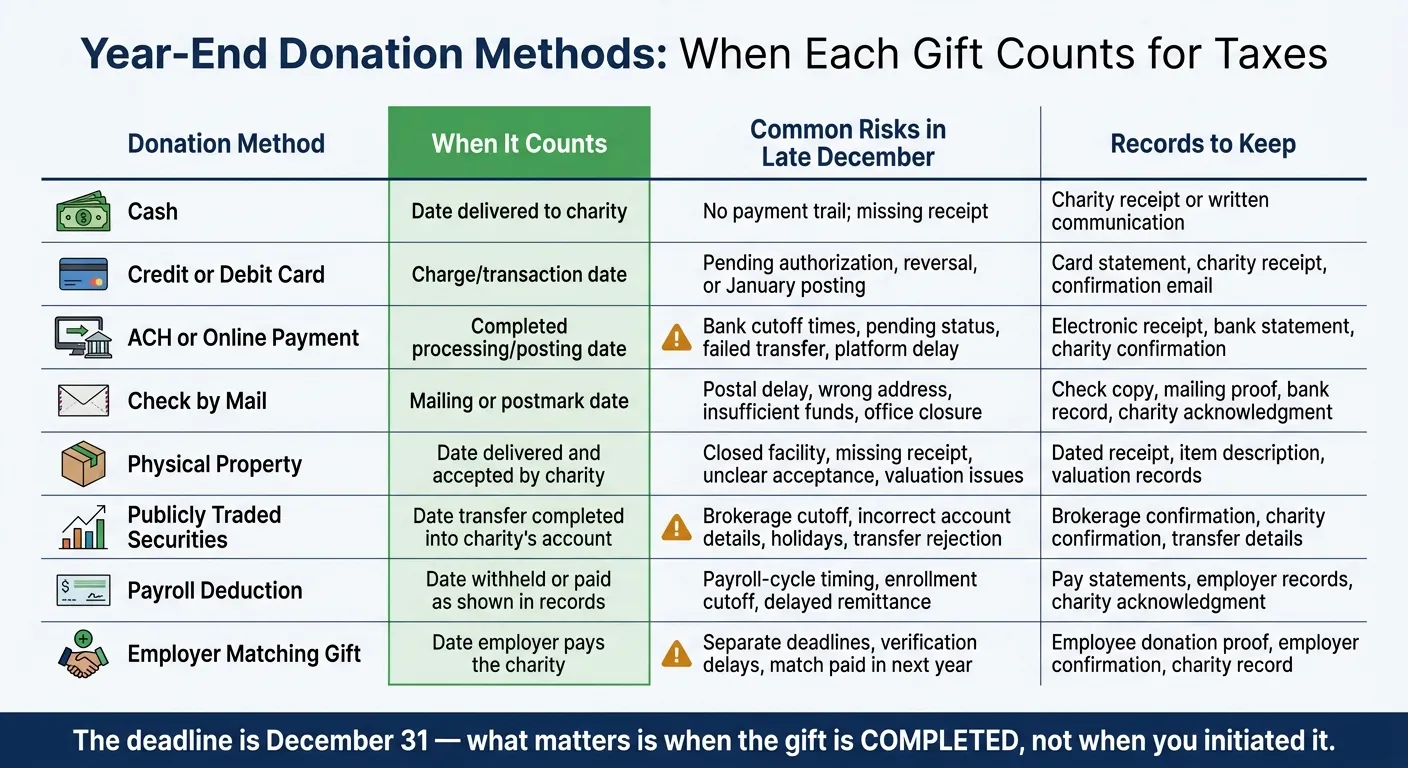
Once you know a year-end gift may lower your tax bill, the next step is simple: pick the donation method based on when the gift legally counts. Dec. 31 is the line. What matters is whether the donation is finished by then.
Cash, Card, ACH, and Check Donations
Cash gifts count when they’re delivered to the charity. Keep a receipt that shows the organization, date, and amount.[4][5][6]
A credit or debit card donation counts in the year the charge is made, even if you don’t pay the card bill until later. Save your card statement and the charity’s confirmation email.[4][8]
For ACH transfers and online payments, the submission date does not count. The key date is when the bank or payment service posts the transfer. Check your bank account for the completed processing date, not the day you clicked send.[5]
A mailed check generally counts on the mailing date if it’s properly addressed. Send checks several business days before Dec. 31, and keep a copy of the check along with proof of mailing.[4][1]
Property, Securities, and Payroll or Matching Gifts
For donated physical property, such as clothing, furniture, or household goods, the contribution counts when you unconditionally deliver it to the charity or its authorized agent.[4] Get a dated receipt when you drop it off, and don’t leave property after hours.
A stock gift counts when the shares reach the charity’s account, so it’s smart to start early in December.[7] Keep both brokerage and charity confirmations showing the transfer was completed before year-end.
Payroll gifts count when the amount is withheld from your pay. Use pay stubs and W-2s to document those donations.[5]
Track the employer match on its own. It counts when the employer pays the charity, not when you make your gift.[1] That payment may happen in the next tax year, so check the timing with your employer before including it in the current year.
Donation Method Comparison: Reliability in Late December
Late in December, the safest option is usually the one you can prove was completed before year-end.
| Donation method | When it counts | Common processing risks | Records to retain |
|---|---|---|---|
| Cash | Date delivered to the charity | No independent payment trail; missing receipt | Charity receipt or written communication |
| Credit or debit card | Charge or transaction date | Authorization remains pending, transaction is reversed, platform posts in January | Card statement, charity receipt, confirmation email |
| ACH or online payment | Completed processing or posting date | Bank cutoff times, pending status, failed transfer, platform delay | Electronic receipt, bank statement, charity confirmation |
| Check by mail | Mailing or postmark date | Postal delay, wrong address, insufficient funds, office closure | Check copy, mailing proof, bank record, charity acknowledgment |
| Physical property | Date delivered and accepted by charity | Closed facility, missing receipt, unclear acceptance, valuation issues | Dated receipt, item description, valuation records |
| Publicly traded securities | Date transfer is completed into the charity’s account | Brokerage cutoff, incorrect account details, holidays, transfer rejection | Brokerage confirmation, charity confirmation, transfer details |
| Payroll deduction | Date withheld or otherwise paid, as shown in records | Payroll-cycle timing, enrollment cutoff, delayed remittance | Pay statements, employer records, charity acknowledgment |
| Employer matching gift | Date employer or matching administrator pays the charity | Separate deadlines, verification delays, match paid in next year | Employee donation proof, employer confirmation, charity record |
This timing issue is exactly why December gifts should be set up early and tracked as they post. If your donation is getting close to Dec. 31, move it earlier in the month and keep proof as each step clears.
Build a December Donation Schedule to Avoid Processing Delays
Once you know which gifts may count, work backward from Dec. 31. The goal is simple: spread donations across the month so each one has time to clear before the deadline.
Early December: Estimate Deductions and Start Transfers
Start by estimating your 2026 income and projecting your total itemized deductions. That gives you a clearer sense of whether added gifts will help you itemize.
After you’ve decided which charities to support, double-check the basics: the charity’s legal name, tax ID, transfer instructions, receiving account, and any holiday closures. A small mismatch here can slow everything down.
This is also the point to begin your most complicated gifts. Start mutual-fund transfers by mid-November and electronic stock transfers by mid-December. For property valued over $5,000, set up a qualified appraisal now. Form 8283 Section B requires signatures from both the appraiser and the charity, and that back-and-forth takes time.[9][10]
Put the slowest gifts in motion first so they can settle before year-end.
Mid- to Late December: Finish Complex Gifts and Confirm Deadlines
By mid-December, your securities transfers should already be underway. At this stage, don’t just check that you submitted the transfer. Confirm that it settled. A transfer started in December but received in January counts in the next tax year.[11]
This is also the window to submit employer matching gift requests. Many employer portals use their own cutoff dates, and some of those dates land before Dec. 31. The matching payment itself may not go out until the next year.
Submit the request as soon as your donation posts. Then keep those approval records separate from your personal donation receipts. If you’re giving noncash property, plan the drop-off or pickup before the charity closes for the holidays, and get a dated receipt that describes the items.
December 31: Save Proof That the Donation Was Completed
On Dec. 31, save proof that each gift was completed. Download receipts and keep bank, card, or brokerage confirmations that show the completed date.
For gifts of $250 or more, the IRS generally requires a written acknowledgment from the charity, so make sure you have it before you file your return.[3]
If a transaction still shows as pending at the end of the day, contact the charity and the payment processor right away to confirm which date will appear on the final record. A pending charge, a failed ACH, or a brokerage transfer that didn’t settle in time can push your deduction into the next tax year - and you may not spot the problem until tax season.[11][4]
Use this schedule to sort gifts by processing speed.
| Gift type | Start by | Key confirmation to get |
|---|---|---|
| Mutual funds | Mid-November[12] | Written confirmation from charity that transfer is complete |
| Publicly traded stock | Mid-December[12] | Brokerage and charity confirmations showing receipt date[11] |
| Noncash property (>$5,000) | Early December[9][10] | Signed Form 8283 Section B and qualified appraisal |
| Employer matching gift | As soon as your donation posts | Employer approval record and charity acknowledgment |
| Mailed check | Several business days before Dec. 31[4] | Check copy and proof of mailing or postmark |
| Credit card or online gift | Before Dec. 31[4] | Completed charge confirmation, not just authorization |
Use Bunching and Recordkeeping to Get More from Your Gifts
Once you’ve set your donation dates, the next step is deciding whether to bunch gifts so you can claim a deduction. If your total itemized deductions still won’t get past the standard deduction, bunching can help by shifting planned gifts into one tax year that does qualify.
Annual Giving vs. Bunched Giving: A Side-by-Side Look
Bunching means putting two or more years of planned charitable gifts into one tax year instead of spacing them out evenly. The idea is simple: push your itemized deductions above the standard deduction in the high-giving year, then take the standard deduction the following year when your charitable giving drops.
For example, a taxpayer who gives $6,000 each year may come out ahead by giving $12,000 in one year and taking the standard deduction the next.
| Factor | Annual giving | Bunched giving |
|---|---|---|
| Pattern | Similar gifts every year | Multiple years of gifts in one year |
| Deduction effect | May stay below the standard deduction | May exceed the standard deduction in the contribution year |
| Cash flow | Predictable, spread over time | Requires a larger one-year gift |
| Main risk | Donations may produce no incremental deduction | May exceed AGI limits or strain liquidity |
| Recordkeeping | Annual receipts collected each year | More documentation concentrated in one year |
Before you move ahead, there are two limits to weigh.
- Cash gifts to public charities are generally deductible up to 60% of your AGI. Any extra amount can usually be carried forward for up to five years.[4]
- Bunching only works if you can handle a bigger one-year gift without throwing off savings, bills, or other money plans.
A tax professional should run the numbers using your actual 2026 figures before you change your giving schedule.
Match Each Gift to the Records the IRS Expects
If you bunch gifts, paperwork matters even more. More donations in one year means more receipts, more acknowledgments, and more chances for something to slip through the cracks. In a bunching year, all that proof lands in one filing season, so your tracking needs to be tighter.
Different gifts call for different records. For cash, card, or electronic gifts under $250, a bank statement, credit card statement, or charity receipt is generally enough.[5] For any single gift of $250 or more, you need a written acknowledgment from the charity. That acknowledgment must state the amount, confirm whether you received any goods or services in return, and be in hand before you file your return.[3] One document can cover both rules if it includes all the required details.[3]
Charity dinners and events work a little differently. You can deduct only the amount that exceeds the value of what you received. For payments over $75, the charity must give you a written disclosure with a good-faith estimate of the benefit’s value.[6] Keep the event notice, disclosure statement, and payment record together. It sounds a bit old-school, but this is one of those times when a neat file can save a headache later.
For noncash donations, the charity’s receipt describes the property but does not set the value. That’s on you.[5] If your total noncash contributions go over $500, Form 8283 is generally required.[3] If a single item or group of similar items is valued above $5,000, you’ll also need a qualified appraisal and Form 8283 Section B, with signatures from both the appraiser and the charity.[3][13] And if noncash contributions go above $500,000, the qualified appraisal generally must be attached to the return itself.[3]
Use Deductible.me to Track Values, Receipts, and Giving Goals
Deductible.me can help you track giving goals, store receipts, estimate donated-item values with AI, and generate IRS-compliant, Form 8283-ready reports for noncash gifts. Use those records to finish the year-end checklist below.
Year-End Verification Checklist
Use the records you gathered above to check each gift before you file. This step helps you confirm that each donation counts for 2026. A careful review now can save you a headache when it’s time to prepare your return.
Start with eligibility. Make sure the recipient is a qualified charity in the IRS Tax Exempt Organization Search. Gifts to individuals and political campaigns don’t count. Save the organization’s legal name and the search results with your tax file.[2]
Verify completion, not just initiation. Check the completed date on each record. Use the date tied to the way the gift was made, whether that was payment, transfer, or delivery. For cards and electronic payments, keep the transaction confirmation and the account statement. For donated property, keep the charity’s delivery or acceptance record.
Compare each charity acknowledgment with your bank, brokerage, or payroll record. Check that the legal name, amount, date, and gift type match.
Use the table below to spot mismatches fast.
| Gift type | Completion check | Key record to retain |
|---|---|---|
| Cash, card, or ACH | Transaction completed by Dec. 31 | Bank or card statement + charity receipt |
| Check | Proof of mailing or delivery, plus bank or charity record showing completion | Mailing evidence + bank record or charity record |
| Publicly traded securities | Brokerage transfer completed by Dec. 31 | Brokerage transfer confirmation + charity acknowledgment |
| Household goods or property | Itemized receipt, condition description, and delivery proof | Itemized receipt with condition description + delivery evidence |
| Payroll deduction | Pay stub and employer payroll record showing withholding | Pay stub or employer statement + payroll records |
Recalculate your itemized deductions using the final amounts. Then track any charitable carryforward on its own.
Hold off on large, noncash, donor-advised-fund, or unclear gifts until a tax professional confirms the deduction.
FAQs
What if my donation is pending on December 31?
For tax purposes, your donation counts on the date it’s actually delivered or transferred to the charity. If it’s still pending on December 31, it usually doesn’t count for the current tax year unless the transfer is completed by that date.
If you want the tax break for this year, make sure the transaction is fully completed before year-end.
How do I know if itemizing will save me more than the standard deduction?
Itemizing usually saves you more only when your total write-offs are higher than the standard deduction for your filing status.
That can include deductions like:
- Charitable donations
- State and local taxes
- Mortgage interest
- Medical costs
For 2025, the standard deduction is $15,000 for single filers and $30,000 for married couples filing jointly.
If your total is close to that cutoff, one move may help: bunching two years of charitable gifts into a single tax year. That can push your deductions high enough to itemize for that year.
Can I deduct a donation if I received something in return?
Yes, but you need to subtract the value of any goods or services you received.
You can deduct only the part of your contribution that’s more than the fair market value of what you got in return.
To stay compliant, make sure the charity gives you a contemporaneous written acknowledgment that includes a good-faith estimate of what you received.