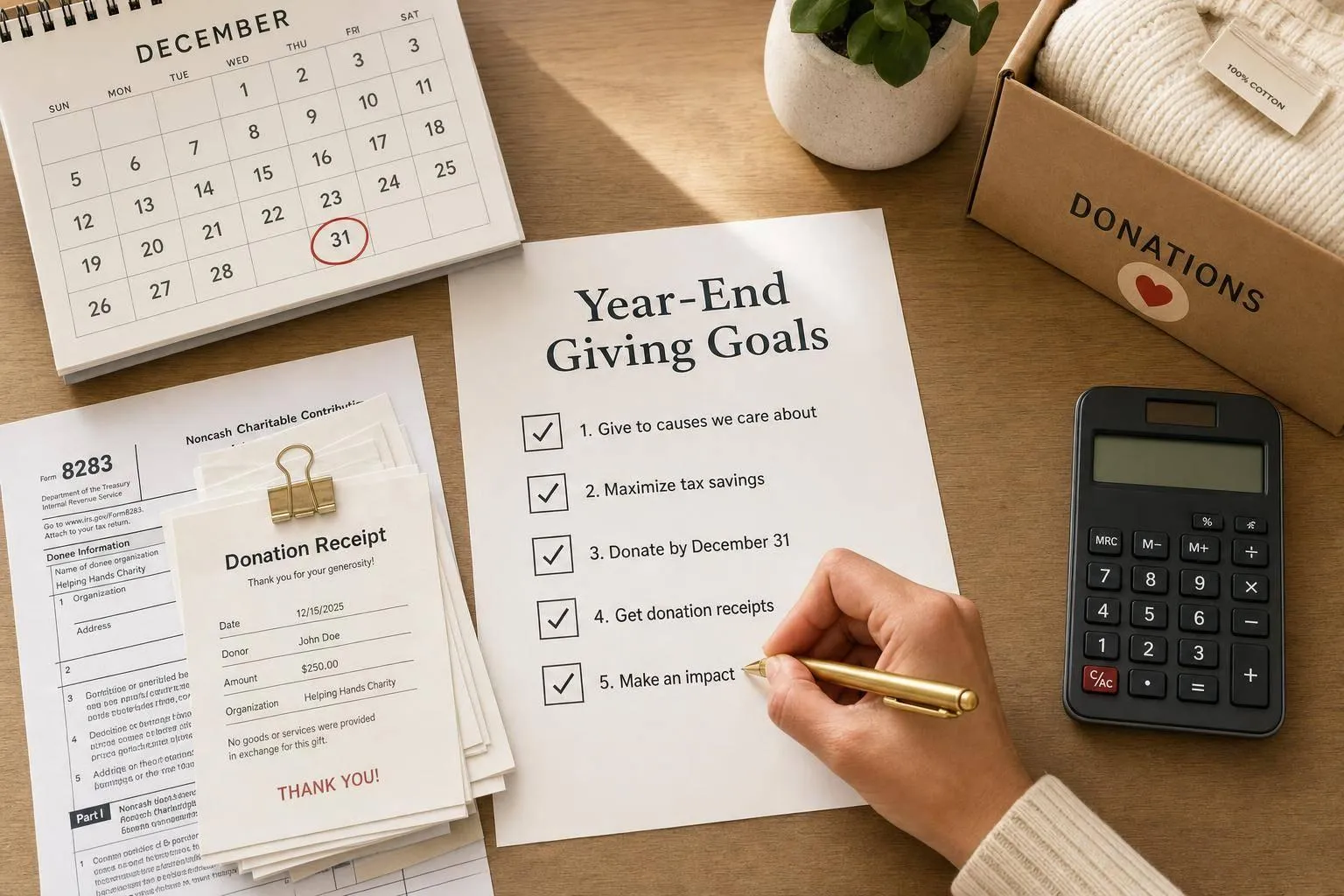
If I want a 2026 tax break for my donations, I need to finish my gifts by December 31, 2026, keep the right records, and make sure itemizing beats the standard deduction.
Here’s the short version:
- For 2026, the standard deduction is $15,000 for single filers and $30,000 for married filing jointly.
- Charitable deductions usually help me only if I itemize on Schedule A.
- Gifts usually count only if I give to an IRS-qualified charity.
- Cash, noncash items, stock, DAF gifts, and QCDs each have different timing and record rules.
- For gifts of $250 or more, I need a written acknowledgment from the charity.
- If my total noncash gifts exceed $500, I may need Form 8283.
- If a single item or similar-item group is over $5,000, I may need a qualified appraisal too.
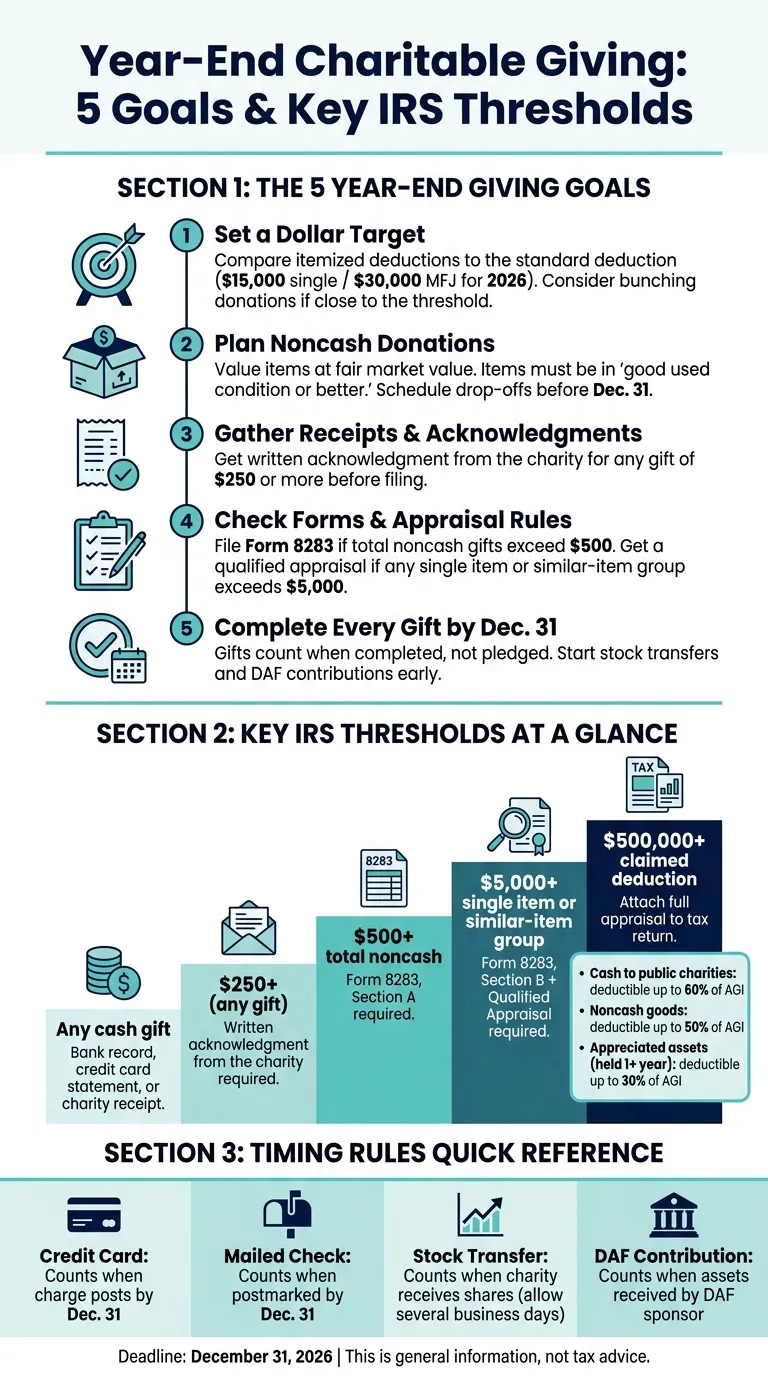
This article boils year-end giving down to five clear goals: set a dollar target, plan noncash donations, gather receipts, check form and appraisal rules, and complete every gift before the deadline.
Giving at Year’s End and Tax Law Changes for 2026
Quick Comparison
| Goal | What I need to do | Main cutoff |
|---|---|---|
| Set a giving target | Check if itemizing will beat the standard deduction | December 31, 2026 |
| Plan noncash gifts | Value items at fair market value and track condition | $500 / $5,000 thresholds |
| Gather receipts | Get proof for each gift | $250 acknowledgment rule |
| Check forms | See if Form 8283 or appraisal applies | Over $500 / over $5,000 |
| Finish gifts on time | Make sure the gift is completed in 2026 | December 31, 2026 |
Put simply: if I want my giving to help on my 2026 federal return, I need to match my donation plan, paperwork, and timing before the year ends.
What to Know Before Setting Year-End Giving Goals
Before you set any dollar targets, it helps to know a few IRS rules that shape how much of your giving can lower your tax bill. This is general information, not tax advice.
How Itemizing Affects Your Deduction
First, look at itemizing. This is the part that decides whether a donation helps your federal taxes at all. A charitable deduction lowers federal tax only if you itemize on Schedule A. If your other deductions do not already put you above the standard deduction, a year-end gift may not change your tax bill.
If your giving is close to that cutoff, one move may help: bunch planned donations into one tax year so you itemize that year, then take the standard deduction the next [1][2][3].
Why Charity Type and Gift Type Matter
The IRS does not treat every gift the same way. Your deduction limit depends on what you give and who receives it.
| Gift Type | Recipient | Limit as a Share of AGI |
|---|---|---|
| Cash | Public charity | Up to 60% [4][5][6][7][8] |
| Noncash goods (clothing, furniture) | Public charity | Up to 50% [9][5][10][7][8] |
| Appreciated assets held more than one year | Public charity | Up to 30% [4][5][10][7][8] |
For 2026 itemizers, only gifts above 0.5% of AGI count toward the deduction. Amounts over the limit can usually carry forward for up to five years [10][11][7][8].
Why Timing Matters at Year-End
Timing can make or break a current-year deduction. A check counts when it is postmarked by December 31. A credit card gift counts when the charge posts, not when you pay the bill [12][13][14][15][16].
Stock transfers and other noncash gifts often take more time to finish. So if you want them to count for the current tax year, start early. This is one of those small details that can trip people up.
For current-year deductions, the main issue is simple: what date does the gift count? From there, you can decide whether giving now helps your tax result more than waiting.
With those ground rules in place, set your first goal: a dollar target.
1. Set a Dollar Target for Charitable Giving Before December 31
How the Deduction Rule Shapes Your Target
Start with the number that determines whether giving changes your tax picture: the point where itemizing beats the standard deduction.
For 2026, the standard deduction is $15,000 for single filers and $30,000 for married filing jointly.[17] Cash donations to public charities are generally deductible up to 60% of your AGI.[4][5]
The main issue is simple: Will your itemized deductions end up higher than the standard deduction? If not, a donation may still matter for personal reasons, but it may not change your federal tax result.
Set Your Target
Compare your expected itemized deductions with the standard deduction. The difference between those two numbers gives you a practical giving target.
Say you’re just short of the line. In that case, bunching can make sense. Instead of splitting a planned recurring gift across two tax years, you give the full amount before December 31. That may push your deductions over the threshold, so you can itemize in one year and take the standard deduction in the next.[18][19]
One more point matters here: a deduction does not cut your tax bill dollar for dollar. It reduces taxable income, so the tax savings depend on your marginal tax rate.
By December 31
To count for the 2026 tax year, your gift needs to be completed by December 31.[20]
A few timing rules matter:
- Gifts charged to a credit card before midnight on December 31 generally count, even if you pay the card bill later.
- Mailed checks are riskier if you wait too long, since timing can depend on when the check is postmarked and received.[20]
Keep the Records You’ll Need
The paperwork is pretty straightforward, but you need the right proof.
- For gifts under $250, keep a bank record, credit card statement, or receipt.[17][21]
- For gifts of $250 or more, get a written acknowledgment from the charity before you file.[17][21]
With your target in place, the next step is planning your noncash donations.
2. Plan Your Noncash Donations and Valuation Steps
IRS Deduction Rule Tied to the Goal
Noncash donations - like clothing, furniture, electronics, and similar items - are generally deductible at fair market value (FMV). In plain English, that means what the item would sell for on the open market. It’s the secondhand resale price, not the amount you paid when it was new.
For most used clothing and household goods, the IRS expects the items to be in “good used condition or better” to qualify.[22][23] If you’re dealing with higher-value items, follow the IRS rules for valuation and proof before you claim the deduction. Once you settle on a value, line up the records you’ll need before year-end.
Year-End Action Deadline
For drop-offs, the charity must receive the items by December 31, 2026. If you need a pickup, book it early. A pickup in January moves the deduction to the next tax year.[24]
Required Records or Forms
The paperwork changes based on the total value of your noncash donations for the year:
| Total Noncash Value | Required Documentation |
|---|---|
| Under $250 | Receipt from charity or bank/credit card record |
| $250–$500 | Written acknowledgment from the charity |
| Over $500 | Written acknowledgment + Form 8283, Section A |
| Over $5,000 (single item or group) | Written acknowledgment + Form 8283, Section B + qualified appraisal |
A couple of practical points matter here. The charity should describe what you gave, but you assign the value.[21][25] It also helps to photograph each item before drop-off and write down its condition and your value estimate.[24]
Tax-Planning Opportunity
If your noncash donations may go over the $5,000 threshold, set up a qualified appraisal before you donate, not after. That’s a big one. Appraisers need to inspect the property, and the appraisal has to meet IRS timing rules to count.[26][27]
Deductible.me can log items, estimate FMV, and flag the $500 and $5,000 thresholds.
With the values set, gather your receipts and written acknowledgments now so you’re not scrambling for paperwork after December 31.
3. Gather Receipts and Written Acknowledgments Now
IRS Deduction Rule Tied to the Goal
After you assign values to noncash gifts, the next hurdle is documentation. The IRS wants specific records, not just proof that money left your account. For gifts of $250 or more, you need a timely written acknowledgment from the charity before you file your return, or before the filing deadline, including extensions.[28][29][30]
That acknowledgment needs to include:
- The charity’s name
- The date of the gift
- The cash amount or a description of the property
- A statement saying whether you received anything in return
If you got no goods or services, or only intangible religious benefits, the letter must say that plainly. If the acknowledgment is missing or arrives late, the IRS can deny the deduction even if the donation itself was made.[29][31]
Year-End Action Deadline
Ask for acknowledgments now while the details are still easy to check and there’s still time to fix mistakes.
Required Records or Forms
| Donation Amount | What You Need |
|---|---|
| Under $250 | Bank or credit card statement, or charity receipt |
| $250 or more | Timely written acknowledgment from the charity |
Noncash gifts over $500 or $5,000 also call for Form 8283, and gifts over $5,000 need a qualified appraisal.[32][33][34]
When an acknowledgment comes in, read it line by line. Make sure it shows the contribution date, the right amount or property description, and the goods-or-services disclosure. This is one of those small details that can trip people up. Even one missing line about goods or services has been enough for the IRS to reject an otherwise valid deduction.[29][31]
If something looks wrong, reach out to the charity and ask for a corrected letter before you file.
Tax-Planning Opportunity
Once your receipts are in order, compare your verified total with your itemizing threshold. Deductible.me can track annual giving goals and store receipts in one place.
With your records sorted, the next step is to see whether Form 8283 or a qualified appraisal is needed.
4. Check Whether Form 8283 or a Qualified Appraisal Is Required
IRS Deduction Rule Tied to the Goal
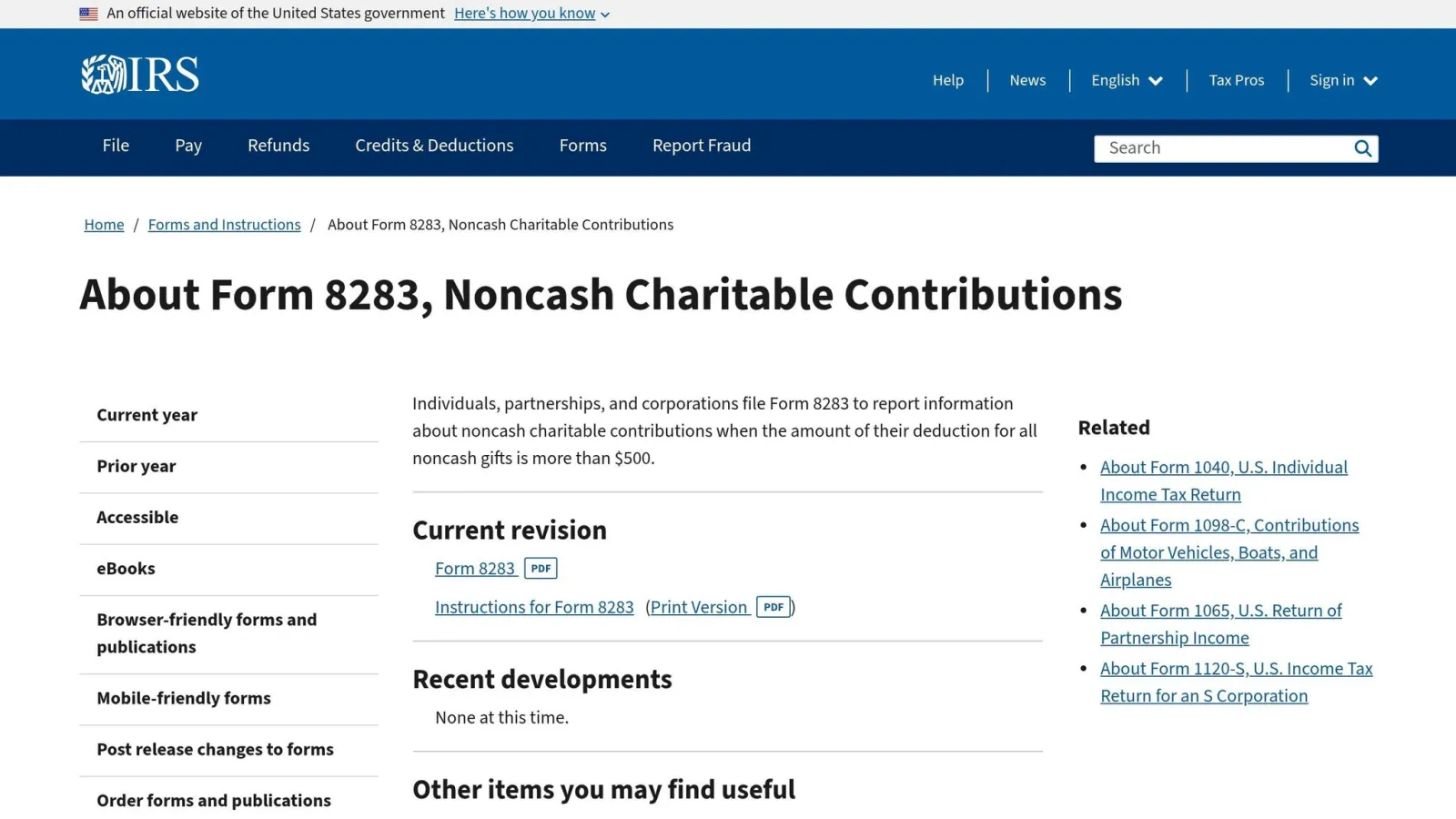
Once you’ve gathered your receipts, the next step is simple: check whether your noncash donations set off extra IRS forms. Form 8283 is required if your total noncash donations for the year exceed $500.[35]
Here’s how the IRS rule breaks down:
| Noncash Donation Value | Form 8283 Section | Qualified Appraisal Required? |
|---|---|---|
| More than $500 and up to $5,000 per item or similar-item group | Section A | No |
| More than $5,000 per item or similar-item group | Section B | Yes |
| Publicly traded securities, any value | Section A | No |
One part trips people up: the $5,000 test applies to similar items added together across the year, not just a single donation.[36][5] So if you donate clothing, furniture, or other similar property in separate batches, the combined total may put you over the line.
Year-End Action Deadline
The donation itself must be made by December 31, 2026 for it to count on your 2026 tax return. For gifts that need an appraisal, the appraisal must be dated within 60 days before the contribution date, and that window includes the contribution date itself.[36][5]
If you’re planning to donate a high-value item in late December, don’t wait until the last minute. Appraisers can get booked up, and timing matters here.
Required Records or Forms
For Section B, Form 8283 is only the appraisal summary. It is not the appraisal itself. The form must include the signature of the qualified appraiser and the charity’s authorized representative.[27][26][37][38] Both signatures need to be on the form before you file.
Crypto gets different treatment here. It is not treated as a publicly traded security for this rule.[39] That means if you donate crypto worth more than $5,000, you generally need both a qualified appraisal and Section B. Real estate and artwork also often fall into Section B. And if your claimed deduction for property is more than $500,000, you must attach the qualified appraisal to your return along with Form 8283.[40][41]
Tax-Planning Opportunity
Before December 31, add up your noncash donations by category, such as:
- Clothing
- Furniture
- Electronics
- Crypto
That gives you a clear view of whether any similar-item group is getting close to $5,000. If it is, you still have time to book an appraiser or decide if the deduction makes sense given the appraisal fee.
Deductible.me can track noncash gifts, flag the $500 and $5,000 limits, and generate IRS-ready reports.
Keep the form, appraisal, and donation records in one place so you’re not digging through files when it’s time to prepare your return.
5. Complete Gifts Before the 2026 Tax Year Deadline
Once your receipts and forms are lined up, the final step is simple: make sure each gift is completed by December 31, 2026. This part comes down to timing.
IRS Deduction Rule Tied to the Goal
A gift counts only when it is completed, not when it is promised.[42] So after you’ve checked the paperwork and appraisal rules, the next move is to lock in the transfer date.
If a gift takes time to process, use the completion date, not the pledge date:
| Giving Method | When the Gift Counts |
|---|---|
| Online or ACH | Date the transfer clears before the platform’s year-end cutoff[20] |
| Stock or other securities | Date the charity receives the shares[43][44] |
| Donor-advised fund (DAF) | Date assets are received by the DAF sponsor[45][46] |
| IRA qualified charitable distribution (QCD) | Date the funds reach the charity[47] |
Year-End Action Deadline
December 31, 2026 is the hard cutoff. But some gifts need a few business days to settle. Stock transfers, for example, can take several business days, so start early enough for the charity to receive the shares by December 31, 2026.[43][44][48] If you wait until the last few days of December to call your broker, the transfer could slide into January.
Online gifts have their own timing issues too. Charities and payment processors often set internal cutoffs on December 31, 2026, so don’t assume you can give at 11:59 p.m. in your time zone and still have it count.[20]
Tax-Planning Opportunity
Getting the gift done before year-end can also help you manage 2026 taxable income. If you have a large income event in 2026 - like a bonus, stock option exercise, or business sale - moving charitable gifts into that same year may help offset part of that jump.
A donor-advised fund can be useful here. If you contribute before December 31, 2026, you can claim the deduction now and decide later which charities receive the grants.[45]
And if you’re close to the standard deduction threshold, bunching two years of giving into 2026 may make itemizing worth it.
Tools to Track Donation Goals and Documentation
After your gifts are done, use one system to track your goals, receipts, and forms.
Tracking Annual Giving Targets
A simple tracking setup helps you see how you’re doing against your 2026 giving goal all year long. Set a clear dollar amount, log each gift when you make it, and check your progress before year-end.
Deductible.me tracks goals and gifts in one place. You can use one dashboard to see your target and year-to-date giving at a glance. The same log can also hold noncash item photos and valuation notes.
Keeping Records for Noncash Donations
Keep item descriptions, condition notes, donation dates, charity names, photos, and fair market value estimates in the same place so your records are easy to review later.[49][50][27]
Photograph each item and save those photos with your valuation notes. When everything lives together, it’s much easier to match each donation to its receipt later.
Organizing Receipts and Tax Forms
Attach each receipt or timely written acknowledgment before you file.
Deductible.me lets you attach digital receipts and acknowledgments to each donation. You can also flag Form 8283 and appraisal needs in the same record, along with the item details your preparer needs.[49][51]
Key Deadlines and Documentation Reminders
These last checks can make the difference between a 2026 deduction and no deduction at all. The goal is simple: make sure each gift is completed by Dec. 31, 2026, and make sure your records match IRS rules.
When a Gift Counts for the 2026 Tax Year
December 31, 2026 is the deadline. A gift has to be finished by that date, not just intended, discussed, or pledged.
Here’s how that works in practice:
- Mailed checks: A check counts if it’s postmarked by Dec. 31, 2026. Don’t wait until the last minute. Mail it early enough to get that Dec. 31, 2026 postmark.[5][4][52]
- Credit card and online gifts: The gift counts only when the charge is processed by Dec. 31, 2026.[52]
- Donor-advised funds (DAFs): The deduction counts in the year the DAF receives the assets. If you’re giving stock or mutual funds, start early because the transfer and settlement process can take several business days.[53][2]
Once the gift is done, the next step is paperwork. That’s where many people slip.
Documentation Thresholds to Review Before Filing
| Donation Type & Amount | Documentation Required |
|---|---|
| Cash, any amount | Bank record, credit card statement, or charity receipt showing the organization name, date, and amount.[28] |
| Any gift of $250 or more | Written acknowledgment from the charity.[54][33] |
| Total noncash gifts over $500 | Form 8283, Section A, filed with your return.[40][27][33] |
| Single noncash item or group of similar items over $5,000 | Qualified appraisal plus Form 8283, Section B.[54][33][50] |
Before you file, check each acknowledgment letter and make sure it includes what you need. Also confirm that any total noncash gift over $500 appears on Form 8283.
It’s smart to review your records in January or early February 2027, before filing. If a receipt or acknowledgment is missing, or if a letter leaves out key details, ask for a corrected version in January.[5][28]
Conclusion
A year-end giving plan works best when you start with clear goals. Use the five goals above to finish your year-end giving before Dec. 31, 2026. That checklist helps protect your deduction. These five goals work best as one system. Put simply: line up your gifts, records, and deadlines before the year ends.
Review your giving in October or November before deadlines start stacking up. Pull a year-to-date giving report, compare it with your goal, list any noncash items you still want to donate, schedule drop-offs or pickups before mid-December, and confirm deadlines for stock transfers or other more complex gifts. A short review now can help you avoid filing problems later.
Deductible.me can track your goal, value noncash gifts, and store receipts and acknowledgments in one place.
FAQs
How do I know if itemizing saves more than the standard deduction?
Itemizing can save you more if your total deductions are higher than the standard deduction for your filing status.
That includes write-offs like:
- Charitable donations
- State and local taxes
- Mortgage interest
- Qualifying medical expenses
For 2025, the standard deduction is:
- $15,000 for single filers or married filing separately
- $30,000 for married filing jointly
- $22,500 for heads of household
If your total is close to one of those amounts, bunching two years of charitable giving into one tax year may help you get over the line and make itemizing worth it.
What counts as a similar-item group for the $5,000 appraisal rule?
For the $5,000 appraisal threshold on Form 8283, a similar-item group means items of the same type of property that the IRS treats as one collection. Instead of looking at each donation on its own, you add their fair market values together.
If the total fair market value of the item or similar-item group is more than $5,000, and the property is not publicly traded securities, you need a qualified appraisal for Section B.
When should I start stock, DAF, or QCD gifts before year-end?
Start well before December 31 so your gift counts for the current tax year. These transfers can take several business days, and stock gifts can take even longer.
Getting started early gives you a better shot at making sure the assets are legally transferred, or the funds are in the charity’s hands, before year-end. Deductible.me can also help you track your giving goals and keep clear records for tax reporting.