Ultimate Guide to Timing Charitable Donations
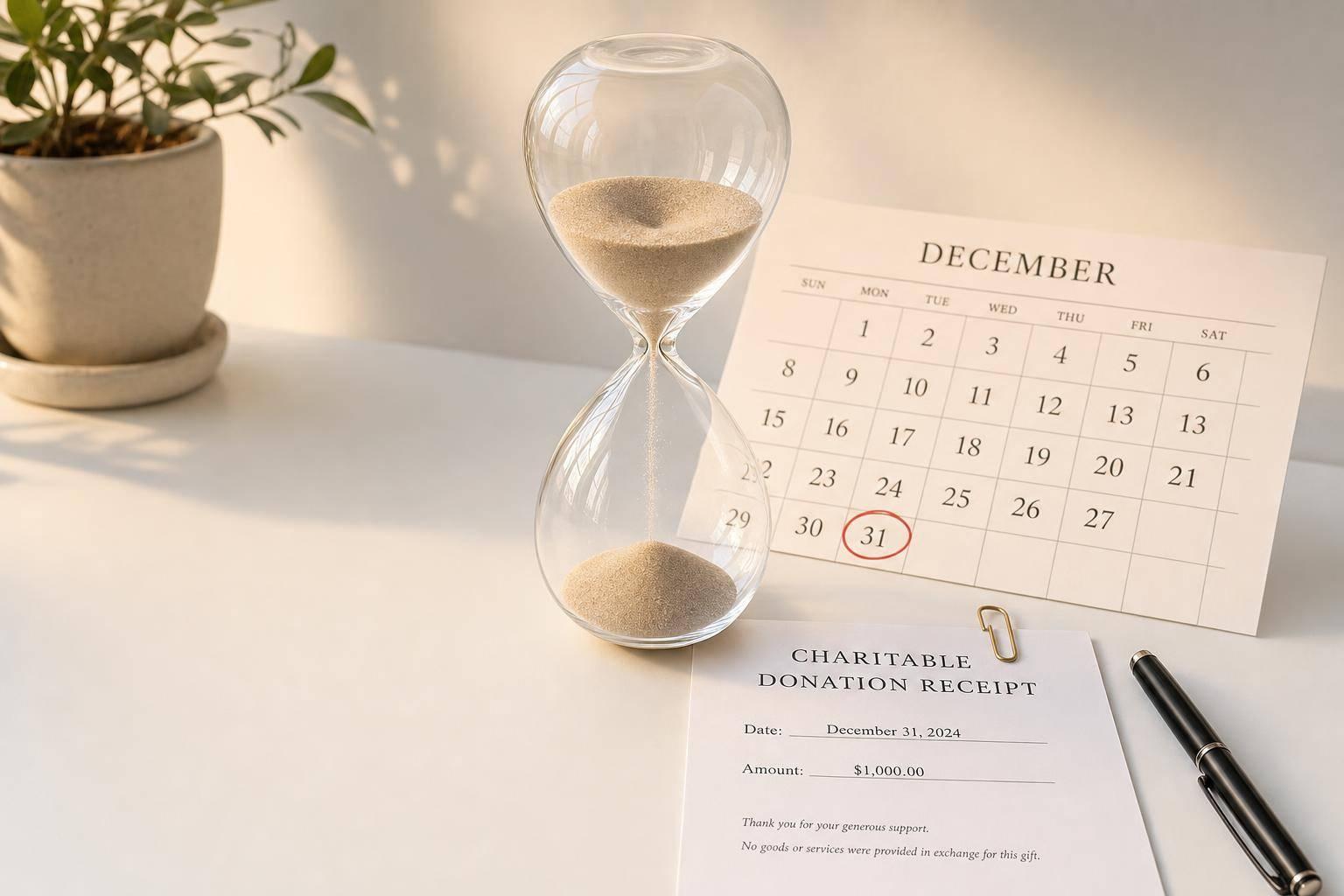
If your gift is not complete by December 31, 2026, you generally do not get the deduction for 2026. That is the whole issue in one line.
Here’s the short version: the IRS cares about when you gave up control of the money or property, not when you planned the gift. A USPS-mailed check can count on the postmark date, a credit card gift counts when the charge posts, and stock gifts count only when the shares land in the charity’s account. That one timing rule can decide whether your deduction goes on your 2026 return or slips into 2027.
Before I go any further, these are the points I’d keep in front of me:
- A pledge is not deductible until I actually pay it.
- December 31 is the cutoff for most year-end gifts.
- USPS and private carriers are treated differently for mailed checks.
- Bank transfers, stock gifts, and QCDs need extra lead time.
- Any gift of $250 or more needs a written acknowledgment before I file.
- Cash, stock, and other property have different AGI limits.
- Starting in 2026, itemizers face a 0.5% AGI floor.
- Bunching donations may help if I want to itemize instead of taking the standard deduction.
A few numbers matter here too. Cash gifts to public charities are generally capped at 60% of AGI, long-term appreciated assets at 30% of AGI, and unused amounts can often carry forward for up to five years. For noncash gifts over $500, I may need Form 8283, and for gifts over $5,000, I may also need an appraisal.
So this guide is not just about when to give. It is about how I can match the gift date, records, and tax-year plan so I do not lose a deduction I expected to claim.
Making donations in 2026: What new tax rules mean for charitable giving now and later
sbb-itb-e723420
When a donation counts: IRS timing rules by gift type
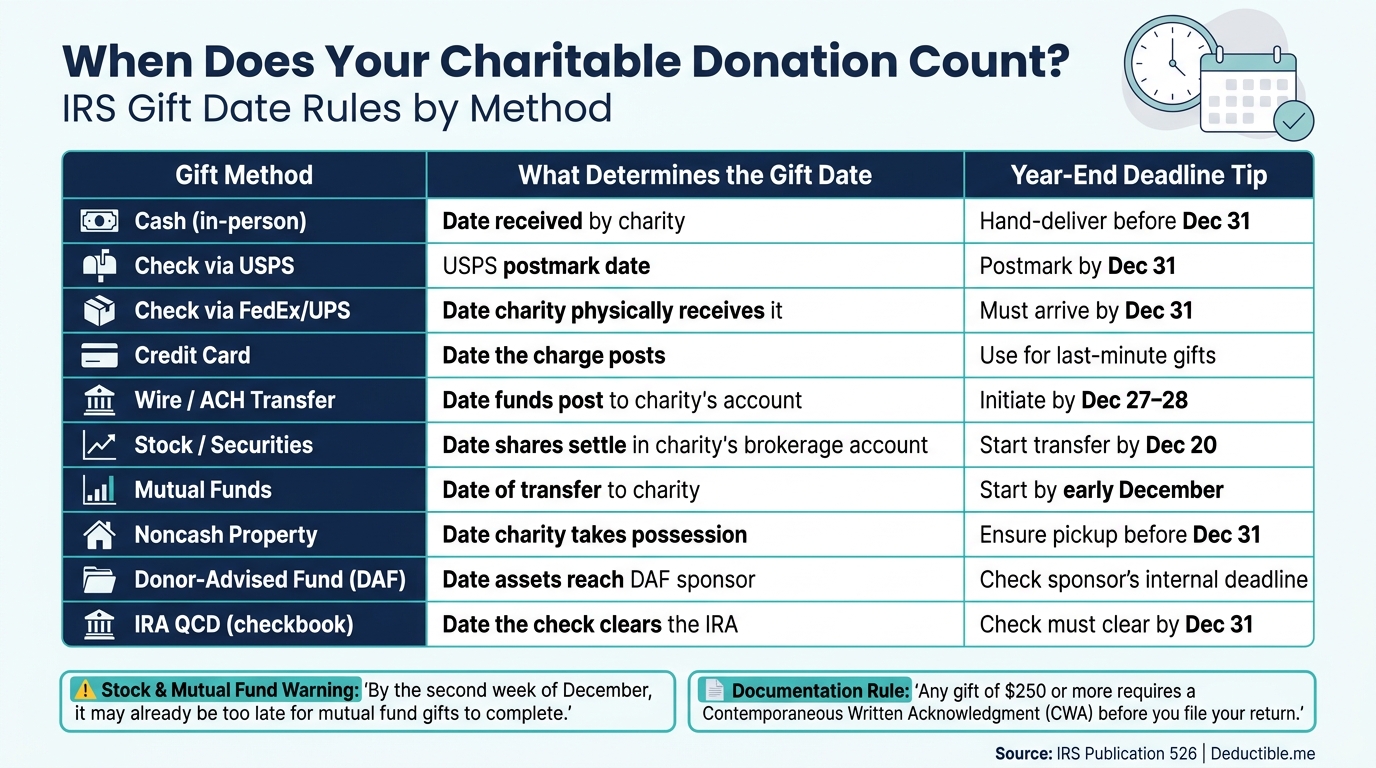
Charitable Donation Timing Rules by Gift Method (2026 Tax Year)
The date of your gift depends on how you give. And in the last few days of December, that detail can make all the difference.
Cash, checks, cards, bank transfers, and payment apps
Cash gifts count when the charity receives the money [1].
Credit card donations count when the charge posts, not when you pay the card bill. That’s why credit cards can work well for last-minute giving [1][4].
Checks follow a split rule, and this is where people get tripped up. If you mail a check through the U.S. Postal Service, the gift counts on the postmark date [1][10]. If you send that same check through FedEx, UPS, or another private carrier, the gift date is when the charity physically receives it [1][4].
Wire transfers and ACH payments count when the funds post to the charity’s account [1][10]. If you wait until the very end of December, bank holidays and cutoff times can push the transfer into January. A safer move is to start the transfer by Dec. 27–28 to avoid bank delays [4].
So while both electronic payments and mailed gifts can work at year-end, the deadline is not one-size-fits-all.
Noncash items, securities, donor-advised funds, and QCDs
Property gifts follow the same basic idea, but they often take more time to finish.
Household goods and other physical property count when the charity takes possession. If pickup happens in January, the deduction moves to January too [11].
Stock transfers count when the shares are credited to the charity’s brokerage account [1][10]. That timing matters because these transfers can take a while. Start stock gifts by Dec. 20, and give mutual funds even more lead time [4][10][11].
"By the second week of December, it is already too late for most mutual fund gifts to be completed." - Kara Morin, PG Calc [10]
Donor-advised fund contributions are deductible when the assets reach the sponsoring organization, not when the sponsor later sends grants to individual charities [1][4]. Many DAF sponsors also use earlier internal cutoffs, so you’ll want to check the sponsor’s deadline ahead of time [7][3].
For a Qualified Charitable Distribution, or QCD, the rule depends on how the money leaves the IRA. If the IRA custodian issues the check, the QCD counts when the funds leave the IRA. If you have IRA checkbook privileges, the check must clear the IRA by Dec. 31 [1][10].
Once the IRS gift date is set, your records need to line up with that date. Here’s the quick version:
| Method | What determines gift date |
|---|---|
| Cash / In-person check | Date received by charity representative |
| Check (USPS) | Date of the postmark |
| Check (FedEx/UPS) | Date of physical receipt by charity |
| Credit card | Date the charge posts |
| Wire / ACH | Date funds post to the charity's account |
| Securities (electronic) | Date shares settle in charity's brokerage account |
| Mutual funds | Date of transfer to the charity |
| Noncash property | Date of possession by charity |
| DAF contribution | Date assets reach the DAF sponsor |
| IRA QCD (checkbook) | Date the check clears the IRA |
Once the gift date is fixed, the next step is proving it with the right records.
Deadlines, deduction limits, and records you need
December 31 deadlines, AGI limits, and carryforwards
Once you lock in the gift date, the next thing to check is how much you can deduct and what happens if you go over the limit.
Cash gifts to public charities are capped at 60% of AGI. Noncash property is capped at 50% of AGI. Long-term appreciated assets, such as stocks, are capped at 30% of AGI [6][8].
Starting in 2026, itemizers also face a 0.5% AGI floor. That means only charitable contributions above that threshold are deductible [8][9].
If your donations go past these limits, the extra amount doesn't just disappear. You can carry it forward for up to five years [6][8][9].
Once the gift date and deduction limit are clear, the next job is proving the gift.
Written acknowledgments, Form 8283, and appraisal timing
Getting the date right isn't enough. You also need the right paperwork, and the rules get tighter as the gift gets larger.
For any single contribution of $250 or more, you need a contemporaneous written acknowledgment (CWA) from the charity. You must have it by the time you file your return or by the return's due date, including extensions, whichever comes first. The acknowledgment must say whether you received any goods or services in exchange for the gift [5][7][2].
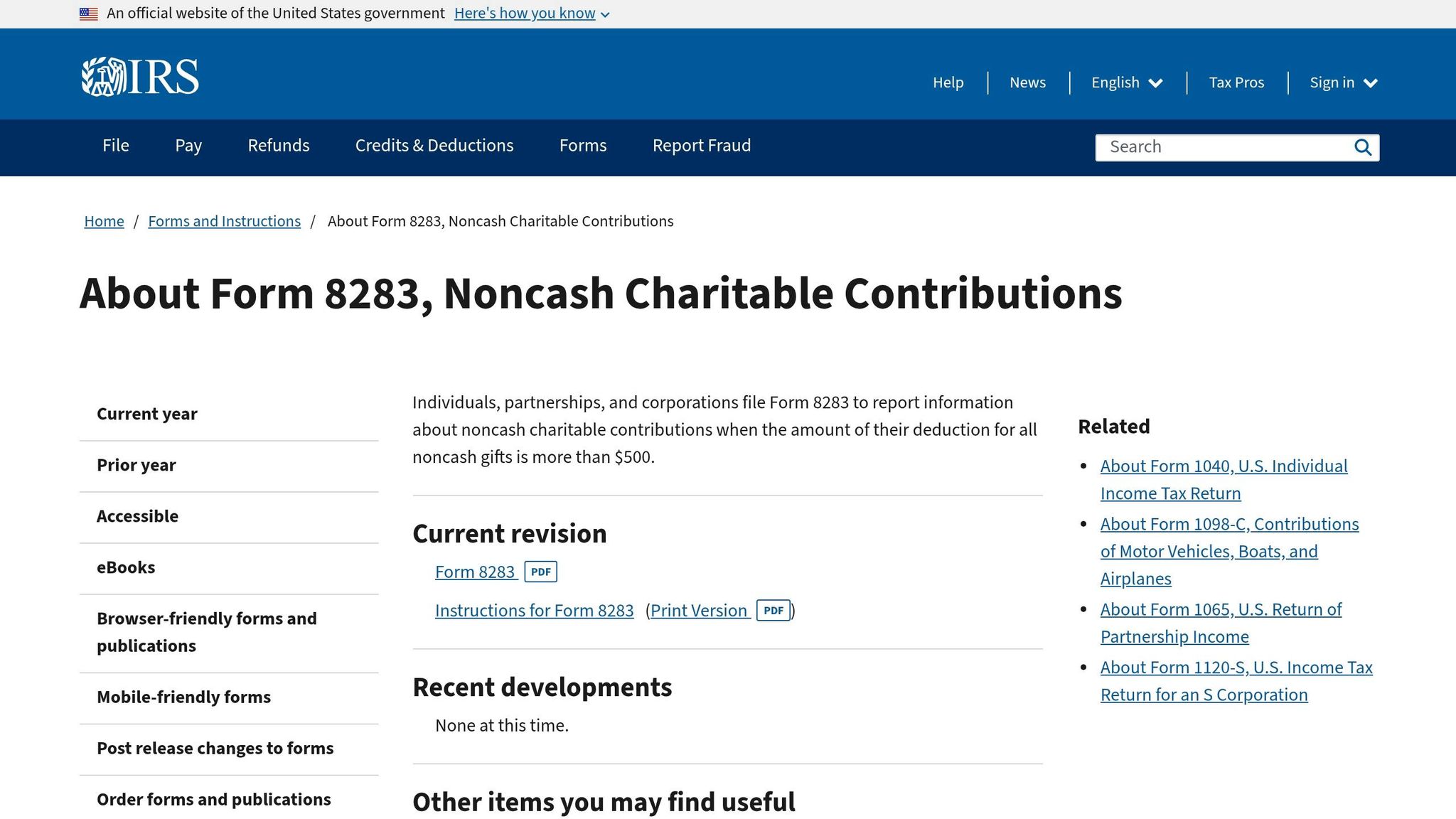
For noncash donations, total contributions over $500 require Form 8283. Section A covers items up to $5,000, and Section B is required for items over $5,000 [6][5][13].
For gifts over $5,000, you also need a qualified appraisal. It must be done no earlier than 60 days before the contribution date and received by the return due date [5][2].
If you get the value wrong, the cost can sting. Accuracy-related penalties for misstated values can reach 20% of underpaid tax, and 40% for gross valuation misstatements [2].
| Gift Type / Size | Basic Documentation | Extra Requirement |
|---|---|---|
| Cash < $250 | Bank record, credit card statement, or receipt | - |
| Cash $250+ | Contemporaneous Written Acknowledgment (CWA) | CWA must be received before filing the return |
| Noncash $500–$5,000 | Receipt + Form 8283 (Section A) | Must document cost basis, acquisition date, and FMV |
| Noncash > $5,000 | CWA + Form 8283 (Section B) | Qualified appraisal required (60-day window before gift date) |
Using Deductible.me to keep donation dates and values organized
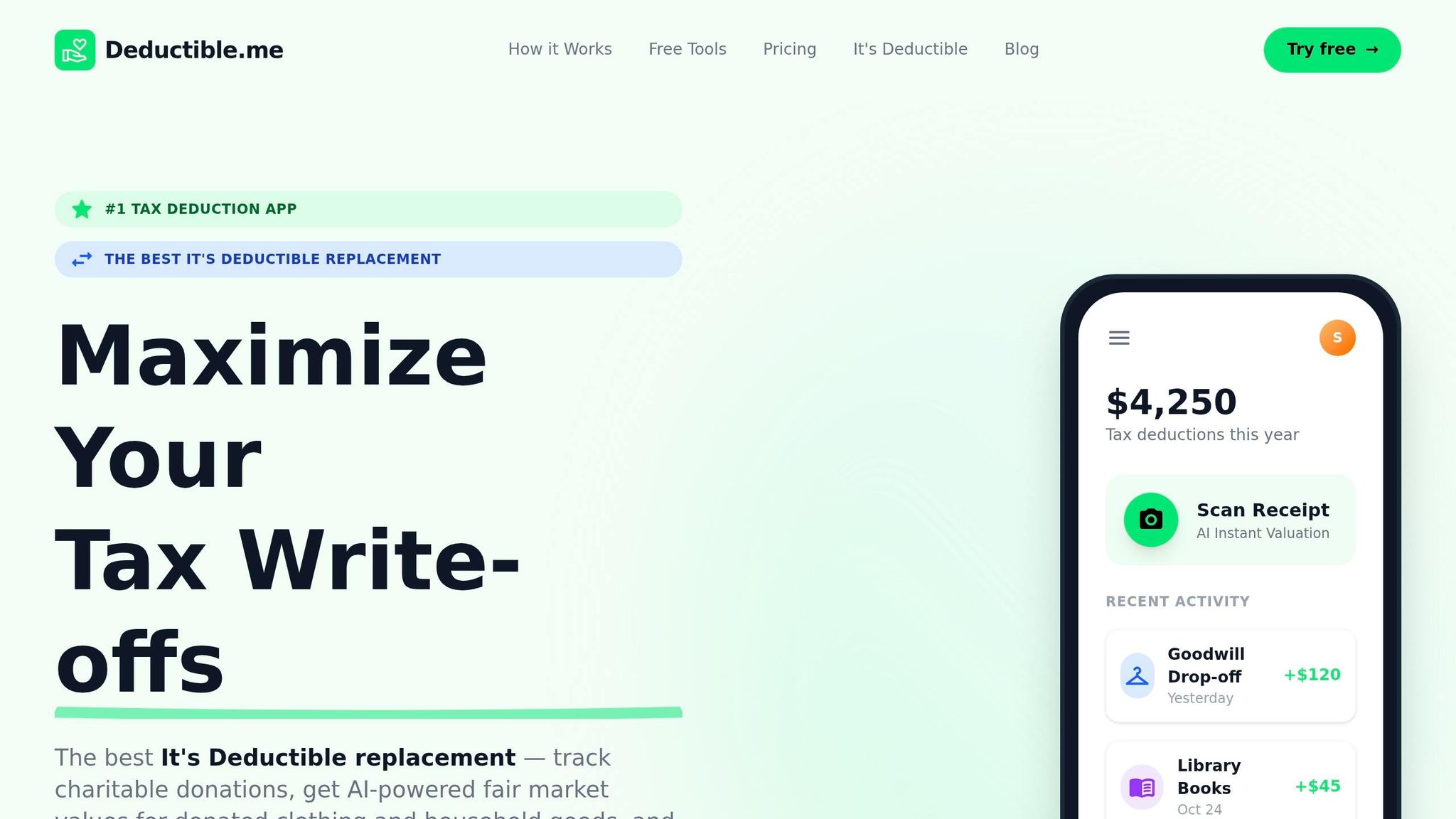
Year-end giving can fall apart fast when dates, values, and receipts live in three different places. Deductible.me helps timestamp donations, store receipts and photos, and generate Form 8283 reports.
The rules here are simple, but they don't leave much room for mistakes. When your dates and records are in order, it's much easier to think about timing moves that can improve the deduction itself.
Timing strategies to get more from your charitable deductions
Once you know the filing rules, the next step is simple: pick the right time to give.
That matters more than most people think. A donation can be generous either way, but the tax result can look very different depending on when you make it.
Bunching donations to clear the standard deduction threshold
About 90% of taxpayers take the standard deduction, so most charitable gifts don't lead to any tax break[14]. That's why timing matters. If your itemized deductions don't get past the standard deduction, your charitable write-off may not change your tax bill at all.
Bunching means putting two or three years of planned donations into one tax year so your itemized deductions go above the standard deduction[14][16][17]. In the years between, you take the standard deduction. Your total giving doesn't change. You just shift the schedule.
A donor-advised fund can make this much easier. A DAF lets you claim the deduction in the year you contribute, then send grants to charities over time[15][17]. That way, you can bunch for tax purposes without changing the pace of your support.
The new 2026 0.5% AGI floor also gives bunching more weight[18][12][9].
Accelerating or delaying gifts around income changes
A deduction saves more when your tax rate is higher.
So if you're having a high-income year - maybe from a business sale, a big bonus, RSU vesting, or a Roth conversion - that's often the time to move gifts forward. The deduction can offset income taxed at your top rate[17][19].
You can push this further by bunching three to five years of planned giving into that one year[14]. Same giving goal, better tax use.
On the flip side, it can make sense to wait if you expect to be in a higher bracket later, or if you want to use the new 2026 above-the-line cash deduction for non-itemizers[18][9].
Donating appreciated assets and planning across the calendar year
After you decide which year to give, the next call is what to give.
Donating appreciated securities straight to a charity or DAF is one of the best moves from a tax angle. If you sell appreciated stock and then donate the cash, you owe capital gains tax first. If you donate the stock itself, you avoid that tax and can still deduct the full fair market value, up to 30% of AGI. Any extra amount can carry forward for five years[14][15][16].
The catch is timing. Stock transfers have to be credited to the charity's account by December 31[3][17]. So waiting until December 30 is cutting it WAY too close. Mid-December is a safer target.
A simple yearly rhythm can help:
- Mid-year (June/July): Review income and realized gains to see if this should be a bunching year[19].
- By mid-December: Start stock transfers, finish any needed appraisals, and confirm QCD requests if you're age 70½ or older.
Deductible.me can help you track donation dates and values, so tax season doesn't turn into a scavenger hunt.
These timing moves can make an ordinary gift work harder on your return.
Conclusion: A clear framework for timing your charitable donations
You claim a charitable deduction when the gift is complete - not when you plan to give, and not when the charity later uses the money. That one rule shapes every year-end move, whether you're giving by check, credit card, stock transfer, or QCD [1][2].
The catch is that each payment method runs on its own clock. A card charge may post fast, while bank transfers, securities, and QCDs can take more time. Stock gifts are where people get tripped up most often, which is why it's smart to start those by mid-December so the shares settle in the charity's account before December 31 [4][3].
Documentation matters just as much as timing. If your gift is $250 or more, you need a contemporaneous written acknowledgment [7][2].
Why does all this matter? Because timing affects both whether you can take the deduction and how much that deduction is worth. The strongest tax outcome usually comes from matching timing with a plan: bunch donations so you get past the standard deduction, and place larger gifts in high-income years when the deduction offsets income taxed at your top rate [20][21].
The playbook is pretty simple: confirm the gift date, check the records, then line up the donation with your income and deduction plan. From there, choose the asset and tax year that give you the best result. Deductible.me can help you keep those dates, values, and records in one place.
FAQs
What if my donation misses the December 31 deadline?
If you miss the December 31 deadline, you usually can't claim that donation on the prior year's tax return. Charitable gifts don't work retroactively.
The IRS says the gift must be completed by December 31 to count for that tax year. Deductible.me can help you track your yearly giving goals and donation history, so you're not scrambling at the end of the year.
Should I donate cash or appreciated stock?
Often, stock that has gone up in value and has been held for more than 12 months can be more tax-efficient to donate than cash.
Here’s why: when you donate shares directly, you may deduct the full fair market value of the stock. You also skip capital gains tax on the growth in value. That can make a big difference if the shares have climbed a lot over time.
Cash is simpler. It’s easy, direct, and common. But it doesn’t come with that capital gains tax edge. For deduction limits, cash gifts are generally deductible up to 60% of AGI, while long-term appreciated assets are capped at 30%.
There’s one big catch. If you’ve held the security for less than 12 months, you can deduct only your original cost basis, not the current market value. In that case, cash may be the better move.
How do I know if bunching donations will help me?
Bunching donations can make sense if your total itemized deductions - including charitable gifts, mortgage interest, and medical expenses - usually come in below the standard deduction.
Here’s the basic idea: instead of spreading your planned donations across multiple years, you group two or more years of giving into a single tax year. That may let you itemize in that year, then take the standard deduction in the years in between.
For some people, that simple timing shift can lead to a better tax outcome without changing their overall giving plan. Deductible.me can help you track your annual goals and see whether this move could make a meaningful difference for you.