
Retirement and Giving: 7 Tax Moves for Donors
If I want to give more and pay less tax in retirement, I need to match each gift to my income, age, and asset type. In this article, the main moves are simple: give in the right year, use a QCD after age 70½, use stock instead of cash when gains are large, bunch gifts when I’m close to the standard deduction, and track carryforwards when a deduction is too large to use at once.
Here’s the short version:
- I may get more tax value from gifts made before retirement if I’m in a higher bracket
- After retirement, lowering AGI can matter more than getting a deduction
- QCDs can start at age 70½ and RMDs often start at 73
- Cash gifts usually need me to itemize to help on my tax return
- Appreciated stock can cut capital gains tax and still give a deduction if I itemize
- Bunching gifts into one year can push me over the standard deduction
- Unused deductions can carry forward for up to five years
- Year-end timing and proof of gift matter, especially for QCDs, stock gifts, and Form 8283
Quick Comparison
| Method | Main tax result | Itemizing needed? | Best fit |
|---|---|---|---|
| QCD from IRA | Lowers AGI | No | Age 70½+, IRA owners, RMD planning |
| Cash gift | Deduction | Usually yes | Donors already itemizing |
| Appreciated stock | Deduction + no capital gains tax on the gift | Yes | Donors with low-basis taxable investments |
| Bunched gifts | Bigger one-year deduction | Yes | Donors near the standard deduction |
| Carryforward | Uses excess deduction later | Yes, in future years too | Large cash or stock gifts |
If I’m retired or close to it, this article shows the seven tax moves that can make my giving work better on my return and with my income plan.
QCDs: The Tax-Smart Way to Give in Retirement (2025 Qualified Charitable Distributions Guide)
sbb-itb-e723420
How retirement changes the tax math of giving
Retirement changes when income shows up and how it gets taxed. Paychecks stop. In their place, you may have Social Security, pension income, and IRA withdrawals. That change is a big deal because the same gift can have a very different tax effect before retirement than it does after.
For many retirees, the main issue is simple: they no longer itemize. So a small cash gift may feel generous, but it might not lead to any tax break at all. In retirement, the bigger lever is often lowering AGI, not chasing a deduction.
Why does that matter? Because a lower AGI can help keep more of your Social Security benefits tax-free. Once combined income goes above $25,000 for single filers or $32,000 for married couples, up to 85% of those benefits can become taxable [8]. A lower AGI can also help you steer clear of Medicare IRMAA surcharges. Those surcharges are based on AGI from two years earlier, and they can add meaningful costs to your Part B and Part D premiums [1][3].
That creates a useful window: if you can cut taxable income before required withdrawals start, your gift may do more than support a cause you care about. It may also trim taxes and Medicare-related costs.
The right move depends on a few things:
- Whether you itemize
- What asset you're giving
- Your income level
- Whether reducing AGI is the main goal
Those details shape which method gives you the best tax result.
| Strategy | Effect on AGI | Requires Itemizing? | Best Situation |
|---|---|---|---|
| Cash gift (itemized) | No change | Yes | Retirees with enough deductions to itemize |
| Qualified Charitable Distributions (QCDs) from an IRA | Reduces AGI directly | No | Retirees age 70½+ managing RMDs or Medicare costs |
| Appreciated stock | No change | Yes (for deduction) | Donors with taxable brokerage accounts |
The next seven moves build on these differences, so you can time gifts with a bit more precision.
1. Time gifts for lower-income retirement years
If your income falls after your last paycheck, the next move is figuring out when to give.
There’s often a gap between your final wages and the start of Social Security or required minimum distributions (RMDs). That window can create a lower-tax year. And that changes the math.
A charitable deduction cuts your tax bill at your marginal rate. So a $1,000 donation saves about $240 in the 24% bracket and $320 in the 32% bracket[5]. Put simply, the same gift is worth less when you’re in a lower bracket.
That said, lower-income years can still be a smart time to itemize. If your total deductions are close to the standard deduction, one well-timed gift may push you over the line.
The flip side is easy to miss: that same dip in income can make pre-retirement gifts less tax-efficient. That’s why timing matters so much, and why giving before retirement deserves a closer look.
Once retirement income starts to settle, the picture shifts again. For donors age 70½ or older, a QCD may be the best route in lower-income years because it skips AGI. Cash gifts are generally limited to 60% of AGI. If your gift goes past that cap, you can usually carry the extra deduction forward for up to five years.
2. Make larger gifts before your retirement date
One smart move is to make bigger charitable gifts before you retire.
Your final working years are often your peak earning years. That matters because a tax deduction usually helps more when your tax rate is higher. Put simply: the same gift can save you more on taxes while you're still getting a paycheck than it will after that paycheck ends.
There’s another angle here too. While you’re still working, you may be more likely to itemize deductions, especially if you have mortgage interest and state and local taxes. In high-tax states, that can make itemizing much easier before retirement. Once you retire and some of those expenses drop, itemizing can get tougher. And when that happens, your charitable gifts may not give you any added tax break.
A common way to handle this is to front-load a larger gift into a donor-advised fund before retirement. You take the deduction now, then recommend grants to charities later.
After retirement, the timing question changes again as your income settles into a different pattern.
3. Shift some donations to after retirement when income levels off
Once you retire, income often becomes more predictable. That can make it easier to set a fixed giving plan and decide how much you want to donate each year.
It can also make QCDs easier to schedule. And timing matters here. If your IRA sends the money to you first, that amount counts toward your RMD and can't be treated as a QCD. To qualify, the IRA has to send the funds directly to the charity. If the money passes through your hands first, it no longer counts.
The admin side matters too. Keep your donation records in order so year-end gifts and QCDs are simple to track and document.
4. Donate appreciated stock and other long-term assets
If you have taxable brokerage assets in retirement, what you donate can matter just as much as when you donate it. A smart move is to give long-term appreciated stocks, mutual funds, or ETFs. When you do that, you can avoid capital gains tax and deduct the asset’s fair market value. The key is to transfer the shares straight to the charity. If you sell first, you trigger the gain and lose that tax edge.
There’s an important rule here: the asset must have been held for more than one year, and it must be worth more than you paid for it, to qualify for the fair market value deduction[4]. If you donate shares you held for less than a year, your deduction is limited to your cost basis[4]. Also, deductions for long-term appreciated assets are capped at 30% of your AGI, while cash donations can go up to 60%[5].
This approach can be especially helpful in the years before RMDs begin, or during periods when retirement income is still changing. In those years, keeping an eye on both AGI and capital gains can make a big difference.
There’s also a handy twist if you want to keep the same market exposure. Donate your most appreciated shares, then use the cash you would have donated to buy the same stock again. That gives you new shares with a higher cost basis, which can cut future tax exposure if those shares go up in value[2].
For gifts over $5,000, attach a qualified appraisal and Form 8283, Section B.
For IRA owners age 70½ or older, QCDs can reduce AGI even more directly.
5. Use qualified charitable distributions from an IRA
For retirees who keep most of their savings in an IRA, QCDs are often the cleanest tax move. If you're age 70½ or older, a qualified charitable distribution, or QCD, lets your IRA send money straight to a charity without adding that amount to your taxable income. And yes, you can do this even if you take the standard deduction.
The 2025 annual QCD limit is $108,000 per person[10]. If you're married and each spouse has a separate IRA, the combined total can go up to $216,000. One detail matters a lot here: the IRA has to send the money directly to the charity. If the money lands in your account first, it becomes taxable.
A QCD can also help beyond the charitable gift itself. Since it lowers AGI, it may reduce how much of your Social Security gets taxed and may help with Medicare-related premiums[10][1]. That can make QCDs especially useful in the years before RMDs start.
The timing rule is pretty simple, but easy to miss: do the QCD before any other IRA withdrawal for the year. If you take money out first, that earlier withdrawal may satisfy your RMD before the QCD does.
Once the timing is handled, the last piece is paperwork. Your custodian will send Form 1099-R, but you still need to report the QCD the right way on Form 1040 and keep the charity acknowledgment for gifts of $250 or more[2][5]. Also, QCDs can't go to donor-advised funds or private foundations[2].
6. Bunch multiple years of donations into one tax year
Bunching works when it pushes your itemized deductions above the standard deduction. For retirees, that can be especially useful in the window after wages end and before RMDs climb. In 2025, the standard deduction is $15,000 for single filers and $30,000 for married couples filing jointly[5].
Here’s the basic idea: instead of giving the same amount every year, you group multiple years of gifts into one tax year. That way, you may be able to itemize in that year and then take the standard deduction in the next.
Example: A couple that normally gives $20,000 a year can bunch $40,000 into one year, itemize that year, then take the standard deduction the next. This can turn several modest retirement gifts into one itemizing year.
The most common way to do this is with a donor-advised fund. A DAF lets you take the deduction in the high-giving year, then send grants to charities over time. In plain English, you separate the tax deduction from the timing of the charity’s receipt. Bunching can work with either cash or appreciated assets, and the tax rules for each are covered in the sections above. That’s why it makes sense to weigh it against IRA-based giving.
QCDs don’t work the same way. They can lower AGI and count toward RMDs, but they do not give you an itemized deduction. So the better move depends on your tax picture for that year: is it more helpful to lower AGI, or to claim a larger itemized deduction?
Tools like Deductible.me can help track bunched gifts and keep acknowledgment records organized.
7. Carry forward unused charitable deductions for up to five years
If a big gift or a bunched donation puts you over the yearly limit, the extra deduction doesn't vanish. It can carry forward for up to five years and help in later tax years. That can matter a lot before or during retirement, especially when income drops and a stock gift suddenly runs into the cap.
The yearly limits depend on the type of asset you give:
- Cash to a public charity is capped at 60% of AGI
- Long-term appreciated assets, like stock, are capped at 30% of AGI[5]
That 30% of AGI limit is often the one that trips people up in retirement. A large stock donation may go over the cap in a lower-income year, which leaves part of the deduction to carry into future years.
There's one catch: a carryforward only helps in years when you itemize on Schedule A. If you take the standard deduction, you can't use the carryforward for that year.
Starting in 2026, itemizers also have to deal with a new 0.5% AGI floor. That means the first 0.5% of AGI isn't deductible[2]. On a $200,000 AGI, that's $1,000 of donations that won't count[2].
QCDs work differently. They don't create carryforwards because they aren't claimed as a deduction. Instead, they're excluded from taxable income, so AGI limits don't apply[7][2]. In plain English, a carryforward is more of a fallback than the main reason to make the gift.
The recordkeeping matters most with noncash gifts that may carry forward. For noncash gifts over $500, keep Form 8283 and any required appraisals for the full carryforward period. Keep the appraisal and Form 8283 with your tax records through the full carryforward period.
Cash vs. appreciated assets: key tax tradeoffs
In retirement, the big choice is often cash vs. appreciated assets. That choice can matter even more when income falls and itemizing is less of a sure thing.
Appreciated assets can do two things cash simply can't:
- Avoid capital gains tax
- Preserve the deduction for the asset's full fair market value
At the same time, AGI puts limits on both. Cash gifts are generally capped at 60% of AGI, while long-term appreciated assets are capped at 30%[5].
| Feature | Cash Donations | Appreciated Long-Term Assets |
|---|---|---|
| Capital gains tax | Not applicable | Avoided on the appreciation |
| Deduction amount | Face value of cash given | Fair market value (FMV) |
| AGI deduction limit | Up to 60% of AGI [5] | Up to 30% of AGI [5] |
| Holding requirement | None | Must be held more than one year |
| 2026 cash-gift deduction for non-itemizers | Up to $1,000 (single) / $2,000 (married filing jointly) for direct cash gifts to a charity [2] | Does not apply [2] |
| Documentation | Bank record or receipt | Receipt or acknowledgment; Form 8283 and appraisal rules for larger gifts |
There’s one detail in 2026 that can tilt the math. If you take the standard deduction, you may still deduct up to $1,000 if you're single or $2,000 if you're married filing jointly for direct cash gifts to a charity[2]. That tax break does not apply to appreciated assets or gifts to donor-advised funds[2].
That means cash can win for smaller gifts, especially for non-itemizers.
A simple way to think about it:
- Use cash for smaller gifts
- Use appreciated assets for larger gifts with meaningful gains
- Start with your lowest-basis shares first
For IRA owners, QCDs add a third path. They can reduce AGI without relying on an itemized deduction.
QCDs vs. cash gifts vs. appreciated securities: a side-by-side look
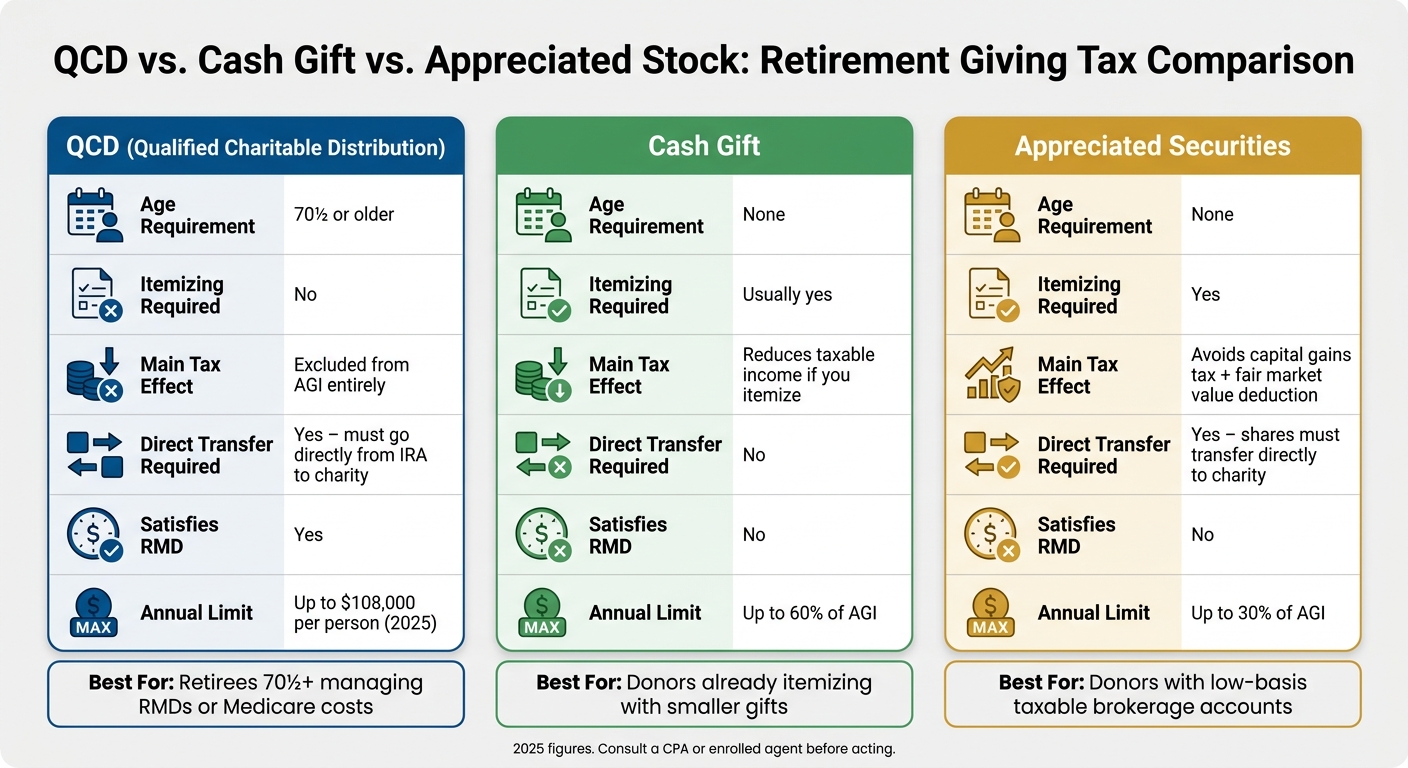
QCD vs. Cash Gift vs. Appreciated Stock: Retirement Giving Tax Comparison
Use this quick comparison to pick the most tax-efficient way to give during retirement. Timing matters. So does the asset you donate. This table helps you match each method to your tax goal.
| Feature | QCD | Cash Gift | Appreciated Securities |
|---|---|---|---|
| Age Requirement | 70½ or older [10] | None | None |
| Itemizing? | No - excluded from AGI | Usually yes | Yes |
| Main Tax Effect | Excluded from AGI | Reduces taxable income if you itemize | Avoids capital gains tax and can provide a fair market value deduction when you itemize [6] |
| Must Transfer Directly | Must go directly from a traditional IRA to charity | Not required | Shares must transfer directly to charity |
| Satisfies RMD? | Yes | No | No |
| Limit | Up to $108,000 per person in 2025 [10] | Generally up to 60% of AGI [5] | Generally up to 30% of AGI [5] |
QCDs are often the cleanest option if your goal is to lower AGI, since the distribution never gets included in taxable income. That can make a big difference if you're trying to keep more of your income off the return.
There’s one timing rule here that trips people up: for QCDs, the first IRA dollars that come out during the year count toward your RMD. So if you want the gift to satisfy part or all of that RMD, make the QCD before taking any other IRA withdrawal.
Next up: year-end deadlines and proof-of-gift rules before you finish the transfer.
Year-end timing and documentation reminders
Once you know what to give and when to give it, the last piece is timing the transfer so it lands in the right tax year.
December 31 is the cutoff. A gift counts for the current tax year only if the transfer is complete by then [7][11]. That matters a lot for QCDs and stock gifts, since those can take time to process. If you're planning either one, give yourself breathing room so the transfer clears by Dec. 31.
You’ll also want your CPA to review how QCDs show up on Form 1099-R. The form may not clearly separate a taxable IRA distribution from a tax-free charitable transfer [2]. And timing matters with IRA withdrawals for another reason: a missed RMD can lead to a 25% IRS penalty on the amount not withdrawn [12]. That’s a steep hit, so waiting until the final week of December is a gamble.
Then make sure your records match the size and type of gift:
| Gift size | Required Documentation |
|---|---|
| Under $250 | Bank record, credit card statement, or receipt from the charity [5] |
| $250 – $500 | Written acknowledgment from the charity [5] |
| Over $500 (non-cash) | Written acknowledgment and Form 8283, Section A [5] |
| Over $5,000 (non-cash) | Qualified appraisal and Form 8283, Section B [5] |
Late-December giving can still work, but the paper trail matters more when you're close to the deadline. Deductible.me can store receipts, track noncash gifts, and generate Form 8283 reports.
Conclusion
In retirement, the best giving move is the one that fits that tax year, not just the cause you care about. Giving tends to work better when you line up the gift with your income, tax bracket, and the kind of asset you're giving. The hard part is picking the right move for that specific year.
When a gift gets more complicated, timing and reporting matter just as much as generosity. If you're lining up a QCD with an RMD or donating a concentrated stock position, talk with a qualified U.S. tax professional - such as a CPA or enrolled agent - before you act. Taking an RMD before processing a QCD can wipe out the tax break on those funds[9]. Deductible.me can help you track annual giving goals and generate IRS-compliant reports for noncash gifts.
In retirement, the right gift at the right time can cut taxes while also supporting the charities you value.
FAQs
Should I give before or after I retire?
It depends on your age and your tax bracket.
If you give before retirement, while you're still in a higher tax bracket, the tax break is often bigger. Why? Because each deduction offsets income that's taxed at a higher rate.
After retirement, things can shift. A lower-tax window before required distributions start may open the door to other tax-smart moves.
Once you reach age 70½, Qualified Charitable Distributions from an IRA can count toward RMD rules and keep the gift out of your taxable income.
When is a QCD better than a regular donation?
A Qualified Charitable Distribution is often the better move because the money goes straight from your IRA to the charity without being counted as taxable income.
That matters a lot if you take the standard deduction, since you may not get much tax help from a normal charitable write-off.
If you're 73 or older, a QCD can also count toward your required minimum distribution without adding to your tax bill. And that can have a ripple effect: it may help lower taxes on your Social Security benefits and cut your Medicare Part B premium.
How do I choose between cash and appreciated stock?
It comes down to your tax goals and how the market is doing right now.
If you donate stock that has gone up in value and you’ve held it for more than one year, that move is often more tax-efficient than giving cash. Why? You may avoid capital gains tax and still claim a deduction based on the asset’s full market value.
Cash, of course, is simpler. It’s the standard way many people give to charity, and it gets the job done. But it doesn’t give you that same capital gains tax edge.