
Temporary Charitable Limits: What Changed?
Charitable tax rules changed significantly in 2026. Here’s what you need to know:
-
For non-itemizers:
- New above-the-line deduction for cash donations.
- Deduct up to $1,000 (individuals) or $2,000 (married filing jointly).
- Applies only to cash gifts to qualified public charities (excludes donor-advised funds, private foundations).
-
For itemizers:
- A 0.5% AGI floor now applies.
- Only donations exceeding 0.5% of your Adjusted Gross Income (AGI) are deductible.
- Example: With a $200,000 AGI, the first $1,000 of donations isn’t deductible.
-
Other updates:
- High-income taxpayers in the 37% bracket face a deduction cap of 35%.
- Qualified Charitable Distributions (QCDs) from IRAs bypass the 0.5% floor and have a 2026 limit of $111,000.
Key takeaway: Non-itemizers now have a direct tax benefit for charitable giving, while itemizers face stricter limits. To maximize benefits, consider bunching donations or exploring options like QCDs.
If you donate to charity, the 2026 tax rules just changed your deduction.
What Changed in the Charitable Deduction Rules
The One Big Beautiful Bill Act (OBBBA), signed into law in mid-2025, introduced updates to charitable deduction rules starting with the 2026 tax year. These updates include new opportunities and limitations for taxpayers, impacting both those who take the standard deduction and those who itemize.
New Above-the-Line Deduction for Non-Itemizers
Taxpayers opting for the standard deduction can now reduce their taxable income through charitable contributions. For single filers, up to $1,000 in cash donations can be deducted, while married couples filing jointly can deduct up to $2,000 [7].
However, this deduction is limited to cash donations made to qualified public charities. Eligible contributions include gifts made via checks, credit cards, ACH transfers, or payroll deductions. Contributions to donor-advised funds, private foundations, or supporting organizations are excluded [1].
Jon Bergdoll and Patrick Rooney from Indiana University explain:
"The new rule will allow people who file on their own to shave up to $1,000 off their taxable income, or $2,000 for married couples who file jointly. Those amounts will not be adjusted for future inflation." [4]
Next, let’s look at how these changes affect taxpayers who itemize their deductions.
The New 0.5% AGI Floor for Itemizers
For taxpayers who itemize, a new restriction applies: only the portion of charitable donations exceeding 0.5% of Adjusted Gross Income (AGI) is deductible. The chart below illustrates how this floor works for various AGI levels:
| Taxpayer AGI | 0.5% Floor (Non-Deductible Portion) |
|---|---|
| $100,000 | $500 |
| $250,000 | $1,250 |
| $500,000 | $2,500 |
| $1,000,000 | $5,000 |
Additionally, taxpayers in the 37% tax bracket now face a cap on the deduction benefit, limited to 35%. For example, under the new rules, a $10,000 donation would save $3,500 in taxes instead of $3,700, as it would have under the 2025 rules [8].
Temporary vs. Permanent Changes
Some of these provisions are here to stay, while others are temporary. For instance, the above-the-line deduction for non-itemizers and the 60% AGI limit for cash contributions to public charities are now permanent under the OBBBA [8]. Previously, the 60% AGI limit had been a temporary measure.
On the other hand, the increased SALT deduction cap, which rises to $40,400 in 2026, is temporary and will revert to $10,000 in 2030 [8]. This temporary increase could significantly impact taxpayers, as a higher SALT deduction cap may lead more people to itemize, making the 0.5% AGI floor applicable to their charitable donations. Understanding which provisions are permanent versus temporary is essential for planning your charitable giving effectively.
Who Qualifies Under the New Rules
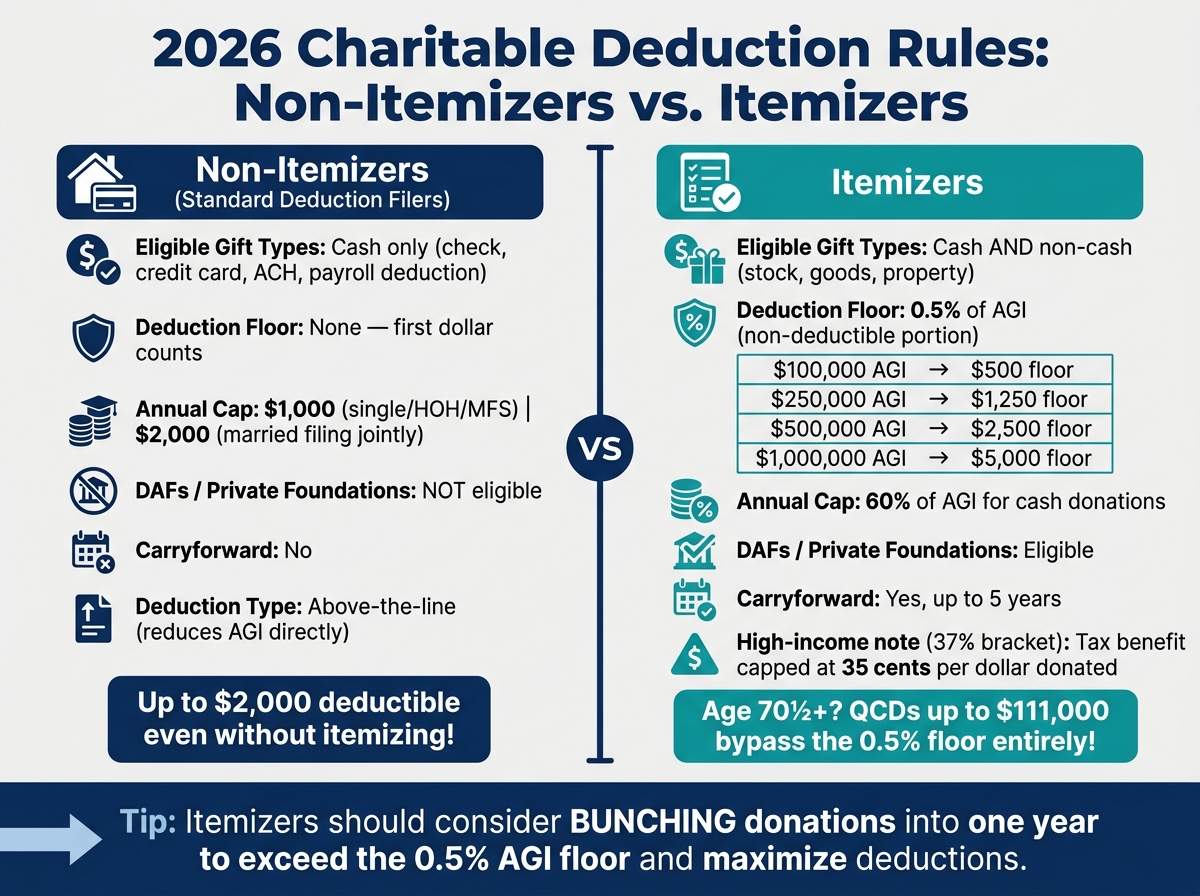
2026 Charitable Deduction Rules: Non-Itemizers vs. Itemizers
Eligibility for Non-Itemizers
The updated rules bring a notable change for taxpayers who typically rely on the standard deduction. Unlike itemized deductions, the new above-the-line deduction directly reduces Adjusted Gross Income (AGI), making it more impactful for a broader group of taxpayers [10]. Under these provisions, single filers, heads of household, and married individuals filing separately can deduct up to $1,000 in cash donations. For married couples filing jointly, the deduction increases to $2,000 [9]. This adjustment, introduced as part of the OBBBA's temporary measures, aims to provide meaningful tax relief for individuals who no longer itemize their deductions.
"This change opens the door for millions of Americans to deduct up to $1,000–$2,000 of giving annually, even if they don't itemize." - Megan Lencoski, Carnegie Investment Counsel [7]
Next, let’s look at how these changes impact taxpayers who itemize their deductions.
How the Rules Affect Itemizers
For those who itemize, the introduction of a 0.5% AGI floor changes how charitable contributions are deducted. Only donations exceeding this threshold qualify for deduction. For example, a donor with an AGI of $500,000 who gives $20,000 would only be able to deduct $17,500, as the first $2,500 (0.5% of AGI) is excluded [3]. To maximize deductions, taxpayers may need to consolidate smaller donations into a single year to surpass the threshold.
High-income donors in the 37% tax bracket face an additional limitation. The tax benefit per charitable dollar is now capped at 35 cents, instead of the previous 37 cents under the 2025 rules [5]. John J. Moller, CPA at Capaldi Reynolds & Pelosi, explains:
"The new 0.5% AGI floor means small annual gifts may not be deductible unless you bunch contributions into a single year." [2]
For donors aged 70½ or older, there’s a strategic option: Qualified Charitable Distributions (QCDs) from an IRA. These distributions are excluded from gross income, bypass the 0.5% floor, and have an annual limit of $111,000 starting in 2026 [1].
Why These Rules Focus on Cash Donations
The focus on cash donations simplifies tax benefits for non-itemizers, making it easier for everyday donors to participate. For tax purposes, "cash" includes gifts made via check, credit or debit card, ACH transfer, online payment, or payroll deduction [12].
Non-cash contributions, such as donated goods, stock, or property, and gifts to donor-advised funds (DAFs) or private foundations, don’t qualify for the above-the-line deduction [1]. However, itemizers can still deduct these types of donations, though they remain subject to the 0.5% AGI floor [7]. This distinction highlights the varying eligibility criteria between non-itemizers and itemizers, as shown below:
| Feature | Non-Itemizers | Itemizers |
|---|---|---|
| Eligible gift types | Cash only | Cash and non-cash (e.g., stock, goods) |
| Deduction floor | None - first dollar counts | 0.5% of AGI |
| Annual cap | $1,000 ($2,000 joint) | 60% of AGI for cash |
| DAFs/Private Foundations | Not eligible | Eligible |
| Carryforward | No | Yes, up to 5 years |
sbb-itb-e723420
How the New Limits Affect Your Giving Strategy
These tips can help you adjust your charitable giving approach to align with the recent changes in contribution limits.
Timing Your Contributions for Tax Efficiency
When it comes to donations, timing now plays a bigger role. With the 0.5% AGI floor for itemizers, spreading out smaller donations throughout the year may not yield any tax benefits. Instead, consider grouping multiple years' worth of donations into a single year to surpass the 0.5% AGI threshold. In alternate years, you can then take the standard deduction [8][14]. Tools like a Donor-Advised Fund (DAF) can make this strategy easier by allowing you to consolidate your contributions and claim a larger immediate deduction [11][13].
If you're 70½ or older, you might want to explore Qualified Charitable Distributions (QCDs) from your IRA. These transfers - up to $115,000 - go directly to a qualified charity and bypass the 0.5% floor altogether [13].
"Under the new 0.5% AGI floor, bunching charitable deductions can become a more effective strategy." - Mercer Advisors [13]
Once you've planned your donation timing, keeping a close eye on your contributions throughout the year is key.
Tracking and Managing Your Donations
Given the 0.5% AGI floor, tracking your donations as the year progresses is critical - not just waiting until tax season. For example, if your AGI is $120,000, only donations exceeding $600 will be deductible. Staying aware of your totals ensures you know when you've crossed that threshold.
Tools like Deductible.me simplify this process. Its annual giving goal tracker provides real-time updates on your donations, ensuring you stay on top of your contributions. For non-cash gifts, the app offers AI-powered valuation and IRS-compliant reporting, including preparation for Form 8283, which helps you meet the stricter documentation requirements.
Carryforward Rules for Itemizers
Understanding carryforward rules can further refine your tax strategy. If your cash donations to public charities exceed 60% of your AGI in one year, the excess isn’t wasted - it can be carried forward and applied to your taxes for up to five years [8][14]. Additionally, any amount disallowed by the 0.5% AGI floor in the year of the donation is added to your carryforward total, ensuring you’re not penalized for the same contribution across multiple years [3].
What Records Donors Need to Keep
Keeping accurate records is crucial if you want to claim tax deductions for your donations. The IRS has specific guidelines, and the requirements have become stricter in recent years.
Required Records for Cash Gifts
When making cash donations, you’ll need either a bank record (like statements, canceled checks, or credit card records) or a written acknowledgment from the charity. For donations of $250 or more, the rules are even stricter: you must have a contemporaneous written acknowledgment (CWA) from the charity before filing your return [16][17].
"Under a new recordkeeping rule... the donor must obtain and keep a bank record or a written communication from the donee as a record of the contribution. Donor-prepared records like check registers are insufficient." - Internal Revenue Service [16]
For single donations of $250 or more, a bank record alone isn’t enough. The CWA should confirm the donation amount and state whether you received any goods or services in return. "Contemporaneous" means you need this acknowledgment before filing your tax return, so don’t wait - request it promptly.
If your donation was over $75 and you received something in return (like a gala ticket or a tote bag), the charity must provide a written disclosure estimating the value of the benefit you received. In this case, you can only deduct the portion of your donation that exceeds the value of that benefit [16].
Non-cash donations come with their own, equally specific documentation requirements.
Reporting Non-Cash Donations
Non-cash gifts must also meet IRS documentation standards. Here's what you need to know based on the value of your donation:
| Donation Value | Required Documentation | IRS Form |
|---|---|---|
| Under $250 | Receipt with charity name, address, date, and item description | None |
| $250–$500 | Contemporaneous Written Acknowledgment (CWA) | None |
| Over $500–$5,000 | CWA + records of cost basis and acquisition date | Form 8283, Section A |
| Over $5,000 | CWA + qualified appraisal by a qualified appraiser | Form 8283, Section B |
| Over $500,000 | CWA + qualified appraisal attached to the return | Form 8283, Section B |
The IRS also requires you to group similar items when calculating totals. For instance, if you donated several pieces of furniture to different charities throughout the year, you’d need to combine their values. Additionally, clothing and household goods must be in "good used condition or better" to qualify. Items in poor condition valued over $500 require a qualified appraisal regardless [16][18].
Tools That Make Recordkeeping Easier
Staying organized can be a challenge, but digital tools can help. Platforms like Deductible.me offer features like advanced receipt management and AI-powered valuation to streamline the process. Their IRS-compliant reports make preparing Form 8283 much easier, especially for non-cash donations. For just $2/month (Premium plan), you can store and organize all your donation records digitally, ensuring you have everything ready if the IRS comes calling.
Conclusion: Getting the Most Out of Temporary Charitable Limits
The temporary changes to charitable giving limits are reshaping how taxpayers approach donations. Starting in 2026, nearly 90% of standard deduction filers will be able to reduce taxable income by up to $1,000 for individuals or $2,000 for joint filers through cash donations to qualified charities [10][4]. For itemizers, donations must surpass a 0.5% AGI threshold, and those in the 37% tax bracket will now see a maximum tax benefit capped at 35% [11][6].
To navigate these changes effectively, planning becomes essential. For instance, grouping donations together to exceed the AGI floor can help maximize tax benefits. Additionally, exploring alternative giving methods can provide further advantages. Donors aged 70½ or older may benefit from Qualified Charitable Distributions (QCDs), which allow up to $111,000 per individual in 2026 to bypass both the AGI floor and the 35% cap, while also excluding the amount from gross income [2][1].
"Smaller gifts may no longer produce incremental tax benefit for itemizers... gift timing, aggregation strategies, and tax efficient vehicles such as Qualified Charitable Distributions (QCDs) are likely to play a larger role in thoughtful philanthropy planning." - Bruce Keeler, RI Foundation [1]
Keep in mind that contributions to Donor-Advised Funds (DAFs) do not qualify for the non-itemizer deduction. To meet the requirements, donations must be in cash and sent directly to a qualifying 501(c)(3) public charity [15].
Finally, staying organized is key to ensuring compliance. Tools like Deductible.me can help you track both cash and non-cash donations, generate IRS-compliant reports, and keep your records audit-ready, making tax season far less stressful.
FAQs
Do my donations qualify as “cash” for the $1,000/$2,000 deduction?
Yes, donations made through methods like checks, electronic transfers, online payments, credit or debit cards, payroll deductions, or gift cards that can be redeemed for cash qualify as "cash" contributions. These methods align with IRS guidelines for cash donations under the temporary charitable limits for the $1,000/$2,000 deduction in 2026.
How do I calculate the 0.5% AGI floor on my charitable deductions?
To figure out the 0.5% AGI floor, take your adjusted gross income (AGI) and multiply it by 0.005. For instance, if your AGI is $100,000, the floor comes out to $500. Only the portion of your contributions that goes beyond this amount can be deducted. To determine the deductible amount, subtract the floor from your total donations. This rule applies exclusively to taxpayers who itemize deductions - those who take the standard deduction aren't affected.
When should I use a QCD instead of a regular donation?
If you’re 70½ or older, a Qualified Charitable Distribution (QCD) can be a smart move to satisfy your Required Minimum Distribution (RMD), reduce your taxable income, and avoid increasing your Adjusted Gross Income (AGI). This approach is particularly useful if you take the standard deduction and aren’t able to itemize your deductions.
A QCD lets you donate directly from your IRA to a qualified charity. The best part? It offers tax advantages you won’t get with regular charitable contributions.