Itemized Charitable Deductions: IRS Rules
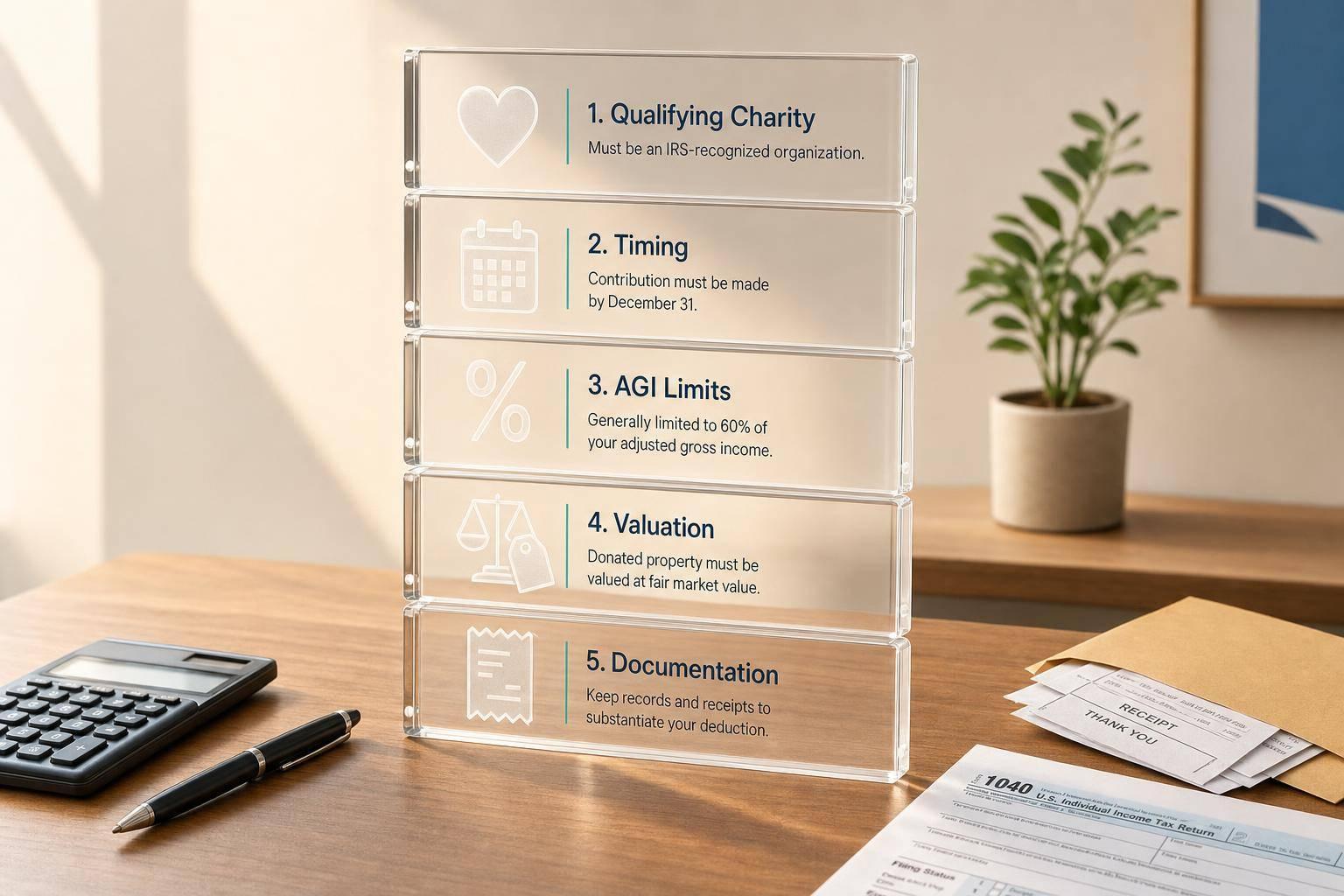
If I want a charitable tax deduction, four things must line up: I must itemize on Schedule A, give to an IRS-qualified organization, follow the right tax-year and value rules, and keep the right proof. Miss just one of those, and the deduction can be denied.
Here’s the short version in plain English:
- I can deduct charitable gifts only if I itemize
- Gifts to people, political groups, or many crowdfunding campaigns do not count
- Cash and property can both qualify, but property needs more records
- If I get something back, I deduct only the part above that value
- Cash gifts to public charities are often limited to 60% of AGI
- Extra amounts can usually carry forward for up to 5 years
- A check mailed by 12/31 counts for that tax year
- For gifts of $250 or more, I need a written acknowledgment from the charity
- For noncash gifts over $500, I usually need Form 8283
- For a single item or similar items over $5,000, I usually need an appraisal
A few dollar thresholds drive most of the rules: $250, $500, $5,000, and $500,000. And one of the biggest mistakes is simple: people claim a donation but do not have the IRS-required receipt language to back it up.
| Rule area | What I need to know |
|---|---|
| Itemizing | No Schedule A, no charitable deduction |
| Recipient | Must be an IRS-qualified organization |
| Timing | Donation counts in the year I give up control |
| Value | Noncash gifts use fair market value, not original cost |
| Proof | Records get stricter at $250+, $500+, and $5,000+ |
If I check the charity, track the date, use a supportable value, and keep the right records, I put myself in a much better position when I file.
Qualified charities and eligible donations
Organizations that qualify and recipients that do not
The IRS lets you deduct gifts only when they go to a qualified organization under section 170(c).[2][3] That group includes churches, schools, hospitals, medical research groups, organizations that protect children or animals, veterans' groups, and certain U.S. government units when the gift is for a public purpose.[2][3]
Here’s the part that trips people up: tax-exempt status alone doesn’t mean your gift is deductible. Gifts to labor unions, trade associations, social clubs, political organizations, lobbying groups, and chambers of commerce don't count.[10][12] The same goes for gifts made straight to individuals, including crowdfunding campaigns that send money right to a person.[1][10]
Cash, property, and quid pro quo contributions
Once the recipient passes the test, the next step is the kind of gift you made.
Cash gifts and noncash property gifts can both be deducted, but noncash gifts usually bring more paperwork. You need to figure out the value and keep better records.[2]
One rule that surprises a lot of donors is the quid pro quo rule. If you get something of value in return for your payment, you can deduct only the amount that goes beyond the fair market value (FMV) of what you received.[2][9] Say you pay $200 for a charity gala ticket and the dinner and entertainment are worth $80. Your deduction is $120.
For quid pro quo contributions over $75, the charity must give you a written disclosure that includes a good-faith estimate of the value of the goods or services you got back.[9] Small token items under IRS insubstantial-benefit thresholds don’t cut down your deduction.[9]
How to verify a charity's status before claiming a deduction
Before you give - and for sure before you file - check the IRS Tax Exempt Organization Search (TEOS) tool at IRS.gov. You can look up the organization by its legal name or Employer Identification Number (EIN) to see whether the IRS lists it as a public charity, private foundation, or another qualifying organization. You can also check if its tax-exempt status has been revoked.[8]
It’s smart to save a screenshot or printout of the TEOS result with your tax records.
After you confirm the charity, the next test is how much of the gift the IRS lets you deduct.
sbb-itb-e723420
AGI limits, timing rules, and valuation basics
AGI percentage limits and the five-year carryover rule
Your charitable deduction doesn’t just depend on what you gave. It also depends on your adjusted gross income (AGI), the kind of property you donated, and the type of organization that received it. Cash gifts to public charities are usually capped at 60% of AGI. Other gifts can fall under 50%, 30%, or 20% limits.[2]
Here’s the quick version.[2][6]
| Gift Type | Public Charity | Private foundations and other lower-limit recipients |
|---|---|---|
| Cash | 60% of AGI | 30% of AGI |
| Ordinary-income property | 50% of AGI | 30% of AGI |
| Long-term appreciated assets (e.g., stock) | 30% of AGI | 20% of AGI |
If your donations go over the limit, the extra amount usually isn’t gone for good. You can carry it forward for up to five tax years and use it against that same limit type in later years.[2][6]
Say your AGI is $100,000 and you donate $75,000 in cash to a public charity. In most cases, you can deduct $60,000 this year and carry the remaining $15,000 into a future year.
Those limits matter only if you can back up the gift with records.
Which tax year your donation belongs to
Once you know the limit, the next issue is timing. The IRS puts the deduction in the year you gave up control of the money or property.
- A check counts when it’s mailed or postmarked by December 31, even if the charity cashes it in January
- A credit card or online gift counts when the charge posts
- A payroll deduction counts in the year the wages are withheld
- A property donation counts when the item is physically delivered or when title legally transfers
It sounds simple, but this is where people slip up. A gift promised in December isn’t the same as a gift completed in December.
How the IRS values noncash property donations
For noncash donations, the IRS usually looks at fair market value (FMV). That means the price a willing buyer would pay a willing seller.[2][5][11] In plain English, it’s usually the item’s resale value, not what you paid for it.
That’s why used household goods are generally valued at thrift-store or resale prices.[5][11][3] If you bought a coat for $200, but it would sell for $25 at a consignment shop, your deduction is $25 - not the original purchase price.
Deductible.me can organize donation records and generate IRS-ready valuation reports for noncash gifts.
Valuation only helps if your records support the number.
Cash Donations: Navigating Itemizing and New Deduction Thresholds
Receipts, Form 8283, appraisals, and recordkeeping
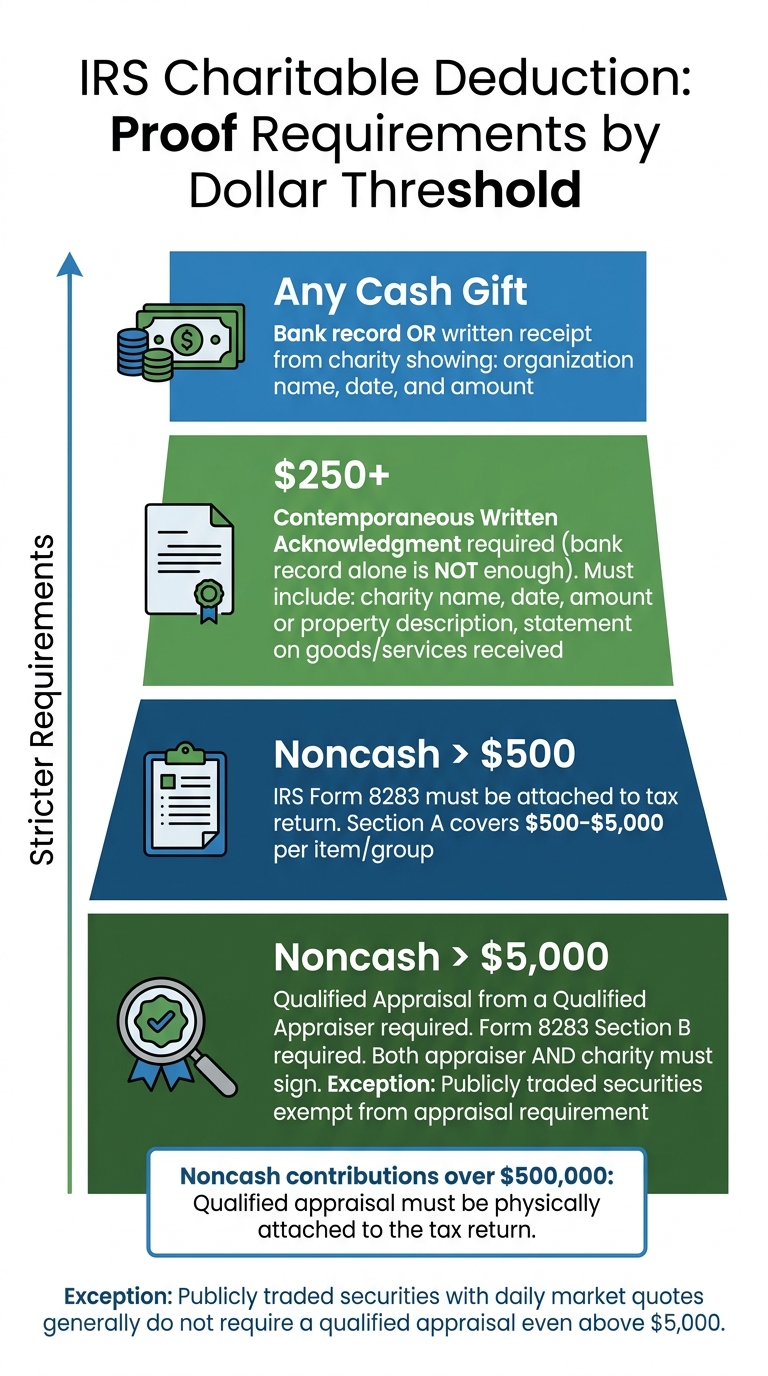
IRS Charitable Deduction Thresholds & Proof Requirements
Proof required for cash gifts and donations of $250 or more
Once you've figured out the value of a gift, the next job is proving it. That's the part many people miss. If your records aren't in order, the IRS can deny the deduction. And the rules get stricter as the gift amount goes up.
For any cash gift, keep either a bank record or a written message from the charity that shows the organization's name, the date, and the amount given.[2][23] But when one gift hits $250 or more, a bank record by itself isn't enough. You also need a contemporaneous written acknowledgment from the charity by the earlier of your filing date or the return's due date, including extensions.[2][22][23]
That acknowledgment needs to include:
- the charity's name
- the date
- the cash amount given, or a description of donated property
- a statement saying whether you received any goods or services in return
If you did get something back, the acknowledgment should describe it and give an estimated value. If the only thing you received was an intangible religious benefit, the acknowledgment must say that.[4][16][1][17][19]
This part matters more than people think. A letter that leaves out the goods-and-services statement does not meet the rule. So even if the donation was real, a missing or incomplete receipt can wipe out the deduction.
Here are the main thresholds:
- $250 or more: contemporaneous written acknowledgment required
- Total noncash deductions over $500: Form 8283 required
- Single noncash item or group of similar items over $5,000: qualified appraisal and Form 8283, Section B required
- Noncash contributions over $500,000: qualified appraisal must be attached to the return
When Form 8283 and a qualified appraisal are required
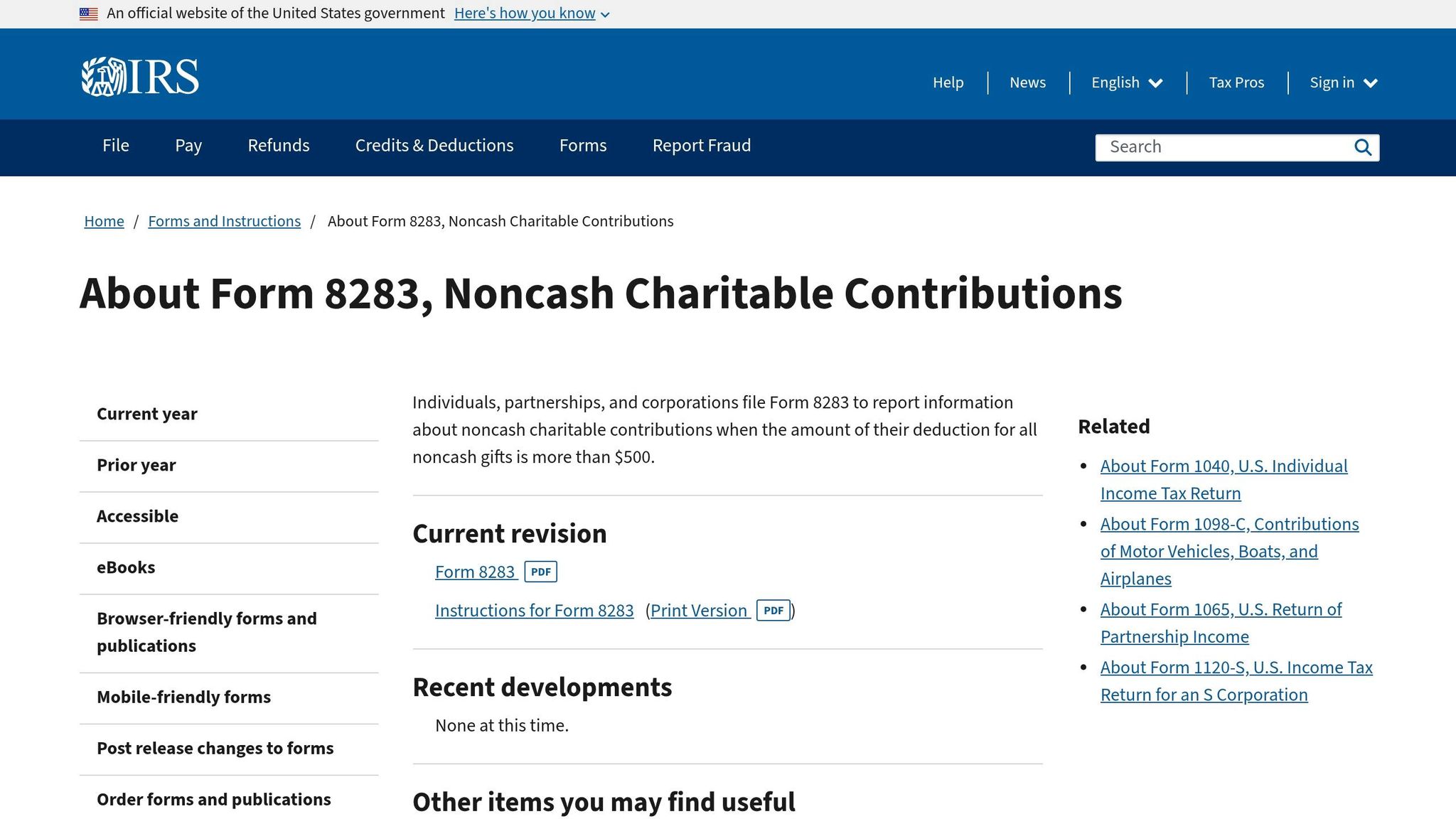
Bigger noncash gifts come with extra filing rules. If your total noncash deductions for the year are more than $500, you must attach Form 8283 to your return.[2][15][18]
Section A covers most noncash donations when the deduction for one item, or a group of similar items, is more than $500 but not more than $5,000. Section B kicks in when a single item or group of similar items goes over $5,000. At that point, you usually need a qualified appraisal from a qualified appraiser, and both the appraiser and the charity have to sign the form.[2][14][16][18]
There is one big exception. Publicly traded securities usually don't need a qualified appraisal or Section B, even when the deduction is above $5,000, as long as they meet the daily-quotation rules.[7][20]
For other high-dollar property, this is where people can get tripped up. If the appraisal is missing, or Form 8283 is filled out the wrong way, the IRS can disallow the deduction.[24][25]
Using Deductible.me to organize donation records
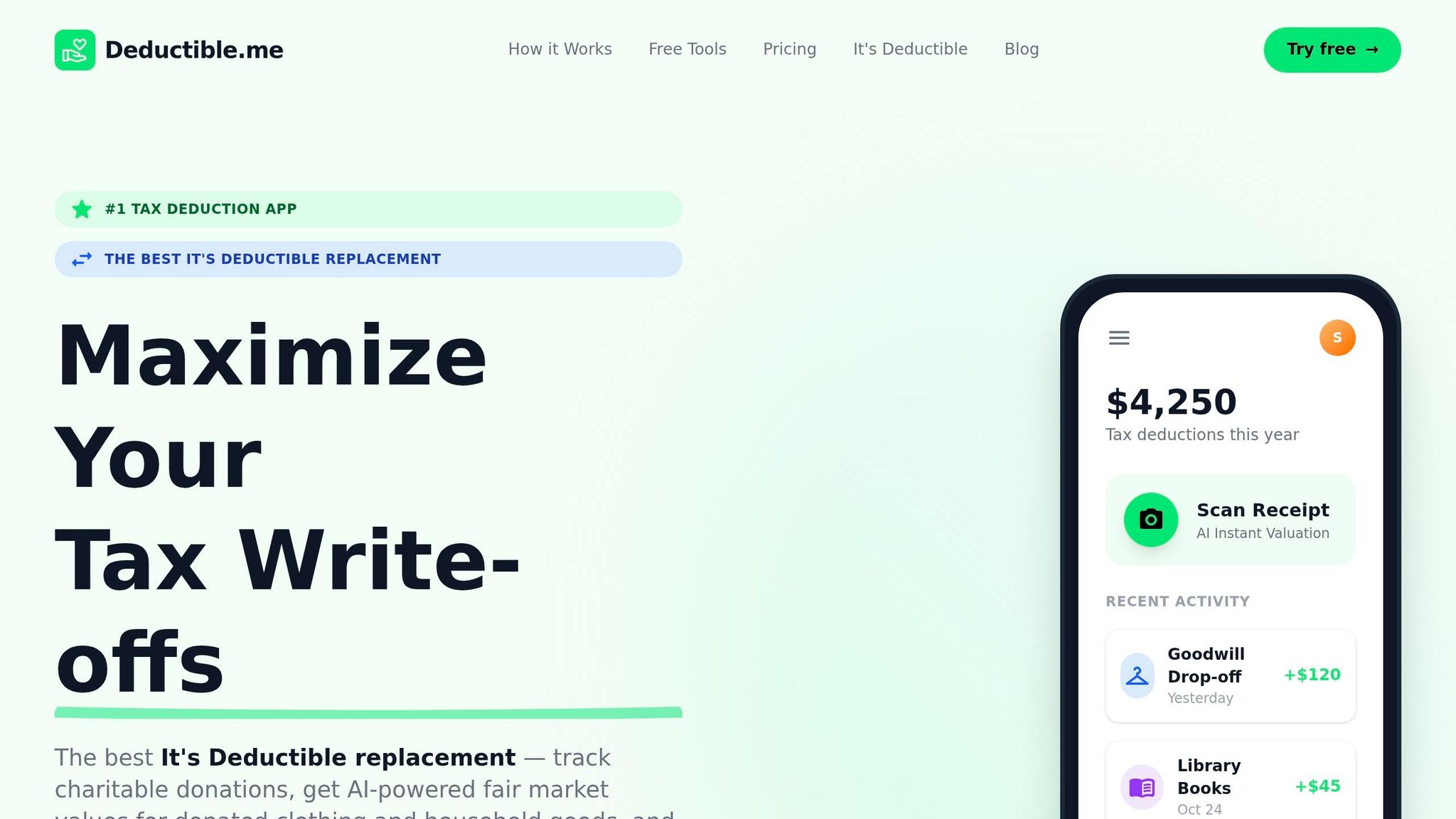
Keeping track of all this can get messy fast. Deductible.me helps you organize donation photos, estimate fair market value, and create IRS-ready reports for Form 8283.
Common filing mistakes and key takeaways
Eligibility, valuation, and substantiation errors that cost deductions
After you’ve nailed down eligibility, timing, value, and recordkeeping, these are the filing mistakes that most often kill a Schedule A claim.
Most denied deductions come back to a small set of avoidable errors. The usual problems are simple: giving to an ineligible recipient, claiming too much for used clothing or furniture, or forgetting to reduce a quid pro quo gift by the value of what you got back.
Here are the filing traps that show up again and again:
- Ineligible recipient: Check the organization’s status before you donate with the IRS Tax Exempt Organization Search.[27]
- Overstated used-item value: Base value on actual resale prices, not what you paid when the item was new.
- Quid pro quo shortfall: You can deduct only the payment minus the value of the benefit you received. Claiming the full payment is a common audit adjustment.[4]
- Missing written acknowledgment: If a gift is $250 or more, you need a contemporaneous written acknowledgment. Without it, the deduction can disappear.[4]
- Form 8283 not filed: Noncash gifts over $500 need Section A or B. Leaving out the form is one of the most common reasons deductions get denied.[21][18]
- No qualified appraisal: For a single item or group of similar items over $5,000, failing to get an appraisal can wipe out the deduction in full.[21][18]
IRS oversight reviews show the same pattern: missing Form 8283, incomplete descriptions, and missing appraisals.[28] And if values are pushed too high, valuation penalties may follow.[29][30]
What to do before claiming charitable deductions on Schedule A
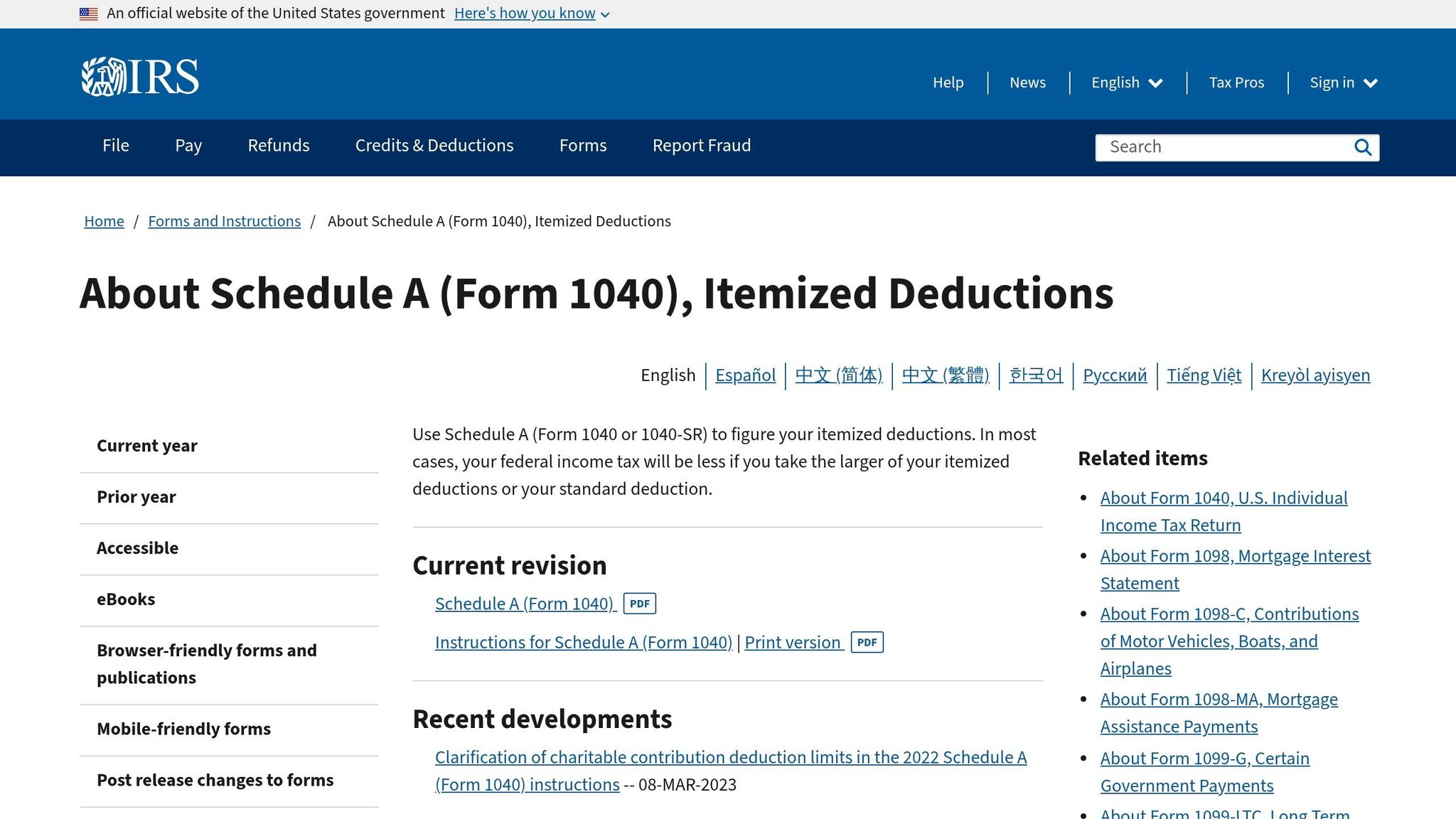
Use this quick review before you file.
Confirm that every recipient is a qualified organization.[27] Make sure each donation was completed by December 31 of the tax year. A pledge alone doesn’t count.[3][5]
For property donations, base your values on actual secondhand market data. If you donated a single item or group of similar items over $5,000, get a qualified appraisal before filing.[21][18]
Also, track unused carryovers on their own so they don’t get lost when you change tax software or move to a new preparer.[26][13] Deductible.me can help track donations, values, and Form 8283 thresholds throughout the year.
Check each of these items before you claim the deduction on Schedule A.
FAQs
Can I deduct donations if I take the standard deduction?
No. You can deduct charitable donations only if you itemize deductions on Schedule A of your federal tax return.
If you take the standard deduction, you can’t claim charitable donations. Itemizing usually makes sense only when your total itemized deductions are higher than the standard deduction for your filing status.
What proof do I need for a donation over $250?
For any charitable donation of $250 or more, the IRS requires a contemporaneous written acknowledgment from the charity.
That means you need to have this letter or receipt by the time you file your tax return or by the return’s due date, whichever comes first. If you wait too long, the deduction can fall apart even if the donation itself was legitimate.
The acknowledgment should include:
- Your name and address
- The date of the donation
- The cash amount, or a description of any noncash items you gave
- A statement showing whether you received any goods or services in return
This is one of those tax rules that sounds small but matters a lot. No letter, no deduction.
When do I need Form 8283 or an appraisal?
File Form 8283 if your total non-cash charitable donations for the tax year are more than $500. This form reports your non-cash contributions and gets attached to your Form 1040.
You’ll need a qualified appraisal for any single item, or group of similar items, valued at more than $5,000. The main exception is publicly traded securities.
If an appraisal is required, complete Section B of Form 8283 and get signatures from both:
- the appraiser
- the recipient charity