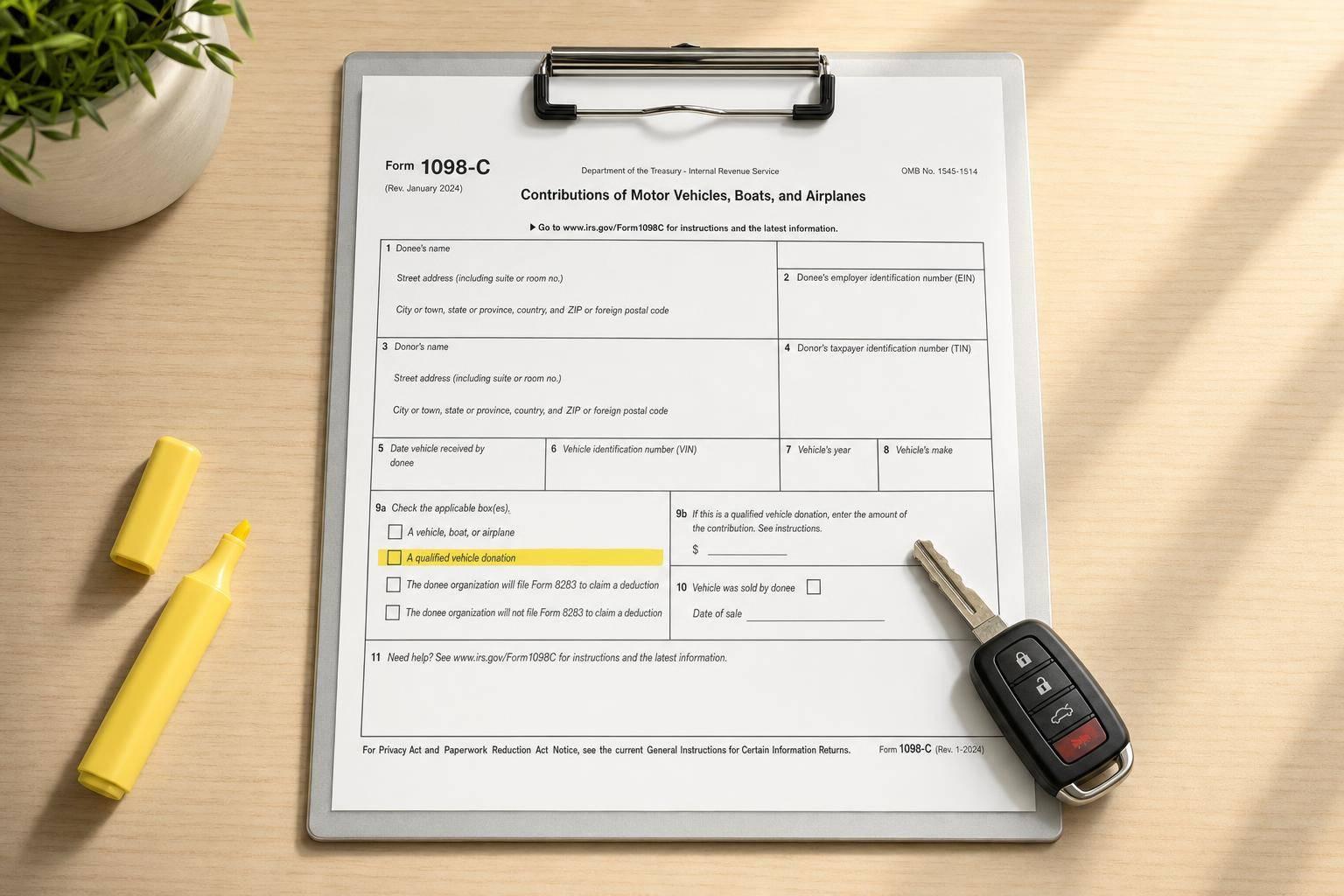
How IRS Form 1098-C Affects Vehicle Donations
If you claim more than $500 for a donated car, boat, or airplane, Form 1098-C can decide whether the IRS allows that deduction.
Here’s the short version: I’d check whether the form is required, whether it arrived on time, what boxes are checked, and whether the amount on it matches the tax return. In many cases, the deduction is limited to the charity’s gross sale proceeds. But if the charity used the vehicle, improved it, or gave it to a needy person, I may be able to use fair market value instead.
Before filing, I’d focus on these points:
- Over $500 claimed? I need Form 1098-C attached to my return.
- No form or late form? My deduction is often stuck at $500 until I fix it.
- Box 4c matters. That number often sets the deduction limit.
- Box 5a or 5b matters too. Those boxes can support an FMV-based deduction.
- Over $5,000 claimed? I also need Form 8283 Section B and a qualified appraisal.
- Wrong VIN, TIN, or dates? Even small errors can cause IRS problems.
A few hard numbers stand out:
- The charity usually has 30 days to send Form 1098-C.
- The strict filing rule starts once the claimed deduction goes above $500.
- For motor vehicles, the VIN should be 17 characters.
- If the vehicle sells for $500 or less, the deduction is usually the lesser of $500 or FMV.
| Issue | What I’d know right away |
|---|---|
| Claimed deduction is $250–$500 | I keep the charity’s written acknowledgment with my records |
| Claimed deduction is $501–$5,000 | I attach Form 1098-C and Form 8283 Section A |
| Claimed deduction is over $5,000 | I attach Form 1098-C, use Form 8283 Section B, and get an appraisal |
| Charity sold the vehicle | My deduction is usually capped at the sale price |
| Charity used or improved the vehicle | I may be able to claim FMV |
| Form is missing or wrong | The deduction can be cut down or denied |
That’s the whole issue in plain English: the form is not just a receipt - it controls the amount I can claim and whether the claim holds up if the IRS asks questions.
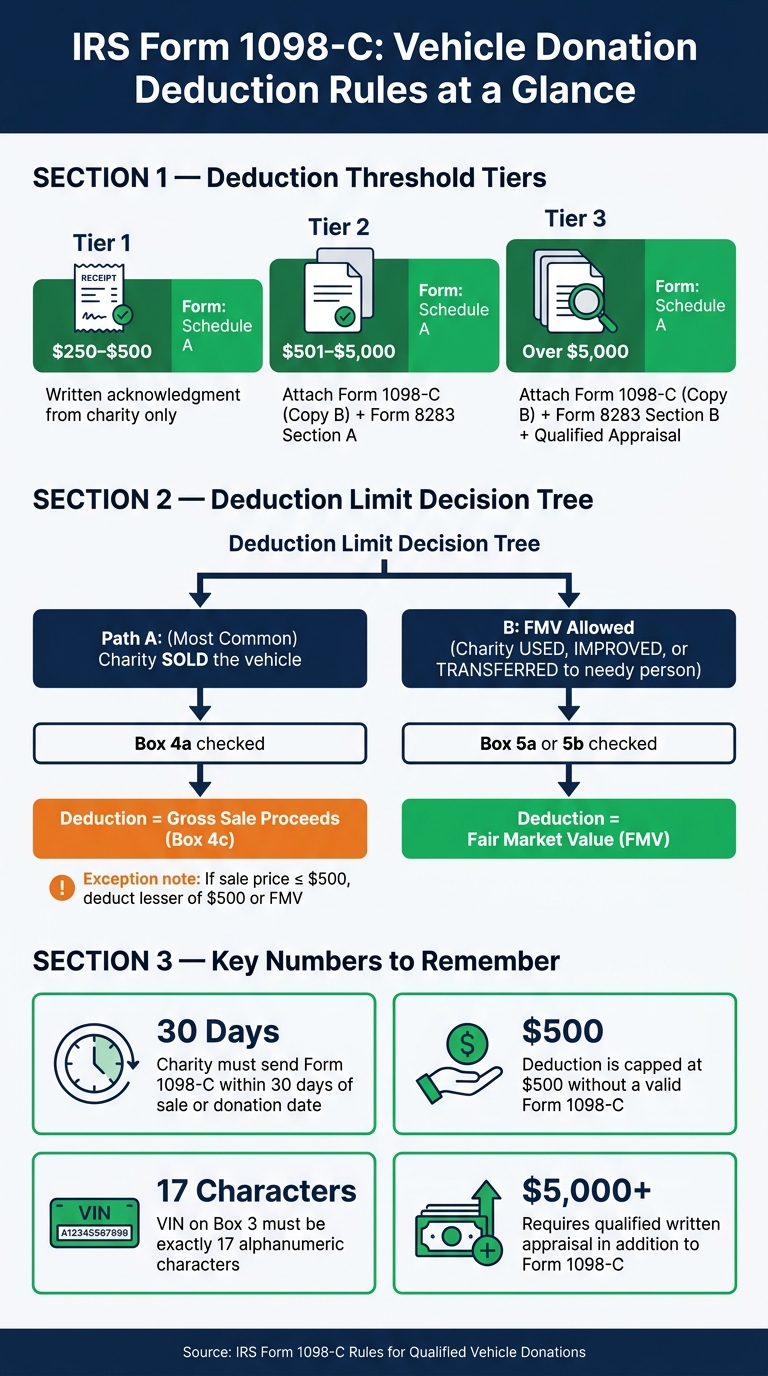
IRS Form 1098-C: Vehicle Donation Deduction Rules at a Glance
IRS Form 1098-C walkthrough (Contributions of Motor Vehicles, Boats, or Airplanes)
sbb-itb-e723420
When Form 1098-C Is Required and What It Must Show
Once you know the donation counts, the next step is simple: make sure the charity sent Form 1098-C on time and that the form lines up with what you're putting on your tax return.
Form 1098-C is the charity's written acknowledgment for a vehicle donation. A charity must issue it for any qualified vehicle donation claimed above $500.
When the Charity Must Send the Form
The charity must send Form 1098-C within 30 days. That 30-day clock starts based on what the charity does with the vehicle [1]:
| Situation | 30-Day Window Starts From |
|---|---|
| Charity sells the vehicle in an arm's length transaction | Date of sale |
| Charity plans significant intervening use | Date of contribution |
| Charity plans material improvement | Date of contribution |
| Charity transfers the vehicle to a needy individual at significantly below FMV | Date of contribution |
If the form shows up late, that can hurt support for your deduction. For claims over $500, Copy B must be attached to your federal return [6].
Key Fields to Check Before Filing
After timing, look at the details. Even small errors can cause trouble, so it's worth checking the form line by line before you file.
- Donor name and TIN - Both must be listed. If the TIN is missing, the deduction may be capped at $500 [1].
- Vehicle Identification Number (Box 3) - For motor vehicles, this must be exactly 17 alphanumeric characters [1].
- Date of contribution (Box 1) - This should match the date you report on Form 8283 [6].
- Gross sale proceeds (Box 4c) - This is the sale price before fees or expenses. In most cases, it sets the deduction limit [1].
- Certification boxes (Box 5a/5b) - These show whether the charity certified significant use, material improvement, or transfer to a needy individual. If neither box is checked, your deduction is capped at gross proceeds instead of fair market value [1].
- Odometer reading (Box 2a) - Enter mileage in miles, not kilometers. If you need to convert kilometers, multiply by 0.62137 [1].
This is one of those spots where a quick review can save a headache later. If the form and your return don't match, that's the kind of thing the IRS can zero in on fast.
How Form 1098-C Affects the Amount You Can Deduct
Once the form is correct, the next step is simple: figure out how it changes your deduction. Form 1098-C tells you whether your deduction is limited to the charity's gross sale proceeds or whether you may use fair market value (FMV).
Most Donations Are Capped at the Charity's Gross Sale Proceeds
In most cases, if the charity sells the vehicle and doesn't use it or make a material improvement to it, your deduction is limited to the gross proceeds listed in Box 4c of Form 1098-C [1][2].
There is one common exception. If the vehicle sells for $500 or less, you can generally deduct the lesser of $500 or the vehicle's FMV [2].
When Fair Market Value May Still Apply
FMV can still be used in three cases. Form 1098-C shows this through Box 5a or Box 5b [1].
- Significant intervening use - Box 5a is checked. The charity uses the vehicle in a substantial way as part of its regular operations, so your deduction may be based on FMV instead of being capped by gross sale proceeds [1].
- Material improvement - Box 5a is checked. The charity makes repairs that materially increase the vehicle's value. Routine cleaning or painting doesn't count, so FMV may apply only when the work goes beyond that [3][1].
- Transfer to a needy individual - Box 5b is checked. The charity sells or gives the vehicle for much less than FMV to help someone in need as part of its mission, which supports an FMV-based deduction [3][5].
Comparison Table: Sale Proceeds vs. Fair Market Value Scenarios
The table below shows how Form 1098-C changes the deduction in common situations.
| Scenario | What Form 1098-C Shows | Deduction Limit |
|---|---|---|
| Vehicle sold by charity | Box 4a checked; gross proceeds in Box 4c | Limited to gross proceeds in Box 4c [1][2] |
| Vehicle used by charity | Box 5a checked; description of use in Box 5c | Fair Market Value (FMV) [1] |
| Vehicle improved then sold | Box 5a checked; description of improvements in Box 5c | Fair Market Value (FMV) [3][1] |
| Vehicle given to a needy individual | Box 5b checked | Fair Market Value (FMV) [3][5] |
Before you file, check the form line by line. A missing box, wrong amount, or incomplete description can cut down your deduction or slow things down.
Common Form 1098-C Problems and How to Fix Them
Once you know how Form 1098-C sets the limit on your deduction, the next job is making sure the form itself doesn’t trip you up. This is where people often run into trouble. The form may show up late, include simple typos, or contain a certification that doesn’t line up with what happened to the vehicle.
Missing or Late Form 1098-C Can Delay or Reduce Your Deduction
If your vehicle deduction is more than $500, you need to attach Form 1098-C before you file. If it hasn’t arrived, contact the charity right away. Double-check your name, address, and TIN, and make sure the charity is tax-exempt. If the form comes in after you already filed, amend your return once you have it. Until then, keep your title transfer paperwork and any donation receipt that shows the contribution date [1] [6].
Once the form is in your hands, go box by box and make sure it matches the donation.
Errors on the Form Can Increase Audit Risk
A Form 1098-C with mistakes can draw IRS attention or knock out your deduction. Common issues include the wrong VIN, the wrong donor name, or missing gross proceeds in Box 4c. One problem stands out: a certification of significant use when the charity sold the vehicle soon after getting it. If that certification doesn’t match the facts, your deduction may drop to the gross proceeds amount. If anything looks off, ask the charity for a written explanation before you file [1].
For any error, ask the charity for a corrected Form 1098-C before you submit your return [1]. While you wait, pull together backup records like the signed title, photos, repair receipts, and valuation notes. These records don’t replace the form, but they can help support your deduction if the IRS asks questions [2] [7].
Use the table below to connect each issue with the fastest next step.
Problem-Solution Table for Common Filing Issues
| Problem | What the IRS Rule Says | Immediate Action | Keep | Deduction Impact |
|---|---|---|---|---|
| No Form 1098-C received | A deduction over $500 requires a timely acknowledgment within 30 days of sale or contribution [1] [6]. | Contact the charity. | Title transfer records, donation receipt, correspondence with the charity [4]. | Deduction generally limited to $500 without the form [1]. |
| Form received after filing | The acknowledgment must be received by the filing date or due date, including extensions [6]. | File an amended return once the form arrives [1] [6]. | Copy of original return, Form 1098-C, title transfer paperwork. | Deduction over $500 generally can't be claimed until the form is attached [6]. |
| Sale proceeds lower than expected | The deduction is generally limited to the gross proceeds in Box 4c [3] [2]. | Check whether Box 5a or 5b applies; if not, accept the lower amount [3]. | Form 1098-C Box 4c, valuation reference for comparison [2]. | Deduction capped at the actual gross proceeds from the sale [2]. |
| Form shows charity use, but vehicle was sold quickly | Significant use must be substantial, not incidental, to justify an FMV-based deduction [1]. | Request a written explanation from the charity; do not file until resolved [1]. | Photos of vehicle condition, repair records, charity's mission statement [1]. | Deduction may be reduced to gross proceeds; potential audit risk [1]. |
| VIN or donor name is incorrect | The form must include an accurate 17-character VIN and correct donor TIN to be valid [1]. | Request a corrected Form 1098-C. | Original vehicle title, registration, and the corrected form [4]. | Deduction may be disallowed; increased risk of IRS rejection or audit [1]. |
| Missing charity certification language | The charity must certify the arm's length sale or intended significant use/improvement [1]. | Ask the charity to check the correct box (4a, 5a, or 5b) and provide the required descriptions [1]. | Written correspondence with the charity about vehicle use or sale [1]. | Deduction may default to gross proceeds instead of FMV [1]. |
How to File Correctly and Keep Records That Support Your Deduction
How Form 1098-C and Form 8283 Work Together
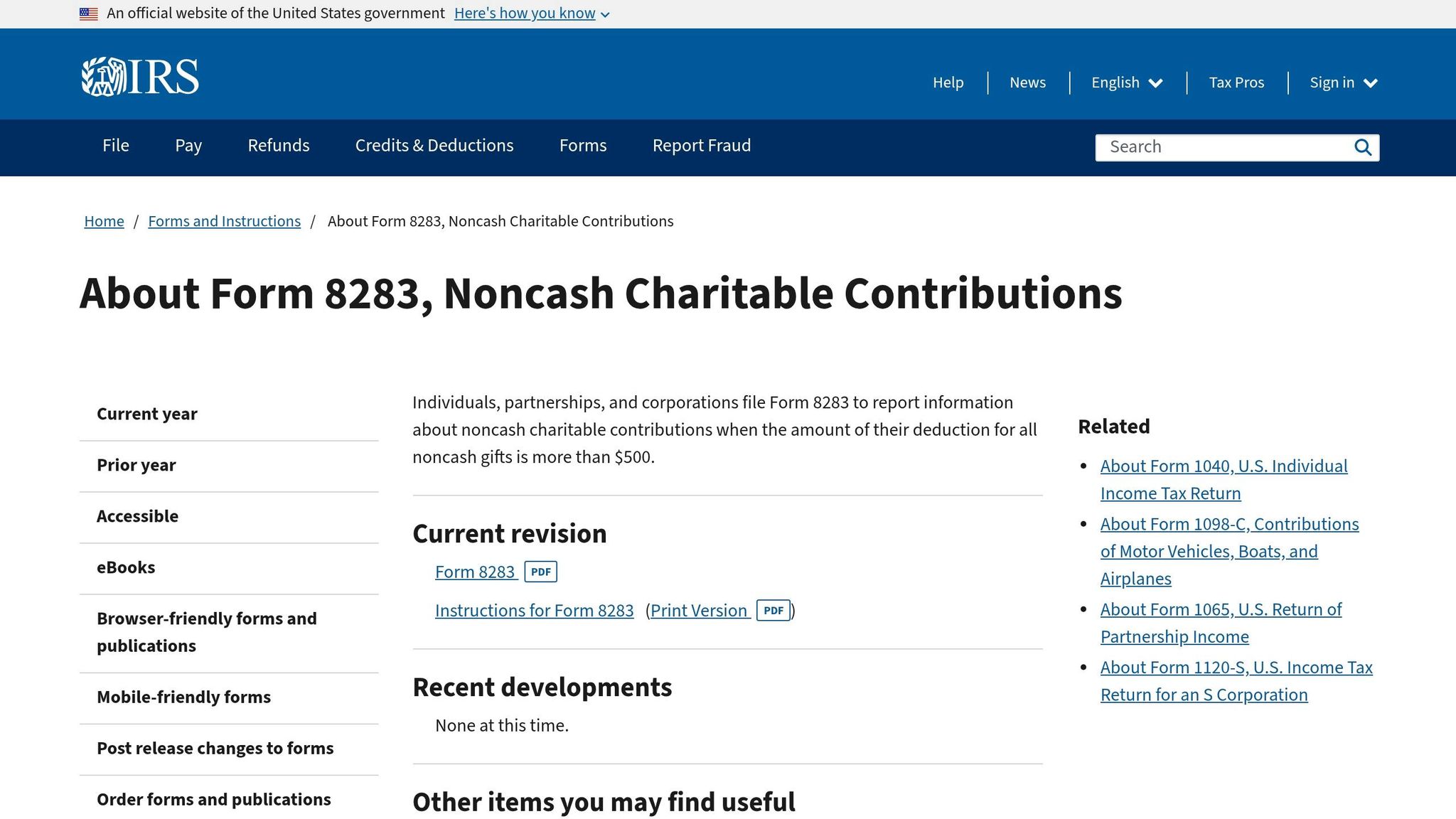
For vehicle donations, the paperwork changes once you cross the $500 and $5,000 marks. The key is simple: make sure Form 1098-C, Form 8283, and Schedule A all line up with the same donation amount. Form 1098-C backs up what you report on Form 8283 and Schedule A.
If your deduction falls between $250 and $500, a contemporaneous written acknowledgment from the charity is enough. Keep that with your tax records. Once your deduction goes above $500, you need to attach Copy B of Form 1098-C and Form 8283 (Section A) to your federal return. If your deduction is over $5,000, switch to Form 8283 (Section B) and get a qualified written appraisal [1][2][6]. And one more thing: you can claim the deduction only if you itemize.
Once those forms match the donation amount, the main problem shifts to something less flashy but just as important: missing paperwork or half-finished records.
Requirements Table by Deduction Amount
Use this simplified filing map for the most common deduction ranges.
| Deduction Amount | Forms Required | Vehicle-Specific Acknowledgment Rules |
|---|---|---|
| $250–$500 | Schedule A (Form 1040) | Must include the charity name, date, vehicle description, and goods/services statement. Keep the charity acknowledgment with your records [6]. |
| $501–$5,000 | Form 8283 (Section A) + Form 1098-C (Copy B) | Must include your TIN, the VIN, and certification of the sale or intended use. Attach both to the return [1][6]. |
| Over $5,000 | Form 8283 (Section B) + Form 1098-C (Copy B) | Same as $501–$5,000, plus appraiser and donee signatures on Form 8283. Qualified written appraisal required [2]. Attach both to the return. |
Using Deductible.me to Close Recordkeeping Gaps
If your records are scattered across receipts, title papers, and old emails, pull them together before you file. Deductible.me keeps donation records, titles, and acknowledgments in one place and generates Form 8283-ready documentation.
Conclusion: Why Form 1098-C Deserves Attention Before You File
Form 1098-C controls your deduction. If you donated a vehicle worth more than $500, this form decides whether you can claim more than that amount. And that’s just the starting point. It also helps set the deduction amount itself.
If the charity sold the vehicle, Box 4c will usually cap your deduction at the gross sale proceeds, unless Box 5a or Box 5b applies.[2][8] Timing matters too.
The charity must send the acknowledgment within 30 days of the sale date or the donation date, depending on what it did with the vehicle.[1] When this form shows up late, or doesn’t show up at all, filing often gets stuck. That’s one of the main reasons vehicle deductions run into delays.
Before you file, match Form 1098-C to Form 8283. Also reduce your deduction by any goods or services listed in Box 6. When the form, the numbers, and your records all line up, your deduction is much easier to defend.
Deductible.me can help keep donation records and Form 8283-ready documentation organized.
FAQs
What if I never get Form 1098-C?
If you never receive Form 1098-C, you usually can't claim a deduction of more than $500 for your vehicle donation. The IRS requires this form, or a contemporaneous written acknowledgment with the same details, to support the deduction.
If you don't have that paperwork when you file your federal tax return, the deduction will likely be disallowed. Contact the recipient organization right away and ask for the documentation.
Can I deduct fair market value instead of the sale price?
Usually, no. If the charity sells your donated vehicle, your deduction is usually capped at the actual sale price - even when the vehicle’s fair market value is higher.
You can deduct the fair market value in a few cases:
- The charity makes significant intervening use of the vehicle
- The charity performs material improvements
- The charity sells or donates the vehicle to a needy individual at a price far below market value for a charitable purpose
That’s the key split: sale price in most cases, fair market value only in a narrow set of situations.
Do I need an appraisal for my vehicle donation?
Usually, no. In most cases, you don’t need a qualified written appraisal if your deduction is limited to the vehicle’s gross sale proceeds.
But there’s a line to watch: if your claimed deduction is over $5,000 and it’s not limited to those sale proceeds, a qualified appraisal is required. That can happen if the charity made major use of the vehicle or made major improvements to it.
In that case, you also need to complete Section B of Form 8283.