IRS-Compliant Valuation for Non-Cash Donations
When donating non-cash items, valuing them correctly is key to staying within IRS rules and maximizing your tax deductions. The IRS uses Fair Market Value (FMV) - what an item would sell for in its current condition - as the standard for valuation. Here's what you need to know:
- FMV Basics: It's not about retail or original prices. For example, a $150 coat may now be worth $30–$40.
- Common Mistakes: Avoid overestimating value, grouping items together, or neglecting documentation.
- Documentation Requirements:
- Under $250: Basic receipt.
- $250–$500: Written acknowledgment from the charity.
- Over $500: Additional records and IRS Form 8283.
- Over $5,000: Qualified appraisal required.
Tools like Deductible.me can simplify this process by estimating FMV and organizing your records for as little as $2/month.
Proper valuation and documentation ensure you get the deductions you deserve without IRS issues. Read on for detailed methods, common pitfalls, and tech solutions to streamline the process.
IRS Form 8283 walkthrough (Noncash Charitable Contributions)
sbb-itb-e723420
What Is Fair Market Value (FMV)?
Fair Market Value (FMV) is the standard used by the IRS to assess the value of donated goods. Understanding FMV is essential if you want to meet IRS documentation requirements. The IRS defines FMV as "the price property would fetch in an open market" [3]. Simply put, it’s the amount a knowledgeable buyer would pay a willing seller under normal conditions.
FMV isn’t about what you originally paid or the sentimental value of an item. Instead, it’s strictly about what someone would realistically pay for it today. For instance, a winter coat that originally cost $150 might now have an FMV of just $30–$40. Let’s break down how FMV differs from retail prices and what factors influence its calculation.
Why FMV Is Different from Retail and Original Prices
FMV focuses on the current used-market value, which is often much lower than the original or retail price. For example, items in excellent condition usually sell for only 30–40% of their original cost, while those in average condition might bring in just 10–20% [2]. That $80 coffee maker you’re donating? Its FMV might be closer to $5 to $15, depending on its condition and age [2].
It’s also important to understand how FMV compares to other valuation methods. Book value, for instance, is based on the original cost minus depreciation, while liquidation value reflects a quick-sale scenario [4]. FMV strikes a balance between these extremes, representing what someone would reasonably pay in a typical, unhurried transaction.
What Affects FMV
Several factors play a role in determining FMV, with condition being the most important. The IRS generally requires donated items to be in "good used condition or better" to qualify for a deduction. Goodwill Industries offers a helpful guideline: donate only items you’d feel comfortable giving to a friend or family member [1].
Age and obsolescence are also major factors, especially for electronics. Older models tend to lose value quickly. For example, a three-year-old laptop might have an FMV anywhere from $30 to $250, depending on its condition and specifications [2]. Market demand is another key consideration. When researching FMV, focus on actual "sold" prices rather than active listings, and adjust for any flaws or imperfections in the item.
Common Valuation Mistakes and How to Avoid Them
Now that we've covered fair market value (FMV) and its key factors, it's important to steer clear of common mistakes that could raise red flags with the IRS. Errors like overvaluing items, poor recordkeeping, or missing critical documentation can lead to deductions being denied. Let’s break down these pitfalls and how to dodge them.
Overestimating Value with Retail Prices
One of the most frequent missteps is using original purchase prices or replacement costs to estimate FMV. The IRS specifically looks out for this type of overvaluation [1]. For instance, that $80 coffee maker you bought five years ago isn’t worth $80 today. Its FMV is based on what a similar used item might sell for at a thrift store - likely between $5 and $15 [2].
To stay compliant, focus on thrift store prices or the resale value of used items. Generally, items in excellent condition might fetch 30–40% of their original price, while those in average condition might only bring in 10–20% [2]. When researching online, avoid using active listings as a reference. Instead, look for "completed" or "sold" listings to establish a realistic FMV.
Failing to List Items Individually
Another common issue is lumping donations together without providing specific details. For example, labeling a donation as a "bag of clothes" or "box of toys" without itemizing the contents can jeopardize your deduction. The IRS requires a breakdown of each item, including its condition and value, especially for higher-value donations that may cross reporting thresholds.
To strengthen your documentation, take photographs of high-value items or large batches of donations. This visual proof could be crucial if you're ever audited. A good rule of thumb: if an item isn’t in good enough condition to gift to a friend, it likely doesn’t meet IRS standards.
Missing Required Documentation for Higher-Value Donations
As the value of your donations increases, so do the IRS’s documentation requirements. Here’s a quick guide to what you’ll need:
| Donation Value | Required Documentation | Key Form/Requirement |
|---|---|---|
| Under $250 | Receipt from the charity and your personal records | None |
| $251–$5,000 | Contemporaneous Written Acknowledgment (CWA) and an itemized list | IRS Form 8283, Section A [6] |
| Over $5,000 | CWA and a qualified appraisal | IRS Form 8283, Section B [6] |
For donations under $250, a simple receipt from the charity paired with your own records is usually enough. But once donations exceed $250, you’ll need a CWA from the charity. If your total non-cash donations top $500, you must file IRS Form 8283 and include a detailed list. For items or groups of items valued over $5,000, a formal appraisal by a qualified appraiser is mandatory.
Keeping thorough records throughout the year is essential. Missing even one required document can result in the IRS rejecting your deduction, no matter how accurate your valuations are. By addressing these common mistakes, you’ll be better prepared to meet IRS standards and make the most of your charitable contributions.
IRS-Approved Valuation Methods
When determining the fair market value of non-cash donations, the IRS allows three main approaches. Each method suits different types of items and ensures proper compliance while maximizing your deductions.
Using Value Guide Ranges
Organizations like Goodwill and the Salvation Army provide value guides that list price ranges for common household items based on their condition. These guides work well for donations like clothing, linens, and small kitchen appliances. Items are typically categorized into conditions such as "Good", "Very Good", and "Like New", with corresponding values.
"The price that buyers of used items actually pay in used clothing stores, such as consignment or thrift shops, is an indication of the value." – IRS Publication 561 [7]
When applying these guides, adjust for wear and tear. For instance, a coffee maker missing parts or a shirt with a minor stain should be valued at the lower end of the range. Always document the guide used and the item's condition for your records. If an item isn’t listed in standard guides, consider using another valuation method.
Comparable Sales Data
For items where brand, model, or unique features influence value - like electronics, designer goods, or certain furniture - researching actual sales data provides a more accurate estimate. This involves reviewing completed sales on platforms like eBay or specialty resale websites. The IRS considers sales of comparable items as the second-best indicator of fair market value, after the item's original purchase price or selling price [9].
Focus on sold listings only. As noted by the International Society of Appraisers, "Only sold results should be used when determining FMV. Asking prices are merely aspirational and do not reflect a consummated transaction" [9]. Using completed sales ensures your valuation reflects real market conditions. For complex or high-value items, a professional appraisal may be necessary.
Qualified Appraisals for High-Value Items
For donations valued over $5,000, a professional appraisal is required [8]. This rule applies even if similar items are donated to multiple charities. The appraiser must be certified by a recognized organization and meet specific education and experience standards. The appraisal should be completed within 60 days before the donation and submitted with your tax return [8]. Importantly, appraisers cannot charge fees based on a percentage of the appraised value [8]. For artwork valued at $50,000 or more, you can request an official IRS Statement of Value for a $5,700 fee (covering up to three items, with an additional $290 per item) [8].
| Method | Best For | Cost | Accuracy |
|---|---|---|---|
| Value Guide Ranges | Clothing, linens, small kitchen items | Free (DIY) | Broad/general estimates |
| Comparable Sales Data | Electronics, furniture, designer goods | Free (DIY research) | Model- and condition-specific |
| Qualified Appraisals | Jewelry, art, real estate, items >$5,000 | Professional fee | Highly detailed/legal standard |
To protect your deductions, choose the most suitable method and keep thorough records. For any item valued over $500, take photos to document its condition - this visual proof could be essential if the IRS reviews your claim.
Documentation Requirements by Donation Amount
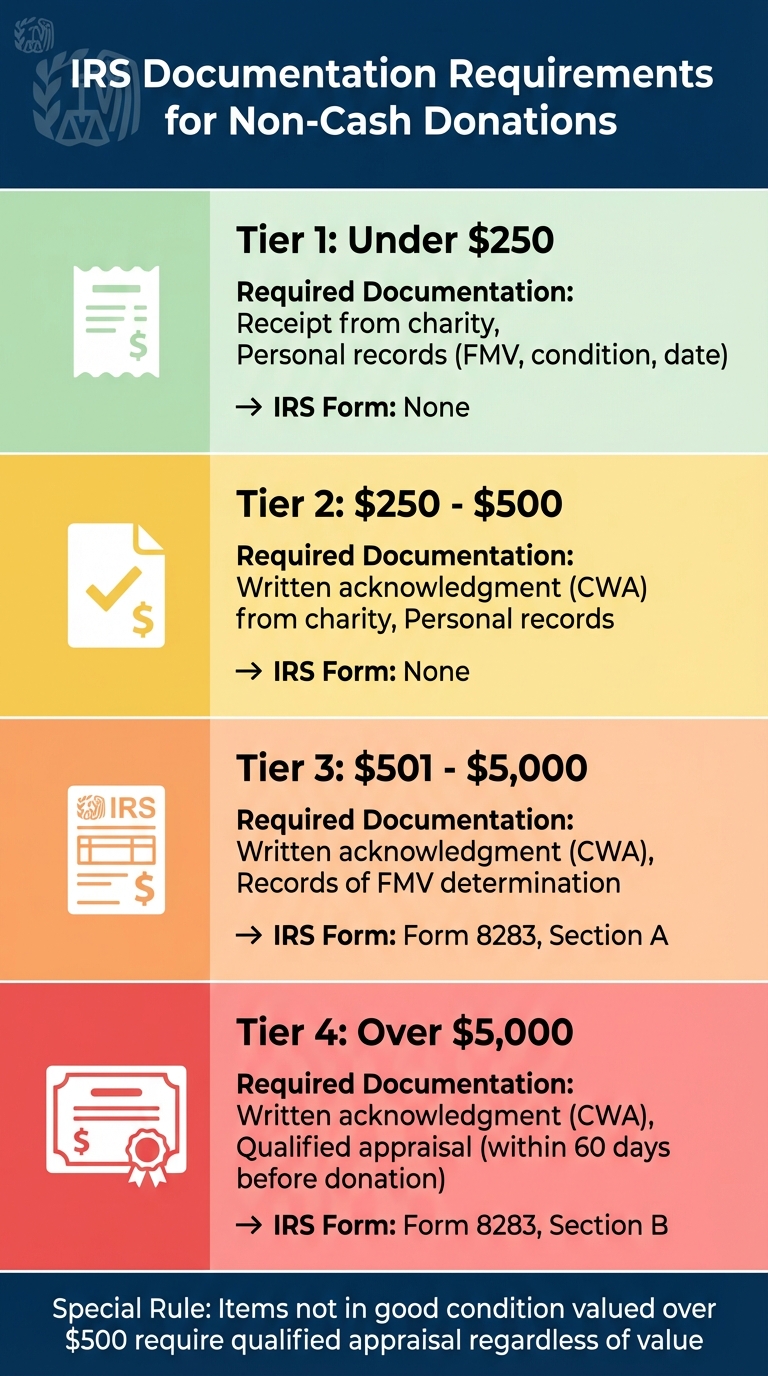
IRS Documentation Requirements for Non-Cash Donations by Value
When it comes to non-cash donations, it's not just about estimating their value correctly. You also need to document them properly to meet IRS rules. These requirements vary depending on the amount you claim, and knowing the thresholds can help you avoid issues like rejected deductions or audits.
Donations Under $250
For donations under $250, you'll need a receipt from the charity that includes key details: the charity's name, address, the date and location of the donation, and a detailed description of the donated items. If you use an unattended drop-off, keep a personal record with this same information.
Document the fair market value (FMV) of each item and how you determined it - whether through the Goodwill Valuation Guide, similar sales, or other methods. Taking dated photos of the items before donating is a good way to prove their condition. Hold on to these records for at least three years after filing your tax return. If you received anything in return for your donation, deduct its value from your total claim.
Donations Between $250 and $500
When your donation is $250 or more, the rules tighten. You must get a contemporaneous written acknowledgment (CWA) from the charity. This acknowledgment should clearly state whether you received any goods or services in exchange for your donation, and if so, it must include a good-faith estimate of their value. A simple "thank you" note won't cut it.
Make sure to get the acknowledgment before you file your tax return or the due date (including extensions). Bank statements or canceled checks alone won't suffice for donations at this level. Also, keep in mind the "similar items" rule: if you donate multiple similar items to different charities and their combined value exceeds $500, you'll need to file Form 8283.
Donations Over $500
If your total non-cash donations exceed $500, you'll need to file IRS Form 8283 with your tax return. Here's how it breaks down:
- Section A: For items or groups of similar items valued between $501 and $5,000.
- Section B: For items valued over $5,000. These require a qualified appraisal from a certified professional, completed within 60 days before the donation.
The summary table below outlines the documentation requirements based on donation value:
| Donation Value | Required Documentation | IRS Form Needed |
|---|---|---|
| Under $250 | Receipt from charity + personal records (FMV, condition, date) | None |
| $250 – $500 | Written acknowledgment (CWA) from the charity | None |
| $501 – $5,000 | Written acknowledgment (CWA) + records of how FMV was determined | Form 8283, Section A |
| Over $5,000 | Written acknowledgment (CWA) + Qualified Appraisal | Form 8283, Section B |
Important Note: If you claim a deduction over $500 for a single piece of clothing or household item that isn't in good used condition or better, you'll need to complete Section B and get a qualified appraisal - even if the item's value is under $5,000 [6]. The IRS also considers similar items donated to different charities as a single group when calculating thresholds, so it's crucial to track all your donations throughout the year.
Keeping detailed and accurate records, as described here, not only ensures compliance but also strengthens your case in the event of an audit.
Using Technology for Accurate Valuation and Compliance
Managing donated items, determining their fair market value, and keeping IRS-compliant records can be a daunting task - especially if you make multiple donations throughout the year. Relying on outdated manual methods increases the risk of missed deductions and incomplete documentation. Thankfully, modern tools simplify this process, making it faster, more precise, and far less stressful.
AI-Powered Valuation for Better Deductions
Deductible.me takes the guesswork out of valuations with its AI-powered engine. By analyzing photos of your donated items, it quickly suggests IRS-compliant fair market values. Instead of wasting time flipping through valuation guides or hunting for comparable sales on eBay, the app evaluates your item’s type, brand, and condition to deliver a reliable estimate in seconds. It even guides you through categorizing items as Good, Very Good, or Excellent/Like New, ensuring your valuations align with the IRS's "good used condition or better" requirement [2][5].
The app’s valuation database pulls from real-world data, like eBay sales and thrift store pricing, providing estimates that stand up to scrutiny. This approach avoids common mistakes, such as overestimating based on retail prices or undervaluing items you think have little worth. For example, a single box of household items - like kitchen gadgets, books, and home décor - can add $50 to $100 or more to your deductions when itemized properly [2]. While accurate valuations are crucial, streamlined digital recordkeeping ensures your compliance with IRS rules.
Simplified Recordkeeping and Reporting
Accurate valuations are just the first step. Deductible.me also makes recordkeeping effortless by replacing outdated paper-based systems with a digital platform that logs your donations instantly. It links itemized lists to digital receipts, creating a time-stamped record of all the details you’ll need for tax filings [2]. This feature becomes especially handy if your donations exceed $500, requiring you to file Form 8283. The app automates this process, preparing detailed itemized lists with acquisition dates and cost basis information [5][11].
For just $2/month with the Premium plan, you get unlimited tracking and advanced receipt management. At the end of the year, the app generates a detailed, IRS-compliant report summarizing all your contributions, saving you and your tax preparer valuable time [11]. With both web and mobile access, you can manage your donations from anywhere - whether you're at home on your laptop or snapping photos at the donation center on your phone [5][10].
Conclusion
Navigating IRS-compliant non-cash donation deductions becomes much simpler when you stick to the guidelines. A key element is understanding Fair Market Value (FMV) - essentially, what a buyer would reasonably pay a seller for an item in its current condition. As DeductAble explains, "The core principle is simple: An accurate valuation ensures you get the full tax benefit you're entitled to, while solid documentation provides the proof the IRS requires." [2]
To avoid common pitfalls, steer clear of using retail prices, grouping items together, or neglecting proper documentation. Instead, rely on IRS-approved valuation methods like value guide ranges, comparable sales data, or qualified appraisals for higher-value items. Keep in mind that an item’s condition plays a major role in determining FMV. Be diligent about maintaining detailed, IRS-compliant records for every donation, and hold onto them for at least three years.
For those looking to streamline the process, tools like Deductible.me can make it easier. With features like AI-powered valuation and digital recordkeeping, you can snap a photo of your donation, get instant IRS-compliant estimates, and generate detailed year-end reports - all for just $2/month with the Premium plan. This eliminates the hassle of manual tracking or sifting through valuation guides. By following these steps, you not only maximize your tax savings but also ensure you're fully prepared in case the IRS comes knocking.
FAQs
How do I prove fair market value if I’m audited?
To demonstrate fair market value (FMV) during an audit, it's crucial to keep thorough documentation of your non-cash donation. This should include receipts, detailed records describing the items' condition and value, and, when required, appraisals. For larger donations, a qualified appraisal might be mandatory. You can support your valuation by referencing comparable market data, like prices from thrift stores or online marketplaces. Make sure all your records align with IRS guidelines to ensure they are accurate and complete.
What counts as “similar items” for the $500 and $5,000 thresholds?
Items labeled as "similar" typically mean those of the same category and condition - for instance, gently used clothing or furniture of a similar quality. Their value should represent their fair market value, which is the price they could reasonably fetch in an open marketplace.
When do I need a qualified appraisal for non-cash donations?
If you're planning to claim a tax deduction for a non-cash donation exceeding $5,000, you'll need a qualified appraisal. The IRS mandates this step to confirm the fair market value (FMV) of items such as artwork, real estate, or collectibles. To stay compliant, make sure to include both the appraisal and IRS Form 8283 with your tax return. Skipping this could lead to your deduction being denied - or even penalties.