
Yes, I can use a QCD from an inherited IRA - but only if I am age 70½ or older, the money goes straight to a qualified charity, and I still follow the inherited IRA payout rule that applies to me.
That’s the short answer. For 2026, the QCD limit is $111,000 per person. A QCD can cover all or part of my yearly RMD if I have one. But it does not erase the SECURE Act’s 10-year deadline for emptying many inherited IRAs.
Here’s the plain-English version:
- My age matters, not the original owner’s age
- The transfer must go from the IRA custodian to the charity
- A QCD can reduce taxable income
- A QCD can count toward that year’s RMD
- A QCD does not extend or remove the 10-year payout rule
- The transfer must be done by December 31
- Donor-advised funds, private foundations, and supporting groups do not qualify
If I want to avoid tax mistakes, I need to check three separate rule sets:
- Am I old enough to make a QCD?
- Do I have a yearly RMD on this inherited IRA?
- Am I still under a 10-year deadline to empty the account?
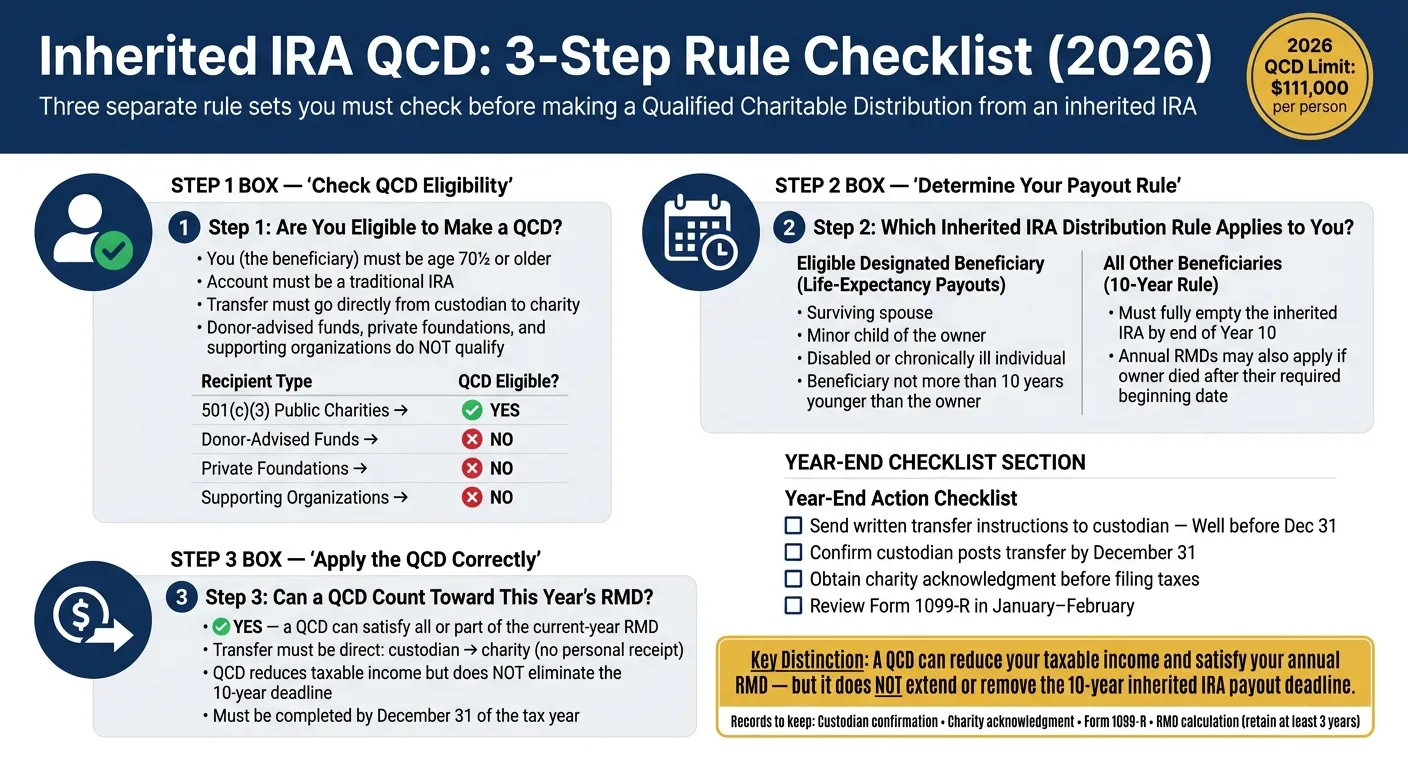
How to Give to Charity Tax-Free With an Inherited IRA (QCD Rules Explained)
Quick Comparison
| Rule area | What I need to know | Main result |
|---|---|---|
| QCD eligibility | Am I 70½+ and using an IRA transfer straight to charity? | If yes, the transfer may qualify as a QCD |
| Yearly RMD rule | Does this inherited IRA require a distribution this year? | If yes, a QCD may satisfy part or all of it |
| 10-year rule | Do I have to empty the account by year 10? | If yes, the deadline still applies even if I use QCDs |
Bottom line: I should treat QCD rules, RMD rules, and the 10-year inherited IRA rule as separate issues. That’s the cleanest way to keep the tax break and avoid missing a payout deadline.
Step 1: Check Whether the Beneficiary Can Make a QCD from an Inherited IRA
Having an inherited IRA does not automatically make someone eligible for a QCD. The beneficiary has to qualify based on their own status.
Age, Account Type, and Direct-Transfer Requirements
Here’s the plain-English version: the beneficiary must be 70½ or older on the date of the transfer. The original owner’s age doesn’t matter. Only the beneficiary’s age counts.
The QCD also has to come from a traditional IRA. And the transfer must go directly from the custodian to the charity. That part matters a lot. If the beneficiary takes the money first and then sends it to the charity, the IRS does not treat it as a QCD. It becomes taxable income instead. [1][2]
Once both sides check out - the beneficiary and the charity - you can move to Step 2 to see whether the distribution also has to meet inherited IRA payout rules.
Charities and Recipients That Do Not Qualify for QCDs
Before you request the transfer, make sure the charity is eligible. Some recipients are flat-out excluded under IRS rules, even if they sound charitable on the surface.
| Recipient Type | QCD Eligible? | Notes |
|---|---|---|
| 501(c)(3) Public Charities | Yes | Must be a direct transfer from the custodian [1][3] |
| Donor-Advised Funds (DAFs) | No | Explicitly excluded by IRS rules [1] |
| Private Foundations | No | Excluded by IRS rules [3] |
| Supporting Organizations | No | Excluded to ensure immediate charitable use [3] |
So this first step is only about basic eligibility. After that, the next issue is whether the inherited IRA distribution rule also applies.
Step 2: Determine Which Inherited IRA Distribution Rule Applies
Once you’ve confirmed QCD eligibility, the next step is to figure out which inherited IRA withdrawal rule applies to you.
That rule tells you whether you need to take annual RMDs, or whether you only need to meet a final payout deadline. And that matters for QCDs. It affects whether a QCD can offset a required yearly withdrawal or simply reduce taxable income from a distribution taken during a 10-year window.
How to Use the SECURE Act Decision Points
The SECURE Act sets the rule for whether you follow life-expectancy payouts or the 10-year rule.
To sort that out, check these three points:
- Whether the owner died before or after their required beginning date
- Whether you qualify as an eligible designated beneficiary
- Which 10-year deadline applies to your situation
Eligible designated beneficiaries include:
- Surviving spouses
- Minor children of the owner
- Disabled or chronically ill individuals
- Beneficiaries not more than 10 years younger than the owner
10-Year Rule vs. Life-Expectancy Distributions
For all other beneficiaries, the 10-year rule applies. That means the inherited IRA must be fully distributed by the end of the 10th year after the owner’s death.
There’s one extra wrinkle. If the owner died after reaching their required beginning date, annual RMDs may also apply during the 10-year period, not just at the final deadline.
Beneficiary Type and Payout Deadline: Comparison Table
| Beneficiary Category | Rule Group | Key Result |
|---|---|---|
| Surviving spouse | Eligible designated beneficiary | May use life-expectancy payouts |
| Minor child of owner | Eligible designated beneficiary | May use life-expectancy payouts |
| Disabled or chronically ill individual | Eligible designated beneficiary | May use life-expectancy payouts |
| Beneficiary not more than 10 years younger than the owner | Eligible designated beneficiary | May use life-expectancy payouts |
| All other individuals | Not an eligible designated beneficiary | 10-year rule; full distribution by the end of year 10 |
This split shapes how a QCD works in practice. In some cases, it can cover an annual RMD. In others, it can only apply to the distribution you take in that year during the 10-year period.
Step 3: Apply a QCD to the Inherited IRA’s Annual RMD Without Missing the Final Deadline
Once you know which payout rule applies to your inherited IRA, the next step is simple: can a QCD count toward this year’s required withdrawal? Yes - but only if the transfer is done the right way, and only for the current tax year.
When a QCD Can Satisfy All or Part of the Year’s RMD
If your inherited IRA has a current-year withdrawal requirement, a QCD can satisfy some or all of it. But the money has to go directly from the IRA custodian to a qualifying 501(c)(3) charity. If the beneficiary gets the funds first, it does not count as a QCD. [1]
Annual RMD Requirement vs. 10-Year Payout Deadline
A QCD can count toward that year’s required withdrawal, in whole or in part, and it counts as the distribution for that year. But it does not change the 10-year payout deadline.
That’s the key distinction. A QCD helps with taxes by keeping the distribution out of taxable income. It does not change the rule that the inherited IRA must still be emptied by the end of the 10-year period. So even if the tax treatment works in your favor, the calendar still rules the day. [1]
Where Timing Mistakes Happen Most Often
Timing is where people often slip up. The QCD must be completed by December 31. If the custodian processes it after year-end, it applies to the next tax year and won’t satisfy the current year’s RMD. [1]
Start early. Custodian delays happen, and waiting until the last minute can backfire.
Also, keep the custodian’s confirmation and the charity’s receipt with your tax records. You’ll want proof of the transfer, the date it was completed, and the charity’s acknowledgment when it’s time to report it on your return.
Execution, Recordkeeping, and Key Takeaways
Year-End Checklist for Making the Distribution Correctly
A transfer posted after December 31 counts for the next tax year. So once the transfer is approved, do one last check before filing.
| Action | Timing | If Missed |
|---|---|---|
| Send written transfer instructions to the custodian | Well before December 31 | Personal receipt of funds makes the distribution taxable income. [1] |
| Confirm the custodian posts the transfer by December 31 | By December 31 | The transfer shifts to the next tax year and misses the current-year deadline. [1] |
| Get the charity acknowledgment before filing | Before filing taxes | Receipt stating “no goods or services were provided” - IRS may disallow the income exclusion. [4] |
| Review Form 1099-R | January–February | Reporting errors can trigger tax on income that should be excluded. [1] |
Treat this as your final pre-filing check. A small delay here can create a tax issue that was easy to avoid.
Keep these items together with your tax records:
- Custodian confirmation
- Charity acknowledgment
- Form 1099-R
Key Rules to Remember and Records to Keep
The 2026 individual QCD limit is $111,000. [1]
Keep the custodian confirmation, charity acknowledgment, written transfer instruction, Form 1099-R, and your RMD calculation for at least three years.
FAQs
Does my age or the original owner’s age determine QCD eligibility?
No. QCD eligibility is based on your age, not the original owner’s age.
To qualify, you must be at least 70 1/2 when the distribution is made. Inherited IRAs can have separate withdrawal and required minimum distribution rules, but the QCD age rule still applies to the person taking the distribution.
Can a QCD fully satisfy my inherited IRA RMD?
Yes. A Qualified Charitable Distribution (QCD) can satisfy your inherited IRA RMD. It counts toward the amount you’re required to withdraw, and the money sent through the QCD isn’t included in your taxable income.
There’s one key rule: the transfer has to go directly from your IRA custodian to an eligible 501(c)(3) public charity.
Does a QCD change the 10-year inherited IRA deadline?
No. A Qualified Charitable Distribution (QCD) does not change the 10-year deadline for emptying an inherited IRA.
Those are two separate rules. The 10-year rule still applies, and a QCD does not extend or change that deadline.
A QCD can help satisfy RMDs for eligible account holders. But it does not affect the final date by which the inherited IRA must be fully distributed.