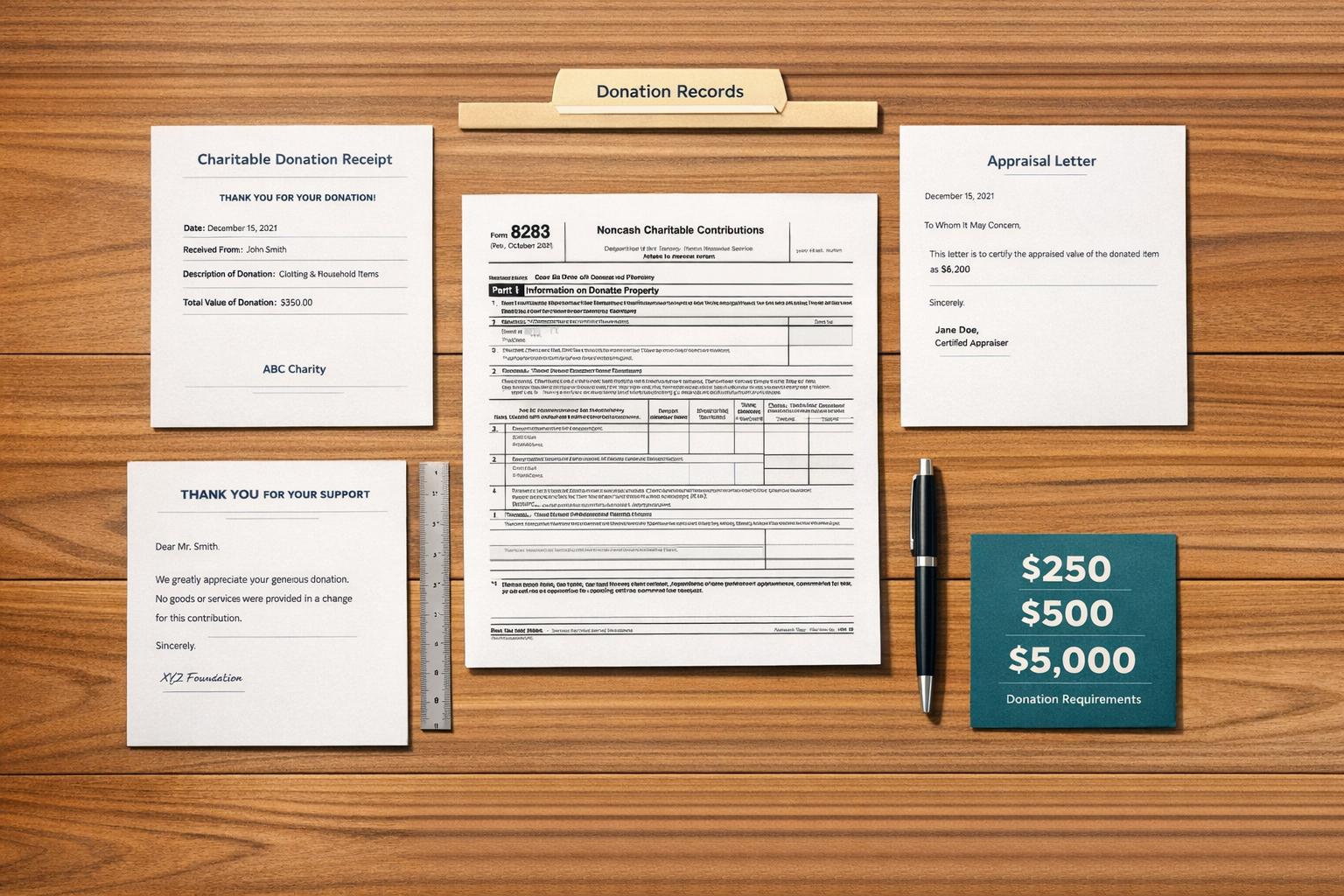
IRS Rules for Donation Receipts Explained
When claiming charitable donations on your taxes, the IRS requires specific documentation to approve deductions. Here's what you need to know:
- Cash Donations Under $250: Provide a bank record (canceled check, bank statement) or a written acknowledgment from the charity showing the donation amount, date, and charity name.
- Cash Donations $250 or More: Obtain a contemporaneous written acknowledgment from the charity, including whether goods or services were received and their value.
- Non-Cash Donations: Requirements vary by value:
- Under $250: Receipt with the charity’s name, date, and item description.
- $250–$5,000: Written acknowledgment and Form 8283 (if total non-cash donations exceed $500).
- Over $5,000: A qualified appraisal and Form 8283 signed by the charity.
- Quid Pro Quo Donations: If you receive something in return, only the amount exceeding the fair market value of what you received is deductible. The charity must disclose the value of goods or services provided.
- Record Retention: Keep all documentation for at least three years after filing, though seven years is safer.
To verify if a charity qualifies for tax deductions, use the IRS Tax Exempt Organization Search tool. Donations to foreign charities, individuals, or political groups are generally not deductible. Proper records are non-negotiable, as missing or incomplete documentation can lead to denied deductions.
Staying organized with tools like Deductible.me can simplify tracking and ensure compliance with IRS rules.
How to Donate to a Church or Charity
sbb-itb-e723420
What the IRS Requires for Donation Receipts
IRS Donation Receipt Requirements by Amount and Type
The IRS has specific rules for documenting charitable donations, and these vary depending on the type of donation - cash or property - and its value. Here's a breakdown of what you need to know for each scenario.
Cash Donations Under $250
For cash donations under $250, you’ll need either a bank record (like a canceled check or a bank/credit card statement) or a written receipt from the charity [2]. This rule applies to all contributions made on or after January 1, 2007.
"A donor may not claim a deduction for any contribution of cash, a check, or other monetary gift made on or after Jan. 1, 2007, unless the donor maintains a record of the contribution in the form of either a bank record (such as a cancelled check) or a written communication from the charity (such as a receipt or a letter) showing the name of the charity, the date of the contribution, and the amount of the contribution." – Internal Revenue Service [2]
If you make payroll donations, keep your pay stub or Form W-2 showing the withheld amount, along with a pledge card or similar document from the charity.
Cash Donations of $250 or More
For cash donations of $250 or more, a written acknowledgment from the charity is required. This must be obtained by the time you file your tax return or its due date (including extensions) [8].
The acknowledgment should include:
- The charity's name.
- The donation amount.
- A statement clarifying whether any goods or services were received in exchange.
If you received any benefits (like event tickets or meals), the acknowledgment must specify their estimated value. Only the amount exceeding this value is deductible. If the benefit was intangible (e.g., a religious benefit), the receipt must state this, but it doesn’t need to assign a value.
Non-Cash Donations Under $250
For non-cash donations valued under $250, you’ll need a receipt that includes:
- The charity's name and address.
- The date of the donation.
- A brief description of the donated items.
The receipt should not list a dollar value, as determining the fair market value is your responsibility. If obtaining a receipt isn’t feasible (e.g., dropping items at an unattended location), maintain written records with the same details. For clothing and household items, it’s helpful to document the condition of each item as well.
Non-Cash Donations from $250 to $5,000
For non-cash donations valued between $250 and $5,000, a written acknowledgment from the charity is required. This should include:
- A description of the donated property.
- A statement about whether any goods or services were received in return.
If your total non-cash contributions exceed $500, you’ll also need to file Form 8283 (Section A) with your tax return. The acknowledgment must be received by the time you file your return or its due date. While the charity should describe the items, it won’t assign a monetary value.
Non-Cash Donations Over $5,000
For non-cash donations exceeding $5,000 (excluding money and publicly traded securities), additional steps are required:
- Obtain a qualified appraisal from an appraiser meeting IRS standards.
- File Form 8283 (Section B) with your tax return, which includes a description of the property.
An authorized official from the charity must sign Part V of Section B on Form 8283 to confirm receipt of the property. You’re also required to provide a copy of the completed form to the charity. If the charity sells or disposes of the donated property within three years, it must file Form 8282 within 125 days and send you a copy. This could impact your reported deduction.
Summary of Documentation Requirements
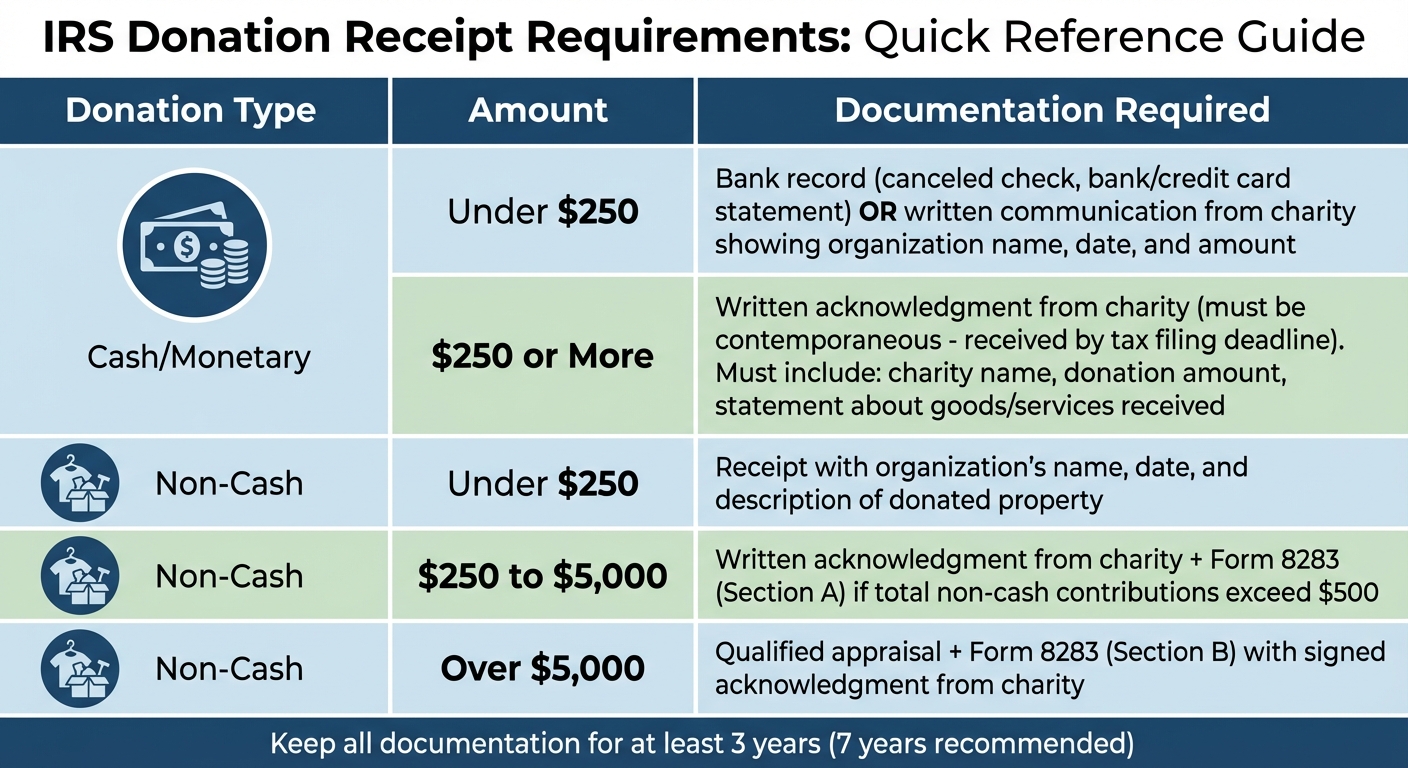
Here’s a quick reference guide to the documentation needed for each type of donation:
| Donation Type | Amount | Documentation Required |
|---|---|---|
| Cash/Monetary | Under $250 | Bank record or written communication from the charity |
| Cash/Monetary | $250 or More | Written acknowledgment from the charity |
| Non-Cash | Under $250 | Receipt with organization's name, date, and description of the donated property |
| Non-Cash | $250 to $5,000 | Written acknowledgment; file Form 8283 (Section A) if total non-cash contributions exceed $500 |
| Non-Cash | Over $5,000 | Qualified appraisal and Form 8283 (Section B) with a signed acknowledgment from the charity |
Next, we’ll explore what makes a donation receipt valid.
What Makes a Donation Receipt Valid
Making sure your donation receipt meets the IRS standards is crucial for a smooth tax filing process. A receipt isn’t valid just because you have it - it must include specific details to comply with IRS rules. Without these elements, your deduction could be denied.
Here’s what you need to know about the information required to make your receipt IRS-compliant.
Information Required on Every Receipt
The details you need depend on the type and size of your donation. For cash donations under $250, you can use a bank record - like a canceled check, bank statement, or credit card statement - or written communication from the charity. This document must include the organization's name, date of the donation, and the amount [6].
For donations of $250 or more, you’ll need a contemporaneous written acknowledgment. This acknowledgment must include the charity's name, the donation amount (or a description of the donated property), and a statement clarifying whether any goods or services were provided in return. To qualify as "contemporaneous", you must receive the receipt by the earlier of two dates: the day you file your tax return or the filing deadline (including extensions) [6]. If your receipt is missing any of these details, request a corrected version from the charity before filing your taxes.
If you received something in return for your donation - like event tickets, a meal, or merchandise - the receipt must estimate the value of those goods or services [6]. Your deduction is then limited to the amount you contributed minus the value of what you received.
Additional Requirements for Non-Cash Donations
Non-cash donations come with extra rules. The receipt must include a detailed description of the donated property, but the charity won’t assign a dollar value - that’s up to you [6]. The description must be clear enough for the IRS to understand what was donated.
For quid pro quo contributions over $75 (where you received goods or services in return), the charity must provide a written disclosure statement. This statement should estimate the value of what you received [6][10]. If the charity fails to provide this disclosure, they could face a penalty of $10 per contribution, up to $5,000 per fundraising event [6].
"The written acknowledgment must state whether the donee provides any goods or services in consideration for the contribution." – IRS [6]
For clothing or household items, the IRS requires that items be in "good used condition" or better to qualify for a deduction [6][1]. If the items are in lesser condition, deductions may be denied unless the total value exceeds $500 and is supported by a qualified appraisal.
For high-value non-cash donations over $5,000, a receipt alone won’t suffice. You’ll need a qualified appraisal, and an authorized official from the charity must sign Part V of Section B on Form 8283 to confirm receipt of the property [7][1]. Without this signature, your documentation isn’t complete.
Lastly, personal records - like your own notes or photos - are no longer enough to substantiate deductions [6]. Proper documentation must come directly from your bank or the charity itself.
Which Organizations and Donations Qualify
Now that we’ve covered receipt validity, let’s dive into ensuring both your donation and the organization receiving it meet IRS requirements.
To qualify for a tax deduction, donations must be made to approved organizations in acceptable formats.
"Charitable contributions, or donations, are gifts of goods or money to a qualified organization. Deductions for these amounts are generally taken on Schedule A – Itemized Deductions for individual taxpayers." – Taxpayer Advocate Service [3]
Knowing which organizations and donations are eligible can save you from surprises when tax season rolls around.
How to Verify an Organization Qualifies
The simplest way to confirm if a charity is IRS-approved is by using the Tax Exempt Organization Search (TEOS) tool at IRS.gov/TEOS [11][13]. This free resource allows you to search the Publication 78 database, which lists organizations eligible to receive tax-deductible contributions [11].
You can search using the charity’s Employer Identification Number (EIN) or its legal name. Searching by the nine-digit EIN is more reliable since it’s a unique identifier [11]. If a name search doesn’t yield results, try using the organization’s official legal name instead of a nickname or DBA (Doing Business As) name [11].
When you find the organization, check its deductibility status code. For instance:
- "PC" indicates a public charity, allowing deductions for cash donations up to 60% of your adjusted gross income (AGI) [12].
- "PF" refers to private foundations, which have lower limits - typically 30% of AGI [12].
Some organizations, like churches, government units, or group ruling subordinates, might not appear in the Publication 78 database but still qualify for tax-deductible donations [11]. If you’re unsure, you can ask the organization for a copy of their IRS determination letter [1].
Additionally, review the Auto-Revocation List to ensure the organization hasn’t lost its tax-exempt status after failing to file required returns for three consecutive years [11]. Donations to organizations on this list are not deductible.
After verifying the organization, the next step is ensuring your donation type meets IRS guidelines.
What Types of Donations Are Deductible
Once you’ve confirmed the organization’s eligibility, make sure your contribution qualifies under IRS-approved categories. Deductible donations include monetary gifts (cash, checks, credit cards, payroll deductions, text donations) and property contributions (used clothing, household items, vehicles, stocks, or real estate) valued at fair market value [1][2][4].
If you volunteer for a charity, you cannot deduct the value of your time or services. However, you can deduct unreimbursed out-of-pocket expenses related to volunteering, such as travel costs, uniforms, or transportation [1].
For quid pro quo contributions - where you receive something in return, like a charity dinner or event tickets - you can only deduct the portion of your payment that exceeds the fair market value (FMV) of what you received [1][4]. Charities are required to provide a written disclosure if your total payment exceeds $75 [5][9].
| Deductible Contributions | Non-Deductible Contributions |
|---|---|
| Churches, synagogues, mosques, temples [1] | Gifts to individuals [8][1] |
| Federal, state, and local governments (public use) [1] | Political groups or candidates [1] |
| Nonprofit schools, hospitals, museums [1] | Social clubs, labor unions, chambers of commerce [1] |
| Public parks and recreation facilities [1] | Value of time or professional services [1][4] |
| Volunteer out-of-pocket expenses [1] | Raffle, bingo, or lottery tickets [1] |
| Salvation Army, Red Cross, United Way, Goodwill [1] | Tuition or enrollment fees [1] |
| Qualified veteran service organizations [1] | Blood donated to a blood bank [1] |
Generally, donations to foreign charities are not deductible. However, exceptions exist for certain Canadian, Mexican, and Israeli charities under tax treaties [1]. Contributions made through crowdfunding platforms like GoFundMe are usually considered personal gifts and are not deductible - unless the recipient is a verified 501(c)(3) organization [3].
Managing Receipts with Deductible.me
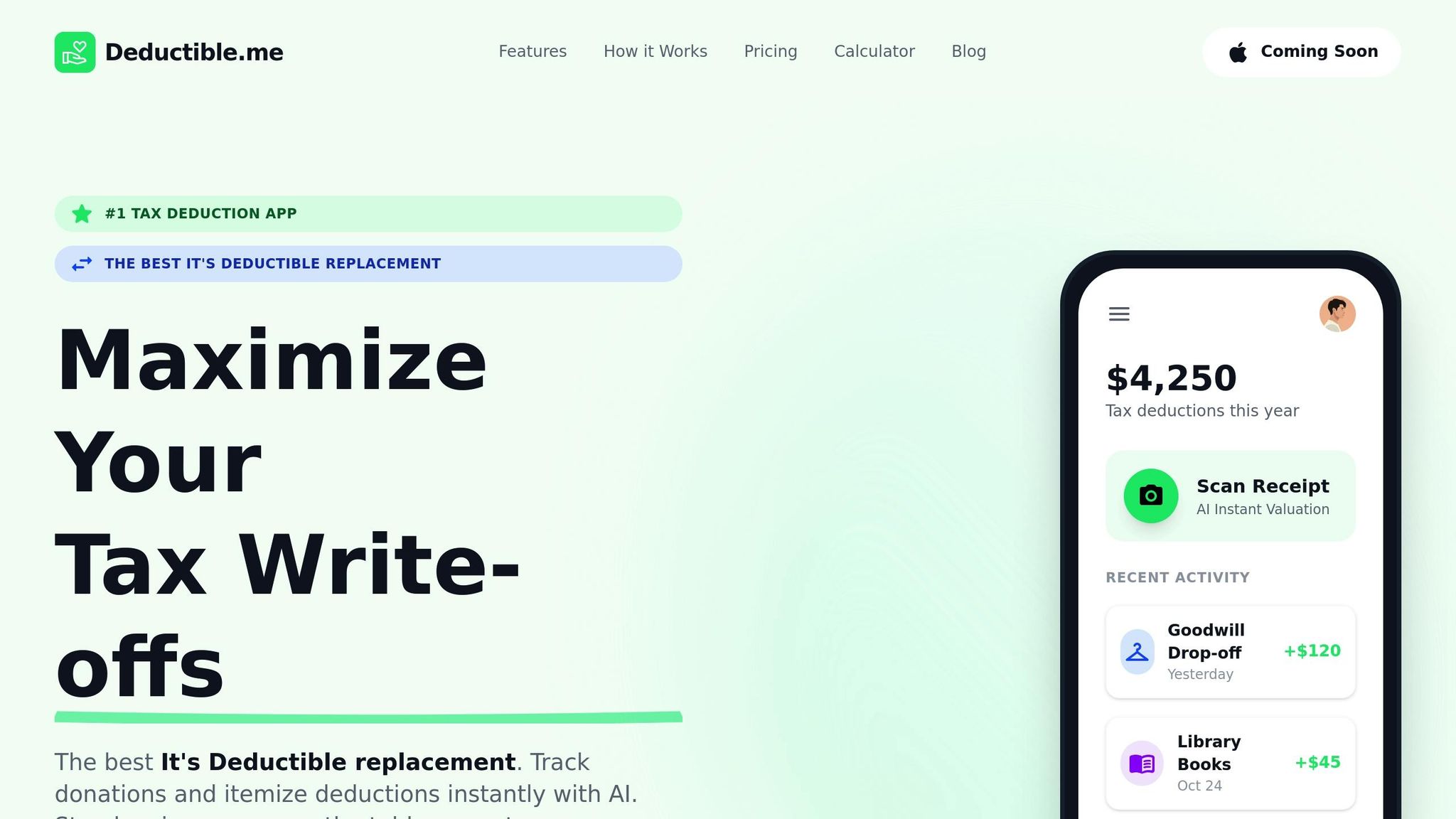
Keeping track of donation receipts can quickly become chaotic with a mix of paper receipts, digital PDFs, and photos. Deductible.me offers a solution to replace the old "shoebox method" of crumpled receipts and endless spreadsheets with a streamlined digital platform. This centralized system not only simplifies record-keeping but also aligns with IRS standards, making tax filing much easier.
Features That Simplify Donation Tracking
Deductible.me provides tools to keep your donation records organized and IRS-compliant. Acting as a secure, centralized hub, it lets you log both cash and non-cash donations instantly. Its AI-powered valuation tool even suggests fair market values based on an item's description and condition - Excellent, Good, or Fair - removing the guesswork and reducing discrepancies.
"DeductAble takes the frustrating guesswork out of the equation by suggesting appropriate values based on the item and its condition." – DeductAble [14]
For non-cash donations, you can document the condition of items by capturing photos, which serve as proof if your deductions are ever questioned. The platform also supports uploading digital receipts - whether PDFs or images of paper acknowledgments - and permanently links them to your donation records. When tax season rolls around, Deductible.me generates a professional, itemized report with all the details required for Schedule A and Form 8283, even for high-value donations over $5,000.
The app works across all devices, from desktops to mobile browsers, so you can record donations no matter where you are.
Why Use Deductible.me
One of the standout benefits of Deductible.me is the time it saves. By recording donations as they happen, you can avoid the last-minute scramble in April and ensure you have a complete, organized record for tax filing. This approach also satisfies the IRS's contemporaneous acknowledgment rule for contributions of $250 or more.
"DeductAble ensures every contribution is logged with the right details from the get-go, building a solid foundation for your tax filings and helping you maximize your itemized deductions." – DeductAble [14]
To minimize errors, use specific item descriptions like "ceramic dinner plates" instead of vague terms like "kitchen items", and attach photos for added accuracy. The platform’s IRS-compliant reporting ensures you include crucial details like the charity’s EIN and donation date.
Deductible.me offers a free plan for occasional donors, allowing tracking of up to $500 in donation value. This includes AI photo scanning, basic receipt tracking, and IRS-compliant reports. For more frequent donors, the Premium plan is available for just $2 per month, providing unlimited donation tracking, advanced analytics, annual giving goal tracking, and priority support.
Conclusion
Main Points to Remember
When it comes to donation receipts, the IRS has clear-cut rules: proper documentation is non-negotiable. Without it, your deduction can be denied[6][2]. For cash donations under $250, you’ll need a bank record or a letter from the charity. If the donation is $250 or more, you must have a contemporaneous acknowledgment[6][5].
Non-cash donations come with stricter requirements as the value increases. Contributions over $500 require Form 8283, and for items worth over $5,000, a qualified appraisal is mandatory[3][6]. Additionally, clothing and household goods must be in at least "good used condition" to qualify[6][15]. Missing any of these details could result in the IRS disallowing your deduction[14].
Staying organized is key. You’re responsible for maintaining proper records and verifying the charity’s tax-exempt status using the IRS Tax Exempt Organization Search tool before making a donation[6][5]. Don’t wait until tax season - request receipts as soon as you donate. Keep all records for at least three years from your filing date, though holding onto them for seven years is a safer bet[14].
FAQs
What if I lose a donation receipt?
If you misplace a donation receipt, reach out to the charitable organization and ask for a replacement. This is important because the IRS requires documentation to verify charitable contributions. Without it, proving your deduction during an audit could be challenging. Staying organized and maintaining accurate records is key to ensuring compliance.
How do I figure out fair market value for donated items?
The IRS describes fair market value (FMV) as the price that a willing buyer would pay to a willing seller for an item, considering its current condition. To determine FMV, you can use methods such as comparing recent sales of similar items, obtaining professional appraisals, or consulting valuation guides - especially for things like clothing or electronics.
For an easier approach, tools like Deductible.me can help. They offer IRS-compliant valuations and ensure accurate reporting, making the process simpler when preparing for tax purposes.
Do I need to itemize to deduct charitable donations?
Yes, to claim a tax deduction for charitable contributions, you need to itemize your deductions. This involves listing all qualifying expenses, such as donations, on your tax return rather than opting for the standard deduction.