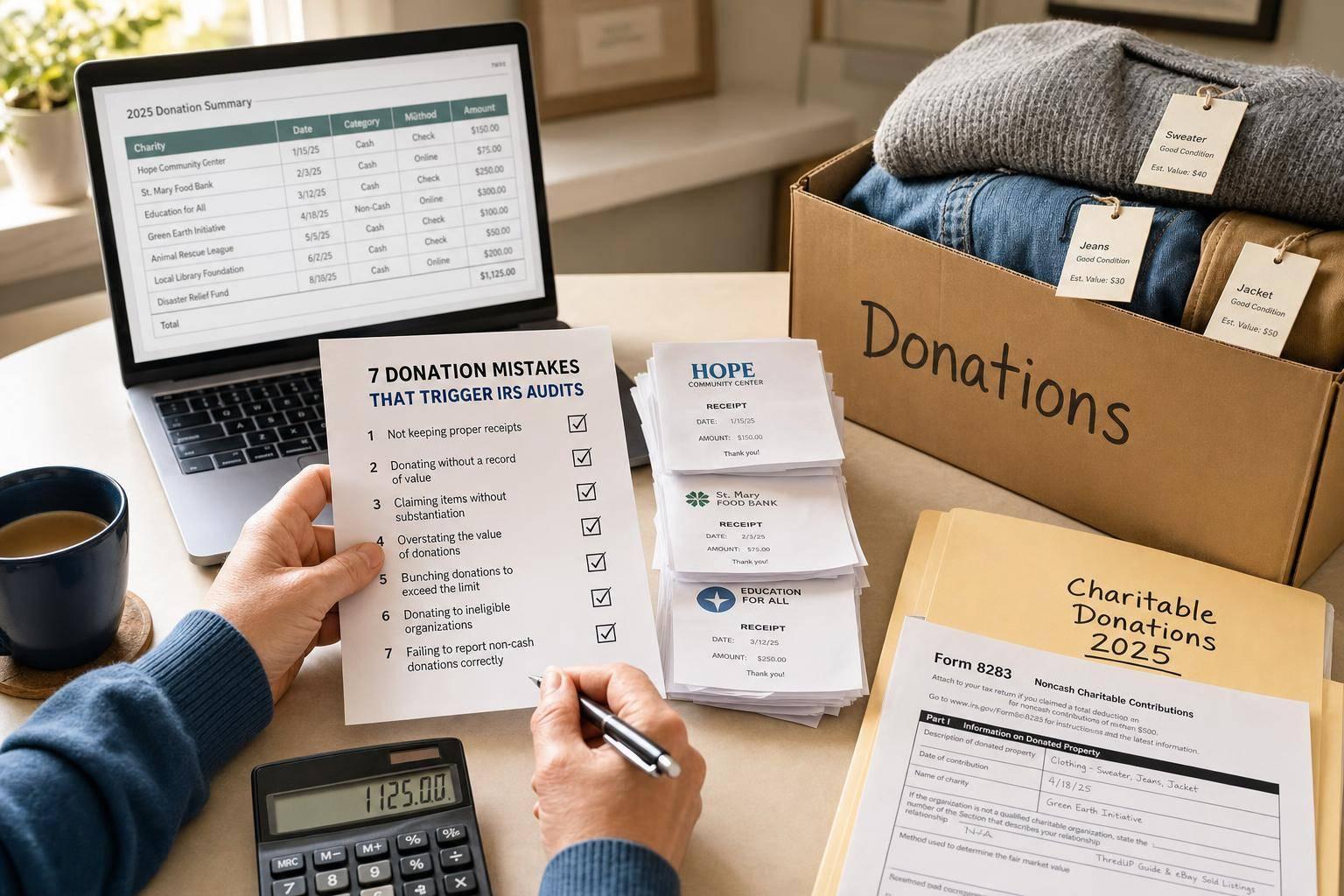
7 Donation Mistakes That Trigger IRS Audits
Most donation audit problems come down to 3 things: missing proof, bad values, and numbers that don’t match. If I itemize, I need to keep receipts, use fair market value for noncash gifts, and make sure every form shows the same totals.
Here’s the short version of what can put a deduction at risk:
- Missing receipts for cash gifts
- Pricing used items too high
- Writing vague descriptions like “bags of clothes”
- Waiting until tax time to rebuild records
- Leaving out or misfilling Form 8283
- Reporting totals that don’t match across forms
- Claiming gifts without the papers the IRS asks for
A few rules matter more than most:
- Cash gifts of $250 or more need a written acknowledgment from the charity before I file.
- Noncash gifts over $500 need Form 8283.
- Noncash gifts over $5,000 usually need an appraisal and the right part of Form 8283.
- For a charity event ticket, I can deduct only the amount above what I got back in food, goods, or services.
Bottom line: if my receipt, value, and tax forms all match, I’m in much better shape.
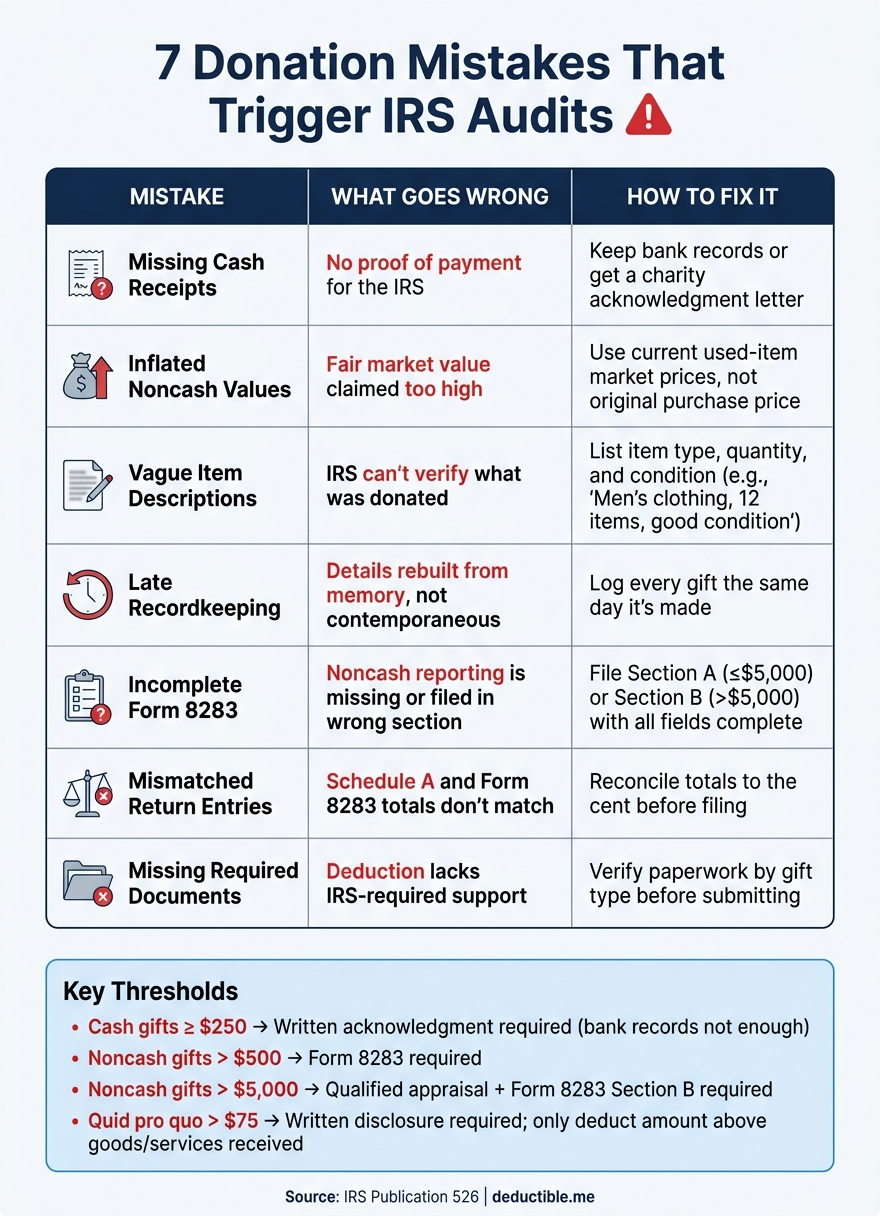
7 Donation Mistakes That Trigger IRS Audits: Quick Reference Guide
The Clothing Donation That Cost Thousands: Avoid This Common Tax Deduction Mistake with Candy Messer
sbb-itb-e723420
Quick Comparison
| Mistake | What goes wrong | What I need to do |
|---|---|---|
| Missing cash receipts | No proof of payment | Keep bank records or charity acknowledgment |
| Inflated noncash values | FMV claimed too high | Use used-item market prices |
| Vague item descriptions | IRS can’t tell what was donated | List item type, count, and condition |
| Late recordkeeping | Details get rebuilt from memory | Log gifts the same day |
| Incomplete Form 8283 | Noncash reporting is missing or wrong | File the right section with all fields filled |
| Mismatched entries | Schedule A and Form 8283 don’t line up | Reconcile totals before filing |
| Missing required documents | Deduction lacks support | Check paperwork rules by gift type |
This is the core of the article: 7 common donation mistakes, why they get IRS attention, and how I can avoid them.
1. Missing receipts for cash donations
This mistake happens more often than people think. You drop cash in a collection basket, mail a check, or tap to give online, then the receipt disappears. When tax season rolls around, you remember making the gift, but you can’t prove it.
This is a proof issue, not a pricing issue. For cash donations under $250, a bank record - like a canceled check, bank statement, or credit card statement - or a written acknowledgment from the charity is enough. Once one gift hits $250 or more, the rules get stricter. You need a contemporaneous written acknowledgment from the charity that includes:
- The organization’s name
- The date of the gift
- The amount donated
- A statement saying whether you received any goods or services in return
“Contemporaneous” means the acknowledgment has to arrive before you file your tax return. If that letter is missing, the deduction may not hold up.
Debit card, credit card, and app-based donations follow the same rule. If the charge is made on December 31, it counts for that tax year, even if you don’t pay the credit card bill until January. For payroll deductions, keep a pay stub or Form W-2 along with a pledge card that names the charity.
How to keep proof for cash gifts
The easiest habit is to save the paperwork when you donate, not later when the details are fuzzy. Write down the charity’s name, the date, and the exact amount right away. If the gift is $250 or more, ask for the acknowledgment letter at the time of the donation.
If a receipt goes missing, contact the charity and ask for a replacement acknowledgment with the original gift details. Digital receipts and scanned copies are fine for IRS purposes as long as you can find them when you need them.
Use this documentation checklist:
| Donation Type | Required Documentation |
|---|---|
| Cash under $250 | Bank record (check/statement) OR written acknowledgment from charity |
| Cash $250 or more | Contemporaneous written acknowledgment from charity (bank records are not sufficient) |
| Payroll deduction | Pay stub, W-2, or employer document AND a pledge card with the charity's name |
| Quid pro quo (over $75) | Written disclosure showing the deductible amount (gift minus value of goods/services received) |
The next risk is overvaluing noncash donations.
2. Inflated values for noncash donations
When you donate a bag of clothes or an old couch, it’s easy to default to the price you paid. That’s usually the wrong number.
The IRS wants fair market value (FMV) instead. In plain English, that means what someone would pay for the item today, not what it cost when it was new. For most household goods, that usually means checking recent prices for similar used items. Use the item’s current fair market value, not the price you paid.
Condition matters too. Clothing and household items generally need to be in good used condition or better to qualify for a deduction at all. If something is heavily worn, stained, or broken, it often won’t qualify, and the IRS can disallow the deduction in full if the item’s condition falls short of that standard [4][9][10]. And once the value is right, the next audit risk is often a fuzzy item description.
How to avoid overvaluing donated items
Don’t ask the charity to assign the value. The charity can say what it received, but putting a dollar amount on the donation is your job as the donor [3].
A simple record can save you a headache later:
- Photograph each item
- Note its condition
- Record the charity name and donation date
- Write down your estimated FMV
Keep the photo with your donation log. A clear description gives you one more layer of support if your deduction gets a closer look.
3. Vague item descriptions
Even if you’ve nailed the fair market value, a fuzzy description can still attract IRS attention. Entries like “bags of clothes” or “miscellaneous household items” don’t say much. The number might be right, but the write-up still falls short if the IRS can’t tell what you gave.
That problem gets bigger when the claimed amount is high. Vague descriptions tied to large noncash donations stand out because Form 8283 asks for a description of the donated property. If your entry is unclear, it’s harder to back up the deduction. And if the IRS decides the value was overstated by a lot, you could face a 40% penalty on the tax underpayment [5].
How to write clear donation logs
Be specific with each item. A good description should spell out the item type, how many you donated, and the condition.
| Vague Description | IRS-Compliant Description | Key Details Added |
|---|---|---|
| Bags of clothes | Men's clothing, 12 items, good condition | Category, quantity, condition |
| Household items | Wooden dining chairs (x4), like-new | Specific item, quantity, condition |
| Kitchen stuff | Stand mixer, good condition | Specific item, condition |
| Electronics | Apple MacBook Pro 2021, excellent condition | Brand, model, year, condition |
If you’re donating a big batch of similar items, the IRS lets you group them. But the description still needs to include the category, quantity, and condition [1]. High-value items should be listed one by one, while similar lower-value items can be grouped [1][6]. And if your total noncash donations go over $500, you need to file Form 8283 [1][4].
Write these details down at the time of donation. Trying to piece them together later is usually where the next problem begins.
4. Late recordkeeping
If you wait until January to sort your records, you end up rebuilding the whole year from memory. That’s a problem. The IRS expects donation records to be created when the gift is made, not months later. For gifts of $250 or more, you need the acknowledgment in hand by the filing deadline or extended deadline [7][3]. Courts often side with denied deductions when taxpayers can’t produce contemporaneous documentation [7].
The fix isn’t complicated: record each gift as soon as you make it.
Waiting too long can also make valuation harder to defend, especially for items with resale prices that shift over time [7].
How to avoid rebuilding records at year-end
Log each donation the same day it happens. Take a photo of the donated items, ask for a receipt before you leave, and save it somewhere easy to find later. If you forget the receipt, contact the charity right away. Don’t put it off until tax season.
A running log throughout the year is much easier to defend than notes pieced together at filing time. And once your records start slipping, form mistakes usually come next. Late recordkeeping also makes Form 8283 errors more likely.
5. Missing or incomplete Form 8283
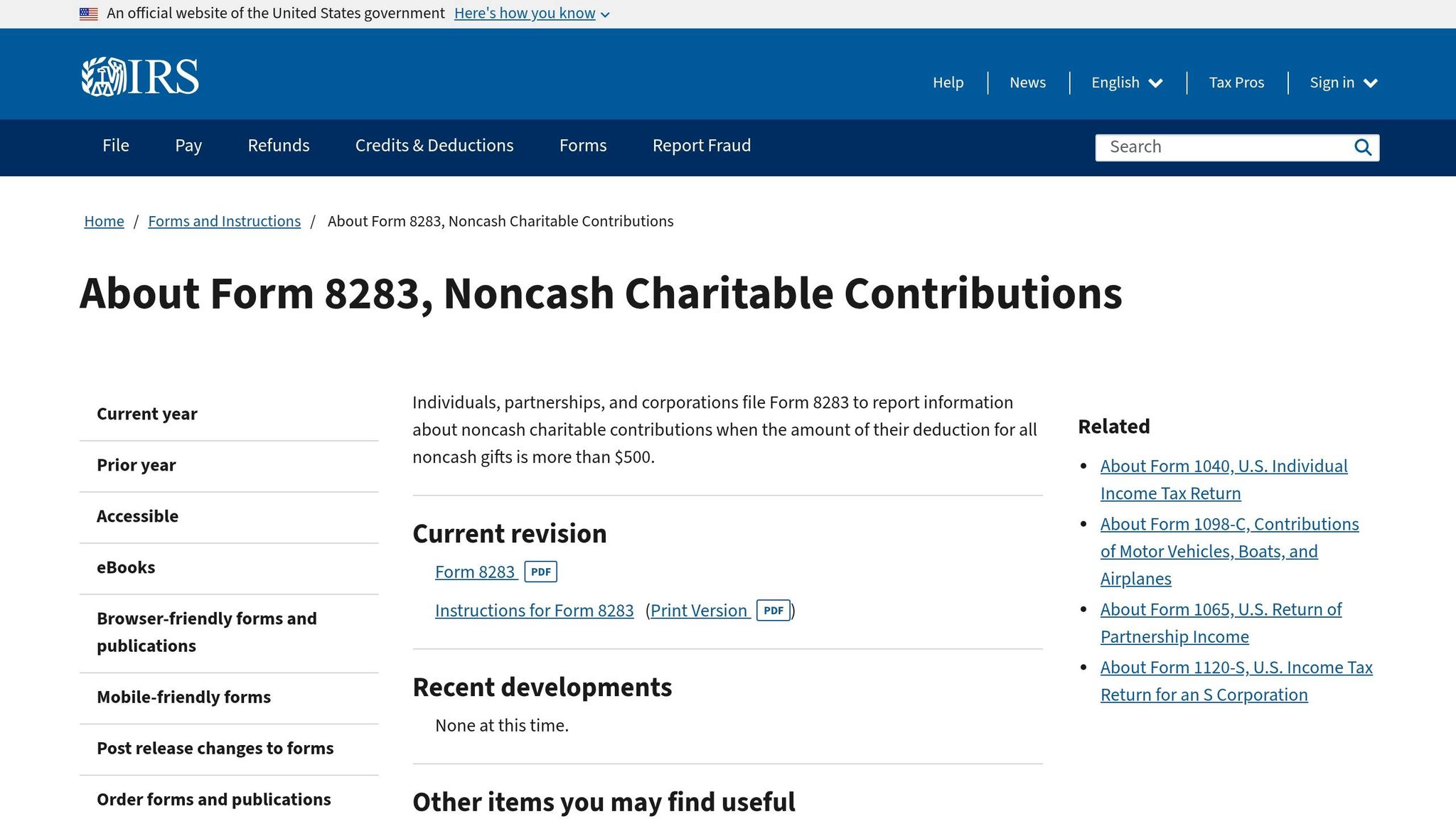
Once your records are in order, the next problem is simple: filing the wrong form, or filing Form 8283 with missing details. That can delay your noncash deduction or knock it out altogether. And when the form doesn't line up with your records, it can draw IRS attention.
If your total noncash donations for the year are more than $500, you must attach Form 8283 to your return [4][1][11]. A missing total, the wrong section, or even one blank field can create trouble.
Section A is for individual items or groups of similar items valued at $5,000 or less. It also covers publicly traded securities at any value. Section B is for any single item or group of similar items worth more than $5,000. Put the donation in the wrong section, and the filing may not hold up. Section B also requires a qualified appraisal and signed statements from both the appraiser and the charity [1][11].
Use the table below to match the donation to the right section.
| Section A | Section B | |
|---|---|---|
| Value threshold | $5,000 or less per item/group | Over $5,000 per item/group |
| Qualified appraisal | Not required | Required |
| Appraiser signature | Not required | Required (Part 4) |
| Charity signature | Not required | Required (Part 5) |
Before you file, total all noncash donations. Then fill in the charity, property description, date, acquisition method, basis when required, FMV, and valuation method [1][11]. Vague descriptions are a common reason fields get left incomplete.
There’s one more item people miss: vehicle donations over $500 also require Form 1098-C [8].
Once Form 8283 is done right, the next risk is mismatched return entries.
6. Mismatched return entries
Schedule A and Form 8283 need to show the same noncash total. When they don't, the problem is usually pretty simple: rounding, double-counting, or mixing personal and business records.
A lot of people trip up by rounding receipt amounts or rolling separate donations into one number. That can throw the totals off fast. Double-counting shows up most often when you bunch gifts into one tax year and accidentally log the same item twice [4]. The same kind of mismatch can happen when personal and business donation records get mixed together. For example, if a donation paid from a business account gets claimed as a personal deduction on Schedule A, or the other way around, the numbers won't line up [8].
Split donations can cause trouble too. They may push Schedule A over the Form 8283 filing threshold while the form itself stays blank, which can trigger a rejection.
Quid pro quo contributions are another common issue. Say you buy a charity gala ticket for $300 and the dinner is worth $80. Only $220 is deductible. If you claim the full amount and don't subtract the value of what you received, your deduction may not match the charity's required written disclosure [8].
How to catch filing mismatches before you submit
Before filing, total your cash gifts and non-cash gifts separately. Don't combine them into one figure [4]. Then open the actual PDF of your return and check that the non-cash total on Schedule A matches the total FMV listed on Form 8283 down to the cent [1]. While you're there, make sure Form 8283 isn't blank.
Use this last review before you submit:
| What to Check | What It Should Match |
|---|---|
| Schedule A non-cash total | Total FMV on Form 8283 [1] |
| Each receipt amount | Exact figure entered on the return (no rounding) [2][6] |
| Charity name on receipt | Charity's legal name |
| Quid pro quo contributions | Net deductible amount (gift minus goods/services received) [8] |
| Entity on receipt | Tax return being filed (personal vs. business) [8] |
A tracking app can help keep receipts and donation totals in one place.
7. Claiming donations without the required documentation
Good intentions don't count for much if you can't prove the gift. The IRS can reject a charitable deduction when the right records aren't there. Even if the amount is correct, missing paperwork can sink the deduction.
How to make sure each deduction is properly supported
Use this as a last check before you file:
- Cash gifts under $250: bank record or written acknowledgment
- Cash gifts of $250 or more: contemporaneous written acknowledgment - bank records alone are not enough [2][3]
- Noncash donations over $500: Form 8283 Section A required [1]
- Noncash donations over $5,000: qualified written appraisal and Form 8283 Section B, signed by the appraiser and the charity [1]
- Quid pro quo contributions over $75: written disclosure from the charity showing the deductible portion - only the amount above the value of goods or services received qualifies [8]
Missing even one required document can cause a problem, so ask for it before you file.
Conclusion: A short checklist to lower donation audit risk
All seven mistakes come back to three issues: weak proof, poor valuation, and records that don’t line up. When your proof, values, and totals match, your return is much less likely to draw attention.
Before you file, use this quick checklist:
| What to Do | Why It Matters |
|---|---|
| Get receipts right after donating | Helps prevent missing proof |
| Use realistic fair market values | IRS expects donor valuation |
| Describe items specifically on logs | Vague entries are harder to defend |
| Track donations throughout the year | Cuts down on year-end errors |
| Complete Form 8283 for noncash gifts over $500 [1][4] | Required for larger noncash gifts |
| Reconcile your totals before filing | Helps catch mismatches before submission |
| Verify each deduction is documented | Missing records can put deductions at risk |
Keep receipts, photos, and acknowledgments in one place so filing stays simple and easier to back up. Deductible.me can help with item valuation, receipt tracking, and IRS-compliant reporting.
FAQs
Do I need to itemize to deduct donations?
Yes. To deduct charitable donations, you need to itemize deductions on Schedule A. If you take the standard deduction, you usually can’t write off those gifts.
So the key step is simple: compare your total itemized deductions with the standard deduction for your filing status. If your itemized total is higher, itemizing may make more sense.
Also, save your receipts and bank records. If the IRS asks questions, that paperwork backs up your claim.
What counts as fair market value for donated items?
Fair market value is the price a willing buyer would pay for an item in its current condition on the open market, like at a thrift store or resale marketplace.
For non-cash donations, you need to figure out this amount based on comparable sales, replacement cost, or a qualified appraisal for high-value items. To qualify, the items must be in good condition or better.
What if I lost a donation receipt?
If you lose a donation receipt, you could lose the deduction too. The IRS usually wants documentation at the time you file, not later. And for donations of $250 or more, you need a written acknowledgment from the charity before you submit your return.
Missing a receipt? Contact the organization as soon as you can and ask for a copy. To make this less of a headache next time, Deductible.me offers donation tracking and IRS-compliant reports.