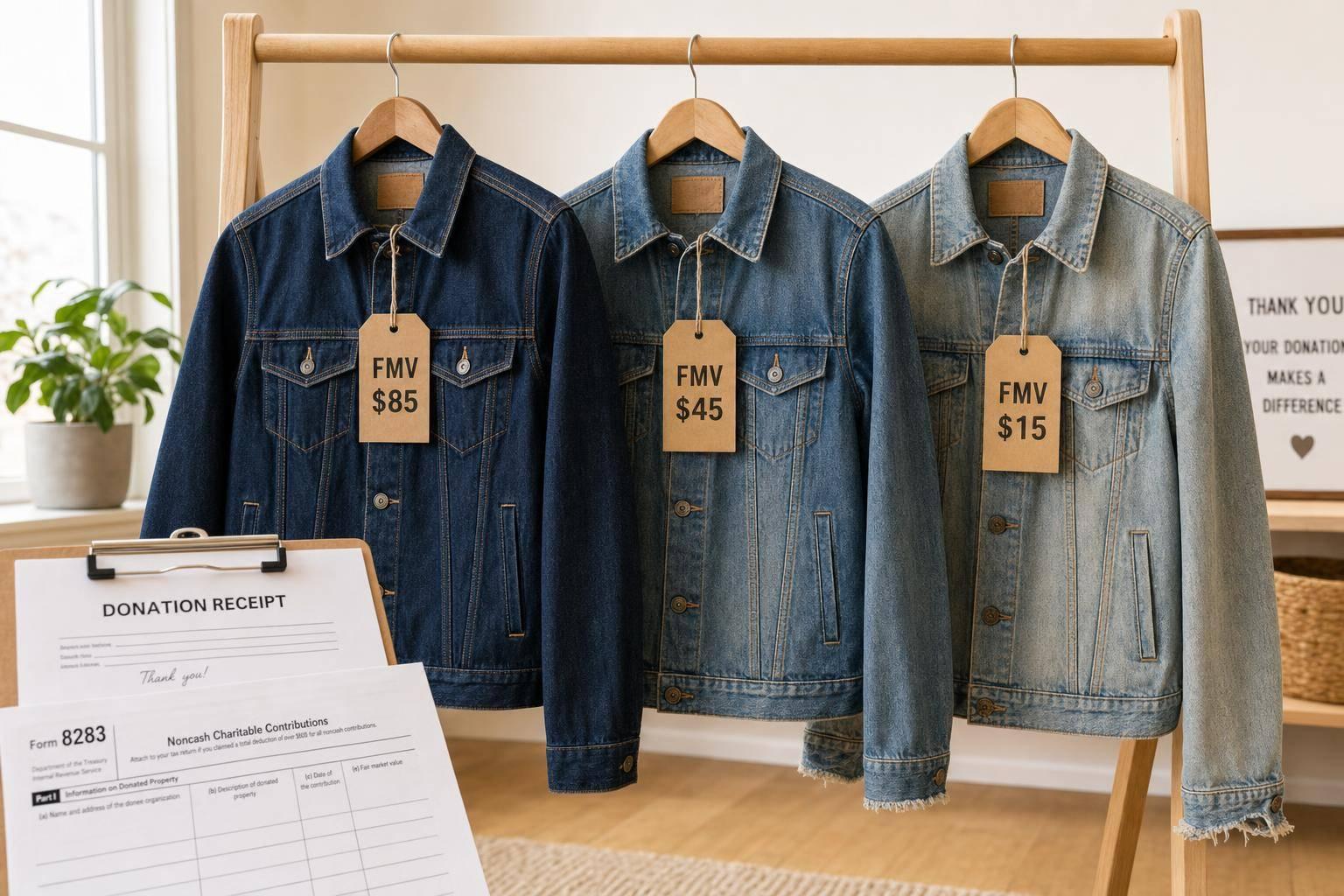
How Depreciation Affects Donation Value
Most donations are worth far less than what you paid. If you claim the wrong number, you could lose part of your deduction or face a 20% or 40% IRS penalty.
Here’s the short version: I should use the item’s fair market value on the donation date, not the old purchase price. For used items like clothes, furniture, and laptops, that usually means checking what similar items actually sold for in used markets. If the item is worn out or broken, the deductible value may be $0. If it’s business property, prior depreciation can shrink the deduction even more.
Before I file, I want to make sure I do these things:
- Use current used-item prices, not retail receipts
- Match the value to the item’s condition
- Keep photos, dates, and charity receipts
- File Form 8283 if the deduction is over $500
- Get an appraisal if the claimed amount is over $5,000
- Watch for business-use and depreciation rules
A few numbers make the point fast:
- A 5-year-old laptop that once cost $1,000 may now be worth only $50 to $150
- A used sofa may fall from $800+ new to about $40 to $400
- Clothing and household goods usually must be in good used condition or better
- Claiming 200% or more of the correct value can trigger a 20% penalty
- Claiming 400% or more can trigger a 40% penalty
| Item or Rule | What I should know |
|---|---|
| Personal items | Deduction is usually based on FMV |
| Broken or poor-condition goods | Value may be $0 |
| Business property | Prior depreciation may cut the deduction |
| Over $500 | Form 8283 may be needed |
| Over $5,000 | Qualified appraisal is usually needed |
So the main idea is simple: don’t price donations like new items. I should price them like used items on the day I gave them away, then keep enough records to back it up.
How the IRS Values Donated Property That Has Depreciated
Fair Market Value vs. Adjusted Basis
When you donate property that has gone down in value, the IRS looks at fair market value (FMV) and adjusted basis.
Adjusted basis usually starts with what you paid for the item, then adds any improvements and subtracts any depreciation you already claimed [3]. For personal property, FMV is usually the number that matters. For business or rental property, both FMV and adjusted basis can put a cap on the deduction.
Here’s the core idea: if the property's FMV is lower than its adjusted basis on the donation date, your deduction is limited to that lower FMV [3]. So if the item has lost value, that drop can shrink the write-off.
When Depreciation and Recapture Limit Your Deduction
For personal items like clothing or furniture, the deduction is usually based on the item’s lower current value.
Business property works differently. If you donated depreciable equipment, depreciation recapture can cut the deduction. And if the asset is fully depreciated, the deduction may be very small or even zero [3].
That rule has a simple purpose: it stops a double tax break. You can’t write off depreciation against ordinary income and then also claim a full charitable deduction based on the same value [3].
Once you know the deduction limit, the next job is backing it up with the proper paperwork.
Forms, Records, and Appraisal Requirements
IRS record rules change based on the deduction amount:
| Deduction Amount | Key Requirements |
|---|---|
| Less than $250 | Receipt from the charity with name, date, and description [7] |
| $250 – $500 | Written acknowledgment from the charity [7] |
| Over $500 – $5,000 | Written acknowledgment plus Form 8283, Section A [4] |
| Over $5,000 | Written acknowledgment, Form 8283, Section B, and a qualified appraisal [4] |
| Over $500,000 | All of the above, with the appraisal attached to your tax return [7] |
IRS Publication 561 is the main guide for figuring out the value of donated property, and Publication 526 covers the general rules for charitable contributions [4][7].
If your deduction is over $5,000, you must file Form 8283, Section B and include a qualified appraisal signed by both the appraiser and the charity [4].
Condition matters too. It can affect both whether the item qualifies and how much you can deduct. Clothing and household goods must be in good used condition or better. Items in poor condition usually don’t qualify [4].
sbb-itb-e723420
Are Tax-Deductible Donations Even Worth It?
Common Donation Valuation Mistakes
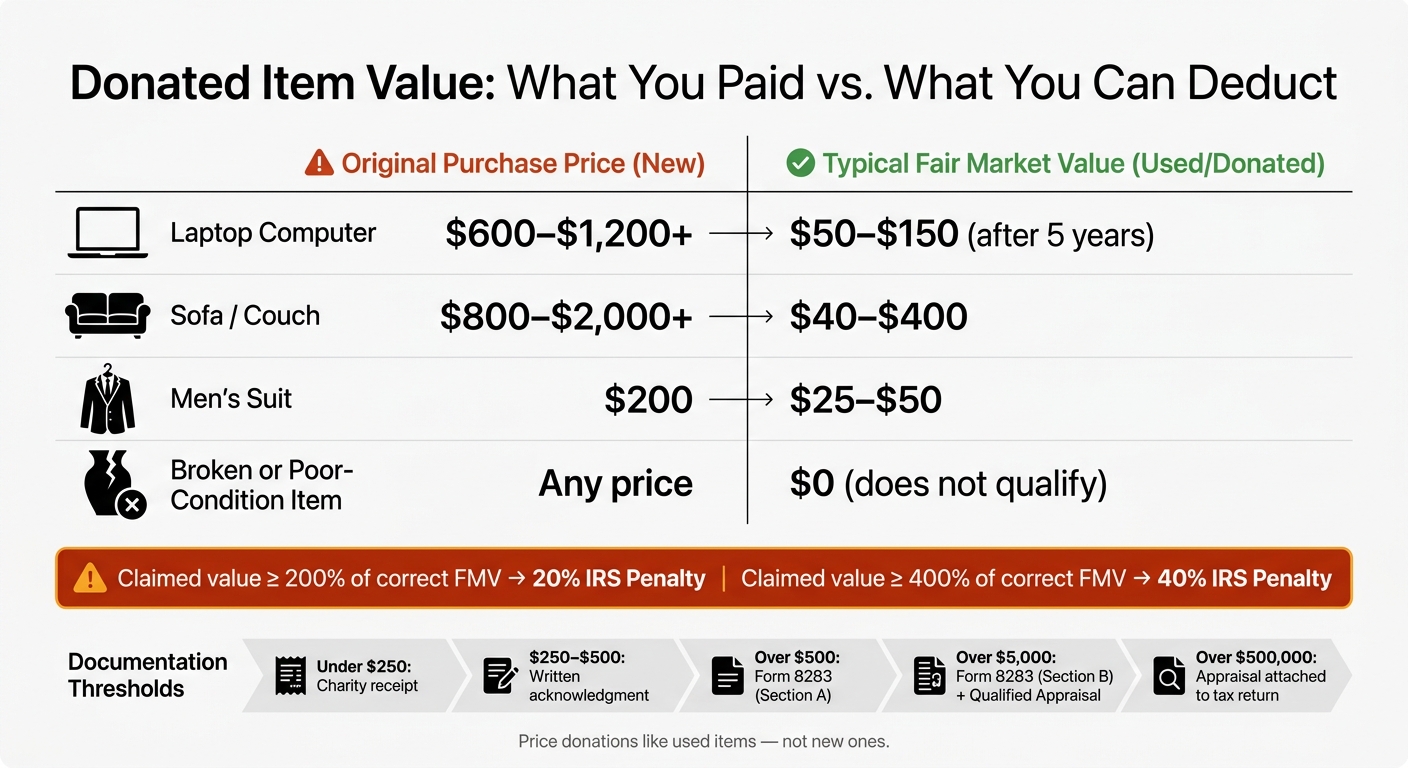
Donated Item Value: What You Paid vs. What You Can Deduct
Once you know the IRS looks at fair market value, the next job is avoiding the mistakes that can push that number too high. The most common problem is simple: people use the old purchase price instead of the item’s value at the time of the donation. That usually happens when depreciation, wear, and earlier tax treatment get ignored.
Household Goods Lose Value Faster Than Most People Expect
A sofa usually isn’t worth anything close to what it cost new when you donate it. In good used condition, it may land in the $40–$400 range [2][8]. A laptop works the same way: a 5-year-old machine often has a fair market value of only $50–$150, no matter what it sold for at retail [1].
| Item | Original Price (New) | Typical FMV (Used) |
|---|---|---|
| Sofa / Couch | $800–$2,000+ | $40–$400 |
| Laptop Computer | $600–$1,200+ | $50–$400 |
These figures reflect typical thrift-store pricing [2][8].
In plain English, condition usually matters more than the original price tag.
Poor Condition Can Reduce an Item's Value to Almost Nothing
Poor condition can cut an item’s value to $0. Clothing and household goods generally need to be in good used condition or better to qualify for a deduction. Stains, tears, missing parts, or electronics that don’t work will often drop the deductible value to $0, no matter what you paid in the past. If an item isn’t usable, its value may be $0.
Business and Mixed-Use Property Require Extra Attention
Business and mixed-use property needs a closer look. If you’re valuing this kind of item, track any prior depreciation and Section 179 deductions before you assign a number. Keep records showing:
- the business-use percentage
- the original acquisition date
- the total depreciation already claimed [3]
Without that paper trail, the deduction is much harder to support.
Those records matter because the next step is documenting the value you claim.
How to Calculate and Document a Realistic Donation Value
Base Your Values on Used-Market Prices, Not Retail Receipts
Once you know the rules, the next step is simple: price items based on what they sell for used, not what you paid at the store.
That means checking current resale prices on places like eBay and Facebook Marketplace. Look at sold listings, not asking prices, and compare items that are in a similar condition. Local thrift store prices can also give you a solid gut check because they show what buyers in the market will actually pay [2][5].
Before you look up prices, sort each item into a condition bucket:
- Excellent - like new, no visible wear (~60–70% of original cost)
- Good - minor wear, fully functional (~40–60% of original cost)
- Fair - noticeable wear but still usable (~20–40% of original cost) [2][5]
Here’s where many people get tripped up: retail price and resale value are often miles apart.
A men's suit that cost $200 new will often fall in the $25–$50 range at a thrift store. That gap is bigger than most people expect, but it lines up with how used goods are priced in practice [2][5].
Records You Should Keep for Every Donation
Document each item before you donate it. After you estimate FMV, keep the proof together in one place so you’re not scrambling later.
For each donation, keep:
- Original cost (if known) and the date you acquired the item
- Date of donation and the name of the receiving charity
- Photos showing the item’s actual condition
- Condition notes with specifics, such as "minor scuff on left armrest", not just "used"
- The method used to estimate FMV, such as eBay sold listings or a thrift store price guide
- For business property: the amount of depreciation previously claimed
| Donation Value | Required Documentation |
|---|---|
| Under $250 | Receipt from the charity with name, date, location, and item description |
| $250–$500 | Contemporaneous written acknowledgment from the charity |
| Over $500 | Form 8283 (Section A) including acquisition date and cost basis |
| Over $5,000 | Section B of Form 8283 and a qualified appraisal |
There’s a good reason to be careful here. If the IRS decides your claimed value is 200% or more of the correct amount, it can charge a 20% penalty on the tax underpayment. That jumps to 40% if the claimed value is 400% or more of what it should have been [6].
Tools That Make Valuation and Reporting Easier
If you want to make this less of a chore, it helps to use a tool that keeps the photos, FMV, and records together.
Deductible.me can scan photos, estimate FMV using current market data, and organize donation records in a format that’s ready for IRS reporting.
Conclusion: Most Donated Items Are Worth Less Than Their Purchase Price
Most donated items are worth less than what you paid for them. Wear, age, and shifts in the market usually pull the value down. That’s why FMV, not original cost, determines the deduction.
The IRS looks at fair market value on the date of the donation. So in most cases, your deductible amount should match the item’s current used-market value, not the price on the old receipt.
The rules get tighter with business property. If the property was used for business or partly for business, adjusted basis and depreciation recapture may cut the deduction even more.
Photos, condition notes, comparable sales, and the right IRS forms help back up the claim.
Key Takeaways for Accurate Donation Reporting
In practice, here’s what that means:
- Use FMV, not purchase price.
- Value the item as used, not new.
- Track adjusted basis and recapture for business property.
- Use the required forms and appraisal at the right thresholds.
Deductible.me can scan photos, estimate FMV, and organize IRS-ready donation records.
FAQs
How do I prove fair market value?
To prove fair market value (FMV), show what a willing buyer would pay a willing seller in an open market.
That means looking at practical details like the item’s age, brand, and condition. Then back up your estimate with comparable sales from thrift stores, consignment shops, or online marketplaces.
Good records matter here. Keep:
- a clear description of each item
- notes on condition
- photos
- your donation receipt
If your donation is worth more than $5,000, you’ll generally need a qualified appraisal.
What if I don’t know what I originally paid?
If you don’t know what a donated item cost when it was first bought, you can still figure out its value by estimating its current fair market value (FMV).
A simple way to do that is to look up recent sale prices for similar items in similar condition on sites like eBay or Craigslist, or check prices at local thrift stores. Deductible.me can make this easier with AI-powered valuation tools and IRS-compliant records.
When does donated business property need extra tax review?
Donated business property needs a closer tax review in two common cases:
- Your total yearly non-cash donations are more than $500
- A single item, or a similar group of items, is worth more than $5,000 and needs a qualified appraisal
You’ll also need to work out the asset’s adjusted tax basis and check whether the gift creates ordinary income. Why does that matter? Because either one can cut your deduction below fair market value.
Deductible.me can help generate IRS-compliant Form 8283 reports.