
How to Use Charitable Giving in Retirement Planning
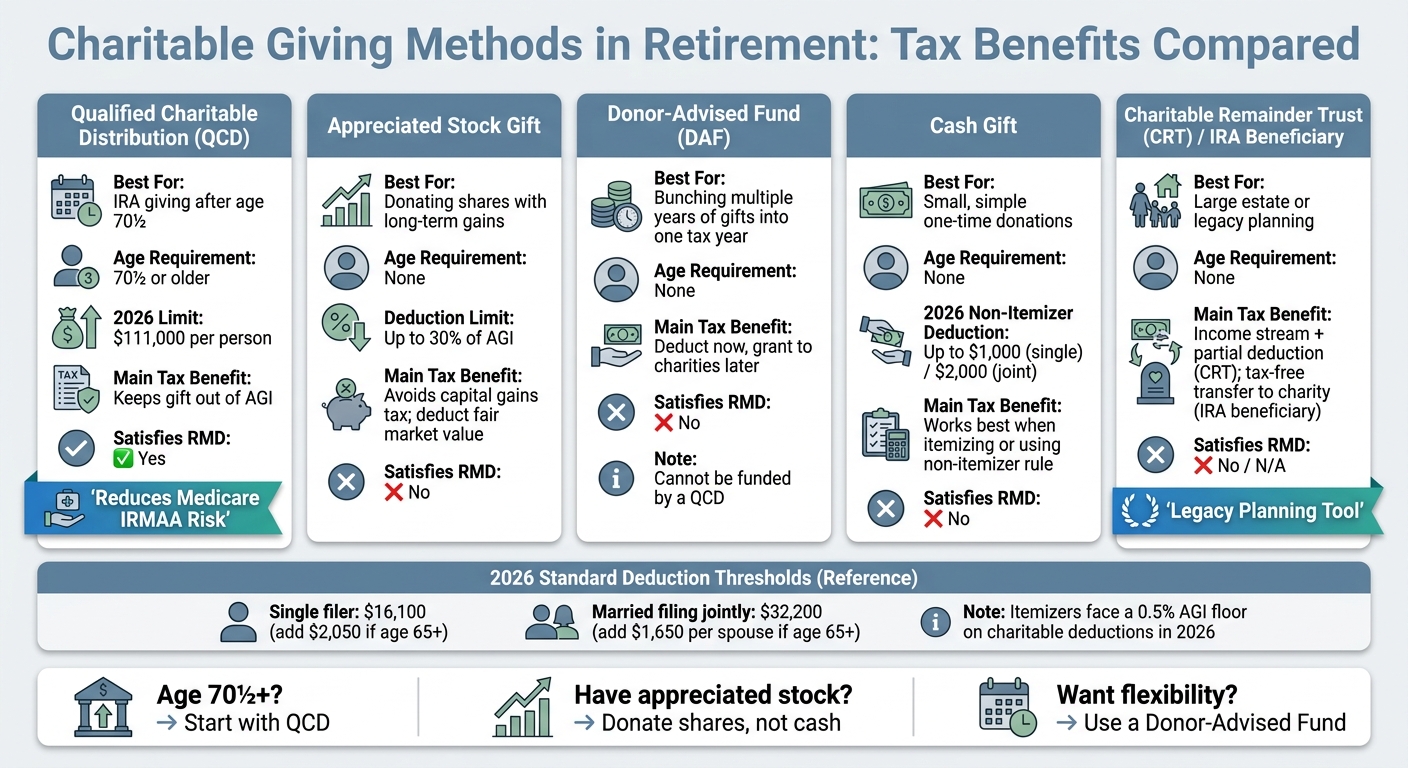
Giving in retirement can lower taxes, but only if I use the right method. A cash gift may do little for me if I take the standard deduction, while a QCD, a gift of appreciated stock, or a donor-advised fund may cut taxes and protect income at the same time.
Here’s the short version:
- I should set a giving limit first so donations do not come from money I may need for living costs, health care, or a market downturn.
- If I am 70½ or older, a QCD can send up to $111,000 from an IRA to charity in 2026 and may count toward my RMD without adding to AGI.
- If I hold stock with gains for more than one year, giving shares instead of cash may help me avoid capital gains tax and still deduct the fair market value, subject to AGI limits.
- If I want to bunch several years of gifts into one year, a DAF can help me itemize in that year and give grants later.
- If I want a legacy gift, I may look at a charitable remainder trust or name a charity as an IRA beneficiary.
- For 2026, the standard deduction is $16,100 for single filers and $32,200 for married couples filing jointly, with extra amounts if I’m 65+.
- If I itemize in 2026, charitable deductions face a 0.5% AGI floor. If I do not itemize, I may still deduct up to $1,000 single or $2,000 joint for direct cash gifts to public charities.
My main takeaway: I should not start with the charity. I should start with my cash flow, AGI, deduction rules, and records. Then I can match each gift to the tool that puts the least pressure on my retirement income.
| Method | Best use | Main tax angle | RMD help |
|---|---|---|---|
| QCD | IRA giving after age 70½ | Keeps gift out of AGI | Yes |
| Appreciated stock | Donating shares with gains | May avoid capital gains tax | No |
| DAF | Bunching gifts into one tax year | Deduct now, grant later | No |
| Cash gift | Small, simple donations | Works best if I itemize or use the non-itemizer rule | No |
| CRT / IRA beneficiary | Large estate or legacy plan | Income, deduction, or tax-smart transfer at death | No / N/A |
That’s the framework I’d use to give with more control and less tax drag in retirement.
Charitable Giving Methods in Retirement: Tax Benefits Compared
Maximize Your Charitable Giving: Tax-Efficient Strategies for Retirees
sbb-itb-e723420
Step 1: Review your cash flow, taxes, and deduction rules before you give
After you set your annual giving limit, look at the income that will support it. That usually includes Social Security, pensions, annuity income, IRA or 401(k) withdrawals, taxable investment income, and RMDs. RMDs start at age 73 if you were born from 1951 through 1959, or at age 75 if you were born in 1960 or later [5]. From there, you can estimate your AGI. That number matters because it can affect your tax bill, how much of your Social Security is taxed, and even your Medicare premiums.
Know when a charitable deduction actually lowers your taxes
Here’s the part many people miss: a donation doesn’t always cut your federal taxes.
Most taxpayers use the standard deduction, which means many cash gifts don’t create any extra tax break. For 2026, the standard deduction is $16,100 for single filers and $32,200 for married couples filing jointly [2]. If you’re 65 or older, you can add $2,050 if single or $1,650 per spouse if married [2]. So if both spouses are over 65, a married couple would need more than $35,500 in itemized deductions before itemizing beats the standard deduction.
A couple of tax-savvy moves can help if your goal is to give and cut taxes at the same time:
- Bunch several years of gifts into one tax year, often with a donor-advised fund, so your itemized deductions clear the standard deduction hurdle.
- Donate appreciated stock you’ve held for more than one year. If you transfer the shares straight to a charity, you can skip capital gains tax and deduct the full fair market value, up to 30% of AGI [7][1].
There’s one more rule to watch in 2026. For people who itemize, charitable deductions are subject to a 0.5% AGI floor, so only the amount above 0.5% of your AGI counts as deductible [4][9]. On the flip side, if you don’t itemize, there’s a new break for direct cash gifts to public charities: up to $1,000 for single filers or $2,000 for joint filers [3][9]. That said, it does not apply to donor-advised funds [3][9].
Keep the records the IRS requires
This is one of those small details that can turn into a headache later. If the paperwork isn’t right, the deduction may not hold up.
Keep these records for each kind of gift:
- Any donation of $250 or more: Get a contemporaneous written acknowledgment from the charity.
- Non-cash gifts over $500: File Form 8283 with your return.
- Non-cash gifts over $5,000: You also need a qualified appraisal, unless the gift is publicly traded stock [9].
QCDs have their own wrinkle. Your IRA custodian will send Form 1099-R, but it usually won’t label the distribution as a QCD. A QCD can count toward part of your RMD without adding to taxable income, but only if you report it the right way on Form 1040 so it isn’t taxed as ordinary income [6][11].
If you keep track of non-cash donations during the year, Deductible.me can help store receipts, track donation values, and create IRS-compliant reports.
Once you have your AGI estimate, know your deduction limits, and have your records in order, you’re in a much better spot to pair each gift with the best giving tool.
Step 2: Pick the right charitable giving tool for your retirement stage
Once you know your AGI, your deduction threshold, and your giving budget, the next step is simple: pick the giving tool that matches your stage of retirement.
That choice matters more than it may seem. The right setup can cut taxes, protect cash flow, or do both. Some tools are best when you need income now. Others work better when you want the tax break this year, but plan to send money to charities later. And some are built less for annual giving and more for legacy planning.
How qualified charitable distributions from an IRA work
A qualified charitable distribution (QCD) lets you send money straight from a traditional IRA to a qualified charity, and that amount is left out of your income. You must be 70½ or older to use a QCD, and the money has to move directly from your IRA custodian to the charity [5][13][9].
The 2026 annual QCD limit is $111,000 per person [13][9]. A QCD can also count toward your RMD without increasing your AGI [5][13][10]. That’s a big deal in retirement, because a lower AGI may help you avoid IRMAA surcharges on Medicare Part B and Part D, and it may also reduce how much of your Social Security gets taxed [12][13].
There’s one rule that trips people up: you can’t use a QCD to fund a donor-advised fund. The money must go straight to a public charity [3][5].
If your main goal is to give now, keep AGI down, and cover part or all of an RMD, a QCD often fits best.
How donor-advised funds and appreciated stock give you more flexibility
A donor-advised fund (DAF) makes sense when your yearly gifts don’t get you past the standard deduction on their own. In that case, you can bunch several years of gifts into one tax year, get over the standard-deduction threshold [1][9][8], and then recommend grants from the DAF later.
That timing gap is the whole appeal. You make the donation in one year for tax purposes, but the charities can receive grants over time.
You can also donate long-term appreciated securities straight to a DAF or directly to a charity. Done right, that helps you avoid capital gains tax and lets you deduct fair market value, up to 30% of AGI [1][7].
A good rule of thumb:
- Use cash when you want the simplest route
- Use appreciated stock when tax savings matter most
- Use a DAF when you want to separate the donation year from the grant year
When to use charitable trusts or beneficiary designations for larger legacy plans
For bigger, longer-range plans, it often makes sense to move beyond yearly giving tools and look at legacy structures.
If you hold appreciated assets and want income now with a charitable gift later, a charitable remainder trust (CRT) may work well [1][9][7]. You place assets into the trust, receive an income stream for life or for a set term, take a partial charitable deduction upfront, and then whatever remains goes to charity when the trust ends.
Another simple move is naming a charity as the beneficiary of a traditional IRA. This works well because charities do not pay income tax, so they receive the full account value. Heirs are different: they would owe ordinary income tax on withdrawals. For larger estates, leaving an IRA to charity and taxable assets to heirs is often the most tax-efficient split [3][1].
Use the comparison below to line up each tool with your income needs and giving goals.
| Tool | Best For | Age Requirement | Satisfies RMD |
|---|---|---|---|
| Qualified Charitable Distribution | Lower AGI and satisfy RMDs | 70½ or older | Yes |
| Donor-Advised Fund | Bunching deductions and flexible grants | None | No |
| Appreciated Stock Gift | Avoiding capital gains | None | No |
| Charitable Remainder Trust | Income plus legacy | None | No |
| IRA Beneficiary Designation | Tax-efficient legacy planning | None | N/A |
Step 3: Work charitable giving into your yearly retirement income plan
Knowing the tools is one thing. Using them in the right order, at the right time of year, is what helps protect your monthly income and keep your giving plan on track. The aim is simple: match each gift with the funding source that puts the least strain on cash flow and taxes.
Match each gift to the best funding source
Think of your giving options as a pecking order. The sequence matters just as much as the dollar amount.
If you're 70½ or older, start with a QCD.
After that, look at appreciated stock you've held for more than one year. In many cases, that works out better than donating cash from your checking account.
Use cash for smaller, one-time gifts.
If you're in a high-income year before retirement, a DAF can make sense. It lets you claim the deduction now and send grants later.
Once you've matched each gift to a source, track it as the year moves along.
Track your giving goals, receipts, and donation values throughout the year
Good records do more than keep things tidy. They make year-end tax filing easier and help if the IRS has questions. That matters even more when your donations include a mix of cash, stock, and other non-cash gifts.
Deductible.me can store receipts, estimate item values, and generate IRS-compliant reports. If you track gifts during the year, filing tends to be much easier.
It's also smart to schedule a mid-year check-in. Maybe your income shifts because of a consulting project, a property sale, or a change in your RMD. When that happens, you can adjust your giving plan before year-end and keep your projected AGI in sight.
Use the comparison table below to match each tool to your income plan.
Compare your options and choose a long-term giving approach
Use this recap to pick the gift method that best matches your income, taxes, and giving timeline.
Once you’ve matched each gift to a funding source, use this as your go-to plan for the year.
Decision guide: which giving method fits your situation
| If you… | Best method |
|---|---|
| Are 70½ or older with an RMD | QCD - lowers AGI, satisfies RMD |
| Hold long-term appreciated stock | Appreciated stock gift - avoids capital gains |
| Want to bunch deductions or give over time | Donor-advised fund - deduct now, grant later |
| Make small, one-time gifts and itemize | Cash gift - simplest option |
| Have a large estate and want income plus a legacy gift | Charitable remainder trust - income stream plus deduction |
Conclusion: Keep your giving in line with your values and your retirement budget
The size of the gift matters less than the way you give it.
Start with the basics: make sure your retirement income is steady. Then use the most tax-aware giving method available to you. If you’re 70½ or older, begin with QCDs. After that, look at appreciated assets. If timing matters and you want more control over when grants go out, a DAF can make sense.
After you choose a default method, check it once a year as your income and RMDs shift. That short annual review helps keep your giving plan lined up with your charitable goals and your retirement budget.
Deductible.me can help you track receipts, values, and annual giving goals.
FAQs
Should I use a QCD or cash donation?
For retirees age 70½ or older, a QCD is often a better tax move than donating cash. With a QCD, money goes straight from an IRA to a qualified charity, and that amount is left out of taxable income.
That matters for another reason too: a QCD can count toward your RMD without adding to your tax bill. By contrast, a cash donation only helps if you itemize deductions. So if you take the standard deduction - or you want to keep your adjusted gross income lower - a QCD may be the smarter option.
When does a donor-advised fund make sense?
A donor-advised fund (DAF) can be a smart move if you want better tax efficiency by bunching several years of charitable giving into a single tax year. That can help push your deductions above the standard deduction, which is often the whole point.
It can be even more useful if you hold highly appreciated assets, like stocks or mutual funds. When you donate those assets to a DAF, you may get an immediate tax deduction based on fair market value and avoid capital gains taxes at the same time.
Can donating stock lower my taxes more than cash?
Yes. Donating stock you've held for more than one year is often more tax-efficient than giving cash.
When you donate the shares directly, you can often avoid capital gains tax on the increase in value. You may also be able to claim an itemized deduction for the stock’s full fair market value.