Charitable Contribution Limits for Stock Gifts
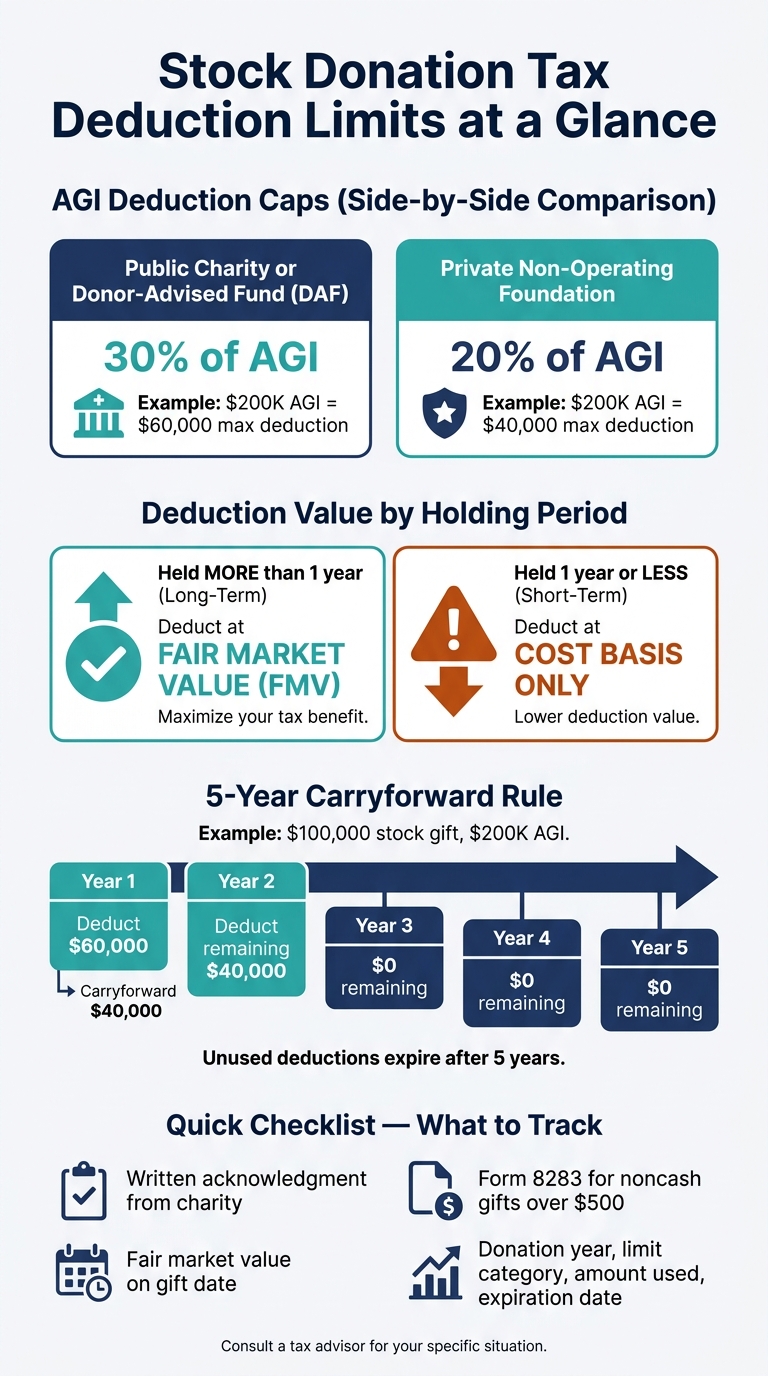
If I donate stock, my tax write-off is usually capped at 30% of AGI for public charities and donor-advised funds, or 20% of AGI for private non-operating foundations. And if I held the stock for one year or less, I usually deduct only my cost basis, not the stock’s market value.
Here’s the short version:
- Long-term appreciated stock given directly to a public charity or DAF is usually deducted at fair market value
- That deduction is usually capped at 30% of AGI
- The same type of gift to a private non-operating foundation is usually capped at 20% of AGI
- Short-term stock is usually deducted at cost basis
- Unused deductions can usually be carried forward for up to 5 years
- Giving cash and stock in the same year can limit how much I deduct right now
- I need good records, including Form 8283 for noncash gifts over $500
A simple example: if my AGI is $200,000, my current-year limit for long-term appreciated stock to a public charity is usually $60,000. If I donate $100,000 of stock, I may deduct $60,000 this year and carry $40,000 into later years.
This article boils down the main tax limits, when fair market value does and does not apply, how the 5-year carryforward works, and what I need to track before December 31.
Stock Donation Tax Deduction Limits: AGI Caps & Key Rules
How Is The Tax Deduction For Stock Donation Calculated? - Tax and Accounting Coach
sbb-itb-e723420
AGI limits for stock donations
Stock gift deductions are capped by AGI, and the limit changes based on who receives the gift and how long you held the shares. These AGI ceilings decide how much you can deduct in the current tax year.
30% of AGI limit for public charities and donor-advised funds
If you donate long-term appreciated stock to a public charity or donor-advised fund (DAF), your deduction is capped at 30% of your AGI for that tax year [1]. For example, if your AGI is $200,000, the most you can deduct for stock gifts to public charities or DAFs in one year is $60,000, no matter how much the shares are worth.
This limit tends to matter most with larger gifts. Say you're moving a big position in a single stock into a DAF. The deduction can end up being more than you can use in one year. When that happens, the unused portion carries forward.
20% of AGI limit for private non-operating foundations
Private non-operating foundations come with a lower cap. If you give the same long-term appreciated stock to a private non-operating foundation instead of a public charity, the ceiling falls to 20% of AGI [1]. With a $200,000 AGI, that means a $40,000 cap - $20,000 less than the public charity option.
Put simply, long-term appreciated stock donated to a public charity or donor-advised fund is capped at 30% of AGI. The same gift to a private non-operating foundation is capped at 20% of AGI.
When lower limits or reduced deduction amounts apply
After AGI caps, the next step is figuring out whether the gift gets full fair market value treatment at all. Even if you're still within the AGI limits, some stock donations are deducted at less than FMV.
Two common situations can shrink the deduction:
- donating stock you've held for one year or less
- giving cash and stock in the same tax year
Short-term stock is generally limited to cost basis
Holding period makes a big difference. If you donate stock held for one year or less, the IRS usually limits your deduction to your cost basis, not FMV [6]. If the stock was held for more than one year, a direct gift to a qualified charity will usually qualify for a deduction based on FMV [3].
That split matters because it changes how much deduction room you still have for the year.
Combining cash and stock gifts can reduce current-year deduction
It's smart to plan cash and stock gifts together. A large cash donation can cut down the amount of stock deduction you can use in the current tax year, and any amount you can't use may be carried forward to later years [1].
Carryforward rules for unused stock gift deductions
If your deduction for a stock gift is more than your AGI limit allows in the current year, you don't lose the extra amount. You can carry the unused deduction forward for up to five more tax years [1].
There’s one catch: the carryforward keeps the same AGI-limit category it started with. So if the deduction was subject to the 30% or 20% limit, it stays there. You can’t shift it into a higher limit later [7]. For filing purposes, use current-year gifts first and then apply older carryforwards.
How the five-year carryforward works in practice
Here’s a simple example. A $100,000 stock gift can be deducted across two years if AGI room is tight.
| Tax Year | AGI | Stock Gift (Current Year) | Carryforward from Prior Year | Max Deduction (30% of AGI) | Actual Deduction Taken | Remaining Carryforward |
|---|---|---|---|---|---|---|
| Year 1 | $200,000 | $100,000 | $0 | $60,000 | $60,000 | $40,000 |
| Year 2 | $200,000 | $0 | $40,000 | $60,000 | $40,000 | $0 |
In this example, a donor with $200,000 AGI gives $100,000 of stock to a public charity in Year 1. Because the deduction is limited to 30% of AGI, only $60,000 can be claimed in that first year. The remaining $40,000 carries into Year 2, where it can be deducted in full.
Any amount left unused after the five-year carryforward period expires is no longer deductible.
That’s why it helps to estimate your AGI before you move shares. A little planning now can save a headache later.
Track the donation year, limit category, amount used, and expiration date in a spreadsheet or Deductible.me. That makes it easier to use the oldest carryforwards first and keep IRS-ready records.
How to fit stock donations into a yearly giving plan
Once you know your AGI caps and carryforwards, the next step is timing the gift.
Estimate your AGI room before transferring shares
Start by estimating your expected AGI for the year. Then subtract any stock gifts you've already made to figure out how much deduction room is left.
Once you have that number, put the transfer on your calendar. Stock transfers should usually be started by December 20–23 so they can settle before the December 31 cutoff[4][5].
Keep records for valuation and tax reporting
Good records make this a lot less painful at tax time. Hold on to:
- A written acknowledgment from the charity that includes a description of the shares, the date of the gift, and a statement that no goods or services were provided in exchange[8].
- Fair market value on the gift date, which is generally the average of that day's high and low prices[8][2].
- Form 8283 if your total noncash donations are more than $500. Publicly traded securities go in Section A and don't need a qualified appraisal[1][2].
Deductible.me can help you stay on top of this during the year by tracking donation dates, storing acknowledgment letters, and generating IRS-compliant reports.
Conclusion: Key rules to remember for stock gift deductions
Long-term appreciated stock held for more than one year and donated to a public charity is generally deductible at fair market value, up to 30% of AGI. Gifts to private non-operating foundations have a tighter 20% cap. Short-term holdings are limited to your cost basis, which often makes them a poorer tax choice for charitable giving. If your gift goes over the annual limit, the unused amount can usually be carried forward for up to five years[1].
Long-term appreciated stock can be a strong tax move when you stay within AGI limits, pay close attention to holding periods, and track carryforwards. Pairing stock gifts with cash donations - and keeping clean records - is what helps turn the rules into actual tax savings. Track gifts in one place so nothing slips through the cracks.
FAQs
How do I know if my stock is long-term or short-term?
It depends on how long you’ve held the stock.
Stock held for more than one year is considered long-term. Stock held for one year or less is short-term.
That difference matters at tax time. If you donate long-term appreciated stock, you can generally deduct its full fair market value and avoid capital gains tax. If you donate short-term stock, your deduction is generally limited to your original cost basis.
What happens if my stock deduction exceeds my AGI limit?
You do not lose the deduction. If your long-term stock donation is more than the 30% AGI limit, the IRS lets you carry the extra amount forward for up to five more tax years.
That means you can keep using the unused portion on future tax returns until you’ve claimed the full deduction or the five-year window runs out.
Can I donate cash and stock in the same tax year?
Yes - you can donate both cash and stock in the same tax year.
The IRS treats them under separate AGI-based limits. Cash donations to public charities are generally deductible up to 60% of AGI. Long-term appreciated assets, like stock, are usually capped at 30% of AGI.
If your total gifts go over those limits, you can often carry the extra amount forward for up to five years.