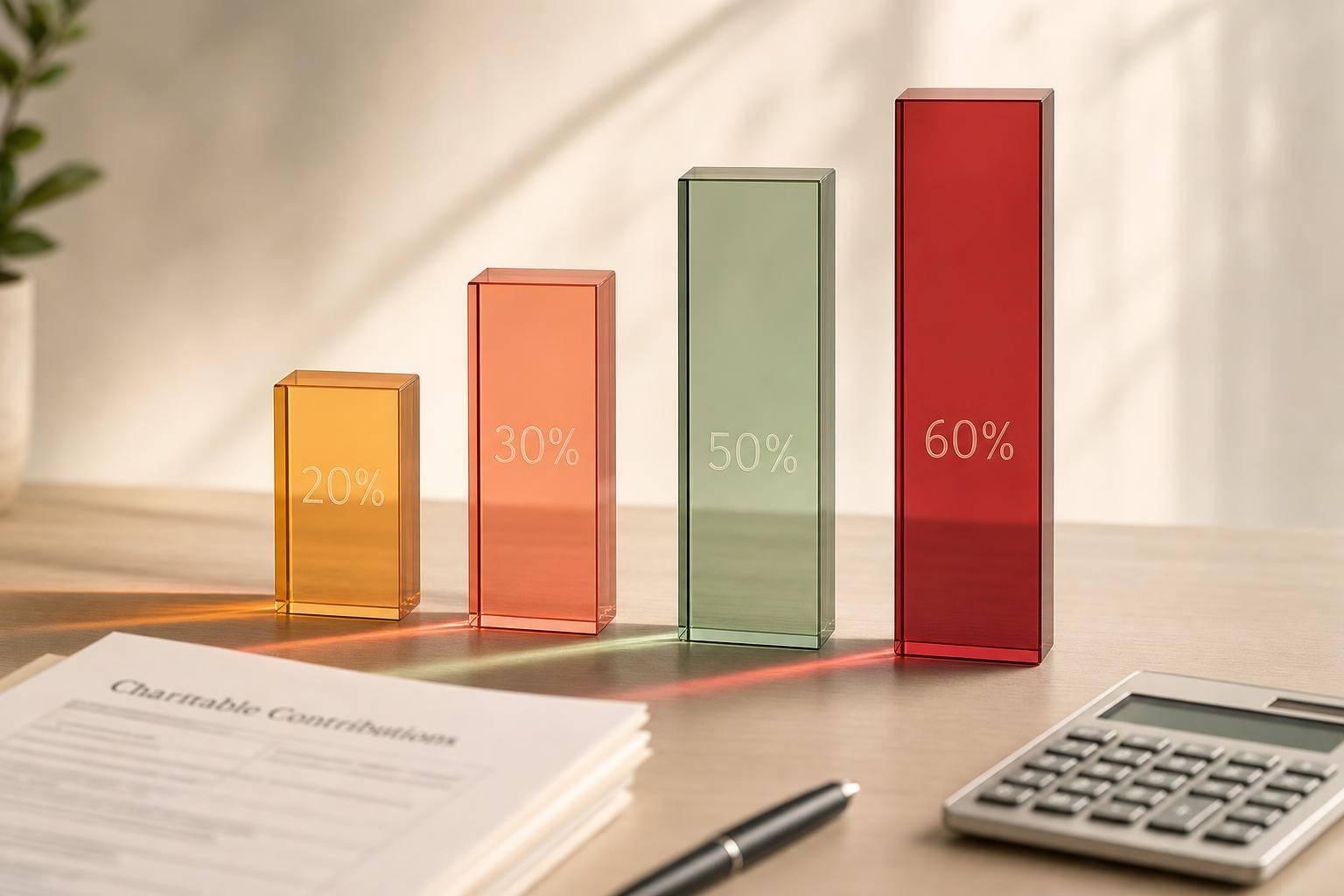
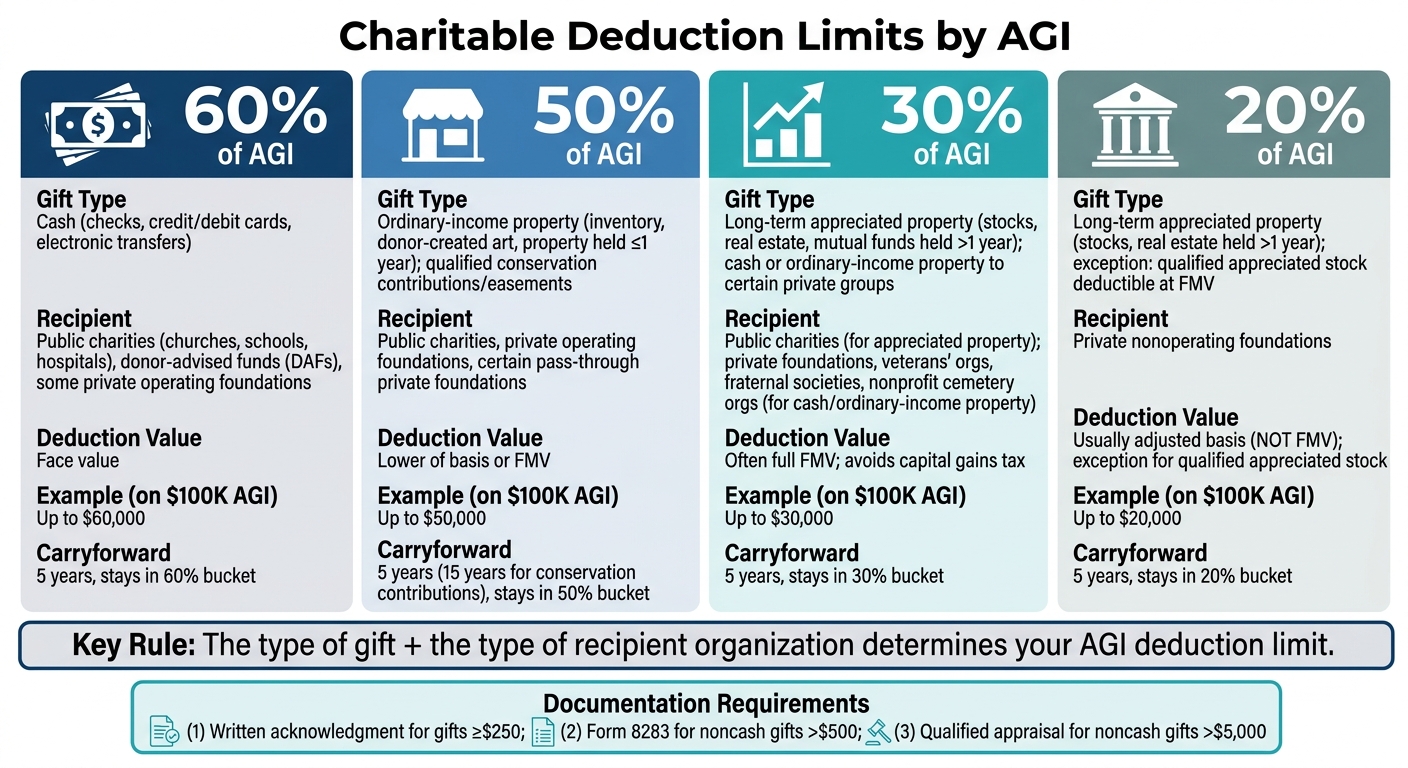
Charitable Deduction Limits by AGI: 20%, 30%, 50%, 60%
Your charitable deduction is not one flat rule. I need to match the gift to the right AGI limit: 20%, 30%, 50%, or 60%.
Here’s the short answer:
- 60% of AGI: cash gifts to most public charities
- 50% of AGI: ordinary-income property and some conservation gifts
- 30% of AGI: long-term appreciated property to a public charity, and some cash gifts to certain private groups
- 20% of AGI: long-term appreciated property to a private nonoperating foundation
A few rules matter right away:
- If I cannot use the full deduction this year, I can usually carry it forward for up to 5 years
- The carryforward keeps the same limit bucket
- Gifts of $250 or more need a written acknowledgment
- Noncash gifts over $500 usually need Form 8283
- Noncash gifts over $5,000 usually need a qualified appraisal
On $100,000 of AGI, the caps are simple:
- $60,000
- $50,000
- $30,000
- $20,000
The big idea is simple: the type of gift and the type of charity decide how much I can deduct.
Charitable Deduction AGI Limits: 20%, 30%, 50%, 60% Explained
Don't Donate Another Dollar Without Watching This
sbb-itb-e723420
Quick Comparison
| AGI limit | What I give | Who gets it | Usual deduction amount |
|---|---|---|---|
| 60% | Cash | Public charity | Face value |
| 50% | Ordinary-income property; some conservation gifts | Public charity or certain related groups | Usually basis or lower amount allowed by rule |
| 30% | Long-term appreciated property | Public charity | Often FMV |
| 20% | Long-term appreciated property | Private nonoperating foundation | Often basis, not FMV |
If I want the biggest current-year deduction, the first question is not how much I gave. It is what I gave and who received it.
1. 20% AGI Limit
This tier comes into play when you donate long-term capital gain property to a private nonoperating foundation. Two things drive the result here: the kind of asset you give and the kind of organization that gets it.
Covered Donation Type
This limit applies to appreciated property, like stock or real estate, that you've held for more than one year.
Eligible Recipient Organization
The recipient must be a private nonoperating foundation. Give that same property to a public charity, and it will often land in the 30% tier instead. In many cases, that also means the deduction can be based on FMV [2][3][8].
Deduction Amount Basis
In most cases, the deduction is capped at your adjusted basis, not FMV.
There is one big exception. Qualified appreciated stock - publicly traded stock with readily available market quotations - can still be deducted at FMV.
"Capital gain property given to a private non-operating foundation is generally deductible only at basis (not FMV) and is limited to 20% of AGI." - Munib Ur Rehman, National Tax Tools [2]
Carryforward Treatment
If you can't use the full deduction in the current year, you can carry the unused amount forward for up to five years [2]. But there's a catch: it stays in the same 20% bucket. Current-year gifts come first, and then carryforwards are used on an oldest-first basis [8][9].
Next comes the 30% tier, which usually applies when the same property goes to a public charity.
2. 30% AGI Limit
If the 20% tier is the tightest bucket, the 30% tier is the close cousin for gifts made to a public charity instead of a private foundation.
In most cases, this tier applies when you donate appreciated assets - like publicly traded stocks, mutual funds, or real estate - that you've held for more than one year. It can also apply to cash or ordinary-income property given to certain private recipients.
Covered Donation Type and Eligible Recipients
The most common setup is pretty straightforward: you give long-term capital gain property to a public charity. That usually means assets that went up in value while you owned them, such as stocks or real estate held for more than one year.
The type of recipient matters a lot here. It decides whether the 30% cap applies to cash or to appreciated property. Long-term capital gain property given to a public charity is generally eligible for a fair market value deduction. Cash or ordinary-income property given to private foundations, veterans' organizations, fraternal societies, or nonprofit cemetery organizations also falls under the 30% cap [1][2].
Deduction Amount Basis
When you donate appreciated stock or real estate to a public charity, you can usually deduct the asset's full fair market value (FMV). On top of that, you also avoid capital gains tax on the growth.
Here’s the simple version: if you bought stock for $4,000 and it later grew to $10,000, you may be able to claim a $10,000 FMV deduction, subject to the 30% cap [3].
That’s why this rule gets so much attention. You’re not just giving the asset away - you may also skip the tax hit that could have come from selling it first.
Carryforward Treatment
If you can't use the full deduction in the current year, the unused part carries forward for up to five years and stays in the 30% bucket [2][3].
That detail matters. The carryover keeps its original character, which means a 30% limit gift stays subject to the 30% limit in a later year. It does not turn into a 60% cash deduction later on [2][7].
Next, the 50% tier covers many of the remaining gifts to public charities.
3. 50% AGI Limit
The 50% tier applies to two main buckets: ordinary-income property and qualified conservation contributions. The big thing to watch is the type of asset you gave and who received it.
Covered Donation Type
This limit covers ordinary-income property - such as inventory, donor-created art, and other property held for one year or less - as well as qualified conservation contributions, including donated conservation easements [2][5][6].
Eligible Recipient Organizations
This tier applies to gifts made to:
- Public charities
- Private operating foundations
- Certain pass-through private foundations that pass contributions through to public charities within 2.5 months after year-end [1]
Deduction Amount Basis
For ordinary-income property, your deduction is limited to the lower of your basis or the fair market value [2][5].
Carryforward Treatment
If you can't use the full deduction in the current year, the unused amount can carry forward for up to five years. For qualified conservation contributions, the carryforward period is 15 years [2][6].
Next: the 60% AGI limit, which covers most cash gifts to public charities.
4. 60% AGI Limit
The 60% tier is the top AGI limit for charitable deductions. It applies to cash gifts to public charities.
Covered Donation Type
This limit is only for cash contributions. That includes checks, credit or debit card payments, and electronic transfers [2].
Eligible Recipient Organizations
The 60% limit covers cash gifts to public charities, such as churches, schools, and hospitals. It also includes cash contributions to donor-advised funds (DAFs). In some cases, certain private operating foundations can qualify too [2][3].
Deduction Amount Basis
Cash gifts are deducted at their face value [2][3]. So there’s no basis math and no fair market value adjustment to sort out, which makes this tier much simpler than the property-based rules.
Carryforward Treatment
If your cash gifts go over 60% of your AGI in a tax year, you don’t lose the extra amount. You can carry it forward for up to five more tax years [2][4]. That carryover still stays under the same 60% limit.
Next, the examples and planning points show how this cap plays out on actual tax returns.
Examples, Planning Points, and Pros and Cons
Here’s what those limits mean on a $100,000 AGI. The four caps turn into dollar limits of $60,000, $50,000, $30,000, and $20,000.
The main planning issue is simple: which bucket does the gift land in? That usually comes down to three things: the recipient’s status, the type of property you give, and whether part of the deduction will need to carry forward.
After that, the bigger concern often isn’t the cap by itself. It’s whether the gift ends up in the least favorable bucket. For example, giving to a private foundation can drop the limit from 60% to 30% for cash gifts, and from 30% to 20% for long-term appreciated property.
Paperwork matters just as much as the percentage limit. Keep:
- bank records for cash gifts
- written acknowledgments for gifts of $250 or more
- Form 8283 for noncash gifts over $500
- a qualified appraisal for noncash gifts over $5,000 [2][3]
If you want help staying organized, Deductible.me can assist with item valuation, receipt storage, IRS-compliant reporting, and annual giving goals.
This side-by-side view makes the tradeoff easier to spot:
| AGI Limit | Gift Type | Recipient | Advantage | Drawback |
|---|---|---|---|---|
| 60% | Cash | Public charity | Highest ceiling; simplest face-value deduction | Needs cash. |
| 50% | Ordinary-income property | Public charity | Can still produce a charitable deduction | Deduction is capped at cost basis, not FMV |
| 30% | Long-term capital gain property | Public charity | FMV deduction; avoids capital gains tax | Lower ceiling than cash gifts |
| 20% | Long-term capital gain property | Private foundation | Deduction available for qualifying property gifts | Lowest cap; often basis-limited. |
Conclusion
The planning issue comes down to one thing: which AGI bucket fits your gift?
Your deduction limit depends on two facts: the asset you gave and who received it. Cash gifts to public charities fall under the 60% limit. Ordinary-income property falls under 50%. Long-term appreciated property given to public charities, or cash given to private foundations, falls under 30%. And long-term appreciated property given to private foundations falls under 20%. [2][3]
If you can’t use the full deduction in one year, the unused amount can carry forward for five years and keeps its original limit. That can help a lot when a large gift needs to be used across more than one tax year. [2][3][4]
For the deduction to stand, you need to line up the gift with the right AGI bucket, use the right value, and keep the IRS records the rules call for. [2][3]
The AGI bucket sets the limit. Your paperwork is what helps protect the deduction.
FAQs
How do I know if a charity is public or private?
Use the IRS Tax Exempt Organization Search tool to check a charity’s tax-exempt status and see how it’s classified.
In most cases, public charities include churches, schools, hospitals, and established nonprofits that serve broad community needs. Private foundations often come with tighter deduction limits. Before you give, make sure the organization is a qualified 501(c)(3).
What happens if my donation fits more than one AGI limit?
If your donations fall under different AGI limits, the IRS applies a set order to figure out your total deduction. That matters because some gifts don't just follow their own cap. They also depend on how much space is left under higher percentage limits.
Here's the basic idea: the 30% capital gain category fits under the 50% ceiling. And gifts to a private foundation are capped at the lower of:
- their own percentage limit, or
- the room left under the 50% and 30% ceilings
It helps to think of it like stacking boxes on a shelf. The higher-percentage limits take up space first, and lower-limit gifts can only use what's left.
When should I deduct basis instead of fair market value?
Deduct the lower of your basis or fair market value if the donated property would have produced ordinary income or short-term capital gain if you had sold it. That usually includes items like:
- Inventory
- Self-created art
- Property held for one year or less
There’s another limit to watch for. If you donate tangible personal property and the charity doesn’t use it in a way that relates to its tax-exempt purpose, your deduction is also capped at basis.
If that rule doesn’t apply, long-term capital gain property donated to a public charity is generally deductible at fair market value.