Limits on Charitable Deductions: What to Know
You may donate $10,000 and still deduct less than that. For 2026, the IRS looks at your AGI, whether you itemize, what you gave, who you gave it to, and whether your records are complete.
Here’s the short version:
- Cash gifts to public charities are usually capped at 60% of AGI
- Long-term appreciated property is often capped at 30% of AGI
- Private foundation gifts face lower limits, such as 30% or 20%
- Itemizers in 2026 face a new 0.5% AGI floor
- Non-itemizers may deduct up to $1,000 if single or $2,000 if married filing jointly, but only for qualifying cash gifts
- Extra amounts over the yearly limit may carry forward for up to 5 years
- Bad paperwork can mean no deduction at all
If I were checking my own deduction, I’d focus on three things first: recipient type, AGI limit, and documentation. That’s because even a valid donation can be cut, delayed, or denied if one of those pieces is off.
A few fast examples help show the rule in action:
- If my AGI is $400,000, the 2026 0.5% floor means the first $2,000 of itemized charitable deductions is disallowed
- If I donate stock held over one year to a public charity, I may deduct fair market value, but usually only up to 30% of AGI
- If I give $250 or more in cash, I need a written acknowledgment from the charity
- If I donate noncash property worth over $5,000, I usually need a qualified appraisal
The bottom line: the deduction is not based only on how much you gave. It depends on the IRS limit that fits your gift, plus whether you kept the right proof.
| Rule Area | What to Know |
|---|---|
| Itemizing | Usually needed for most charitable deductions |
| Non-itemizer rule | Up to $1,000 single / $2,000 MFJ for qualifying cash gifts |
| Cash to public charity | Up to 60% of AGI |
| Appreciated property to public charity | Up to 30% of AGI |
| Cash to private foundation | Up to 30% of AGI |
| Appreciated property to private foundation | Up to 20% of AGI |
| Carryforward | Usually up to 5 years |
| Cash gift of $250+ | Written acknowledgment needed |
| Noncash gift over $5,000 | Appraisal usually needed |
Below, I’d walk through the same core rules in plain English: what limits apply, when deductions shrink, when carryovers help, and what records keep the IRS from denying the claim.
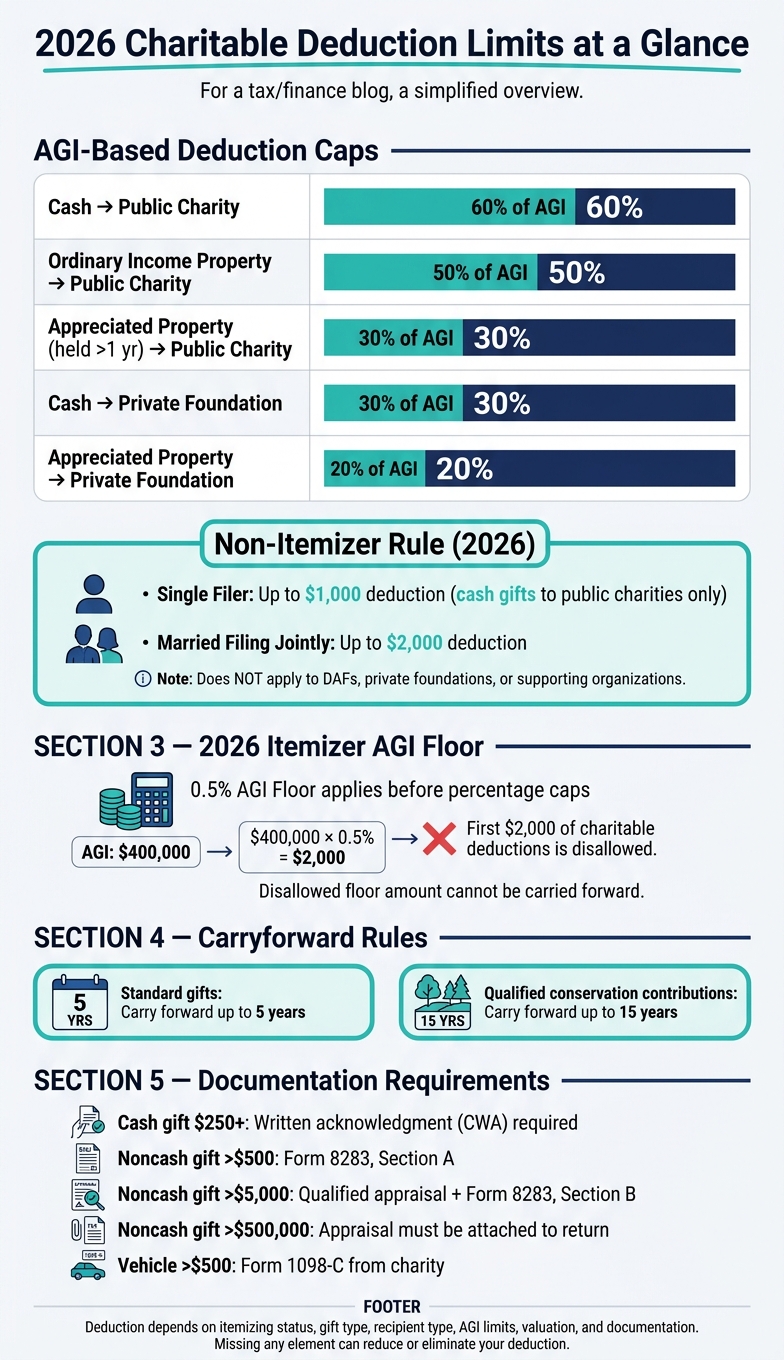
2026 Charitable Deduction Limits by Gift Type & Recipient
New Charitable Deduction Rules for 2026: What High Earners Need to Know
sbb-itb-e723420
What Sets the Limit on Your Charitable Deduction
Your charitable deduction has two main guardrails: AGI-based caps and whether you itemize. If you miss either one, some of your donation may not count for tax purposes.
AGI Limits for Cash Gifts vs. Property Gifts
The IRS limits charitable deductions based on a percentage of your AGI. That percentage changes based on what you donated and who received it.
Cash gifts to public charities are capped at 60% of AGI. If you donate long-term appreciated property that you held for more than one year, the deduction is usually capped at 30% of AGI when you deduct it at fair market value. Private foundations get tighter limits: 30% for cash gifts and 20% for appreciated property [3][6].
There’s one more rule for 2026 that can trip people up. Itemizers must clear a 0.5% AGI floor before the percentage caps even start to matter. Any amount blocked by that floor can’t be carried forward [1][3].
| Gift Type | Recipient | 2026 AGI Limit |
|---|---|---|
| Cash | Public Charity | 60% of AGI |
| Appreciated Property (long-term) | Public Charity | 30% of AGI |
| Ordinary Income Property | Public Charity | 50% of AGI (at cost basis) |
| Cash | Private Foundation | 30% of AGI |
| Appreciated Property | Private Foundation | 20% of AGI |
| Non-itemizer Cash Gift | Public Charity | $1,000 / $2,000 cap* |
Flat dollar cap, not an AGI percentage. Applies only to cash gifts to public charities.
Once you know your AGI limit, the next piece is simple: Are you itemizing, or are you using the 2026 nonitemizer rule?
Itemizing vs. the Standard Deduction, and the 2026 Nonitemizer Rule
In 2026, non-itemizers can take an above-the-line deduction for qualifying cash gifts to public charities. The cap is $1,000 for single filers and $2,000 for married couples filing jointly [3][5][1].
But this rule is narrower than it sounds. It does not apply to:
- DAFs
- Private foundations
- Supporting organizations
If you itemize instead, your total itemized deductions need to beat the 2026 standard deduction before itemizing does you any good. The threshold is $16,100 for single filers and $32,200 for married filing jointly [6][7].
If your donations still go over the limit after all of that, then it’s time to check whether any unused amount can move forward to a later year.
Why Some Donations Are Not Fully Deductible
Even if a gift goes to a qualified organization, the tax break isn't always automatic. A deduction can be cut back, pushed into later years, or wiped out if it runs into IRS limits or paperwork rules.
If your gift is over the allowed limit, the unused part may carry forward. But if the gift fails other IRS tests, the deduction can vanish altogether.
When a Deduction Gets Reduced or Delayed
If your donation goes past the annual AGI percentage cap, the extra amount will usually carry forward for up to 5 years. For qualified conservation easements, the carryforward period is 15 years. That carried amount keeps its original character [1].
Starting in 2026, itemizers also face a 0.5% AGI floor. That floor amount is simply gone. So if a household has $400,000 in AGI, the first $2,000 of charitable deductions is lost under this rule [1].
Property gifts can shrink a deduction too. Short-term capital gain property, ordinary income property like inventory or donor-created art, and tangible personal property put to a use unrelated to the charity's mission are usually deductible only at cost basis, not fair market value.
And if you get something back for your donation, the IRS won't let you deduct the full amount. Say you buy gala tickets or get auction merchandise. In that case, only the amount above the fair market value of what you received counts as deductible.
So the pattern is pretty simple:
- Some deductions get delayed because of AGI limits
- Some get cut back to cost basis or to the amount above fair market value
- Some disappear fully
Once a gift fails the IRS rules for the recipient or the required records, you're no longer dealing with a smaller deduction. You're dealing with no deduction at all.
When a Deduction Is Denied Entirely
Some gifts don't qualify for a deduction, period, even if the donor had good intentions.
Gifts to individuals are never deductible. The same is true for contributions to political candidates, PACs, social clubs, labor unions, and civic leagues. Foreign charities usually don't qualify either, aside from narrow exceptions under certain tax treaties [2][8]. Before you give, it helps to check the organization's status in the IRS Tax Exempt Organization Search (TEOS) tool and look for the "PC" designation.
Paperwork can also make or break the deduction. For cash gifts of $250 or more, you need a contemporaneous written acknowledgment. For noncash gifts over $5,000, you need a qualified appraisal. And if the gift is over $500,000, missing that appraisal means the deduction is denied in full [10][7].
A few other items are flat-out nondeductible:
- Raffle tickets
- The value of your time or services
- Blood donations
How to Calculate Your Deduction and Handle Carryovers
The IRS has a set order for figuring out your charitable deduction for 2026. That matters because the number you gave isn't always the number you can claim.
Start by splitting your donations into cash and noncash gifts. Then give each one the right value:
- Cash: face value
- Most long-term appreciated property: fair market value (FMV)
- Short-term property or ordinary income property: cost basis
After that, work through the limits in this order.
Step-by-Step Calculation Order
First, apply the 0.5% AGI floor for itemizers in 2026. Any amount blocked by that floor does not reduce your carryover [1][3].
Next, test the rest against the AGI percentage caps. The limit depends on both the type of gift and the type of charity. The main ceilings are:
- 60% for cash to public charities
- 50% for ordinary income property to public charities
- 30% for appreciated property to public charities
- 30% for cash or ordinary income property to private foundations
- 20% for capital gain property to private foundations [3][4]
If part of your gift still can't be deducted because it goes over the yearly AGI cap, that extra amount can usually carry forward for up to five years. Qualified conservation contributions get a longer window: up to 15 years [3].
Fair Market Value, Cost Basis, and Noncash Donation Rules
Noncash gifts add one more layer: valuation.
Most long-term appreciated property is deductible at FMV. For clothing and household goods, that usually means thrift-store resale value, not the amount you paid. And there's a hard rule here: the items must be in "good used condition" or better to qualify at all.
Short-term property and ordinary income property, such as inventory, are deductible only at cost basis. Vehicles have their own twist too. If you donate a car and the charity sells it, your deduction is limited to the actual gross proceeds from that sale, not the Kelley Blue Book amount [4][11][12].
| Property Type | Valuation Rule | AGI Limit (Public Charity) |
|---|---|---|
| Cash | Face value | 60% |
| Appreciated stock (held > 1 year) | Fair market value | 30% |
| Short-term property (held ≤ 1 year) | Lesser of cost basis or FMV | 50% |
| Household goods | FMV (thrift-store value) | 50% |
| Vehicle (charity sells it) | Gross proceeds from sale | 50% |
Carryovers and Year-End Timing
When your donation goes over the yearly cap, the extra amount doesn't just vanish. It may carry into later years, subject to the carryforward rules above. For 2026, one point is easy to miss: the 0.5% floor amount that was disallowed does not reduce your carryover, so you take that floor hit only once [13].
Timing can also make or break which tax year gets the deduction. A check counts on the date it's postmarked, even if the charity doesn't deposit it until January. A credit card gift counts in the year the charge is processed, even if you pay the card bill later. Electronic transfers count when the funds leave your account [1][2]. If the gift happens after December 31, it belongs to the next tax year.
Records and Planning Steps That Protect Your Deduction
After you calculate the deduction, the next hurdle is documentation. This is where many taxpayers slip up. If your records are missing or incomplete, the IRS can deny the deduction.
What Records the IRS Requires for Cash and Noncash Gifts
For cash and other monetary gifts, keep a bank record, such as a canceled check or a bank or credit card statement, or written communication from the charity that shows the organization's name, the date, and the amount [10]. If one contribution hits $250 or more, a bank record by itself no longer works.
You also need a written acknowledgment from the charity. This is called a Contemporaneous Written Acknowledgment (CWA). It must state the amount of cash, a description of any property donated, and whether the organization gave you any goods or services in return, along with a good-faith estimate of their value [10][9]. You need to get that acknowledgment by the earlier of your filing date or the return due date, including extensions.
Noncash gifts come with more rules:
| Gift Type & Value | Required Documentation | Form Needed |
|---|---|---|
| Noncash property over $500 | CWA + records of acquisition date, manner, and cost basis | Form 8283, Section A |
| Noncash property over $5,000 | CWA + qualified appraisal | Form 8283, Section B |
| Noncash property over $500,000 | Qualified appraisal attached to the tax return | Form 8283, Section B |
| Vehicle over $500 | Form 1098-C from the charity | Form 1098-C |
For gifts over $5,000, the appraisal must be done no earlier than 60 days before the contribution date and no later than the return due date [3]. There is one big exception: publicly traded securities usually do not need a formal appraisal [10][3].
Once your records are set, timing and the kind of asset you give can shape how much of the deduction you keep.
Planning Steps to Avoid Lost Deductions
Year-end planning can help you hold on to more of your deduction.
Bunching can turn several small giving years into one bigger deduction year. Why does that matter? Because it may help you get past the standard deduction hurdle and deal with the new 0.5% AGI floor in a single year instead of losing part of the deduction year after year [3][4].
The asset you donate matters too. Long-term appreciated stock can work well here. You may deduct the full fair market value and avoid capital gains tax, though this type of gift is subject to a 30% AGI cap [3][12].
It also pays to track donations throughout the year. That makes it easier to watch AGI limits, keep receipts in order, and monitor carryovers. Before you file, check for carryovers from prior years and apply them to the same gift type and AGI limit [3][12].
Conclusion: Key Rules to Keep in Mind Before You Claim
Your charitable deduction depends on several parts lining up at the same time:
- Itemizing status
- Giving to a qualified organization
- The type of gift
- Your AGI-based limits
- Proper valuation
- Solid documentation
Miss one piece, and the deduction can shrink or vanish.
The rules changed in 2026 in ways that can affect what you claim. The new 0.5% AGI floor for itemizers and the restored above-the-line deduction for cash gifts for non-itemizers both change the math [3][4]. Careful tracking and planning, especially around year-end timing, gift selection, and getting your CWA on time, are what help you claim the full deduction allowed.
FAQs
How do I know whether to itemize in 2026?
In 2026, itemize if your total eligible deductions are higher than the standard deduction for your filing status.
That usually includes things like:
- Charitable contributions
- Mortgage interest
- State and local taxes
- Qualifying medical expenses
Here’s the key threshold:
- $16,100 for single filers
- $32,200 for married filing jointly
One more detail matters here: only charitable gifts above 0.5% of your adjusted gross income are deductible.
What counts as a qualified charity?
For tax purposes, a qualified charity is an organization the IRS recognizes under Section 170(c) of the Internal Revenue Code.
That usually includes nonprofits run only for religious, charitable, educational, scientific, or literary purposes. It also covers groups that work to prevent cruelty to children or animals.
Some other organizations may qualify too, including:
- Government entities
- Churches and synagogues
- War veterans’ organizations
- Nonprofit fire companies
- Certain cemetery companies
Before you claim a deduction, check the organization’s status with the IRS Tax Exempt Organization Search tool.
What happens if my donation exceeds the AGI limit?
If your charitable donations go over the IRS adjusted gross income (AGI) limit for the tax year, you usually don’t lose the extra amount.
Instead, you can often carry the unused part forward for up to five years and claim it on future tax returns.
Deductible.me can help you track those carryforward amounts, so you can keep an eye on the five-year window for each contribution.