
5 Steps to Align Donations with Personal Values
Want your donations to reflect what matters most to you? Aligning your giving with your personal values ensures your contributions make an impact where it counts. With over 1.8 million charities in the U.S., it's easy to feel overwhelmed, but this five-step guide simplifies the process:
- Review Your Current Giving Habits: Identify patterns and habits in your past donations. Are you giving intentionally or out of habit?
- Pinpoint Your Core Values: Reflect on what truly matters to you - causes, beliefs, and the change you want to see.
- Find Causes That Match Your Values: Look for organizations that align with your priorities, personal experiences, or professional background.
- Research Organizations: Check mission statements, financial transparency, and measurable results to ensure your donations are well-placed.
- Create a Charitable Mission Statement: Write a clear statement of purpose and track your giving to stay aligned with your goals.
Key takeaway: Giving with intention strengthens your emotional connection to causes, boosts satisfaction, and maximizes impact. Start by understanding your values and choosing organizations that share them.
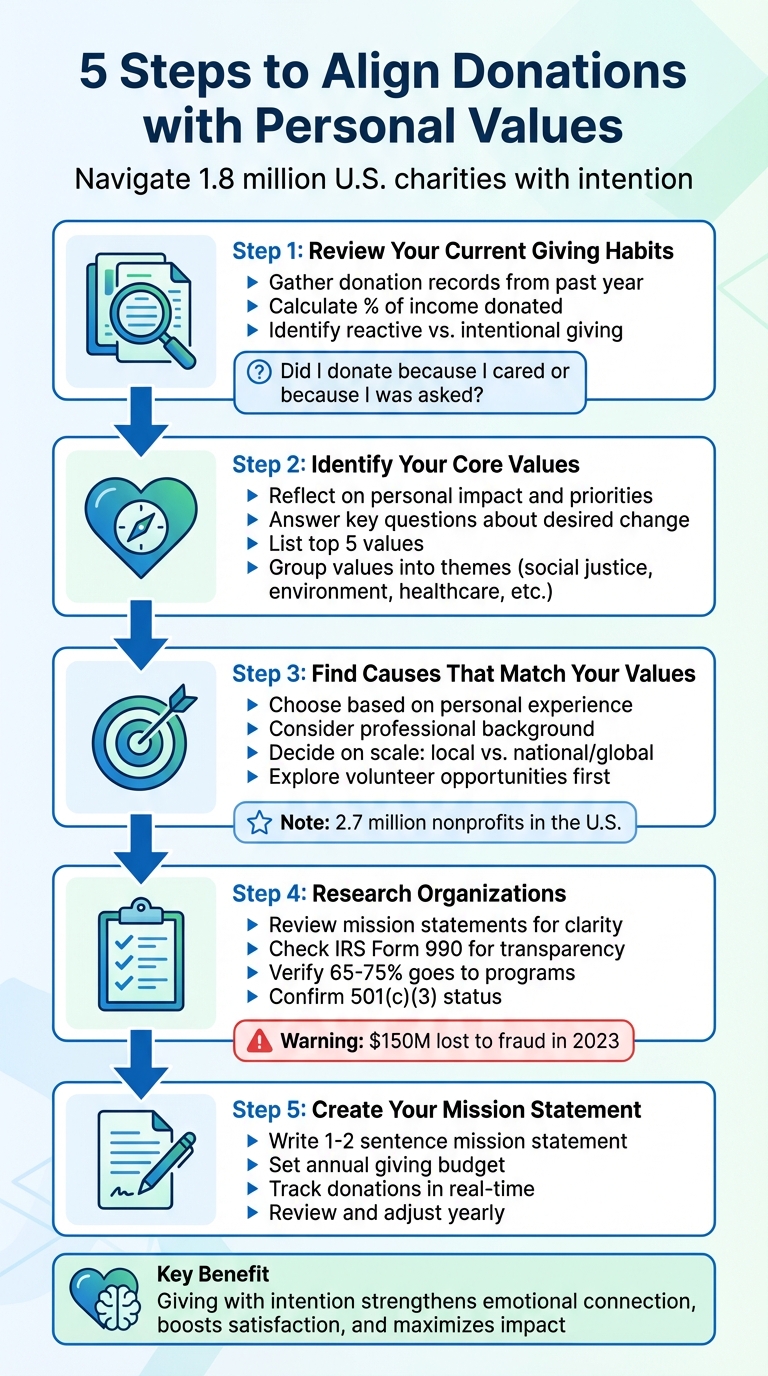
5 Steps to Align Charitable Donations with Personal Values
Step 1: Review Your Current Giving Habits
Start by taking a closer look at your donation history. Many people give reactively - responding to requests or appeals - rather than focusing on causes they genuinely care about [3][4]. This approach often leads to supporting organizations out of habit or social pressures instead of personal passion.
Gather your donation records from the past year. A tool like Deductible.me can help you organize these records and track your annual giving goals. For each organization you supported, ask yourself: Did I donate because I truly cared about this cause, or simply because I was asked? Malcolm Burrows, Head of Philanthropic Advisory Services at Scotia Wealth Management, emphasizes the importance of aligning your charitable giving with your core values, stating: "Being a thoughtful and engaged donor starts by aligning your annual charitable giving with your values and priorities" [3]. This honest evaluation is the first step toward more intentional and meaningful giving. Once you've reviewed your contributions, take a moment to identify patterns in your giving.
List the Causes You Currently Support
Create a list of all the organizations you supported over the past year, from large donations to small checkout contributions. Next to each entry, jot down why you gave. Was it due to a personal connection? A sense of gratitude for services received? To honor someone’s memory? Or simply because someone asked? Many donors give out of a sense of "giving back", even if the cause no longer aligns with their priorities [2][5].
Figure out what percentage of your income you donated last year [3]. This will give you a baseline to help set realistic goals and evaluate whether your current giving aligns with the impact you want to achieve. If your contributions went to more than a dozen organizations, consider whether spreading your support too thin might be reducing your overall impact [3][4].
After compiling your list, take note of any habits that might be limiting your ability to make a difference.
Identify What's Holding You Back
Look for patterns that could be preventing you from giving intentionally. Common obstacles include feeling overwhelmed by too many choices - there are over 1.8 million nonprofits in the U.S. alone [2] - or continuing to support organizations out of habit rather than alignment with your current priorities [4][7]. Some people also struggle with setting clear goals for how much to give and where [4][8]. Emotional barriers, like discomfort discussing money or philanthropic goals with family, can also play a role [4][5].
Identify charities you support simply because "you always have", even if they no longer reflect your values or priorities. These habitual donations might be worth reconsidering, allowing you to redirect resources toward causes that resonate more deeply with you. If managing large annual donations feels daunting, consider breaking your goals into smaller monthly contributions [3].
Recognizing these patterns is a crucial step toward reshaping your giving to align with what matters most to you. By addressing these barriers, you can create a more focused and impactful giving strategy.
sbb-itb-e723420
Step 2: Identify Your Core Values
After reviewing your giving history, the next step is to pinpoint what truly matters to you. Your core values are the backbone of intentional charitable giving. They help shift your donations from spur-of-the-moment decisions to thoughtful, impactful contributions. As the World Values Day Guide explains, "Values help us make better choices, develop healthy patterns of behaviour, and maintain meaningful personal relationships. They are the glue connecting us with others and our communities" [6]. Without a clear understanding of your values, it’s easy to end up supporting causes that don’t fully resonate with your beliefs. Taking time to reflect on these principles will lay the groundwork for more purposeful giving in the future.
Answer Key Questions About Your Priorities
Now that you’ve reviewed your past donations, it’s time to dig deeper into what truly matters to you. Start by reflecting on a few critical questions. Think about which causes or organizations have made a personal impact on your life or the lives of those close to you. Consider the kind of change you want to see in the world and the solutions you feel most passionate about supporting. Ask yourself: Am I giving out of habit, or do I have a clear vision for the impact I want to create? Reflect, too, on the legacy you hope to leave behind and which organizations align with your broader worldview.
Write your answers down - this simple step can help clarify your values and serve as a guide for future decisions. If you share your giving goals with family, it can also help align your efforts and create shared philanthropic priorities. Louise Lee, a Leadership and Life Coach, sums it up well: "It's difficult to excel when you don't know what excellence looks like for you" [6]. These reflections will become a valuable tool when choosing causes that align with your unique priorities.
Group Your Values into Themes
Once you’ve identified your key values, start organizing them into broader themes. For example, if you value equality, that might align with social justice or workforce development. If sustainability is important to you, it could connect to environmental conservation. Begin by listing values like compassion, education, healthcare, or animal welfare, then narrow them down to your top five. Group these under overarching categories such as social justice, environmental conservation, arts and culture, or healthcare.
This step bridges the gap between your beliefs and specific causes, making it easier to navigate the overwhelming number of nonprofit organizations - there are over 1.8 million in the U.S. alone [2]. Grouping your values also helps you say "no" to opportunities that don’t align with your priorities, ensuring your resources go toward causes that matter most to you. And as life changes, revisit these themes regularly. Your values and interests may evolve, so it’s important to adjust your focus over time.
Step 3: Find Causes That Match Your Values
Now that you’ve grouped your values into themes, it’s time to search for causes and organizations that align with what matters most to you. With over 2.7 million nonprofits in the United States alone [11], the challenge isn’t finding an organization - it’s finding one that truly reflects your values and personal experiences. Look for missions that connect with your core beliefs and passions.
Choose Causes Based on Personal Experience
Your personal journey can be a powerful compass for deciding where to give. Think about nonprofits that have directly impacted your life or supported your loved ones. For instance, a scholarship program might have helped fund your education, or a health organization may have provided care for a family member. Giving back to these organizations can feel deeply rewarding [5][9].
Paying it forward is another meaningful way to contribute. Supporting initiatives like teacher development programs or scholarships can honor mentors who shaped your life [7][2]. Similarly, memorial giving - donating to causes that mattered to someone you’ve lost - can be a touching way to keep their legacy alive [5][4].
Your professional background can also guide your choices. For example, if you work in healthcare, you might focus on funding medical research or supporting clinics in underserved areas [4][9]. Ask yourself: What change do I want to see in the world? Where can I invest to help solve the issues that matter most to me? [7][9].
Volunteering is another great way to connect with an organization before deciding to donate. Platforms like VolunteerMatch.com make it easy to explore opportunities and experience a nonprofit’s work firsthand [11].
Decide on the Scale of Impact You Want
Once you’ve identified causes that align with your values, think about the scope of impact that resonates most with you. Are you drawn to local initiatives addressing immediate community needs, or do you prefer supporting national or global organizations tackling larger systemic issues?
Smaller, local nonprofits often provide a more direct and tangible impact. You can see the results of your support up close and even build personal connections with the people or communities you’re helping [5]. On the other hand, national and global organizations focus on broader challenges, such as environmental conservation, global health, or international humanitarian efforts [11][1].
Consider your motivations: Do you want to give back to local institutions that played a role in your success, or are you inspired to contribute to global solutions for issues that weigh heavily on your mind? [3][2]. The choice ultimately depends on what feels most meaningful to you.
For additional guidance, local umbrella organizations like the United Way or community foundations can help you identify regional causes that align with your interests [11]. Online resources like GuideStar.org and Charity Navigator also allow you to search for organizations by category, cause, and location, making it easier to find the perfect match for your values [11].
Step 4: Research Organizations for Alignment and Effectiveness
Once you've identified causes that resonate with your values, it's time to dig deeper into the organizations supporting them. In 2023 alone, over $150 million was lost to fraudulent charities[15]. This makes thorough research not just a good idea but a necessary step. Evaluating an organization's mission and financial practices ensures your donation aligns with your goals and is used responsibly.
Review Mission Statements and Core Values
Start by examining the organization's mission statement. A strong mission should clearly outline who they aim to help, the specific issues they address, and the strategies they use to create change[12]. For example, a mission like "providing after-school STEM programs for underserved youth" is focused and actionable. On the other hand, vague statements like "helping people live better lives" should prompt further scrutiny[12].
It's also important to check whether the organization has maintained a consistent mission over time. Stability in their goals is a good indicator of long-term commitment rather than shifting priorities. Most mission statements can be found on the organization's website, typically in the "About Us" section, or through nonprofit databases like GuideStar[12].
Once you're confident in the mission, the next step is to assess financial transparency.
Check Financial Transparency and Results
An organization's financial transparency reflects its accountability to donors. The IRS Form 990 is a key resource for this - it provides details on revenue, executive salaries, and how funds are allocated[13][16]. You can access these forms through ProPublica's Nonprofit Explorer or request them directly from the organization (they are legally required to provide them)[13].
Here are some financial benchmarks to look for:
- Healthy organizations allocate 65–75% of their budgets to program services rather than administrative expenses[12][15].
- Effective charities typically spend $25 or less to raise $100 in donations[15].
In addition to financial data, look for annual or impact reports that showcase measurable outcomes, such as the number of individuals helped or success rates in their programs. If an organization cannot provide clear results, it may be a red flag.
To verify transparency and efficiency, use trusted platforms like Charity Navigator, CharityWatch, and GiveWell[14][15]. Also, confirm the organization's 501(c)(3) status through the IRS Tax Exempt Organization Search to ensure your contributions are tax-deductible[15]. For managing multiple donations, tools like Deductible.me can help you stay organized and maintain IRS-compliant records for tax purposes.
Step 5: Write Your Charitable Mission Statement and Plan
Wrap up your giving strategy by crafting a clear charitable mission statement and creating a tracking plan. These steps ensure your donations align with your values and help you give with intention and purpose.
Write Your Personal Charitable Mission Statement
Your mission statement should be short and focused - ideally one to two sentences [17]. It should clearly outline what you aim to achieve through your giving, building on the values and causes you’ve already identified. Leadership and life coach Louise Lee emphasizes the importance of clarity:
"It's difficult to excel when you don't know what excellence looks like for you. Generating clarity on who you want to be and how you want to feel is fundamental to your growth and performance." [18]
Think about the values and causes that matter most to you. Use active, present-tense language to make your mission feel immediate and impactful. For instance, instead of saying, "I want to help underserved communities", try: "I support innovative health research and provide care to underserved communities, honoring my experience in the medical field." [4]
Keep in mind, your mission statement isn’t set in stone. Revisit it every year to ensure it reflects your current priorities. Whether you’re giving $500 or $5 million, a well-defined mission statement can guide your decisions and keep your efforts focused [19].
Once your mission statement is in place, it’s time to set actionable goals and track your progress.
Set Goals and Track Your Donations
After defining your mission, establish a specific annual giving budget. This not only helps you stay on track but also makes it easier to decline donation requests that don’t align with your mission [10]. Susan Olson, a financial advisor at Abacus Wealth Partners, explains:
"Narrowing your focus allows you to create a meaningful impact in areas that resonate deeply with you." [10]
Consider giving earlier in the year rather than waiting until the last minute. Early contributions help nonprofits plan their budgets more effectively and reduce year-end stress for you [10]. To stay organized, use tools like Deductible.me to log your contributions in real time [20]. This platform offers AI-powered valuation and IRS-compliant reporting, ensuring your records are accurate and ready for tax season.
Stay engaged with the organizations you support by subscribing to newsletters, reading impact reports, and seeking feedback. This helps you confirm that your donations are making a difference where it matters most.
Conclusion
Giving in alignment with your core values turns donations into a meaningful reflection of what matters most to you. By letting your values guide your decisions - from reviewing past giving habits to planning for the future - you can ensure every contribution has a purpose. As Jay Pluimer from Flourish Wealth Management puts it:
"Knowing that one's contributions are aligned with personal values and purpose can provide a profound sense of fulfillment and joy." [1]
This clarity helps you focus your efforts on organizations where your support can make the greatest difference. Instead of spreading your resources thin across multiple causes, you can channel them in ways that create a visible and lasting impact, avoiding the regret of scattered giving.
Remember, your charitable mission will evolve over time. Life circumstances, financial priorities, and global needs are always shifting. Regularly reviewing your approach and keeping track of your contributions ensures your mission remains in sync with your goals. By monitoring your donations and volunteer efforts, you can see which activities bring you the most satisfaction and adjust accordingly.
Staying organized is key to this process. Tools like Deductible.me make it easier to manage and adapt your giving strategies. With features that let you log donations in real time, maintain IRS-compliant records, and track progress toward annual goals, you can focus on what truly matters - making a difference in the areas closest to your heart.
FAQs
How do I pick my top giving values?
When thinking about where to focus your charitable giving, start by identifying your core personal values. Take some time to write them down - this can help you clarify what truly matters to you. From there, think about issues or causes that align with your beliefs, passions, and long-term goals.
It can also be helpful to discuss these values with your family or others involved in your giving. This kind of conversation helps create a shared sense of purpose and ensures everyone is on the same page. By focusing on causes that genuinely resonate with you, you'll be able to pinpoint the areas that reflect your priorities and guide your giving decisions.
How many charities should I support at once?
The number of charities you choose to support really comes down to your personal goals and how you want to make an impact. Spreading your efforts across too many organizations can lessen the overall effect of your contributions. On the other hand, focusing on just a few charities that align closely with your values and resources can lead to deeper, more meaningful support. Experts often suggest narrowing your focus to maximize your impact, but at the end of the day, the decision is yours and should reflect the kind of difference you’re looking to create.
What are quick red flags a charity may be a scam?
Watch out for warning signs such as financial mismanagement, unclear operations, or unusually high spending on overhead and salaries. If a charity isn't accredited, lacks independent reviews, or fails to provide transparent financial records, that's a cause for concern. Make sure to verify their mission, review their official reports, and rely on trusted evaluation platforms to confirm their credibility.