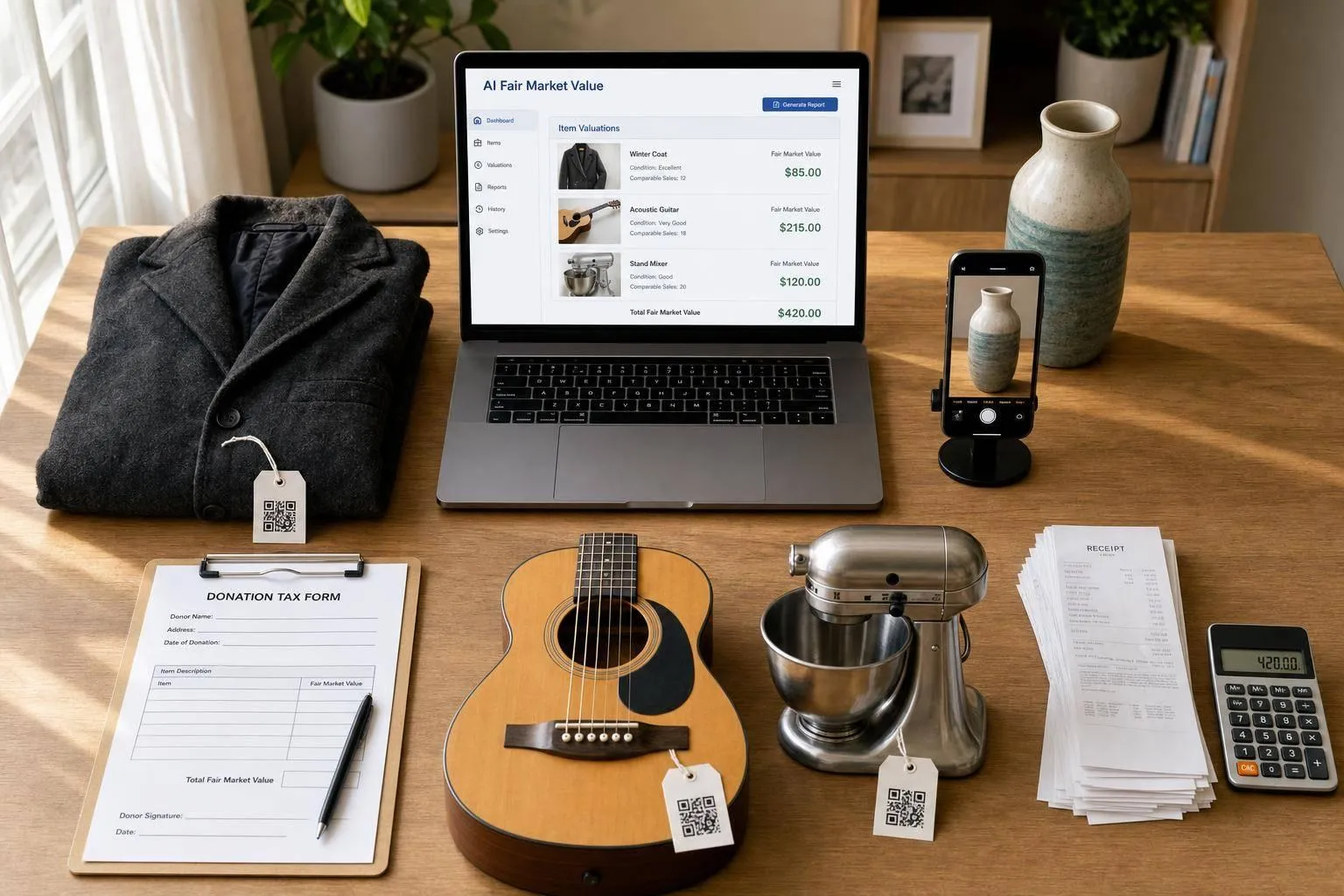
If you use AI to price donated items, treat it as research help - not proof for the IRS. Your deduction depends on the item’s fair market value on the donation date, your records, and, once value gets high enough, a qualified appraisal.
Here’s the short version:
- FMV is not what you paid. It’s what a buyer would likely pay for the used item on the day you donated it.
- AI can help you sort photos, write item descriptions, and find used-sale comps.
- AI cannot replace your judgment, charity records, Form 8283, or a qualified appraisal.
- At $250+, you need a charity acknowledgment.
- Over $500 total in noncash donations, you generally file Form 8283.
- Over $5,000 for one item or a group of similar items, you generally need a qualified appraisal and Section B of Form 8283.
- Art at $20,000+ and noncash property over $500,000 can trigger extra return attachments.
I’d use AI for three things: document the item, find used-market support, and save the trail. Then I’d review the comps, adjust for wear or missing parts, and keep the final number grounded in facts. A charity receipt alone does not set value, and neither does an AI estimate.
A few points stand out:
- Clothing and household goods usually must be in good used condition or better to count.
- Asking prices are weak support; completed sales are better.
- The $5,000 rule can apply to similar items grouped together, not just one item by itself.
- Publicly traded securities usually follow a different reporting path than donated used goods.
If I were doing this myself, I’d keep it simple: photos, condition notes, sold comps near the donation date, charity paperwork, and appraisal records if the thresholds call for them. That’s the core of the article.
IRS Rules for Donated Property (Fair Market Value Determination)
A practical AI workflow for estimating donated property value
Once you have the facts, AI can help you sort them and check value against the market. The basic flow is simple: document the item, compare resale sales, and record the final FMV.
Build a solid item record before assigning value
Before you ask AI for help, document the item well. Include photos, brand, model, serial number, condition, completeness, functionality, accessories, and the donation date. If items would sell at different prices, keep them separate. A designer jacket, a basic jacket, and a jacket with a broken zipper should not be grouped into one averaged value.
If you know the acquisition date, include that too. Small details matter here. They give AI better inputs and make it easier to match the item to used-market sales.
Use resale evidence and manual review to finalize FMV
Use AI to find used-market sales for the same item in similar condition. FMV should rest on actual resale prices, not retail prices or replacement cost. The more precise your item description is, the easier it is for AI to find close comparable sales.[7][8]
Then slow down and review the comparables yourself. This part matters. Make sure:
- the model is the same
- the condition is close
- the sale date is near your donation date
- the sale looks like a normal transaction between unrelated parties
Try to find at least three credible comparables when possible. If you adjust for missing accessories, heavier wear, or a different size, write that down too.[7][8]
Use the table below to separate helpful evidence from background pricing.
| Value or evidence | Supports donated-property FMV? | What to keep |
|---|---|---|
| Background pricing (original cost, retail price, replacement cost, insurance value) | Generally no on its own | Record the source; note why it differs from actual resale value |
| Used resale evidence | Often the most relevant | Save listing details, dates, prices, condition, and adjustments |
| AI estimate | Useful as an organizing and research aid, not conclusive authority | Save inputs, comparables, confidence level, and your final decision |
Say AI estimates a used dining set at $450 based on three online listings. But one chair is missing, and two chairs show heavy wear. In that case, your record should show a final FMV of, say, $275, plus a short note explaining the downward adjustment. Keep the AI output as backup, but list your final FMV separately.[7][6]
How Deductible.me can help with valuation records
Deductible.me can help organize photos, receipts, item descriptions, and Form 8283-ready reports, but it does not replace IRS rules or a qualified appraisal.[3][5][9] Think of it as a filing tool. It helps keep the record in order, while you still make the final FMV call.
Property categories, dollar thresholds, and when an appraisal is required
After AI gives you a draft FMV, the next step is to check the property category and the filing threshold. Some donations are simple to price. Others need a person to step in, and sometimes that means a qualified appraisal.
Common item categories and the valuation evidence that matters
AI tends to do best with common items that sell often in used markets. It starts to struggle when value depends on things like provenance, authenticity, rarity, or a niche buyer pool.
Clothing, household goods, furniture, appliances, and common electronics are often the easiest items to value because you can usually find comparable resale sales. Clothing and household goods generally must be in good used condition or better to be deductible.[10][1]
Vehicles, art, jewelry, antiques, and collectibles are different. Their value isn’t just about how they look. For vehicles, details like mileage and title status matter. For art and collectibles, the big drivers are authenticity, provenance, rarity, and market demand.
| Property category | Typical FMV evidence | When to escalate |
|---|---|---|
| Clothing and household goods | Itemized inventory, photos, condition notes, comparable used-market sales | Usually low; higher for designer or vintage items |
| Furniture | Brand, model, age, condition, local resale listings | Low to moderate; higher for antiques |
| Appliances | Make, model, age, working condition, comparable used sales | Moderate for built-in or commercial equipment |
| Electronics | Exact model, release year, working status, completed resale sales | Low for common devices; higher for rare or collectible electronics |
| Vehicles | Make, model, year, mileage, condition, charity-use documentation | Moderate to high |
| Publicly traded securities | Shares transferred, contribution date, market quotations, brokerage records | Usually low; tax review may still be needed |
| Art | Artist, medium, provenance, comparable auction results | High; qualified appraiser commonly required above $5,000 |
| Jewelry | Metal, gemstones, weight, certificates, comparable sales | High |
| Antiques and collectibles | Maker, rarity, provenance, auction and dealer comparables | High |
Donation thresholds: $250, $500, $5,000, $20,000, and $500,000
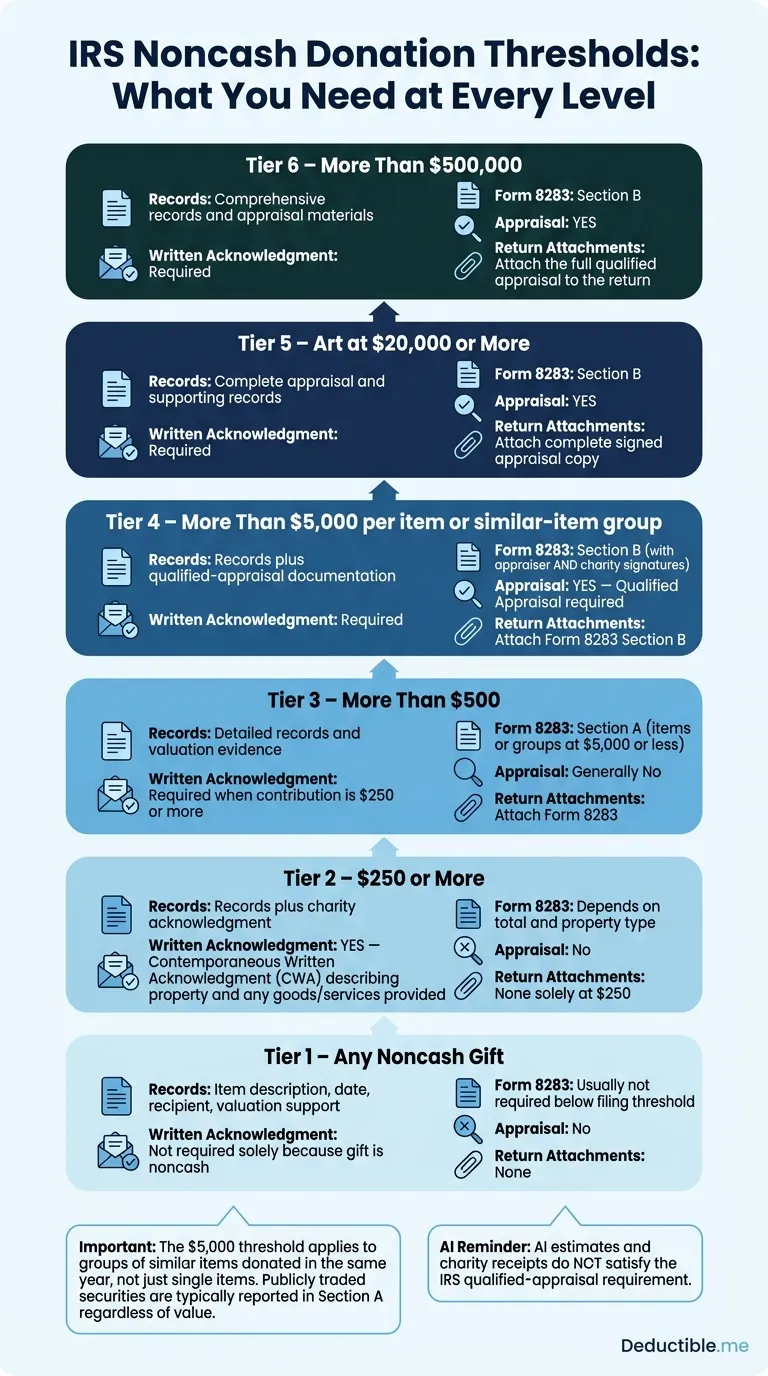
The IRS asks for more paperwork as the deduction amount goes up. For any noncash gift, keep basic records that describe the property, the donation date, and the recipient. Once a contribution reaches $250 or more, you also need a contemporaneous written acknowledgment from the charity. That acknowledgment describes the property, but it does not give the value. That’s on you.[2]
When your total noncash deductions for the year go over $500, you must file Form 8283. Items or groups of similar items valued at $5,000 or less go in Section A. Go over $5,000 for a single item or a group of similar items, and you generally need a qualified appraisal and Section B. Section B also needs signatures from both the appraiser and the charity.[4][5]
Two more rules kick in at higher amounts. Art valued at $20,000 or more requires you to attach a complete copy of the signed appraisal to your return.[3][11] If the claimed deduction for noncash property is more than $500,000, the qualified appraisal must be attached to the filed return.[2][1]
| Deduction range | Donor records | Written acknowledgment | Form 8283 section | Appraisal required | Return attachments |
|---|---|---|---|---|---|
| Any noncash gift | Item description, date, recipient, valuation support | Not required solely because the gift is noncash | Usually not required below filing threshold | No | None |
| $250 or more | Records plus charity acknowledgment | Yes - CWA describing property and any goods/services provided | Depends on total and property type | No | None solely at $250 |
| More than $500 | Detailed records and valuation evidence | Required when contribution is $250 or more | Section A (items or groups at $5,000 or less) | Generally no | Attach Form 8283 |
| More than $5,000 per item or group | Records plus qualified-appraisal documentation | Required | Section B (with appraiser and charity signatures) | Yes - qualified appraisal | Attach Form 8283 Section B |
| Art at $20,000 or more | Complete appraisal and supporting records | Required | Section B | Yes | Attach complete signed appraisal |
| More than $500,000 | Comprehensive records and appraisal materials | Required | Section B | Yes | Attach the qualified appraisal to the return |
One point trips people up all the time: the $5,000 limit applies to groups of similar items, not just one item by itself. So if you donate several pieces of jewelry, a set of similar furniture, or a collection of similar paintings in the same year, you may need to combine them to see whether the threshold is met.[4][2]
Publicly traded securities are usually reported in Section A no matter the value.[5]
These thresholds shape what records you should have in hand before you file.
When AI is not enough
When a category is tough to price, it’s time to move past an AI estimate and bring in a qualified appraiser or tax professional.
The clearest trigger is a claimed deduction that may hit $5,000 for one item or a group of similar items. At that point, a qualified appraisal is generally required, and Form 8283 Section B comes into play.[4][5] Form 8283 is only an appraisal summary, not the appraisal itself. Filling out the form does not satisfy the qualified-appraisal rule for Section B property.[3]
You should also escalate when comparable sales are thin or all over the map, or when the property includes art, collectibles, jewelry, antiques, vehicles, business property, inventory, patents, copyright, trademark, or other intellectual property. Those categories depend on facts AI tools can’t verify well, such as authenticity, provenance, rarity, and niche market pricing.[4][1]
Documentation, common valuation mistakes, and year-end filing steps
After you estimate FMV, the next job is simple: save the proof, fix weak inputs, and file on time.
A defensible FMV doesn’t help much if your records are messy. Once you land on a supportable number, keep the backup in one place.
Records the IRS expects you to keep
Good recordkeeping starts before the donation leaves your hands.
For each noncash gift, build a file with the item’s brand, model, serial number, quantity, and any details that set it apart. Add the donation date and the recipient organization’s legal name. Include notes on condition and completeness, plus photos taken before transfer. That means close-ups of labels, defects, and missing parts too.
Your file should also show how you got to the value. Save completed-sale comparables and note the sale date, platform, condition, and price for each one. If you used an AI tool, keep the estimate, the inputs you entered, and the date you ran it. Hold on to the charity’s receipt and the contemporaneous written acknowledgment (CWA) for any contribution of $250 or more.[2] If you need a qualified appraisal and Form 8283, keep those in the same file.
One detail people miss: track totals by category and by group of similar items. IRS thresholds apply to grouped property, not just single items.
Common AI valuation errors and how to fix them
AI tools can move fast. That’s helpful, but it also makes certain mistakes more likely. Most of them are easy to spot once you know where to look.
| Error | Tax risk | Fix |
|---|---|---|
| Using asking prices instead of completed sales | FMV may be overstated; deduction lacks support | Replace with actual sold prices; record the platform, date, condition, and realized price |
| Using new retail price for used goods | Significant overstatement of value | Find comparable used sales close to the contribution date |
| Ignoring defects, wear, or missing parts | Valuation inflated relative to actual condition | Photograph defects; list missing components; apply evidence-based discounts |
| Misidentifying the maker, model, or edition | Comparable sales may no longer be reliable | Verify labels, serial numbers, model numbers, and other identifying details |
| Assigning one value to a mixed-condition lot | Better items may be undervalued; damaged items overvalued | Separate by condition and value each meaningful subgroup |
| Failing to group similar items | May miss an appraisal or Form 8283 requirement | Calculate totals by item and by group of similar property donated to the same recipient |
| Rounding up without support | Repeated rounding can appear arbitrary | Use the actual supported figure and preserve the calculation |
| Relying on non-appraisal documents for value | AI output and charity receipts do not satisfy the IRS qualified-appraisal rule; a receipt proves transfer, not FMV | Use AI as a starting point; obtain a qualified appraisal when required; keep independent valuation evidence alongside the CWA |
If an AI estimate looks too high or too low, don’t leave it as-is. Go back and check the item’s identity. Replace weak comps with completed-sale data. Adjust for wear, defects, and missing accessories. Then save the revised number with the proof behind it.
A year-end donation checklist to support filing
Use these steps to finish your filing record before December 31. A gift must be completed by December 31 to count for that tax year. If you start the donation in December but it isn’t completed until January, it usually falls into the later tax year. So don’t cut it close. Leave enough time to finish the transfer, get the acknowledgment, and line up an appraisal if you need one.
A practical sequence for year-end giving:
- Confirm the recipient is a qualified organization before donating.
- Inventory and photograph items before transfer - condition, labels, serial numbers, defects.
- Separate routine household goods from specialized property like art, jewelry, collectibles, vehicles, securities, or business property. Each group needs different evidence.
- Review the thresholds above for both individual items and groups of similar items.
- Arrange a qualified appraisal early if any item or similar-item group may exceed $5,000 - don’t wait until tax season.
- Obtain the CWA and confirm it includes the required property description and a goods-or-services statement.[2]
- Complete Form 8283 using the section required by the thresholds above.
- Keep the full tax file - receipts, photos, acknowledgment, valuation evidence, AI output, appraisal, and Form 8283 - with your return records.
Deductible.me can help organize records and prepare Form 8283-ready documentation. Use its output as a starting point, then review everything with the steps above before filing.
Conclusion: Use AI as a support tool, not the final authority
After the workflow, judgment still matters. AI can speed up research, make the valuation process more consistent, and make records easier to document. But the final number on a tax return is still the donor’s responsibility.[1]
That’s the key point: FMV has to match the item’s condition and the market evidence on the donation date. It does not come from retail price, replacement cost, or personal attachment.
Here’s a simple rule of thumb: the more common the item and the easier it is to verify, the more helpful AI tends to be. So yes, AI can help with common household goods. But as value goes up, or the item gets more complex, AI becomes less dependable. At that point, human review matters more, and a qualified appraisal is often the safer move.
Deductible.me can help organize records and draft estimates, but the donor still needs to check the final value. If you’re unsure, use a conservative number and talk with a qualified appraiser or tax professional.
FAQs
Can I use AI as proof of value for the IRS?
AI tools like Deductible.me can help you estimate fair market value and keep a record of how you reached that number for the IRS. That can save time and make the process less of a headache.
But there’s a limit: an AI estimate does not take the place of a qualified appraisal when the IRS requires one.
If a single item, or a group of similar items, is worth more than $5,000, you need a qualified appraisal for IRS purposes. You also need to keep complete records, including:
- descriptions of each item
- notes on condition
- how you determined the value
When do I need Form 8283 or a qualified appraisal?
You need Form 8283 if your total non-cash charitable donations for the year add up to more than $500.
There’s another rule to watch for. If any single item or group of similar items is worth more than $5,000, you also need a qualified appraisal. On top of that, you must fill out Form 8283, Section B and get signatures from both the appraiser and the charity.
How do I value donated items with no clear resale comps?
Start with condition and demand. The IRS generally expects items to be in good used condition or better, and condition is often the main driver of fair market value.
Use realistic pricing sources, like thrift store pricing guides and comparable sold results, not asking prices. Then adjust for age, wear, and defects. Keep records of how you priced the item, along with condition notes, photos, and your sources.
For complex or high-value items, get a qualified appraisal.