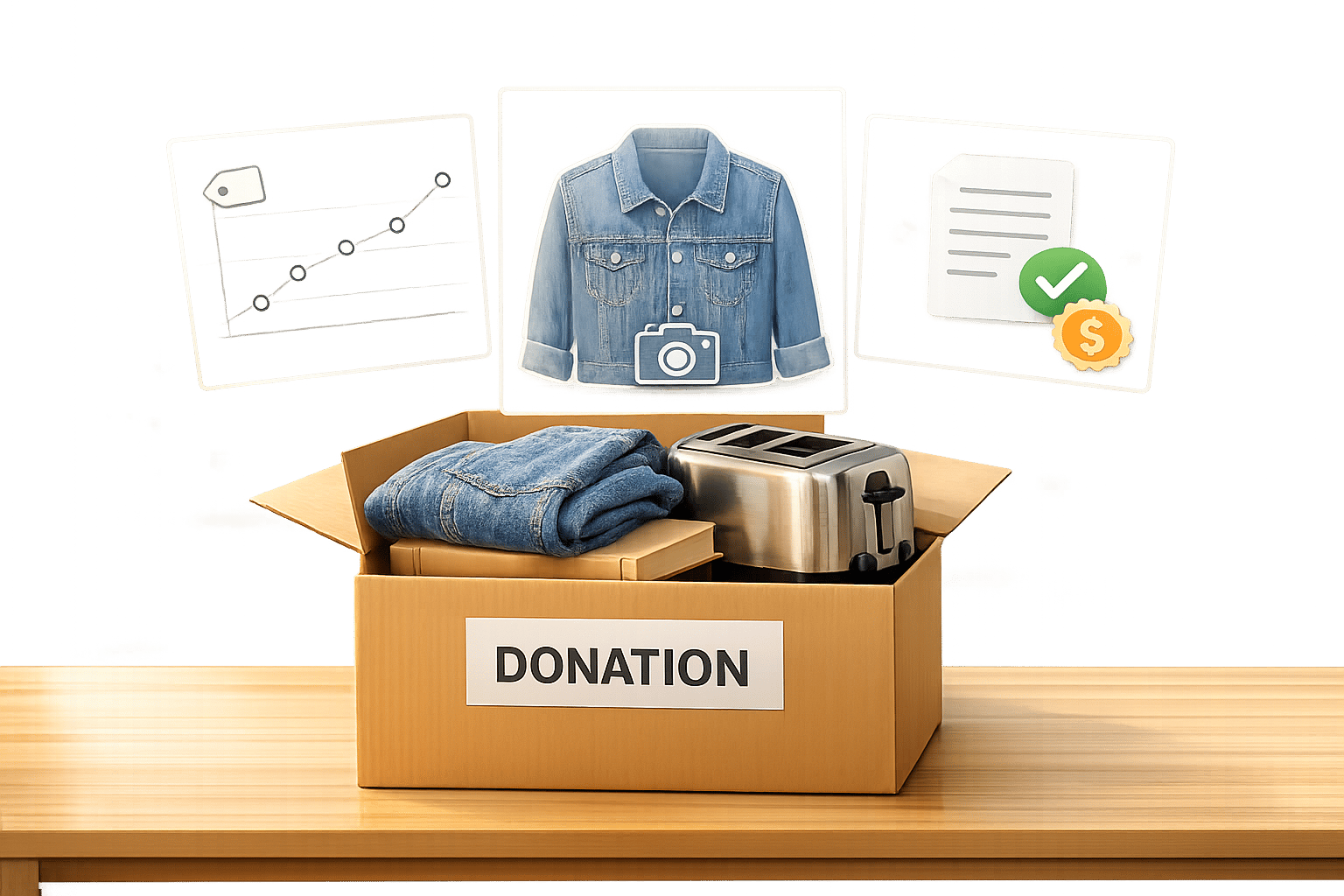
How AI Calculates Fair Market Value for Donations
AI tools simplify estimating the fair market value (FMV) of donated items by analyzing live resale data and aligning with IRS guidelines. This ensures accurate tax deductions and compliance with IRS rules. Here's how it works:
- Data Sources: AI pulls pricing data from platforms like eBay, Facebook Marketplace, Goodwill guides, and specialized databases for vehicles, stocks, and digital assets.
- Item Identification: Using computer vision or text input, AI classifies items by type, brand, and condition (e.g., Good, Fair).
- Price Calculation: AI compares items to resale trends, adjusting for wear and tear, and provides a defensible FMV range.
- Compliance Checks: AI flags donations over $500 (requiring IRS Form 8283) or $5,000 (needing a professional appraisal).
Tools like Deductible.me make this process fast and user-friendly. Upload photos of your items, review AI-generated values, and generate IRS-compliant documentation. For frequent donors, premium features offer unlimited tracking and detailed tax records. This approach saves time, reduces errors, and helps maximize tax savings.
Data Sources AI Uses to Estimate FMV
Primary Data Inputs for AI Valuation
AI tools rely on a mix of trusted data sources to estimate Fair Market Value (FMV). These include live resale listings from platforms like eBay and Facebook Marketplace, valuation guides from organizations such as Goodwill and the Salvation Army, and IRS publications like Publication 561 and Publication 526 [1].
For more specialized items, AI taps into specific databases. For example:
- Vehicles: Kelley Blue Book and NADA Guides.
- Publicly Traded Stocks: High and low averages on the donation date from Yahoo Finance or Google Finance.
- Digital Assets: Cryptocurrency exchanges like Coinbase and Binance, along with CoinMarketCap [5].
| Donation Type | Data Source |
|---|---|
| Clothing & Household | Thrift store guides, eBay sold listings, Facebook Marketplace |
| Vehicles | Kelley Blue Book, NADA Guides |
| Publicly Traded Stock | Yahoo Finance, Google Finance (average of high/low on donation date) |
| Digital Assets | Cryptocurrency exchanges (Coinbase, Binance), CoinMarketCap |
| Art & Collectibles | Auction results, dealer prices, qualified appraisals |
AI then processes this data to ensure consistency and accuracy in valuations.
How AI Normalizes and Standardizes Data
Data pulled from various sources can differ widely. Take a used men's wool coat as an example: its price might vary significantly depending on whether it was sold at a liquidation sale, a consignment shop, or a premium resale platform. To address this, AI filters out extreme outliers (e.g., liquidation prices) to focus on what a typical thrift-market buyer would pay [1].
"The price that buyers of used items actually pay in used clothing stores, such as consignment or thrift shops, is an indication of the value." - IRS Publication 561 [1]
AI also categorizes items into condition tiers - typically Excellent, Good, or Fair - aligning with the IRS requirement that donated goods must be in "good used condition or better" to qualify for deductions. This standardization process ensures the estimates are well-supported and reflect actual market conditions, rather than inflated retail prices [6].
How Deductible.me Applies These Data Sources
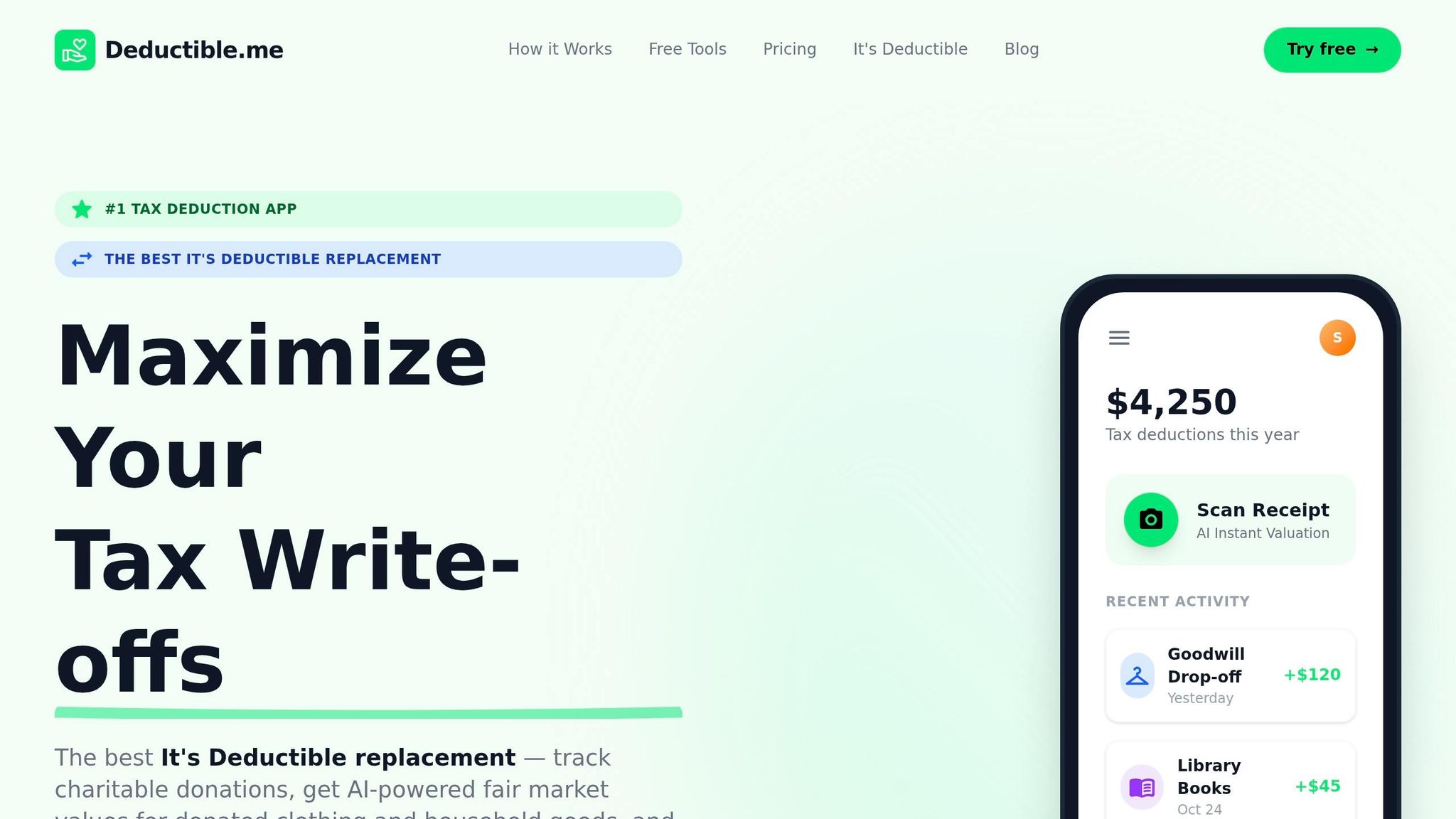
Deductible.me takes these standardized data inputs and integrates them into a seamless valuation system. Users can simply upload a photo of donated items, and the platform automatically identifies each object - from clothing to furniture - and cross-references live resale data with IRS valuation guidelines to generate an estimate in seconds [2].
The tool refines values further based on factors like brand, item type, and user-reported condition, saving users the hassle of manually searching price guides or worrying about IRS compliance. The platform offers a free plan that tracks up to $500 in donations, while the Premium plan ($24/year) provides unlimited tracking and advanced analytics for frequent donors [2].
sbb-itb-e723420
How AI Turns Item Details Into Fair Market Value
Item Recognition and Classification
AI can identify donation items using computer vision technology, analyzing a single photo to automatically recognize categories like clothing, furniture, or kitchenware [2][9].
For descriptions without images, some tools rely on Natural Language Processing (NLP) to extract important details such as the item's name, brand, material, and condition [4]. Once the item is recognized, AI classifies it by type, brand, and condition tier - Excellent, Good, or Fair - and translates this information into clear, standardized descriptions suitable for IRS tax documentation [8].
After this step, the AI moves on to determine the item's value using current market data.
Price Modeling and Valuation
Once an item is classified, AI compares it to thousands of live resale listings to find out what similar items are actually selling for [2]. For items that depreciate over time, the model adjusts the value by accounting for wear and tear, aligning the price with its current condition [1].
The pricing model takes into account factors like brand, category, condition tier, and market demand to generate an estimate that reflects actual resale trends, rather than inflated retail prices. For example, Deductible.me uses live resale data alongside IRS valuation guidelines to calculate what it calls a "defensible fair market value in seconds" [2].
After arriving at an initial valuation, the AI refines its estimate by factoring in market variability and ensuring compliance with tax regulations.
Confidence Ranges and Compliance Checks
Instead of providing a single fixed value, AI offers a low-to-high price range that accounts for market fluctuations, helping donors understand what their item might realistically be worth.
Built-in compliance features ensure adherence to IRS rules. For instance, the system flags when non-cash donations exceed $500, which requires Form 8283, or when an individual item nears the $5,000 threshold, which mandates a professional appraisal [1][6].
"AI is not a substitute for IRS rules or professional advice, but it can be a helpful research assistant when determining reasonable fair market values." - Sam Wesley, Bluestem Financial [8]
While AI provides a starting point, donors remain responsible for reviewing and confirming suggested values before finalizing them. This ensures human oversight, especially where IRS regulations demand it [8].
How to Use AI Valuation Tools for Donations: Step by Step
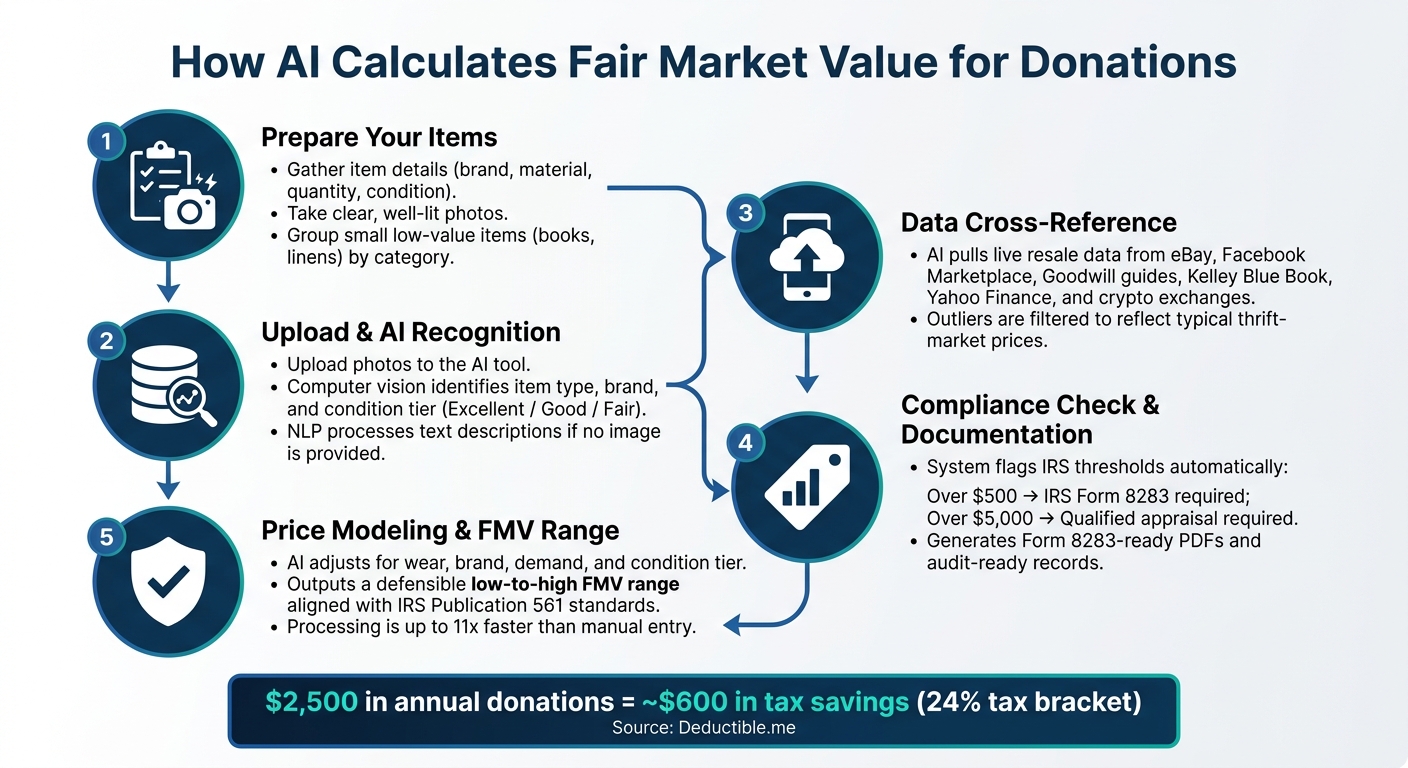
How AI Calculates Fair Market Value for Donations: Step-by-Step
Preparing Items for Valuation
Start by ensuring your items meet IRS standards for being in good used condition and having an accurate fair market value (FMV). Gather important details like brand, material, and quantity for each item, as these factors directly impact the AI's valuation suggestions [8][9]. For smaller, low-value items such as books or linens, group them together to get more consistent category-based estimates [9][3]. Take clear, well-lit photographs of each item or group. These photos not only help the AI's vision model assess the condition but also act as documentation for IRS audits [2][9]. Once everything is organized and photographed, you're ready to upload the items for a quick AI evaluation.
Uploading Items and Running AI Valuations
Snap photos of your donation items - whether it's clothing, kitchenware, or furniture - and upload them to Deductible.me. The platform's AI processes images up to 11x faster than manual entry, identifying items and comparing them to live resale data while aligning with IRS guidelines to suggest a defensible FMV in seconds [2][7]. Review the AI's classifications and suggested values carefully before saving them. For high-value items like branded furniture or electronics, double-check the suggested resale values against the item's actual condition and wear [9]. This extra step ensures your records are accurate and ready for audits. Once you've confirmed the AI-generated values, the system automatically saves the data for easy tracking.
Tracking and Documenting Your Donations
After confirming the valuations, Deductible.me takes care of tracking your donations by charity. The free plan allows you to track up to $500 in donations annually, while the Premium plan (priced at $24/year) offers unlimited tracking, automatically generates Form 8283-ready PDFs, and provides enhanced receipt management [2][8]. To complete your audit trail, photograph the receipts you receive at drop-off, making sure they include the charity's name, date, and location [2][8]. Deductible.me estimates that donors who track $2,500 in annual donations could see around $600 in tax savings if they're in the 24% tax bracket [2].
Staying Compliant and Understanding AI Limitations
Aligning AI Valuations With IRS Rules
AI tools can help estimate the fair market value of donated items, but staying within IRS documentation guidelines is a must to ensure compliance.
| Donation Value | Required Documentation |
|---|---|
| Under $250 | Receipt showing the charity's name, date, and location |
| $250–$500 | Written acknowledgment plus a description of the donated items |
| Over $500 | IRS Form 8283 with records detailing how the value was determined |
| Over $5,000 | Qualified appraisal and IRS Form 8283 (Section B) are required |
| Single item over $500 in poor condition | Qualified appraisal is necessary regardless of other thresholds |
For donations exceeding $5,000, whether it’s a single item or a group of similar items, a qualified appraisal is mandatory. The appraiser’s sign-off must also be recorded on Form 8283. For unique or rare items, specialized appraisals might be needed to meet IRS requirements.
Once the AI provides its estimates, the next step is to compare them with trusted valuation resources.
How to Verify AI-Generated Estimates
To ensure accuracy, cross-check AI-generated values against established valuation guides like those from the Salvation Army or Goodwill. If the AI suggests a value higher than typical resale prices, it’s wise to adjust it downward. Conservative estimates are more likely to withstand IRS scrutiny.
The IRS also advises factoring in details like the item's original cost, comparable sales, replacement cost, and expert opinions when determining fair market value. This multi-step verification helps ensure your deductions are both accurate and defensible.
But verification alone isn’t enough - maintaining proper records is equally critical.
Keeping Records for Audit Readiness
After confirming your valuations, focus on building a solid audit trail. Photos not only help AI tools assess value but also serve as key evidence during an IRS audit. Keep receipts that include the charity’s name, donation date, and location. Additionally, maintain a detailed log that lists the item type, quantity, brand, material, and condition (e.g., Excellent, Good, Fair).
For added convenience, tools like Deductible.me’s Premium plan can streamline this process. It generates Form 8283-ready PDFs in an IRS-recognized format, saving you time and effort when it’s tax season. With these records in place, you’ll be well-prepared for any audit-related inquiries.
Conclusion
AI tools now offer a quick and reliable way to generate data-backed estimates that align with IRS Publication 561 standards.
Here's the bottom line: accuracy protects your deductions. Whether you're donating a few items of clothing or clearing out an entire home office, an AI-generated valuation gives you a solid, audit-ready record. As financial advisor Sam Wesley of Bluestem Financial puts it:
"AI is not a substitute for IRS rules or professional advice, but it can be a helpful research assistant when determining reasonable fair market values." [8]
By combining detailed data inputs with compliance checks, these tools ensure accuracy in fair market value (FMV) calculations, ultimately protecting your tax benefits. And for many donors, those benefits can add up. For example, Deductible.me estimates that a $2,500 annual donation value could save someone in the 24% tax bracket around $600 in taxes [2].
Deductible.me simplifies the entire process, providing instant IRS-compliant documentation and making it easy to track your donations year-round.
FAQs
How does AI know my item’s condition from a photo?
AI leverages cutting-edge computer vision to examine your photos and pinpoint specific items. By assessing visual elements such as wear, tear, and overall structure, it categorizes the item's condition as 'like new,' 'good,' or 'fair.' Once the condition is determined, the AI cross-references this information with resale databases and current market trends to suggest a fair market value. You'll have the opportunity to review and approve these AI-generated insights before finalizing them.
What should I do if the AI value seems too high or too low?
If the AI-generated value seems off, tweak it to a logical and justifiable amount. According to the IRS, Fair Market Value is the price a willing buyer and seller would settle on. To determine this, rely on evidence such as recent sales of similar items in similar condition. Also, make sure to document your reasoning - this could include noting factors like wear and tear or current resale demand. Consistency is key, so ensure your adjustments are reasonable and maintain records to back up your claim.
When do I need Form 8283 or a professional appraisal?
If you're claiming more than $500 in noncash charitable contributions in a tax year, you'll need to file IRS Form 8283. For contributions of a single item or a group of similar items valued above $5,000, a qualified appraisal is mandatory - unless the donation is a publicly traded security. Additionally, if you're donating art worth over $20,000 or any item valued at more than $500,000, the appraisal report must be included with your tax return.