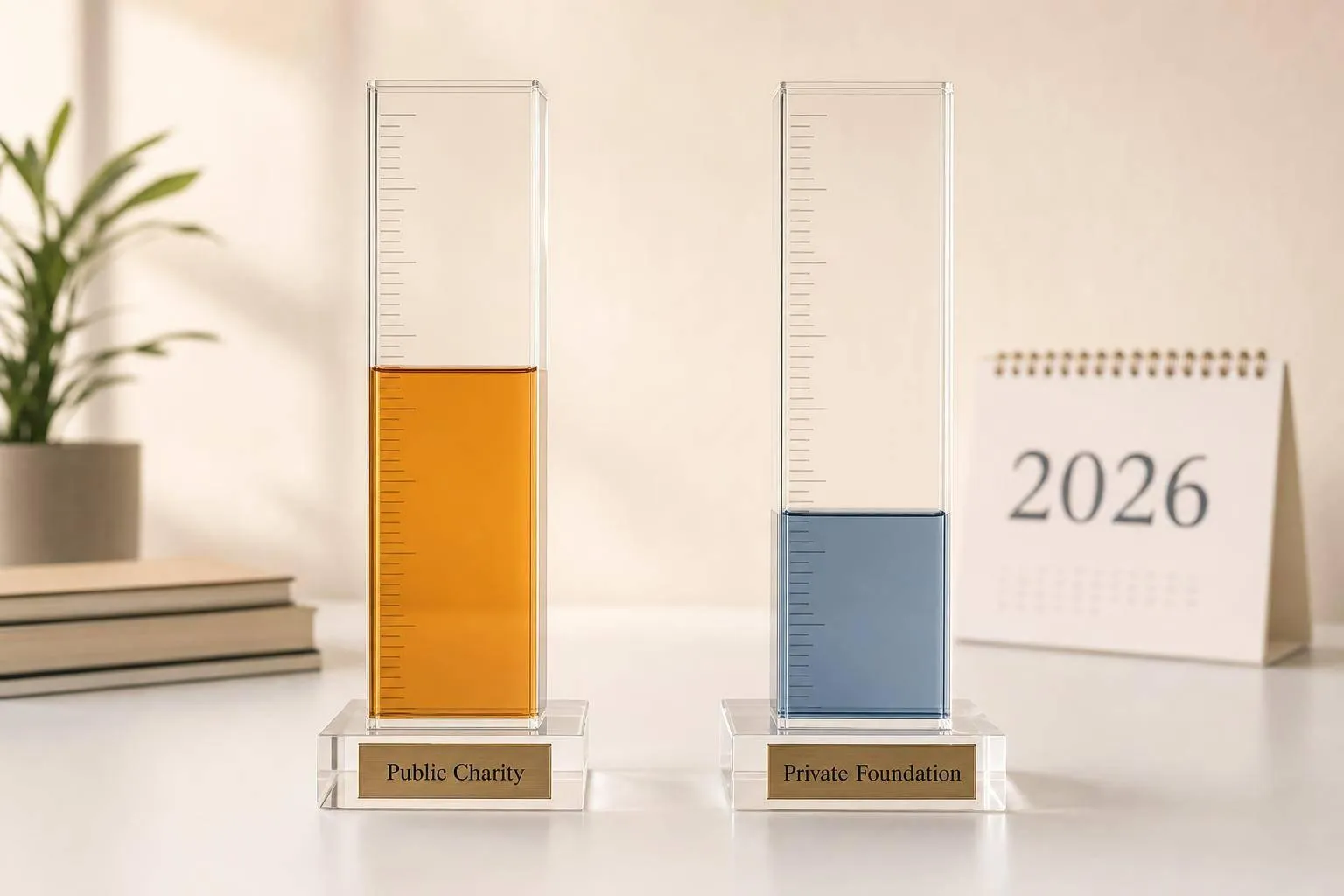
Where you give can cut your 2026 tax deduction in half. If I give cash to a public charity, I can deduct up to 60% of AGI. If I give the same cash to a private foundation, the limit is usually 30% of AGI. On top of that, a new 0.5% AGI floor means the first slice of my charitable giving does not count toward an itemized deduction.
Here’s the short version:
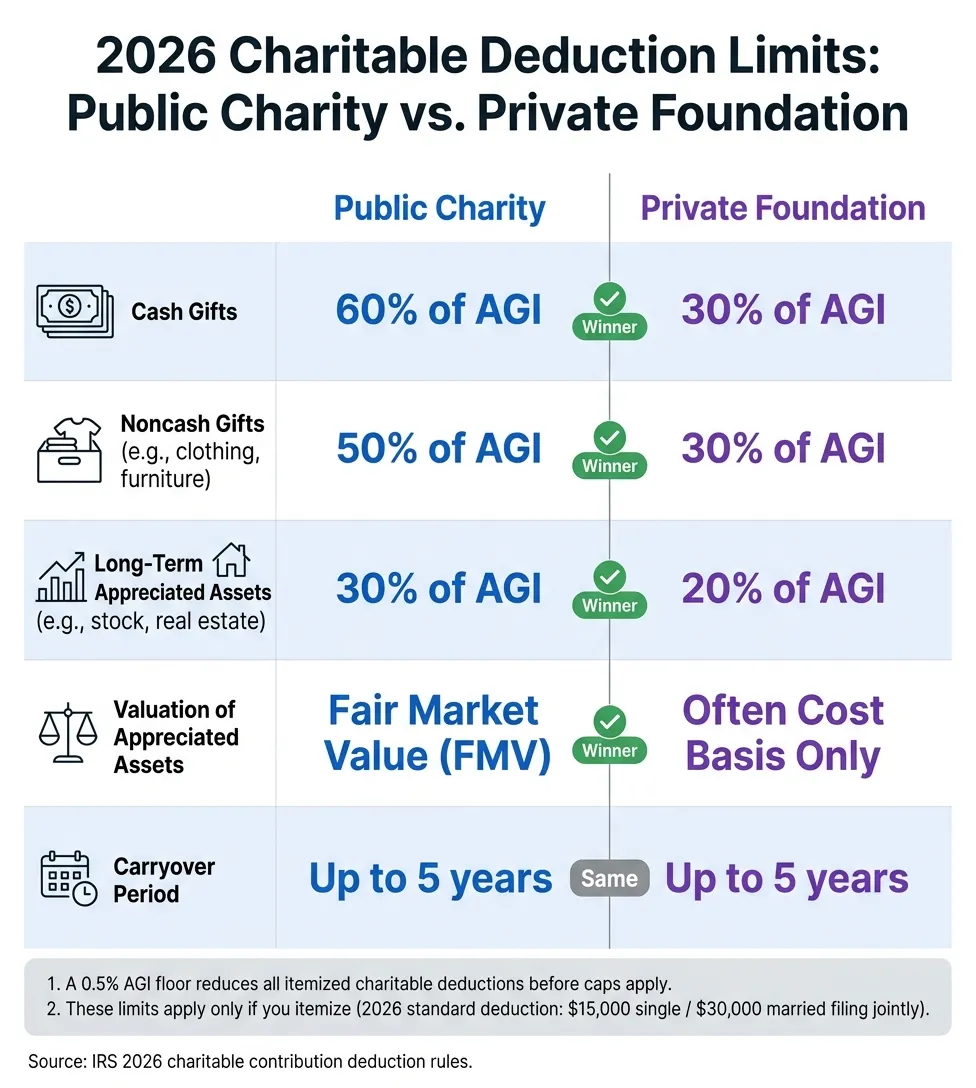
- Cash gifts: public charity = 60% of AGI; private foundation = 30%
- Regular noncash gifts: public charity = 50%; private foundation = 30%
- Long-term appreciated assets: public charity = 30%; private foundation = 20%
- Valuation can change: public charities often allow fair market value for appreciated assets, while private foundations often limit me to cost basis
- Carryovers: amounts blocked by annual limits can usually carry forward for up to 5 years
- Paperwork matters: larger noncash gifts can require Form 8283 and, above $5,000, an appraisal
This also matters only if I itemize, especially with the 2026 standard deduction at $15,000 for single filers and $30,000 for married couples filing jointly. And if I give a mix of cash and property, each gift type follows its own cap.
Quick Comparison
| Gift type | Public charity | Private foundation |
|---|---|---|
| Cash | 60% of AGI | 30% of AGI |
| Noncash items | 50% of AGI | 30% of AGI |
| Appreciated assets | 30% of AGI | 20% of AGI |
| Value used for appreciated assets | Often FMV | Often cost basis |
So if I want the largest 2026 deduction, a public charity usually gives me more room, especially for cash and appreciated stock or real estate.
Understanding the Differences Between Public Charities and Private Foundations
2026 Deduction Limits: Public vs. Private Charities
For itemizers, the big split is the cash limit: 60% for public charities and 30% for private foundations [1]. That gap shows up most clearly with cash gifts. With noncash gifts, the rules get a bit more mixed.
Cash Gifts: 60% of AGI for Public Charities vs. 30% for Private Foundations
Cash gifts to a qualified public charity are deductible up to 60% of your AGI, while cash gifts to most private foundations are capped at 30% of AGI [1]. If your AGI is $200,000, that means a current-year deduction limit of $120,000 for a public charity versus $60,000 for a private foundation.
For higher-income donors making large gifts, that difference matters. The type of organization you give to can directly affect how much of your donation you can deduct this year.
Noncash Gifts and Appreciated Property: 30%, 20%, and Valuation Differences
Noncash gifts follow a different set of limits. Here’s how the 2026 rules break down by gift type:
| Gift Type | Public Charity Limit | Private Foundation Limit | Valuation |
|---|---|---|---|
| Cash | 60% of AGI | 30% of AGI | Face value |
| Noncash gifts (clothing, furniture) | 50% of AGI | 30% of AGI | Fair Market Value (FMV) |
| Long-term appreciated assets (stock, real estate) | 30% of AGI | 20% of AGI | FMV (public charity) / Cost basis (private foundation) |
Long-term appreciated property is where the contrast gets sharper. Gifts to public charities generally qualify for a deduction based on fair market value, while gifts to most private foundations are usually limited to cost basis [1]. Qualified appreciated stock can be an exception [1].
So it’s not just the percentage cap that changes. The value used for the deduction can change too, which can make a big difference on the return.
The New 0.5% AGI Floor and the Non-Itemizer Cash Deduction
There’s another rule layered on top of these limits: a 0.5% AGI floor reduces itemized charitable deductions before the percentage caps apply [1]. That means a gift can qualify, yet still produce a smaller current-year deduction than you might expect.
Non-itemizers can still claim a separate cash deduction for qualifying gifts to public charities.
The examples below show how these rules play out on actual returns.
How the 2026 Rules Play Out in Real Filing Situations
These examples show what changes on an actual return when the 0.5% AGI floor and the annual percentage caps both come into play.
Example 1: Single Professional Itemizing Deductions
Take Marcus, a 38-year-old marketing consultant with $100,000 of AGI in 2026. He gives $40,000 in cash and itemizes.
First, the 0.5% floor trims $500 off the gift. So before you even get to the recipient cap, the amount left for deduction is $39,500.
If Marcus gives to a public charity, the 60% cap is $60,000, so it doesn’t get in the way. He can deduct the full $39,500 in 2026, and there’s nothing left to carry into another year.
If he gives that same $40,000 to a private foundation, the math shifts. The 30% cap sets his limit at $30,000. That means $9,500 carries forward to 2027 [1].
| Item | Public Charity | Private Foundation |
|---|---|---|
| AGI | $100,000 | $100,000 |
| Cash Gift | $40,000 | $40,000 |
| 0.5% AGI Floor | −$500 | −$500 |
| Annual Cap | $60,000 (60%) | $30,000 (30%) |
| 2026 Deduction | $39,500 | $30,000 |
| Carryover to 2027 | $0 | $9,500 |
That split gets even more interesting when a couple gives both cash and appreciated stock.
Example 2: Married Couple Donating Cash and Stock
Priya and Daniel file jointly with an AGI of $250,000. They give $60,000 in cash and $40,000 in long-term appreciated stock with a $10,000 cost basis.
The 0.5% floor is $1,250, so that amount cuts into the deductible gift total before the annual caps are tested.
If they give to a public charity, the numbers work in their favor. The 60% cash cap is $150,000, and the 30% stock cap is $75,000. Both gifts stay under those limits. So in 2026, they can deduct $58,750 of cash and $40,000 of stock, with no carryover.
If they give the same amounts to a private foundation, the caps are tighter. The 30% cash cap is $75,000, and the 20% stock cap is $50,000. The cash gift still fits. But the stock is treated differently: the deduction is limited by the private-foundation rule and valued at cost basis, which is $10,000. So their current-year deduction becomes $58,750 in cash and $10,000 in stock. The rest of the stock’s value doesn’t create any extra tax break [1].
For many business owners, this is where things get personal - literally. The big issue is whether the gift is made by the business or by the owner as an individual.
Example 3: Small Business Owner Giving Personally While Itemizing
Sandra gives personally, not through her business. That means the gift goes on Schedule A, and she gets a tax break only if she itemizes.
If she gives cash to a public charity, the 60% cap applies. If she gives to a private foundation, the 30% cap applies. In either case, the 0.5% floor reduces the deductible amount first. Any amount above the yearly limit carries forward for up to five years, with the type of recipient setting the ceiling [1].
Carryovers, Ordering Rules, and Recordkeeping
Five-Year Carryovers When 2026 Limits Block a Full Deduction
If a gift goes over the 2026 deduction cap, the unused part doesn’t vanish. You can carry it forward for up to five later tax years. And that carryover stays in the same gift bucket, which means the same cap keeps applying to it [1].
Ordering Rules When Mixing Cash, Property, and Recipient Types
The deduction limit depends on both what you gave and who received it. So if you donate cash, appreciated property, and other noncash items in the same year, each one is tested under its own limit category [1].
| Contribution Type | Recipient | AGI Limit |
|---|---|---|
| Cash | Public charity | 60% [1] |
| Ordinary noncash items | Public charity | 50% [1] |
| Appreciated assets | Public charity | 30% [1] |
| Cash | Private foundation | 30% [1] |
| Appreciated assets | Private foundation | 20% [1] |
Documentation: Receipts, Written Acknowledgments, and Form 8283
Once you’ve figured out the deduction, the paperwork is what helps it hold up in an audit. For donations under $250, a bank record, credit card statement, or receipt is enough [1]. For donations of $250 to $500, you need a written acknowledgment from the charity by the return due date [1] [3].
Noncash gifts come with stricter record rules. If your total noncash donations are over $500, you need IRS Form 8283, Section A [1] [2]. If a single item - or a group of similar items - is worth more than $5,000, you also need a qualified appraisal and Form 8283, Section B, signed by both the appraiser and the charity [1] [2].
| Donation Value | Required Documentation | Form Required |
|---|---|---|
| Under $250 | Bank record, credit card statement, or receipt [1] | None |
| $250–$500 | Written acknowledgment [1] [3] | None |
| Over $500 (noncash) | Form 8283, Section A [1] [2] | Section A |
| Over $5,000 (noncash) | Qualified appraisal + Form 8283, Section B [1] [2] | Section B |
Valuation is the donor’s job, so it’s smart to keep receipts, appraisals, and Form 8283 in one place. Deductible.me can help estimate FMV and keep those records organized.
Conclusion: Public Charities vs. Private Foundations - Which Gives the Better Deduction in 2026
Public charities usually give you the bigger 2026 deduction. The gap is pretty clear: 60% vs. 30% of AGI for cash gifts, and 30% vs. 20% of AGI for appreciated assets.
Here’s the quick side-by-side:
| Feature | Public Charity | Private Foundation |
|---|---|---|
| Cash deduction limit [1] | 60% of AGI | 30% of AGI |
| Appreciated asset limit [1] | 30% of AGI | 20% of AGI |
| Appreciated asset valuation [1] | FMV | Often cost basis |
If your top goal is getting the biggest 2026 tax deduction, a public charity is usually the better choice. That’s especially true if you’re giving cash or appreciated assets and want the higher annual cap.
Deductible.me can help you track noncash gifts and create IRS-ready Form 8283 records. For people who itemize, the best tax result usually comes from pairing the type of gift with the recipient that allows the higher deduction limit.
FAQs
Do donor-advised funds count as public charities?
No. Donor-advised funds (DAFs) are not treated as public charities for deduction-limit purposes.
They fall into a separate bucket from eligible 501(c)(3) public charities. So when you’re dealing with qualified charitable distribution (QCD) rules, the money generally needs to go directly to an eligible public charity, not to a DAF sponsor.
How do carryovers work if I exceed my AGI limit?
If your charitable contributions go over the IRS percentage limits based on your adjusted gross income (AGI), you can usually carry the extra amount forward for up to five years.
During that carryforward period, the excess still follows the same percentage limits that applied to the original type of contribution.
When do I need Form 8283 or an appraisal?
You generally need Form 8283 for non-cash charitable donations when the total value of all non-cash gifts for the year is more than $500.
A qualified appraisal is usually required if any single donated item, or a group of similar items, is worth more than $5,000. Publicly traded securities are excluded from that rule.
Use Section A when your total non-cash donations go over $500. Use Section B for items worth more than $5,000, along with the required appraisal.