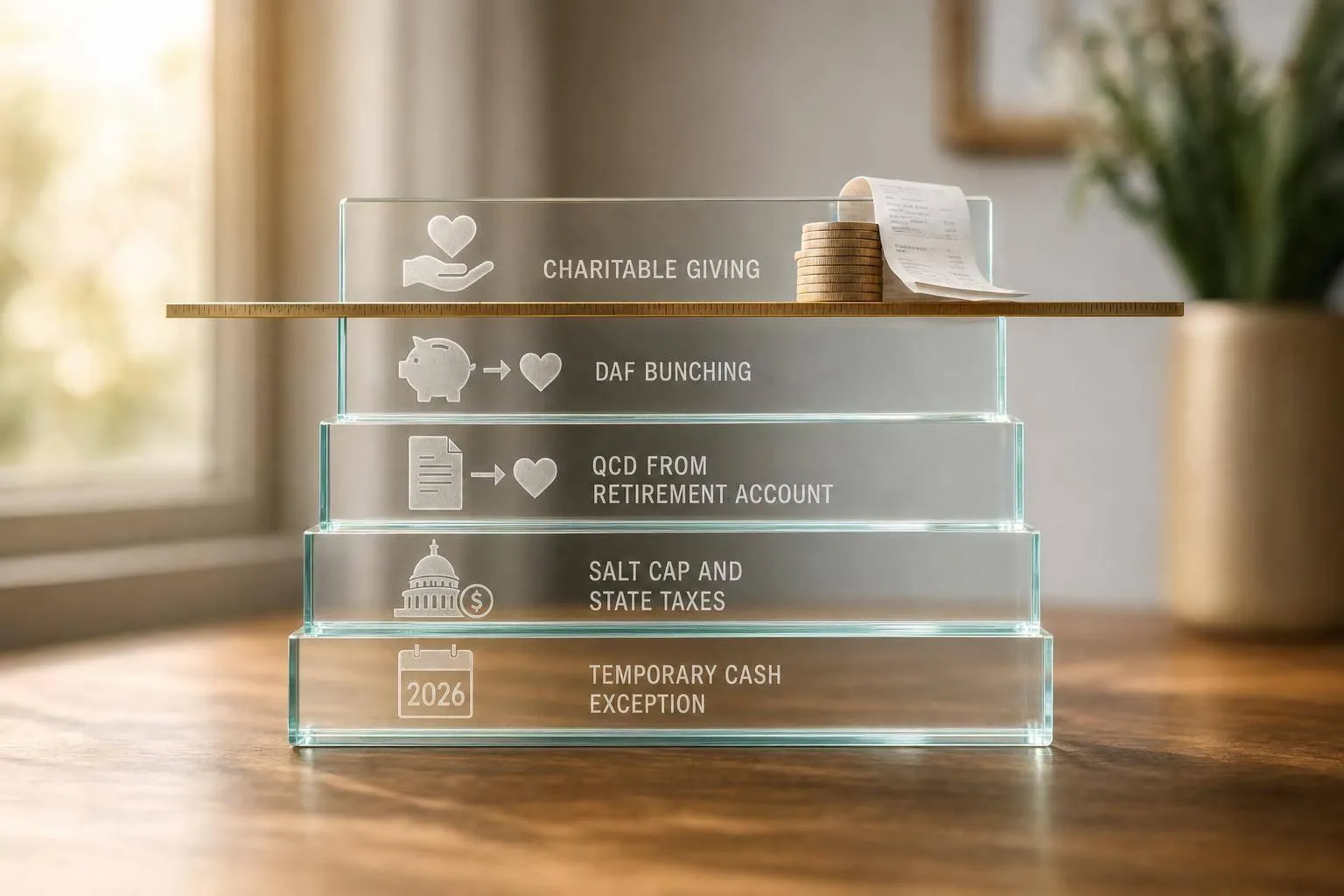
Your gift helps your federal taxes only when it changes the math. In 2026, that usually means one of three things: you itemize, your gift pushes you over the standard deduction, or you use a separate rule like the $1,000 non-itemizer cash deduction ($2,000 for married couples filing jointly) or a QCD.
Here’s the short version:
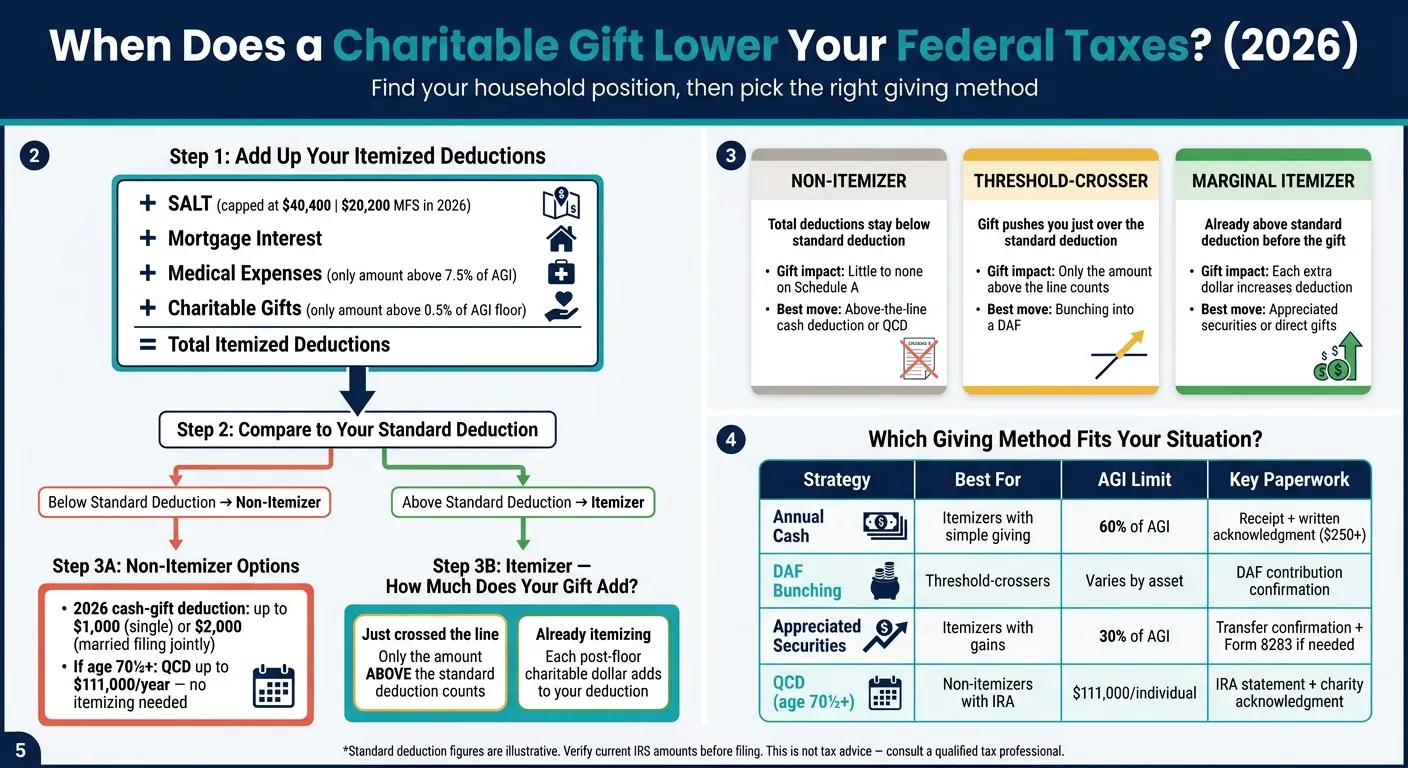
- If your SALT, mortgage interest, medical costs, and charitable gifts do not beat the standard deduction, your gift may not lower your federal tax bill much.
- The SALT cap is $40,400 for most filers in 2026, and $20,200 for married filing separately.
- Charitable gifts for itemizers start only after the 0.5% of AGI floor.
- Medical expenses count only above 7.5% of AGI.
- Cash gifts, stock gifts, DAF bunching, and QCDs all work in different ways.
- Paperwork matters: gifts of $250+ need a written acknowledgment, and noncash gifts over $500 often trigger Form 8283.
In plain English: I’d check whether I’m below the line, just over it, or already itemizing anyway. That tells me if giving now, bunching gifts into one year, donating stock, or using a QCD makes sense.
Quick comparison
| Situation | What the gift usually does |
|---|---|
| I don’t itemize | Little or no Schedule A tax effect; the 2026 cash-gift rule may still help |
| I’m just under the standard deduction | Only the amount above the standard deduction changes my federal deduction |
| I already itemize | Each extra deductible gift dollar often adds to my deduction, subject to IRS limits |
| I’m age 70½+ with an IRA | A QCD can cut taxable income without itemizing |
This guide is about one thing: figuring out when a charitable gift changes your tax result, and which giving method fits that situation.
The Charity Deduction Changed In 2026 - Here’s What You Need To Know
How to Calculate Your Household Itemizing Threshold
Now that the rules are clear, the next step is simple: figure out whether your household actually gets over the itemizing line.
That matters because the point isn’t just to total up deductions. The point is to see when charitable giving changes your federal tax result.
Here’s the order to use:
- Start with SALT
- Add mortgage interest
- Add medical expenses
- Add charitable gifts
For medical expenses, count only the portion above 7.5% of AGI.[8][9]
For charitable gifts, take your total eligible gifts and subtract 0.5% of your AGI. The amount left is what goes into your itemized deduction total, before any other contribution caps or eligibility rules are applied.[5][7]
A charitable deduction starts only after gifts exceed 0.5% of AGI; the floor applies only to charitable gifts.[5]
3 Household Positions: Non-Itemizing, Threshold-Crossing, and Marginal Itemizing
Once you run the numbers, your household will usually fall into one of three spots. And that spot tells you whether a charitable gift changes your deduction at all.
A non-itemizing household stays below the standard deduction even after charitable gifts are added. In that case, giving more usually does not increase the federal deduction. That said, a separate 2026 above-the-line deduction may still apply for qualifying cash gifts, up to $1,000 for single filers or $2,000 for married couples filing jointly.[10][2]
A threshold-crossing household lands just under the standard deduction before the gift. If the gift pushes you over the line, only the amount above the standard deduction creates an incremental deduction. Think of it like stepping onto a curb: only the part that gets you up and over counts.
A marginal itemizing household already sits above the standard deduction before any new charitable gift. In that case, each extra post-floor charitable dollar will usually increase your deduction dollar for dollar, subject to contribution limits.
Comparison Table: When Charitable Gifts Actually Increase Your Deductions
The table below shows four hypothetical U.S. households. Standard deduction figures are illustrative, so check current IRS amounts before you file. The estimated incremental deduction means the amount by which itemized deductions exceed the standard deduction. It shows deduction impact, not tax savings.
| Filing Status | SALT Included | Other Itemized Deductions | Charitable Gifts (Post-Floor) | Total Allowable Itemized Deductions | Standard Deduction | Estimated Incremental Deduction |
|---|---|---|---|---|---|---|
| Single (AGI $120,000) | $10,000 | $6,000 | $2,000 gift → $1,400 deductible | $17,400 | $16,000 | $1,400 |
| Married filing jointly (AGI $200,000) | $30,000 | $8,000 | $5,000 gift → $4,000 deductible | $42,000 | $32,000 | $10,000 |
| Head of household (AGI $80,000) | $15,000 | $5,000 | $3,000 gift → $2,600 deductible | $22,600 | $24,000 | $0 |
| Married filing separately (AGI $100,000) | $20,200 | $7,000 | $4,000 gift → $3,500 deductible | $30,700 | $16,000 | $14,700 |
If you still come in under the threshold, the next thing to look at is timing and which assets you give.
Federal and State Rules to Review Before You Give
After you estimate your itemizing threshold, check the federal and state rules that can change what your gift is worth. SALT can eat up itemized deductions, so these rules can decide whether a charitable gift helps at all.
Federal SALT Limits by Filing Status and Income Level
For 2026, the federal SALT cap is $40,400 for single filers, heads of household, and married filing jointly, and $20,200 for married filing separately.[6][13]
You can usually deduct state and local income taxes or general sales taxes - but not both in the same year. The better move is to use whichever one gives you the larger deduction. Real estate taxes and personal property taxes can usually be added on top of that choice, but they still count toward the same overall cap.[15]
If your modified AGI is above $505,000, or $252,500 if you’re married filing separately, the cap starts to phase down by about 30 cents per dollar. It bottoms out at $10,000 or $5,000, respectively.[6][13]
These limits shape how much SALT ends up on Schedule A and whether a gift helps you get past the standard deduction. SALT and charitable gifts are separate itemized deductions, and each one has to get through federal limits before it changes your final deduction.[11][3][12][14]
Federal vs. State Comparison Table for Charitable Planning
Federal rules set the top line. State rules decide whether the same move works the same way on your state return. That split matters more than many people expect. A gift that helps on your federal return may work differently - or not at all - at the state level.
| Review Area | Federal Treatment | State Question to Ask |
|---|---|---|
| Income tax or sales tax | Deduct one or the other - not both[15] | Does the state follow the federal election, or calculate its own taxable income separately? |
| Property taxes | Included in the SALT cap alongside income or sales taxes[15][6] | Does the state impose separate limits, exemptions, or credits? |
| SALT cap | $40,400 / $20,200 for MFS; phases down above $505,000 MAGI[6][13] | Does the state follow federal caps, use its own limits, or require an add-back? |
| Charitable deduction or credit | Itemized deduction, subject to federal percentage limits and the 0.5% floor[11][12][14] | Is there a deduction, a credit, a subtraction, or no state benefit at all? |
| Carryforwards | Excess contributions carry forward up to five years[11] | How long may unused deductions or credits carry forward, and what ordering rules apply? |
| Donor-advised funds | Deduction applies when assets are transferred to the sponsoring charity | Does the state recognize the same timing, or differ? |
| Documentation | Written acknowledgment for gifts of $250 or more; Form 8283 may be required for noncash gifts over $500[4][11] | Are additional state schedules, certificates, or substantiation forms required? |
Once you map out those rule differences, you can look at timing and asset choice with a lot more confidence.
Bunching and Asset-Based Giving Strategies
Bunching means grouping several years of charitable gifts into one tax year so your itemized deductions go above the standard deduction. With the federal SALT deduction capped, when you give often becomes the main lever for getting over that line. The 0.5% AGI floor makes timing matter even more.[17][18] One guardrail matters here: bunch only the gifts you already planned to make.
Once the timing piece is set, the next step is simple: decide which assets to donate.
Annual Giving vs. Bunching Into One Year
A couple may get little or no extra tax break from giving the same amount every year. But a larger DAF contribution in a single year can push total itemized deductions above the standard deduction. That ties straight back to the threshold issue discussed earlier. The logic is the same. The variable that changes is timing.
A DAF contribution is irrevocable, and the donor no longer owns the assets after making it. From there, the couple can recommend grants to operating charities over future years, which lets them keep the same giving pace while taking the deduction in the year of contribution. Before moving money, check the sponsor’s minimum grant amounts, processing deadlines, eligible recipients, and admin fees. Also, a DAF generally cannot receive a qualified charitable distribution (QCD) from an IRA, so that plan needs to be handled on a separate track.[19][21]
After timing, the next comparison is between cash, appreciated assets, noncash property, and QCDs.
Cash, Appreciated Assets, Noncash Property, and Qualified Charitable Distributions
If bunching looks useful, asset choice can change how much of the gift is deductible.
Cash is the easiest gift to document, but it may not give you the best tax result. Cash gifts to qualified organizations are generally deductible up to 60% of AGI.[24] Any extra amount can usually carry forward for up to five years.[1] Keep a bank or card record, plus a written acknowledgment for gifts of $250 or more.[2]
If you own appreciated securities, the math can work better.
Appreciated securities held for more than one year can give you a fair market value deduction and help you avoid capital gains tax, subject to a 30% of AGI limit.[24] If the securities were held for one year or less, the deduction is generally limited to cost basis. Get transfer instructions from the charity or DAF sponsor well before December 31. Year-end transfers often move slower than people expect.
Other property gifts come with their own valuation and filing rules.
Household goods and clothing generally must be in good used condition or better to qualify for a deduction.[3] Keep an inventory with the description, condition, date, recipient, and value, and add photos. If total noncash contributions are above $500, you need Form 8283. If any single item, or group of similar items, is worth more than $5,000, you generally need a qualified appraisal and Form 8283 Section B, except for publicly traded securities.[2][16] Vehicle donations follow separate rules based on how the charity uses or sells the vehicle, so get the required written records before you file.
Qualified charitable distributions (QCDs) work in a different way. A QCD is a direct transfer from an eligible IRA to a qualified charity by someone age 70½ or older. It is excluded from income, not taken as an itemized deduction, and it can count toward a required minimum distribution if done the right way.[22][23] For 2026, the annual QCD limit is $111,000 per individual. If both spouses have eligible IRAs, each spouse may have a separate limit.[23][25] Because a QCD lowers taxable IRA income without requiring itemizing, it can work well for donors who use the standard deduction.
Strategy Comparison Table: Timing, Paperwork, and Limits
| Strategy | Tax Timing | Itemizing Effect | Proof | Major Limits |
|---|---|---|---|---|
| Annual cash giving | Deduction in the year of each gift | May not clear the standard deduction each year | Bank record; written acknowledgment for $250+[2] | 60% of AGI[24] |
| Bunching into a DAF | Deduction in the DAF contribution year; grants distributed later | Can push total deductions above the standard deduction | DAF acknowledgment | AGI limits vary by asset type[24] |
| Appreciated securities (direct or via DAF) | Deduction in the transfer year | Counts toward itemized deductions | Transfer confirmation; Form 8283 if required[2][3] | 30% of AGI for long-term capital-gain property[24] |
| Qualified charitable distribution (QCD) | Excluded from income in the distribution year | Does not require itemizing | IRA statement; charity acknowledgment; evidence of direct transfer[22][23] | $111,000 per individual in 2026; age 70½+; cannot go to DAFs, private foundations, or supporting organizations[23][25][19][21] |
Documentation, Year-End Calendar, and Final Planning Checks
Once you’ve picked the timing and the asset type, the next job is simple: get the paperwork right.
That matters more than people think. Clean records are what back up the deduction. And for SALT-heavy households, those records can make the difference between claiming the charitable deduction needed to itemize or losing it.
For cash gifts under $250, a bank record or receipt is enough. For any single contribution of $250 or more, you need a written acknowledgment from the charity by the return’s due date, including extensions.[26][2] That acknowledgment should identify the organization, state the cash amount or property description, and note whether goods or services were provided in return.[27]
For noncash gifts, Form 8283 is generally required once total noncash contributions go over $500. A qualified appraisal and Form 8283, Section B are generally required when any item or group of similar items goes over $5,000.[28][20] If the claimed noncash deduction exceeds $500,000, the qualified appraisal generally must be attached to the return.[2][29]
Don’t stop at charity receipts. Keep property-tax bills, payment confirmations, W-2s, estimated-tax vouchers, and prior federal and state returns too. Those records help you reconcile Schedule A and spot state conformity differences. If you use donor-advised funds, keep both the contribution confirmation and the grant records. Just make sure the contribution year and grant year are tracked separately.
If your donation records are all over the place, it helps to use one system instead of five half-finished ones. Deductible.me can organize donated-item records with photo-based valuations and IRS-compliant Form 8283-ready reports. It doesn’t replace a qualified appraisal or a tax professional’s review, but it can help cut down on missing receipts and messy records.
Annual Planning Calendar: January Through December
Use this timeline to turn planning into action.
| Period | Focus | Key Actions |
|---|---|---|
| Jan–Mar | Reconcile | Reconcile prior-year receipts and acknowledgments; identify missing appraisals or Form 8283 data; calculate charitable and SALT carryforwards |
| Apr–Jun | Project | Test itemizing under SALT and giving scenarios; update AGI, filing status, residency, and property-tax estimates |
| Jul–Sep | Choose | Choose bunching, DAF timing, or appreciated-asset gifts; confirm transfer procedures and state rule differences |
| Oct–Nov | Collect | Collect missing receipts; schedule qualified appraisals; inventory noncash property with photos and condition notes |
| December | Complete | Complete all year-end gifts by December 31[30] |
| Post-year-end | Match records and file | Match records across bank, brokerage, and payroll accounts; prepare Form 8283 if noncash gifts exceeded $500[28] |
Conclusion: The Planning Checklist That Matters Most
With the records and deadlines set, the last step is a final check before filing.
Before you file, confirm your itemized deduction total, SALT limits, state rules, documentation, and year-end transfer dates. Small details can shift the outcome. SALT limits, charitable limits, and state rules don’t always line up neatly, and that’s where mistakes tend to happen.
If your situation includes appreciated assets, large noncash gifts, multi-state income, or a bunching year, it makes sense to have a tax professional review the plan before you make year-end contributions.
FAQs
Should I itemize or take the standard deduction?
Itemize on Schedule A only when your total deductible expenses are more than the standard deduction for your filing status.
That total can include deductions like:
- charitable contributions
- SALT
- mortgage interest
- qualifying medical expenses
For 2025, the standard deduction is $15,000 for single filers and married filing separately, $30,000 for married filing jointly, and $22,500 for heads of household.
If your deductible total falls below that amount, the standard deduction will usually give you a bigger tax break.
When does bunching charitable gifts make sense?
Bunching charitable gifts can work well when your total itemized deductions - like donations, state and local taxes, mortgage interest, and medical expenses - are close to, but still under, the standard deduction for your filing status.
Here’s the basic idea: instead of spreading your planned giving evenly across years, you group two or more years of donations into a single tax year. That may let you itemize in that year, then take the standard deduction the next year.
Should I donate cash, stock, or use a QCD?
It depends on your tax situation and your age.
If you itemize, cash gifts are deductible up to 60% of AGI.
Donating long-term appreciated stock can be a smarter tax move in some cases. Why? You may be able to deduct the fair market value up to 30% of AGI, and you can avoid capital gains tax on the appreciation.
If you are 70 1/2 or older, a QCD lets you transfer funds from an IRA directly to a charity. That transfer counts toward your required minimum distribution, but it doesn’t increase your taxable income.