IRS Rules for Public Charity and Foundation Gifts
Your deduction can change fast based on just three things: who got the gift, what you gave, and how much AGI you have. If you give cash to a public charity, the limit is often 60% of AGI. If you give long-term appreciated property to a private nonoperating foundation, the limit can drop to 20% of AGI, and your deduction may be limited to basis instead of fair market value.
Here’s the short version:
- Public charities usually allow higher deduction limits.
- Private nonoperating foundations usually have lower limits.
- Cash, ordinary-income property, and appreciated property each follow different IRS rules.
- Gifts of $250 or more need a written acknowledgment.
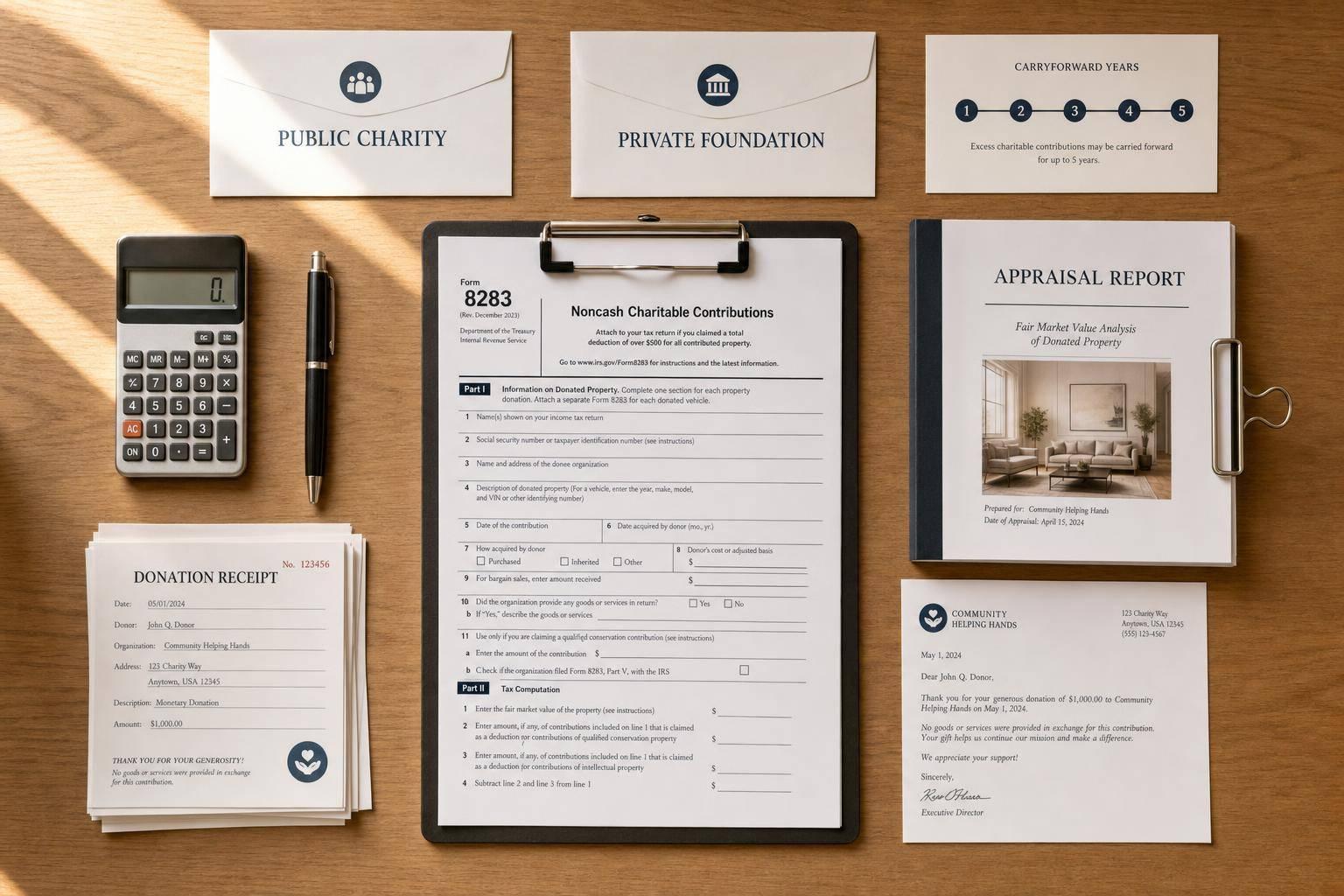
- Noncash gifts over $500 usually require Form 8283.
- Noncash gifts over $5,000 often need a qualified appraisal.
- If your deduction is too large for one year, you can usually carry it forward for up to five years.
A few points stand out:
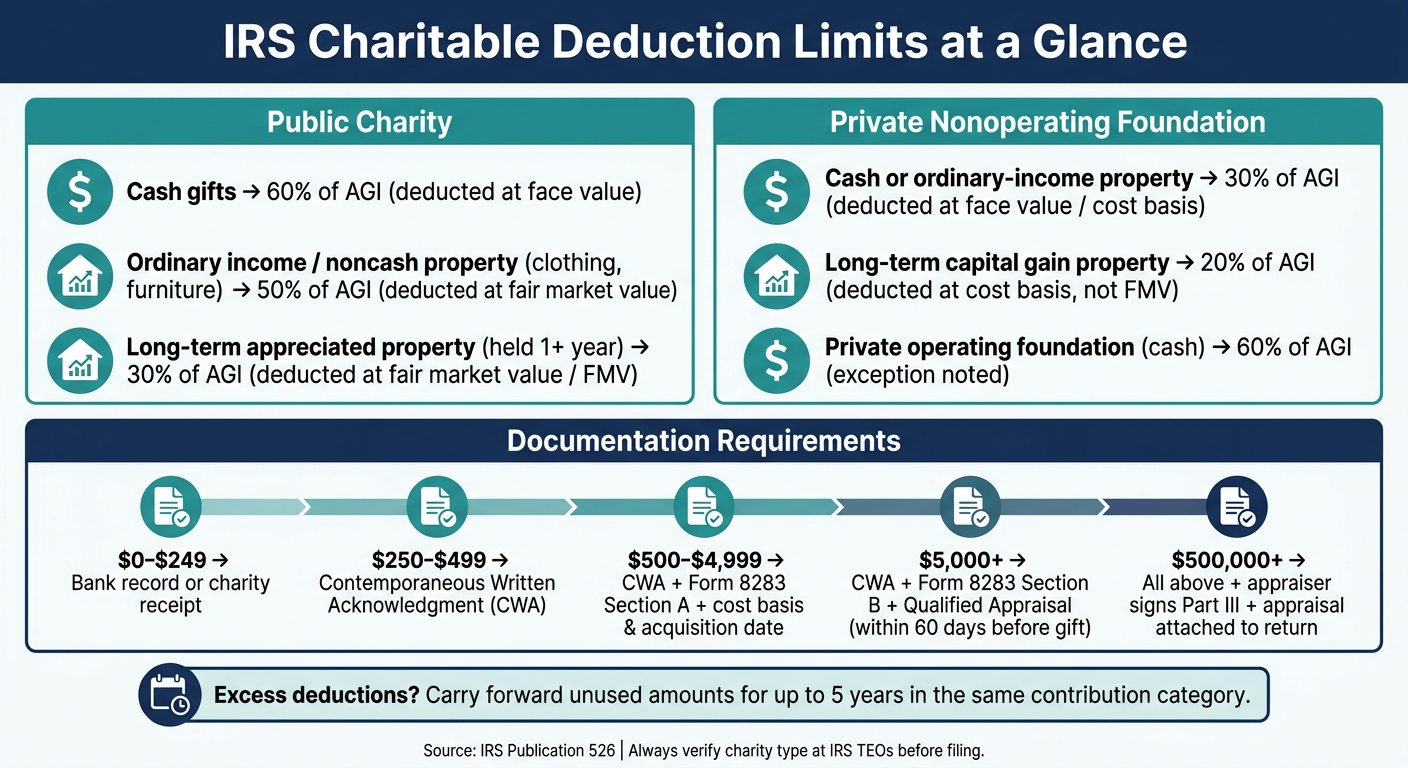
- Cash to a public charity: up to 60% of AGI
- Cash to a private nonoperating foundation: up to 30% of AGI
- Long-term appreciated property to a public charity: up to 30% of AGI, often at FMV
- Long-term appreciated property to a private nonoperating foundation: up to 20% of AGI, often at basis
| Gift type | Public charity | Private nonoperating foundation |
|---|---|---|
| Cash | 60% of AGI | 30% of AGI |
| Long-term appreciated property | 30% of AGI, often FMV | 20% of AGI, often basis |
I’d treat this article as a simple checklist: confirm the charity type, match the gift to the right AGI cap, keep the right records, and track any carryforward before filing.
IRS Charitable Deduction Limits: Public Charity vs. Private Foundation
IRS Limits on Charitable Giving You Need to Know | Karla Dennis
sbb-itb-e723420
Deduction Limits for Gifts to Public Charities and Private Foundations
The IRS sets different deduction caps based on who you give to, what you give, and how long you've owned it. So a cash gift doesn't get treated the same way as donated stock, and a public charity doesn't get treated the same way as a private foundation.
Public Charity Deduction Limits: 60%, 50%, and 30% AGI Ceilings
Here are the main limits for gifts to public charities.
Cash gifts to public charities are generally deductible up to 60% of AGI [1][5]. Donated property, such as clothing or furniture, usually falls under a 50% ceiling. Long-term appreciated assets, like stock or real estate held for more than one year, are capped at 30% of AGI and may be deducted at fair market value (FMV) [1][5].
| Gift Type | AGI Limit | Valuation Rule |
|---|---|---|
| Cash | 60% | Face value |
| Ordinary income property (held 1 year or less) | 50% | Cost basis |
| Noncash property (clothing, furniture) | 50% | Fair market value |
| Long-term appreciated property (held more than 1 year) | 30% | Fair market value |
Private Foundation Deduction Limits: 30% and 20% AGI Ceilings
Private foundations usually come with lower caps.
Private nonoperating foundations use a 30% of AGI limit for cash and ordinary-income property. For long-term capital gain property, such as appreciated stock, the cap drops to 20% of AGI and the deduction is usually based on cost basis, not FMV [1][4].
| Foundation Type | AGI Limit | Valuation Rule |
|---|---|---|
| Cash or ordinary-income property | 30% | Face value / cost basis |
| Long-term capital gain property | 20% | Cost basis* |
| Private operating foundation (cash) | 60% | Face value |
*Publicly traded stock may sometimes qualify for FMV at the 20% limit.
How Ordering Rules Apply When You Give in Multiple Categories
If you make gifts in more than one category in the same tax year, the IRS doesn't just lump them all together. It generally applies current-year contributions first and then looks at any carryovers from earlier years. Within the current year, gifts with higher percentage limits, like cash to a public charity, are usually applied before gifts with lower limits, like long-term stock to a private foundation [4][5].
Hypothetical example: A taxpayer with $100,000 AGI in 2026 gives $5,000 cash to a public charity and $25,000 in long-term appreciated stock to a private nonoperating foundation. The cash gift clears easily within the 60% limit ($60,000). The stock gift hits the 20% ceiling - only $20,000 is deductible in 2026. In 2026, the donor deducts $5,000 of cash and $20,000 of stock this year; the remaining $5,000 carries forward [5].
After the limits, the next question is what proof the IRS requires.
Substantiation, Form 8283, and Appraisal Requirements
A charitable deduction can fall apart if your records don't hold up. The IRS wants proof that you made the gift and proof of what it was worth.
Cash Gift Records and the $250 Written Acknowledgment Rule
For cash gifts, keep a bank record or a written receipt that shows the charity's name, the date, and the amount. If any single gift is $250 or more, you need a contemporaneous written acknowledgment (CWA) before you file [3][8]. That acknowledgment must confirm the amount and say whether you received anything in return.
If you did get goods or services back and the gift was more than $75, the charity has to tell you the value of what you received. You can deduct only the amount that goes beyond that value [8].
Noncash gifts come with more paperwork. And once the value gets high enough, you may also need an appraisal.
Noncash Gift Documentation, Form 8283, and Qualified Appraisals
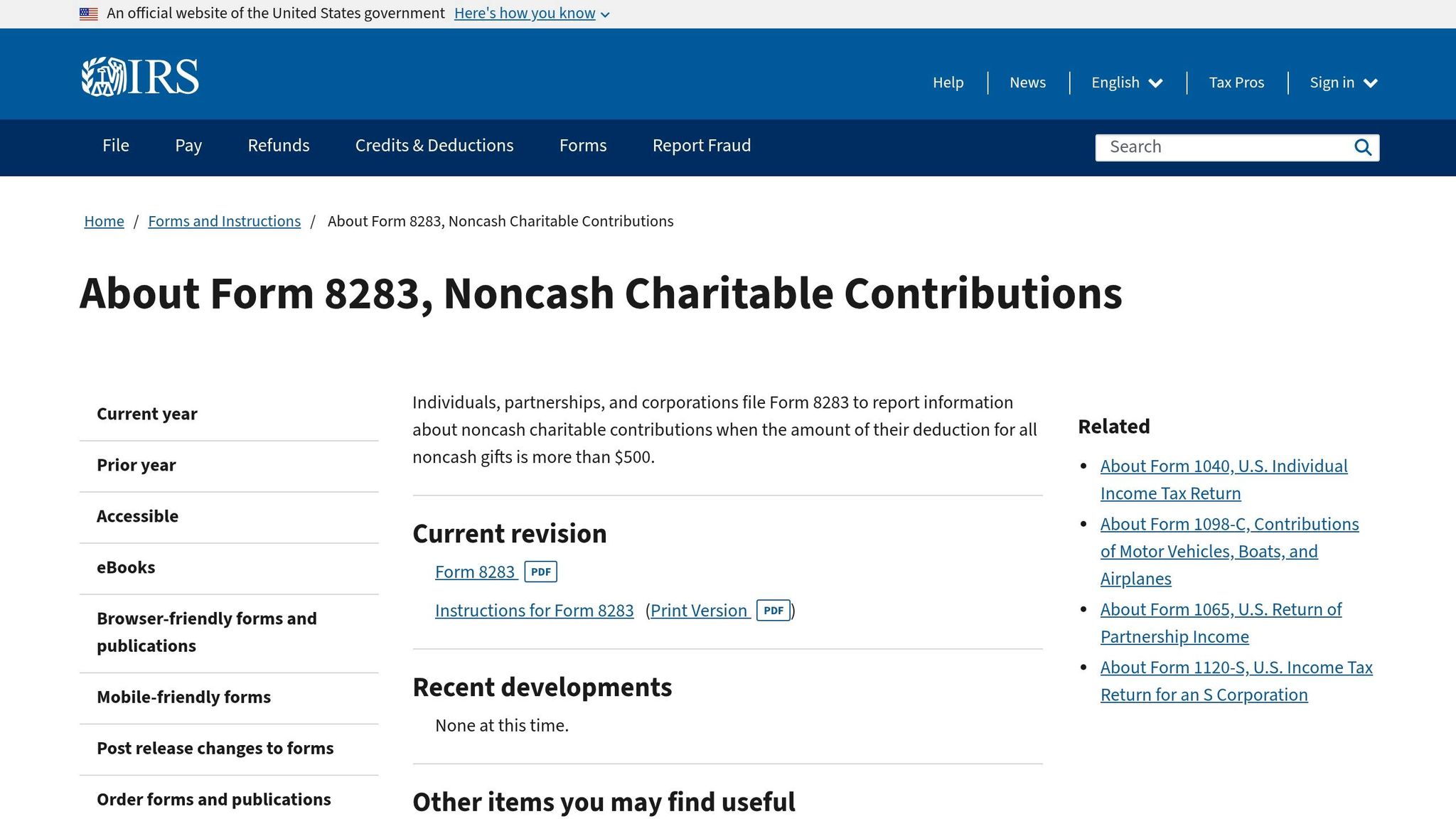
If your total noncash deductions are more than $500, file Form 8283 [1][2]. Section A is for items, or groups of similar items, worth $5,000 or less. Starting in 2025, Section A also asks for the date you acquired the property, how you acquired it, and its original cost basis [10].
Section B is for any single item, or group of similar items, worth more than $5,000. That section requires a qualified appraisal and the required signatures [2].
| Donation Value (Noncash) | Documentation Required | Form 8283 | Appraisal |
|---|---|---|---|
| $0 – $249 | Bank record or charity receipt | Not required | Not required |
| $250 – $499 | Contemporaneous Written Acknowledgment (CWA) | Not required | Not required |
| $500 – $4,999 | CWA + cost basis and acquisition date | Section A | Not required |
| $5,000 and above | CWA + qualified appraisal | Section B (signatures required) | Required |
| $500,000 and above | CWA + qualified appraisal | Section B + appraiser signs Part III | Appraisal typically attached to return |
A qualified appraisal must be dated within 60 days before the gift and finished by the tax return due date [2][11]. The appraiser must either have a recognized professional designation or at least two years of experience valuing that type of property [11].
A few details trip people up all the time:
- Clothing and household items must be in good used condition or better to qualify [1][7].
- Vehicle donations over $500 require Form 1098-C, and the deduction is usually limited to the sale proceeds [8][9].
Using Deductible.me to Organize Valuation and Reporting
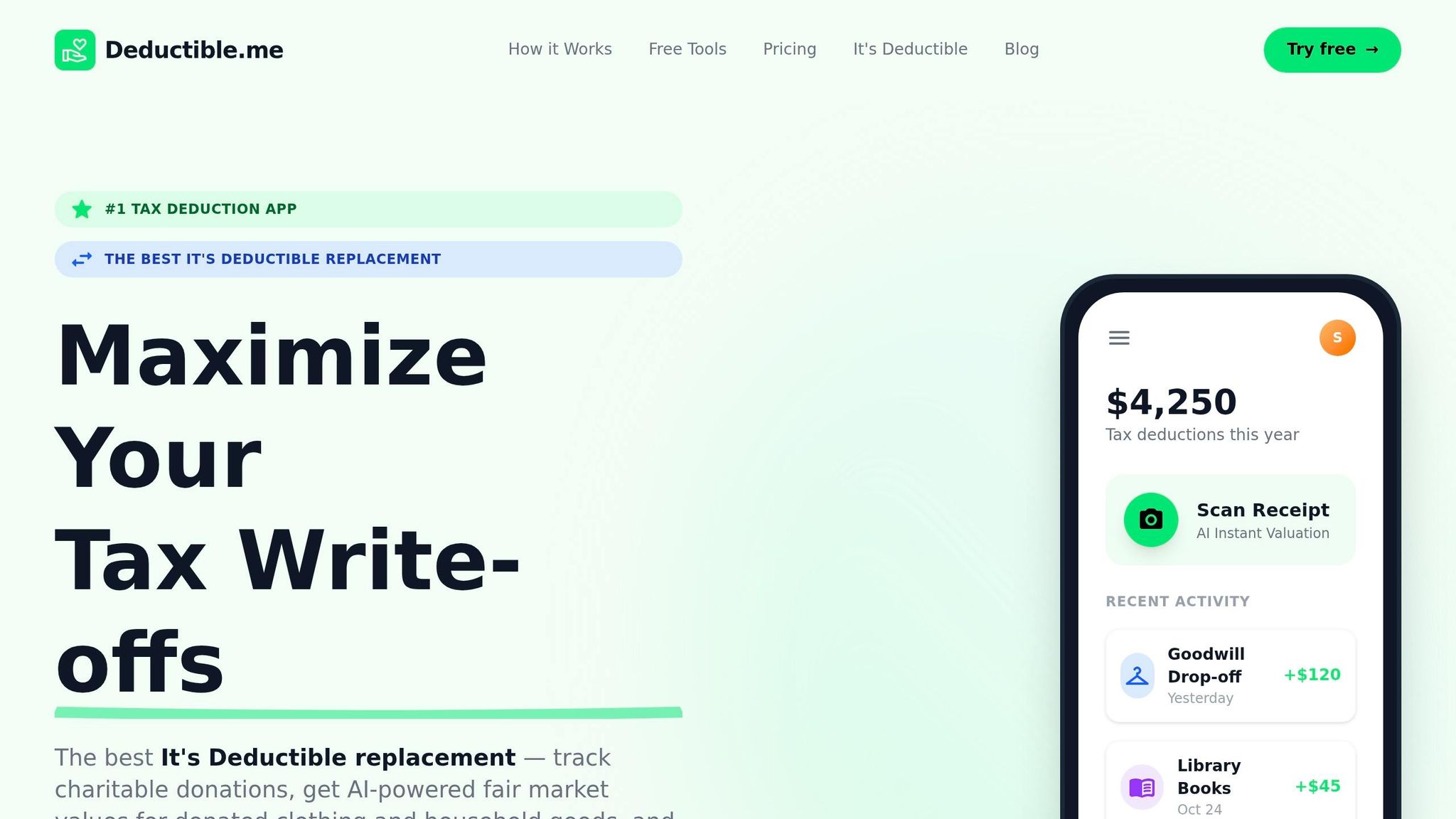
Deductible.me can store receipts, estimate donated-item value from photos, and generate Form 8283-ready reports.
After the paperwork is handled, the next step is figuring out the valuation rules that set the amount you can deduct now and carry forward later.
Valuation Rules and Five-Year Carryforwards
When Fair Market Value Applies and When Basis Limits Your Deduction
Once your records are set, the next step is figuring out what the IRS lets you deduct now and what may need to wait.
The IRS defines fair market value (FMV) as the price a willing buyer and a willing seller would agree on, with neither under pressure to act [12]. That's the starting point for most noncash gifts. But starting point doesn't always mean final deduction.
Here's the basic rule for this section:
- If you donate long-term appreciated property that you've held for more than one year to a public charity, you can generally deduct its FMV.
- If the property is short-term, your deduction is usually limited to your adjusted basis [2].
That split matters. The same asset can lead to a different deduction based on how long you held it.
How Five-Year Carryforwards Work by Contribution Category
If your charitable contributions go over the annual AGI limit, the extra amount doesn't just disappear. You can carry that excess forward for up to five years [1][12].
The IRS also sorts that carryforward by the same percentage-limit category as the original gift. And when you claim deductions in later years, the order matters: the IRS applies current-year gifts first, then the oldest carryovers.
Put simply, if you give big in one year, part of that deduction may stretch across several tax years.
Tracking Multi-Year Giving With Deductible.me
Deductible.me can track carryovers by year and category.
Conclusion: Key IRS Rules to Check Before Claiming a Deduction
Before you file, run through these four checks.
Confirm the recipient's IRS classification in TEOS before you calculate the limit. TEOS shows what kind of organization you're giving to: PC means public charity, POF means private operating foundation, and PF means private nonoperating foundation. Those labels matter because they tie to different AGI limits - 60% for public charities, 50% for private operating foundations, and 30% for cash / 20% for long-term appreciated property for most private nonoperating foundations. [1][4]
Match your gift to the right AGI limit. Cash gifts to public charities are capped at 60% of AGI, while long-term appreciated assets are capped at 30%. For private nonoperating foundations, cash is capped at 30% and long-term appreciated property at 20%. [1]
Documentation is the proof. Keep bank records for cash gifts, a written acknowledgment for gifts of $250 or more, Form 8283 for noncash gifts over $500, and a qualified appraisal for noncash gifts over $5,000. [1][6]
Carry forward any excess for up to five years in the same contribution category. To claim that carryover, you still need to itemize deductions in those later years. Deductible.me can help you track carryforwards and generate Form 8283-ready reports.
FAQs
How do I know if a charity is public or private?
The most reliable way to check is the IRS Tax Exempt Organization Search. You can look up the organization by name or EIN to confirm its status.
You can also ask the organization directly.
This step matters because the IRS uses different deduction limits for gifts made to public charities and certain private foundations.
When is my deduction limited to cost basis instead of fair market value?
For most non-cash donations, you can deduct the fair market value of the item at the time you gave it away. Put simply, that means what it was worth on the date of the donation.
But there’s a catch. In some cases, your deduction is limited to your cost basis - the amount you originally paid for the item.
This often comes up with certain vehicle donations. For example, the lower cost-basis rule can apply if the charity doesn’t use the vehicle, improve it, or give it to a needy individual. It can also apply if the vehicle is sold for $500 or less.
IRS rules for appreciated property can also reduce your deduction to cost basis in some situations.
What happens if my donation exceeds my AGI limit?
You usually don’t lose the deduction outright.
If your charitable contributions go over the AGI percentage limit for a given tax year, the IRS will often let you carry the extra amount forward for up to five future tax years.
Those carryforward amounts can then be used in later years, subject to your AGI limits, until the donation is fully used or the five-year window runs out.