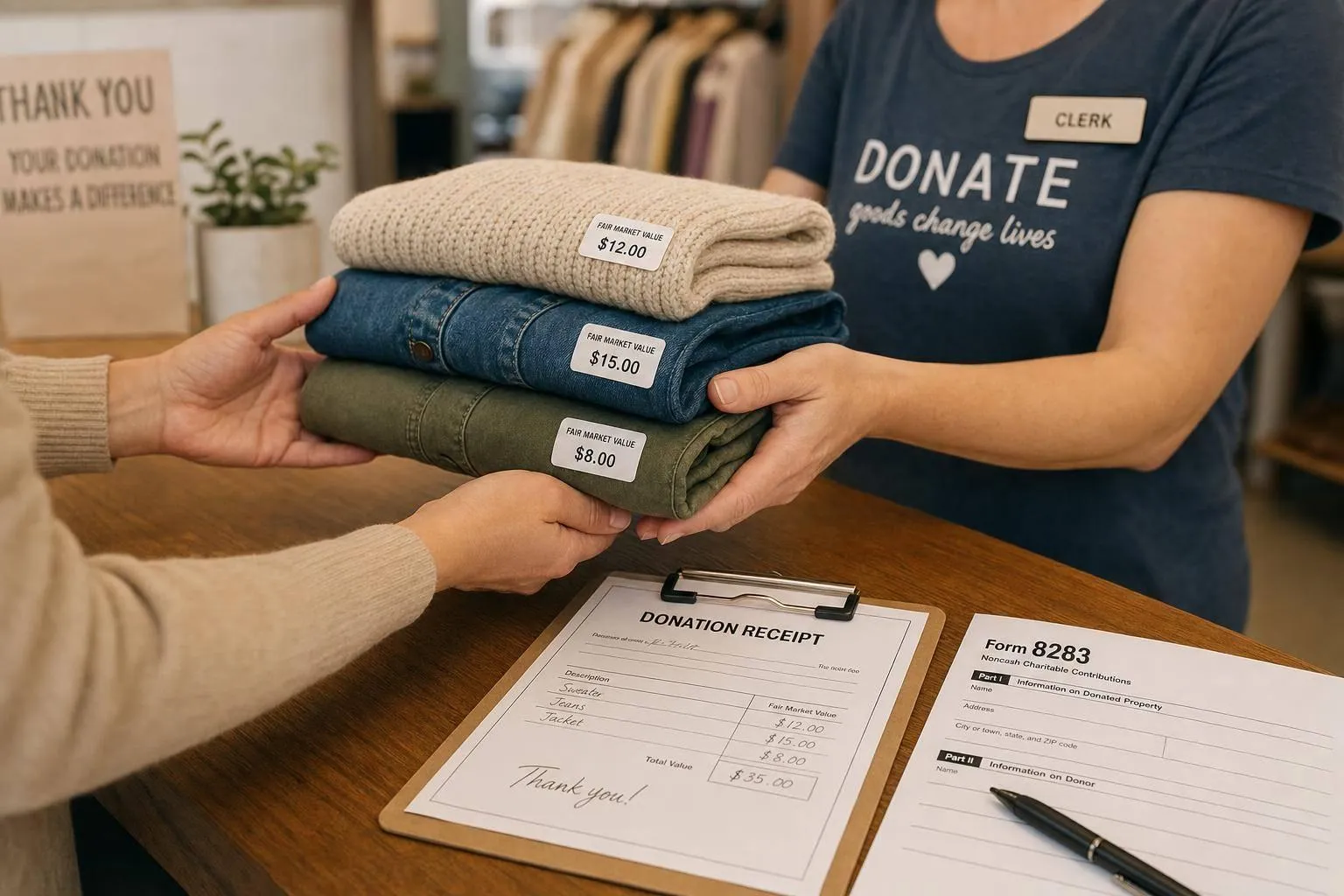
If you donate clothes and want a tax deduction, I only use the item’s fair market value - not the price I paid when it was new. In plain terms, that usually means thrift-store level pricing, not retail pricing.
Here’s the short version:
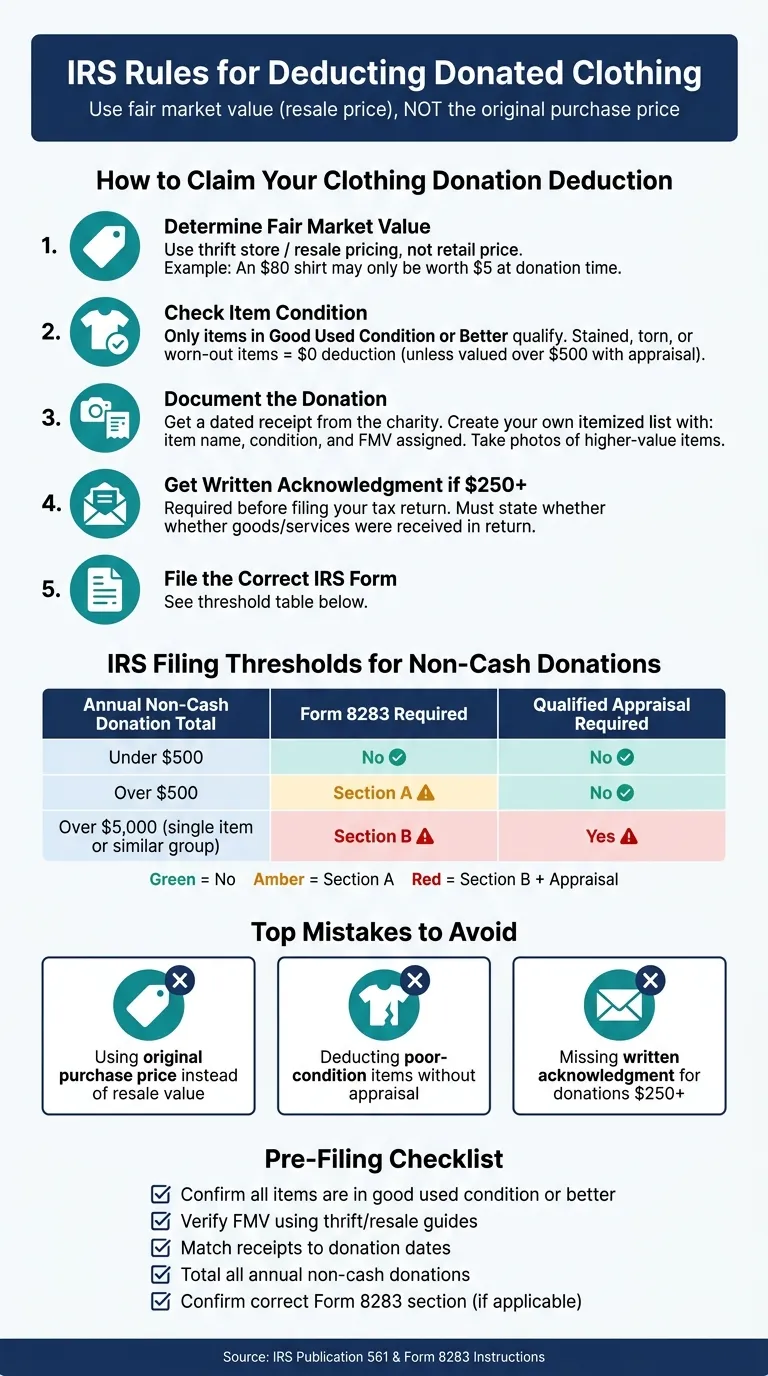
- Clothes must usually be in good used condition or better to count.
- An $80 shirt might be worth only $5 at donation time.
- If one donation is $250 or more, I need a written acknowledgment from the charity before I file.
- If total non-cash donations for the year go over $500, I file Form 8283 Section A.
- If a single item or group of similar items is over $5,000, I usually need Form 8283 Section B and a qualified appraisal.
- The charity does not set the dollar amount for my clothes. I do.
- Photos, receipts, and an item list help support the deduction.
The big mistake is simple: people use the original purchase price. The IRS wants the item’s current resale price based on its condition on the donation date.
A fast way to think about it:
| Rule | What I do |
|---|---|
| Value | Use resale value, not retail price |
| Condition | Deduct only wearable items in good shape |
| $250+ donation | Get written acknowledgment |
| Over $500 for the year | File Form 8283 Section A |
| Over $5,000 for similar items or one item | Get appraisal and use Section B |
My takeaway: if I keep values low and realistic, remove worn-out items, and track each donation as I go, tax filing is much simpler.
How to determine fair market value for donated clothing
Use the item’s current resale value in the condition you donated it in. Start with condition, then match that condition to a resale price.
One thing trips people up all the time: don’t use the original store price. A sweater that cost $80 new might only be worth a small fraction of that at donation time. For tax purposes, FMV is based on what someone would likely pay for it now, not what you paid back then.
Use resale prices, not the original price tag
Start with conservative resale prices from donation guides or comparable listings. Stick to the low end of the range if you can. That makes your deduction easier to support if it’s ever reviewed [5][7].
“The fair market value of each donated item, in good condition or better. Use the tables above as your starting point.” - Salvation Army Donation Value Guide [5]
A resale estimate only makes sense if the item is still in acceptable shape. If the condition is off, the number falls apart fast.
Rate each item by condition before setting a value
Condition is the biggest driver of FMV. Before checking any price guide, sort each item into one of these tiers:
| Condition | Description | Typical Resale Value Example |
|---|---|---|
| Good used condition or better | Clean, functional; no stains, tears, or heavy wear | Qualifies for deduction; use resale range for the item |
| Not deductible in most cases | Visible fading, heavy wear, stains, or tears | Generally not deductible unless it qualifies for the $500 appraisal exception |
Condition can shrink the value or wipe it out altogether. After you set FMV, you still need to check whether the item meets the IRS condition standard, because that rule is what decides whether the deduction holds up under review.
IRS condition rules for deductible clothing
Fair market value matters, but it only counts if the clothing also meets the IRS condition rule.
In most cases, clothing is deductible only if it’s in good used condition or better. If it doesn’t meet that bar, the deduction is usually $0.
What good used condition looks like in plain terms
“Good used condition or better” means the item is wearable and resellable as-is. Put simply, someone could use it without fixing it first. If an item is stained, torn, frayed, or otherwise not usable, it usually doesn’t qualify.
| Feature | Deductible (Good Condition or Better) | Usually Not Deductible |
|---|---|---|
| Fabric | Clean, wearable, no major holes or large stains | Torn, frayed, or permanently stained |
| Fasteners | Working zippers, all buttons present | Broken zippers or missing fasteners |
| Footwear | Matching pairs, soles intact | Single shoes, detached soles, strong odor |
The exception for poor-condition items valued over $500
There is one exception for poor-condition clothing with a high claimed value.
A poor-condition item can still qualify if its claimed value is more than $500 [2][1]. To claim that exception, you need a qualified appraisal and Form 8283 [2][1].
Step-by-step: how to document a clothing donation and meet IRS filing rules
Once you’ve set FMV and checked the item’s condition, document the donation right away. When you drop off your bags, ask the charity for a dated receipt. Then make your own itemized list while the details are still clear.
Your list should include:
- Each item or item category
- Its condition
- The fair market value you assigned
Many charities hand out blank receipts and do not assign values. That part is on you [4][5].
Take photos of higher-value pieces and anything that shows visible wear. It’s a simple step, but it gives you extra proof of condition if the IRS ever asks questions [4].
Receipts and written acknowledgments you need
A valid receipt should include the charity’s legal name, the date, the location, and a description of the donated items. It should not include a dollar value.
If your donation is $250 or more, you also need a written acknowledgment from the charity stating whether you received any goods or services in return. You must have that acknowledgment before you file your tax return, or before the return’s due date, whichever comes first [3].
When Form 8283 and a qualified appraisal are required
Keep an eye on your full-year non-cash donation total, not just each drop-off. The IRS looks at your annual non-cash giving, and the filing rules change as that total goes up [2][1].
| Total Annual Non-Cash Value | Form 8283 | Qualified Appraisal |
|---|---|---|
| Under $500 | No | No |
| Over $500 | Section A | No |
| Over $5,000 | Section B | Required |
For single items or groups of similar items valued at more than $5,000, you’ll usually need Section B, along with the required appraiser and charity signatures [1].
Using Deductible.me to organize valuation and reporting
If you want everything in one spot, use a donation log. Deductible.me can store photos, receipts, and your yearly total automatically. It can also generate a report to support Form 8283 filing [6].
Common clothing donation mistakes and a filing checklist
Once you’ve valued and documented each item, do one last compliance check before you file. This is where a lot of people slip up.
Most problems come from three things: pricing items too high, ignoring condition rules, or missing a reporting threshold.
| Common Mistake | Corrective Action |
|---|---|
| Using original purchase price | Use thrift store or resale market pricing [2][4] |
| Deducting poor-condition items | Only deduct items in “good used condition” or better [2][5] |
| Missing written acknowledgment for donations over $250 | Obtain a written acknowledgment stating that no goods or services were provided in exchange [2][3] |
A checklist to review before you file
Before you submit your return, go through these five steps:
- Confirm condition - Remove any items that are stained, torn, or worn out [2][5].
- Verify your FMV source - Check values against thrift store or resale guides, not the original purchase price [2][4].
- Match receipts to donation dates - Donations of $250 or more need a contemporaneous written acknowledgment [2][3].
- Total your annual non-cash gifts - Add up all non-cash donations for the year before deciding which forms you need [2][1].
- Confirm your Form 8283 requirement - Over $500 total means Section A; over $5,000 for a single item or group of similar items means Section B plus a qualified appraisal [2][1].
If you use Deductible.me to track donations during the year, your running total, photos, and receipts stay in one place. When filing time comes around, you can export IRS-compliant reports without digging through drawers, email inboxes, or old phone photos.
FAQs
Can I deduct clothing donations if I don’t itemize?
No. To deduct clothing donations, you need to itemize deductions on Schedule A of your federal tax return instead of taking the standard deduction.
That usually only pays off if your total write-offs, like charitable donations, mortgage interest, and state and local taxes, add up to more than your standard deduction.
How do I prove fair market value if I’m audited?
Keep records that back up the fair market value you claimed. In most cases, the IRS treats that as the price a willing buyer would pay for the item in its current condition at a thrift store or resale marketplace.
Hold on to an itemized donation list and dated receipts from the charity. If your non-cash donations total more than $500, file Form 8283. If a single item or a group of items is worth more than $5,000, you’ll need a qualified appraisal.
What counts as a group of similar items?
For tax reporting, a group of similar items means several things that share the same general traits, like clothing, kitchenware, or books.
On Form 8283, you can combine those items and report them as one entry instead of listing each one on its own.