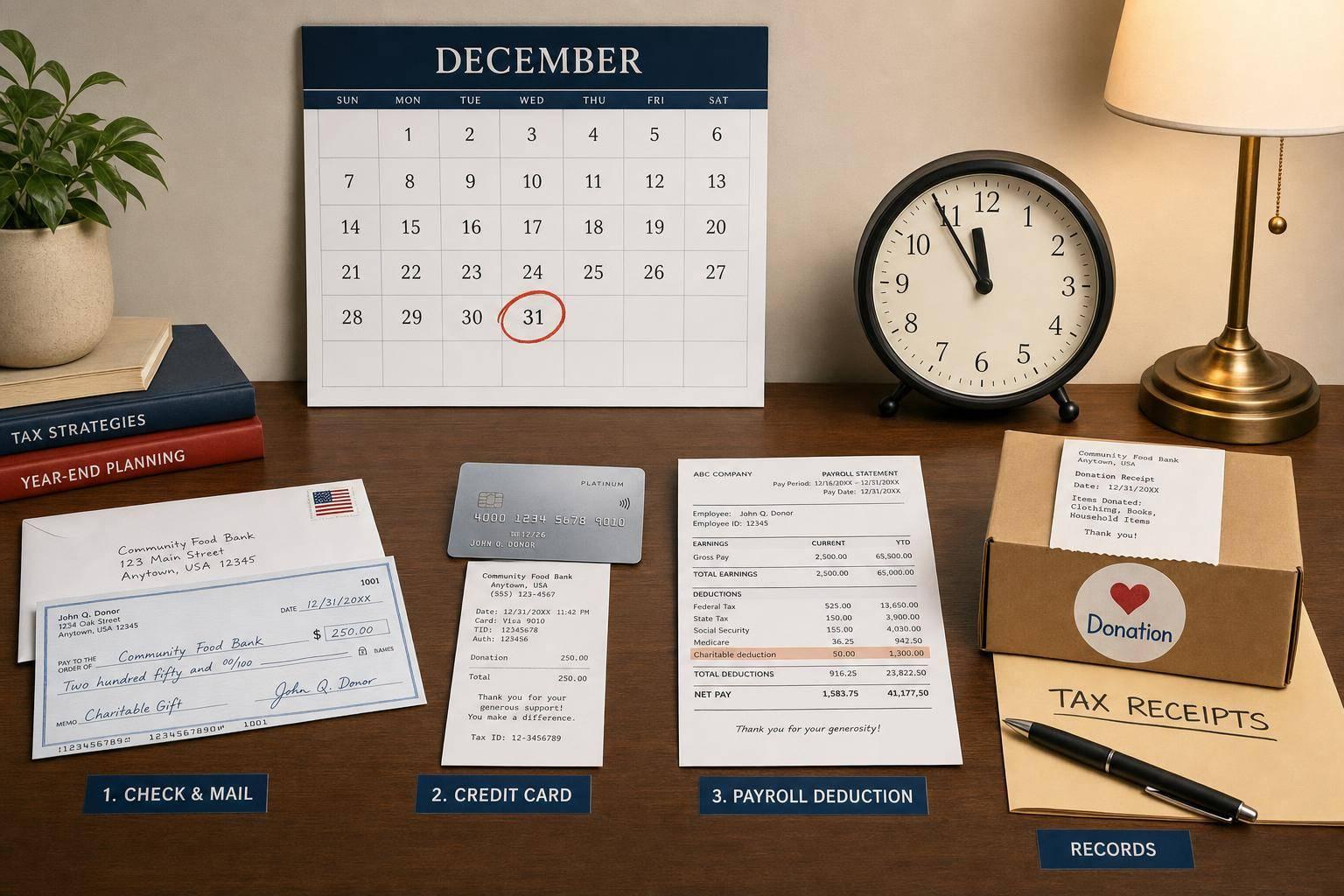
IRS Donation Deadline Rules for Year-End Gifts
Miss the right date by one day, and your tax deduction moves to the next year. If I give by December 31, the deduction usually goes on that year’s return. If the gift is completed on January 1 or later, it goes on the next one.
Here’s the short version:
- Checks sent by USPS: the postmark date controls
- Checks sent by FedEx or UPS: the charity’s receipt date controls
- Credit card gifts: the charge date controls, not when I pay the bill
- Payroll deductions: the withholding date on the paycheck controls
- Donated goods or property: the delivery and acceptance date controls
There’s one more rule that can stop a deduction even if the timing is right: for any single gift of $250 or more, I need a written acknowledgment from the charity. For noncash gifts over $500, I may also need Form 8283. For items over $5,000, I may need an appraisal too.
What this means for me: timing and paperwork both matter. A check postmarked 12/31/2026 can still count for 2026. But a credit card charge that slips past midnight, a paycheck dated in January, or a late property drop-off can push the deduction into 2027.
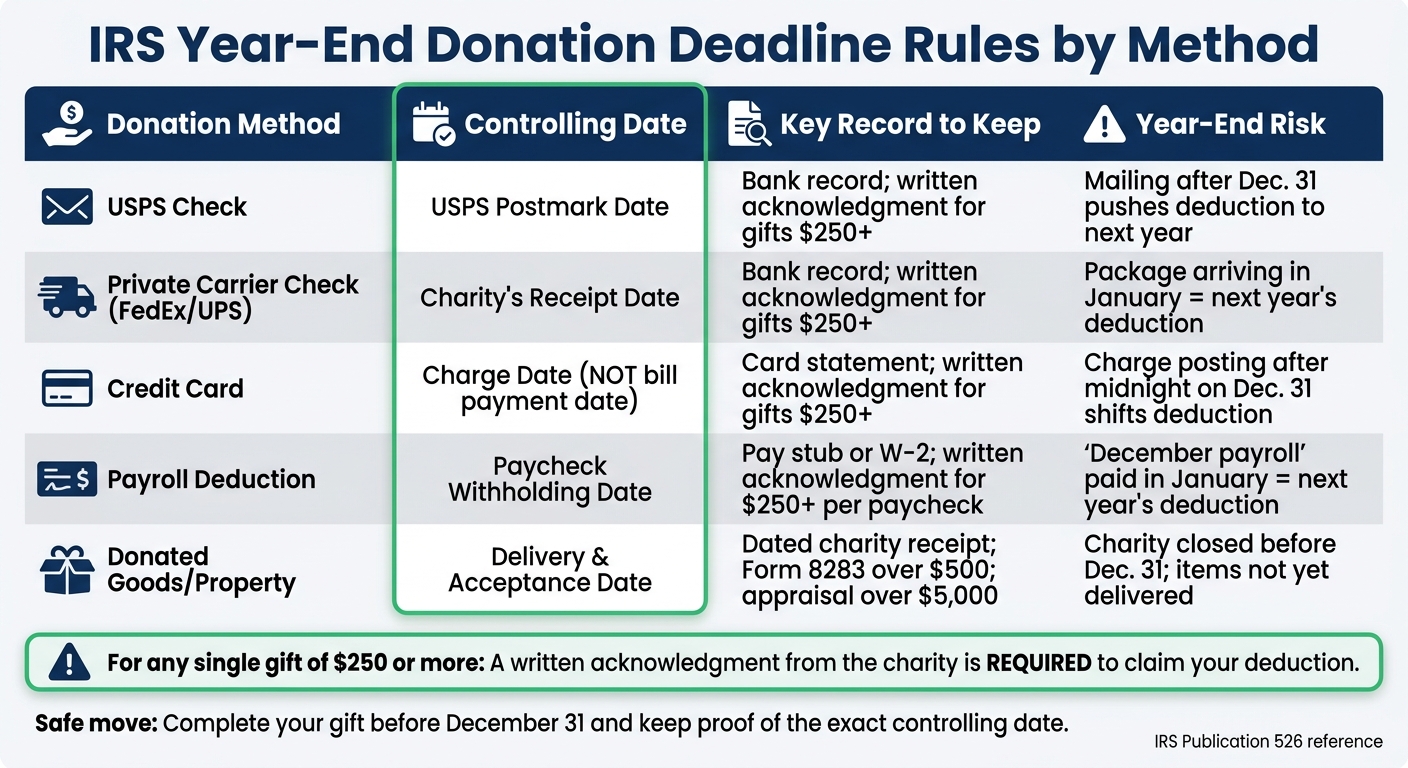
IRS Year-End Donation Deadline Rules by Method
Quick Comparison
| Donation method | Date that controls the tax year | Main record to keep | Common year-end issue |
|---|---|---|---|
| USPS check | USPS postmark date | Bank record; $250+ also needs charity acknowledgment | Mailing after 12/31 |
| Private-carrier check | Charity receipt date | Bank record; $250+ also needs charity acknowledgment | Package arrives in January |
| Credit card | Charge date | Card statement; $250+ also needs charity acknowledgment | Charge posts after midnight |
| Payroll deduction | Paycheck withholding date | Pay stub or W-2; $250+ from one check also needs acknowledgment | “December payroll” paid in January |
| Goods/property | Delivery date | Dated receipt; more forms for higher amounts | Charity closed or intake ends early |
If I’m giving at year-end, the safe move is simple: finish the gift before December 31 and keep proof of the exact date.
sbb-itb-e723420
1. Check Donations
Checks have the most straightforward timing rule of the four methods.
If you mail a check through USPS, the postmark date is what matters, not the date the charity deposits it. If you hand the check to the charity, the receipt date controls instead.[7][17][18]
Required Records
| Gift Amount | Required Documentation |
|---|---|
| Under $250 | A bank record, such as a canceled check or bank statement, or a written communication from the charity[13] |
| $250 or more | A bank record plus a contemporaneous written acknowledgment from the charity[14] |
For any check donation, keep a bank record. If the gift is $250 or more, you also need a written acknowledgment from the charity before you file your return, or by the due date, whichever comes first. That acknowledgment should confirm the amount, the date, and whether you received any goods or services in return.
Year-End Pitfalls
- Mailed after December 31: A check mailed on January 1 or later counts for the next tax year.[1][8]
- Post-dated checks: A post-dated check usually counts on the date written on the check.[11]
- Private carriers: Checks sent by FedEx or UPS can fall under different rules, so a USPS postmark doesn't help here.[3]
- Bounced checks: If the check isn't paid, there's no deductible gift.[12]
Mail checks a few days before December 31 to avoid a last-minute scramble. Next up: credit card gifts, where the charge date is the key date.
2. Credit Card Donations
Unlike checks, credit card gifts count when the charge is processed, not when you pay the card bill.
That timing matters at year-end. For credit card donations, the charge date decides the deduction year. It is not based on the date you pay your statement. IRS Publication 526 says contributions charged to a credit card are deductible in the year you make the charge.[2]
When the Charge Counts
A donation counts when the charge is approved and recorded. If that doesn’t happen until after December 31, the deduction shifts to the next tax year.
This is where people can get tripped up. A late processor timestamp, a declined charge, or a delay in authorization can push the donation into January even if you tried to give on December 31.
Required Records
| Gift Amount | Required Documentation |
|---|---|
| Under $250 | Credit card statement or other bank record showing the charity's name, date, and amount[19] |
| $250 or more | Credit card statement plus a contemporaneous written acknowledgment from the charity showing the amount, date, and any goods or services received[17] |
Year-End Pitfalls
Late-night payments can miss the cutoff if the processor timestamps them after midnight or sends the charge through late review.
A smart move: check the transaction date on your January statement. That date can tell you which tax year the IRS will treat the gift as belonging to.
Payroll deductions follow a different rule. There, the deduction year depends on when the wages are withheld.
3. Payroll Deduction Donations
Payroll deduction gifts count for the tax year when the money is actually withheld from wages. So if a paycheck is dated on or before December 31, that donation goes with that tax year - even if the employer sends the funds to the charity in January.[2][22]
The Controlling Date
For payroll donations, the key date is the paycheck date. That date decides the tax year for the deduction.
Here’s how that plays out. Two employees each give $50 per paycheck to the same charity. Donor A starts withholding in December, so $150 is deductible in 2026. Donor B’s first withholding does not happen until January, which means Donor B’s 2026 deduction is $0.[2][22]
Required Records
| Gift Amount | Required Records |
|---|---|
| Under $250 per paycheck | Pay stub, W-2, or similar employer record showing the withheld amount[2] |
| $250 or more from a single paycheck | Pay stub or W-2 plus written acknowledgment showing no goods or services were received[2][23] |
Each paycheck with $250 or more withheld counts as a separate contribution. In plain English, you can't add up smaller withholdings from different pay periods to get around that cutoff.[23]
Year-End Pitfalls
A pledge card by itself does not create a deduction. Only money that was actually withheld counts. That’s why it helps to check which paycheck is the last one dated on or before December 31.
There’s another easy trap here. Some employers call it the final "December payroll", but the pay date lands in early January. If that happens, the withholding counts for the next tax year, no matter how the campaign materials describe it.[21][4]
Donated goods and property work under a different rule: the charity’s receipt date controls.
4. Donated Goods and Property
Noncash gifts work under a transfer rule, not a payment rule. That means the tax year for your deduction depends on when the charity gets the items or when you give up control of them, not when you decide to donate or pile them in a corner at home.[26][27][28]
Here’s the simple version: if you drop off clothing on December 30 and get a dated receipt, that donation usually counts for that tax year. But if those same boxes sit in your car until the charity opens again in January, the deduction moves to the next tax year.[26][30]
When the Transfer Is Complete
For in-person drop-offs, the IRS looks at the delivery date. For mailed donations, the postmark date usually counts as the contribution date, so hold on to your shipping confirmation or postal receipt.[26][30]
The donation is complete when you no longer control the property. The charity must have accepted the items, and you can’t still have the right to take them back or tell the charity how to use them. So if the boxes are still sitting at home, there’s no deduction yet.[26][27]
Required Records
| Donation Value | Required Documentation |
|---|---|
| Under $250 | Dated receipt from the charity showing the organization's name, the date, and a description of the items |
| $250–$500 | Contemporaneous Written Acknowledgment (CWA) stating whether any goods or services were received in return |
| Over $500 (total noncash for the year) | CWA plus IRS Form 8283, Section A attached to your return |
| Over $5,000 (single item or similar group) | CWA, qualified appraisal, and IRS Form 8283, Section B signed by both the appraiser and the charity |
Year-End Pitfalls
A common slip-up is missing the charity’s last intake date. Many donation centers close early or stop taking drop-offs before December 31. If the handoff happens after year-end, the deduction shifts to the next tax year.[28][30]
There’s another catch here. Clothing and household items must be in good used condition or better to qualify. Worn-out, broken, or incomplete items usually don’t count, unless a single item is worth more than $500 and you have a qualified appraisal.[29][25][30]
Once the transfer date is set, the next issue is proving it.
Documentation Requirements and Year-End Risks
Proof depends on how you give and how much you give.
Once you've pinned down the tax year for the deduction, the next step is simple: make sure your records back it up.
| Donation Method | Required Records | Year-End Risk |
|---|---|---|
| Check | Canceled check or bank statement; $250+ also needs a written acknowledgment. | A USPS postmark by Dec. 31 counts for that year. |
| Credit card | Credit card statement or electronic receipt; $250+ also needs a written acknowledgment. | A charge that posts after Dec. 31 shifts the deduction to the next tax year.[2][34] |
| Payroll deduction | Pay stub, W-2, or employer record; $250+ from one paycheck also needs written acknowledgment. | If the withholding date is in January, the deduction moves to the next year.[2][24] |
| Donated goods | Charity receipt; Form 8283 over $500; appraisal and Section B over $5,000. | Missing the form or required signatures can disallow the deduction.[31][32][34][35] |
One rule matters a lot here: for any gift of $250 or more, you need the charity's written acknowledgment. Without it, the deduction doesn't count. And you need that acknowledgment by the earlier of the date you file your return or the return due date, including extensions.[31][34][35]
Noncash gifts bring a bit more paperwork. If you make a Dec. 31 gift, the appraisal must be dated within 60 days before the donation.[32][33][35] If your total noncash gifts go over $500,000, you also have to attach the appraisal itself to your return.[20][36]
This is where year-end giving can get tricky. The gift may be done in your mind, but if the charge posts late, the paycheck date slips into January, or a form is missing a signature, the deduction can move or disappear.
With the deadline and records pinned down, the next comparison is which method is simplest to use at year-end.
Pros and Cons of Each Donation Method
Now that the filing rules are clear, the main issue is simple: which donation method gives you the cleanest Dec. 31 cutoff? The answer depends on how much control you want over timing and how much paperwork you're willing to deal with.
Here’s the tradeoff in plain English: some methods make the deadline easier to hit, while others ask for more recordkeeping.
| Method | Pros | Cons | Best Use Case |
|---|---|---|---|
| Check | Clear year-end cutoff; easy paper record.[12] | Lost mail or delayed postmarks can push the deduction into the next year.[15] Requires manual retention of bank records and acknowledgments. | Donors who prefer paper giving and can mail by Dec. 31. |
| Credit card | Best for last-minute giving.[2][15] Works for same-day year-end online giving. | If the charge doesn't post until Jan. 1, the deduction moves to the next year. Some donors confuse the charge date with when they pay the bill. | Last-minute year-end gifts and online donations. |
| Payroll deduction | Automatic and budget-friendly; contributions are spread across pay periods.[2] Employer records create a built-in paper trail via pay stubs and Form W-2.[2][10] | New elections or changes usually affect future paychecks only, so you can't use payroll to accelerate a deduction into the current year at the last minute.[2] Requires keeping both payroll records and a pledge card from the charity. | Steady, automatic recurring giving through an employer-sponsored program. |
| Donated goods and property | Donors control the drop-off date, which determines the deduction year.[15] Can support meaningful deductions without any cash outlay. | Highest paperwork burden - receipts, Form 8283 over $500, and a qualified appraisal over $5,000.[37] Charity pickups near year-end can slip into January due to holiday schedules. | Clothing, household items, and higher-value property for taxpayers who itemize. |
In practice, credit cards give you the easiest year-end timing, especially for late online gifts. Checks can work just fine too, but only if you mail them on time. Payroll deduction fits people who like a steady rhythm and want giving to run in the background. Donated goods can lead to bigger deductions in some cases, but they also come with the most paperwork.
Conclusion
The IRS goes by the controlling date, not what you meant to do. That date decides which tax year gets the deduction in every case:
- USPS check: the postmark date controls [2][8][1][9]
- Private carrier check: the charity's receipt date controls [38][3][6]
- Credit card: the charge date controls [5]
- Payroll deduction: the withholding date controls
- Donated goods: the delivery date controls [16][39]
If you're giving near year-end, don't wait until the last week of December. Holiday closures, processing delays, and payroll cutoffs can push even a well-meant gift into the next tax year.
Keep proof of that controlling date, such as a postmarked envelope, card statement, pay stub, or dated charity receipt [8][16][18].
FAQs
What if my donation is submitted on December 31 but processed on January 1?
If you submit a donation on December 31, the deduction year usually depends on how you made the donation and when the gift became legally complete.
In most cases, the tax year is based on the date you gave up control of the gift. That could mean the drop-off date for donated items or the postmark date for a mailed check. So even if the charity doesn’t process the donation until January 1, it will often still count for the earlier tax year.
Do I still need a charity acknowledgment if I have a bank or card record?
Yes. For any donation, you need proof such as a bank record, credit card statement, or standard receipt.
But there’s an extra rule for gifts of $250 or more. In that case, the IRS also requires a written acknowledgment from the charity.
That written note should include:
- The charity’s name
- The date
- A description of the gift
- Whether you received any goods or services in return
How do I prove the date of a noncash donation?
Keep records that show the actual date you dropped off the items or transferred them to the charity. If you can, ask the organization for a dated receipt at the time of the donation.
For donations of $250 or more, the IRS requires a contemporaneous written acknowledgment that includes the date of the contribution.