
Donor-Advised Funds vs Direct Charity Giving
If you want the tax deduction now but the charity can wait, I’d look at a donor-advised fund. If you want the charity to get the money now, I’d give directly. That’s the core difference.
Here’s the short version:
- DAF: I contribute cash, stock, or other assets to the fund now, take the deduction now, and recommend grants later.
- Direct giving: I send the gift straight to the charity, and the charity gets the funds without a middle step.
- Control: With a DAF, the sponsor has legal control after I contribute. With direct giving, I control the gift until I send it.
- Speed: Direct gifts often reach the charity in 2 to 3 business days. DAF grants can take 15 to 45 days.
- 2026 tax rule: Standard-deduction filers may deduct direct cash gifts up to $1,000 if single or $2,000 if married filing jointly. That does not apply to cash gifts made through a DAF.
- Paperwork: A DAF often means one year-end receipt from the sponsor. Direct giving can mean separate records from each charity.
- Asset type: If I’m giving long-held stock or crypto, a DAF may help me avoid capital gains tax and still deduct fair market value, subject to tax rules.
Bottom line: a DAF is often better for tax-year planning and spreading grants over time. Direct giving is often better for same-year support, urgent needs, and the 2026 non-itemizer cash deduction.
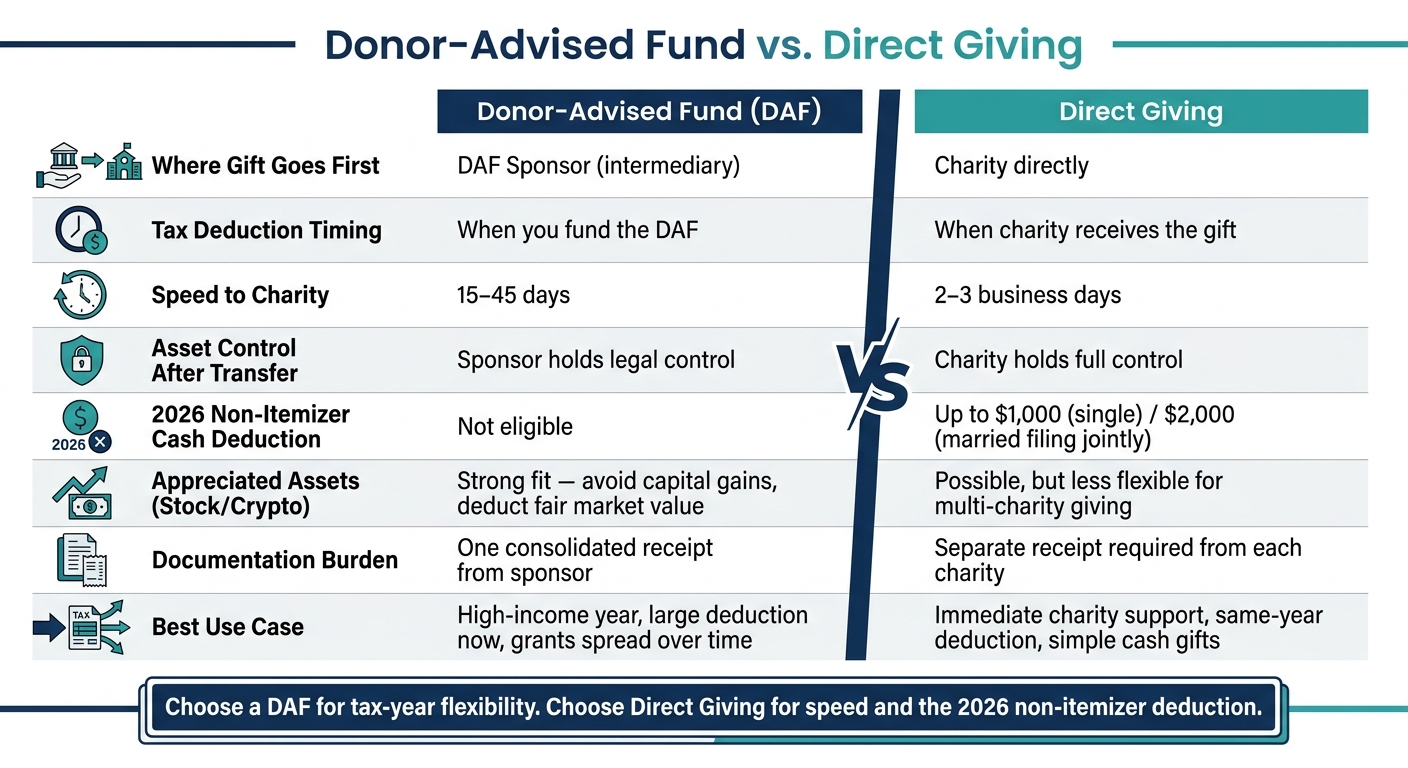
Donor-Advised Fund vs Direct Giving: Side-by-Side Comparison
Donor Advised Funds Explained: Benefits, Tax Strategies, and Hidden Drawbacks
Quick Comparison
| Criteria | Donor-Advised Fund | Direct Giving |
|---|---|---|
| Where the gift goes first | DAF sponsor | Charity |
| When I usually deduct it | When I fund the DAF | When the charity gets the gift |
| Who controls the assets after transfer | Sponsor | Charity |
| How fast charity gets funds | Often 15 to 45 days | Often 2 to 3 business days |
| Middle step involved | Yes | No |
| One receipt for many gifts | Usually yes | No |
| 2026 non-itemizer cash deduction | No | Yes |
| Fit for appreciated assets | Often yes | Can be, but less flexible for multi-charity giving |
If I’m trying to match giving with a tax deadline, this comes down to one question: Do I need the deduction now, the charity support now, or both at the same time?
How Each Giving Method Works
Donor-Advised Funds: Contribute Now, Grant Later
A donor-advised fund is a charitable account run by a 501(c)(3) sponsor. You make an irrevocable contribution of cash, stock, or other assets to the fund. You take the tax deduction when you contribute, then recommend grants later.
That timing matters. Your money goes into the DAF first, not straight to the charity. After that, you can suggest where grants should go. The sponsor reviews your recommendation and usually approves it. Once approved, grants often reach the charity within 3 to 10 business days [8].
There’s one point people sometimes miss: the sponsor legally controls the assets, not you. You can recommend grants, but you don’t make the final call.
These differences shape three things: when you claim the deduction, how much control you keep, and how the money moves to the charity.
Direct Giving: Funds Go Straight to the Charity
Direct giving skips the sponsor. The gift goes straight to the nonprofit.
You transfer cash or property directly to a qualified 501(c)(3) charity, with no intermediary involved. The charity takes ownership of the gift and can use it within a few business days [4].
Your tax deduction starts at the same point the gift is sent. And unlike a DAF, the charity receives the funds right away.
| Feature | Donor-Advised Fund | Direct Giving |
|---|---|---|
| Legal Recipient | DAF sponsoring organization | The charity itself |
| Tax Deduction Timing | When you contribute to the DAF | When the gift reaches the charity |
| Charity Receives Funds | After grant recommendation is approved (3–10 business days) [8] | Usually within a few business days [4] |
| Intermediary | Yes - the DAF sponsor | None |
| Asset Growth Potential | Yes, tax-free within the fund | No |
| Donor Control | Advisory (you recommend; sponsor decides) | Full, until the moment of transfer |
sbb-itb-e723420
Timing, Control, and Grant Flow
Those flow differences lead to three practical planning issues: when the deduction starts, who has control of the assets, and how fast the charity gets the money.
When the Tax Deduction Is Triggered
With a DAF, the deduction starts when assets go into the fund, not when the grants are sent later. With a direct gift, the deduction lands in the year the charity gets the gift.
A few timing details matter here. Credit card gifts count when the charge posts. Checks count by USPS postmark or by physical receipt, depending on how the check is delivered [6].
For the 2026 tax year, standard-deduction donors can deduct cash gifts up to $1,000 for single filers or $2,000 for joint filers. But cash gifts routed through a donor-advised fund do not qualify for that specific deduction [2].
How Much Control the Donor Keeps
Once the deduction is set, the next tradeoff is control.
"Advisory" is literal: you recommend, but you do not direct. With direct giving, the donor controls the transfer until it reaches the charity. With a DAF, that changes once the assets are contributed.
There’s another layer too. DAFs can name successor advisors, such as a spouse or adult child, so someone else can keep recommending grants after your lifetime [3].
How Grant Flow Affects Charity Support
Control also shapes how fast money reaches the nonprofit.
Direct donations usually settle in 2 to 3 business days [10]. DAF grants often take 15 to 45 days to reach the charity [10].
That gap can matter a lot. If a nonprofit has an urgent cash need, waiting a few extra weeks isn’t a small thing. On the donor side, the delay can also be useful when you want to spread support across more than one year. A DAF separates the tax deduction from the grant itself, which can help with multi-year allocation planning, but the charity gets the funds later.
Documentation and Tax Deduction Planning
After timing and control, documentation is the next tax issue. In plain English, your records decide whether a deduction holds up.
Records Needed for Donor-Advised Fund Contributions
With a DAF, the paperwork is fairly simple. The DAF sponsor sends a consolidated tax receipt or annual statement that covers your contributions for the year [4][5]. That receipt is what supports your deduction. Any grants the DAF sends out later are separate from that tax record.
That point matters. The deduction happens when the money goes into the DAF, not when the DAF later sends funds to a charity [6]. Keep the original contribution confirmation and your account statements from the sponsor with the rest of your tax files.
Records Needed for Direct Gifts to Qualified Charities
Direct gifts come with a different set of rules:
- Under $250: A bank record, credit card statement, or receipt from the charity is enough [1][7].
- $250 or more: You need a contemporaneous written acknowledgment from the charity. It must include the organization's name, the date and amount of the gift, and whether you received any goods or services in return [1][7].
- Non-cash gifts over $500: IRS Form 8283 is required, and the donor must determine fair market value [1][7].
- Non-cash gifts over $5,000: A qualified appraisal and Form 8283 Section B are required [1].
There's one deadline that trips people up: you must have the acknowledgment before you file your return or before the filing deadline, whichever comes first [7]. If you donate to several charities in one year, that usually means tracking down separate records from each one.
Matching Each Option to Your Tax Plan
Once the recordkeeping rules are clear, the better option comes down to when you want the deduction to count.
DAFs work well for larger one-year contributions when you want to claim the deduction now and send grants over time. Direct giving works better when you want both the deduction and the charitable support to happen in the same year. It also lines up with the 2026 rule that lets standard-deduction filers deduct cash gifts up to $1,000 for single filers or $2,000 for joint filers. That tax break does not apply to gifts made through a DAF [2].
| Factor | DAF | Direct Giving |
|---|---|---|
| Receipt Source | DAF sponsor issues one consolidated receipt [4][5] | Each individual charity provides its own receipt |
| Documentation Burden | Lower - one sponsor record can cover multiple grants | Higher - records are needed for each charity |
| 2026 Non-Itemizer Cash Deduction | Not eligible [2] | Eligible up to $1,000/$2,000 [2] |
| Best Planning Use Case | Larger contribution now, grants later | Same-year deduction and charitable support |
Choosing the Right Giving Method for Your Plan
When a Donor-Advised Fund Makes More Sense
Once timing, control, and paperwork are clear, the choice usually comes down to three things: your tax year, the asset you're giving, and how soon the charity needs the funds.
A DAF tends to make more sense when you want the deduction now but don't need to send grants right away. Say you have a high-income year after a business sale or a large bonus. In that case, putting more into a DAF can let you lock in the deduction now and recommend grants later [3][5].
A DAF can also be a strong fit for long-held appreciated assets, such as stocks or crypto. Donating those assets to a DAF may help you avoid capital gains taxes, and you may be able to deduct the full fair market value [3][5].
With a DAF, the deduction happens when you make the contribution, not when the grants go out later. That makes DAFs a good match for donors who want to claim the deduction now, give over time, and let the assets grow tax-free in the account while they decide where the money should go [3][9].
When Direct Giving Is the Simpler Choice
Direct giving makes more sense when the charity needs the money right away. In many cases, direct gifts reach the charity within a few business days [4]. There's no account to open, no middle layer, and no sponsor fee to deal with [9].
It's also the better path for standard-deduction filers who want to use the 2026 above-the-line cash deduction. That deduction is up to $1,000 for single filers or $2,000 for joint filers, and it applies to direct cash gifts to qualified charities, not DAF gifts [2].
Key Takeaways for Tax-Smart Charitable Giving
Both methods support qualified charities and can help with tax planning. The main difference is how the giving works in practice. Here's the quick match.
| Your Situation | Better Fit |
|---|---|
| High-income year, want a large deduction now | DAF |
| Donating appreciated stock or crypto | DAF |
| Supporting multiple charities over time | DAF |
| Want funds to reach the charity immediately | Direct giving |
| Standard-deduction filer using 2026 cash deduction | Direct giving |
| Simple, one-time cash gift | Direct giving |
For non-cash direct gifts, Deductible.me can help with valuation and Form 8283 reporting.
FAQs
Can I use both a DAF and direct giving in the same year?
Yes. You can use both a donor-advised fund and direct giving to charities in the same tax year.
A lot of donors do exactly that. They give straight to some organizations right away, or set up recurring gifts, while also putting money into a donor-advised fund to bunch donations and get more from their tax deduction.
Deductible.me can help you track both, so it’s easier to stay within IRS limits and keep up with your annual giving goals.
How do sponsor fees affect a donor-advised fund?
Sponsor fees can shrink the amount that finally reaches your chosen charities. In some cases, those fees are taken out of the gift before the grant goes out, which means the nonprofit may get less than your original donation.
Common costs include setup fees, annual administrative or maintenance fees, and investment-related expenses. Since fees differ from one sponsor to another, review each fund’s fee schedule and grant-making policies with care.
What happens to my DAF if my family wants to keep giving later?
You can name family members as successors to your donor-advised fund by contacting the fund administrator and filling out a beneficiary form. Once that's in place, they can take over the account and keep recommending grants to charitable organizations.
You can also name a charity as the beneficiary for all or part of the fund.