
How Donor-Advised Funds Support Bundling
Bundling donations with donor-advised funds (DAFs) is a smart way to maximize tax savings under the new 2026 tax rules. By combining multiple years of charitable contributions into one large donation, you can exceed the higher standard deduction thresholds - $16,100 for individuals and $32,200 for couples - and claim a larger tax deduction in that year. A DAF allows you to take the deduction immediately while spreading out donations to charities over time.
Key Points:
- Bundling: Consolidate 2–3 years of donations into one year to surpass standard deduction limits.
- DAFs: Provide an upfront tax deduction, tax-free growth, and flexibility in distributing funds to charities later.
- New Rules: Starting in 2026, only donations exceeding 0.5% of your AGI are deductible.
This strategy works especially well in high-income years or when using appreciated assets like stocks, helping you optimize tax benefits while maintaining consistent charitable giving.
Tax Basics for Bundling Donations
Standard Deduction vs. Itemized Deductions
Each year, taxpayers decide between two options to reduce their taxable income: taking the standard deduction, which is a fixed amount set by the IRS, or itemizing deductions by listing specific expenses such as mortgage interest, state and local taxes (SALT), and charitable contributions. The goal is to choose the option that results in the largest deduction.
For 2026, the standard deduction is set at $16,100 for single filers and $32,200 for married couples filing jointly [1]. These thresholds are quite high. For instance, a married couple with $10,000 in SALT deductions and $15,000 in mortgage interest would total $25,000 in fixed deductions. To surpass the $32,200 standard deduction, they would need to donate over $7,200 to charity [1]. Without bundling, smaller annual donations might not make it worthwhile to itemize.
Bundling donations helps overcome this hurdle. By combining three years’ worth of $20,000 donations into a single $60,000 contribution, the same couple could achieve $85,000 in total itemized deductions in one year - $52,800 above the standard deduction threshold. This approach could generate tax savings of $17,167.50 in the year they bundle, compared to just $9,502.50 spread over three years without bundling [1].
Next, let’s look at how AGI limits can impact your ability to deduct charitable contributions.
AGI Limits for Charitable Contributions
In addition to standard and itemized deduction thresholds, the IRS imposes limits on how much you can deduct based on your adjusted gross income (AGI). These limits vary depending on the type of donation and the recipient:
| Contribution Type | Recipient | AGI Deduction Limit |
|---|---|---|
| Cash | Public charity or DAF | 60% of AGI [4][5] |
| Appreciated assets (held 1+ year) | Public charity or DAF | 30% of AGI [2][4] |
| Cash | Private non-operating foundation | 30% of AGI [4][5] |
| Appreciated assets (held 1+ year) | Private non-operating foundation | 20% of AGI [2][4] |
For 2026, a new rule introduced by the One Big Beautiful Bill Act (OBBBA) adds another layer of complexity: a 0.5% AGI floor. This means that only donations exceeding 0.5% of your AGI are deductible [2]. For example, someone with a $500,000 AGI would need to donate more than $2,500 before any charitable deduction applies [2].
High earners face additional restrictions. Those in the top 37% tax bracket will see their tax benefit on charitable gifts capped at 35% under the updated rules [2]. If a bundled donation exceeds the annual AGI limit, the IRS allows taxpayers to carry forward unused deductions for up to five years [2]. However, any portion not used within that timeframe is lost. As Joseph Powanda, CFP®, CPWA® at Range, explains:
"For very large gifts, you may need multiple years to utilize the deduction fully... The unused deduction carries forward for up to 5 years - but it's lost if unused after that period." [2]
These rules highlight the importance of understanding tax thresholds when using tools like donor-advised funds (DAFs) to bundle contributions effectively.
sbb-itb-e723420
Charitable Contributions (Part 1) | Bunching | DAF | QCD | Giving
How to Bundle Donations Using a Donor-Advised Fund
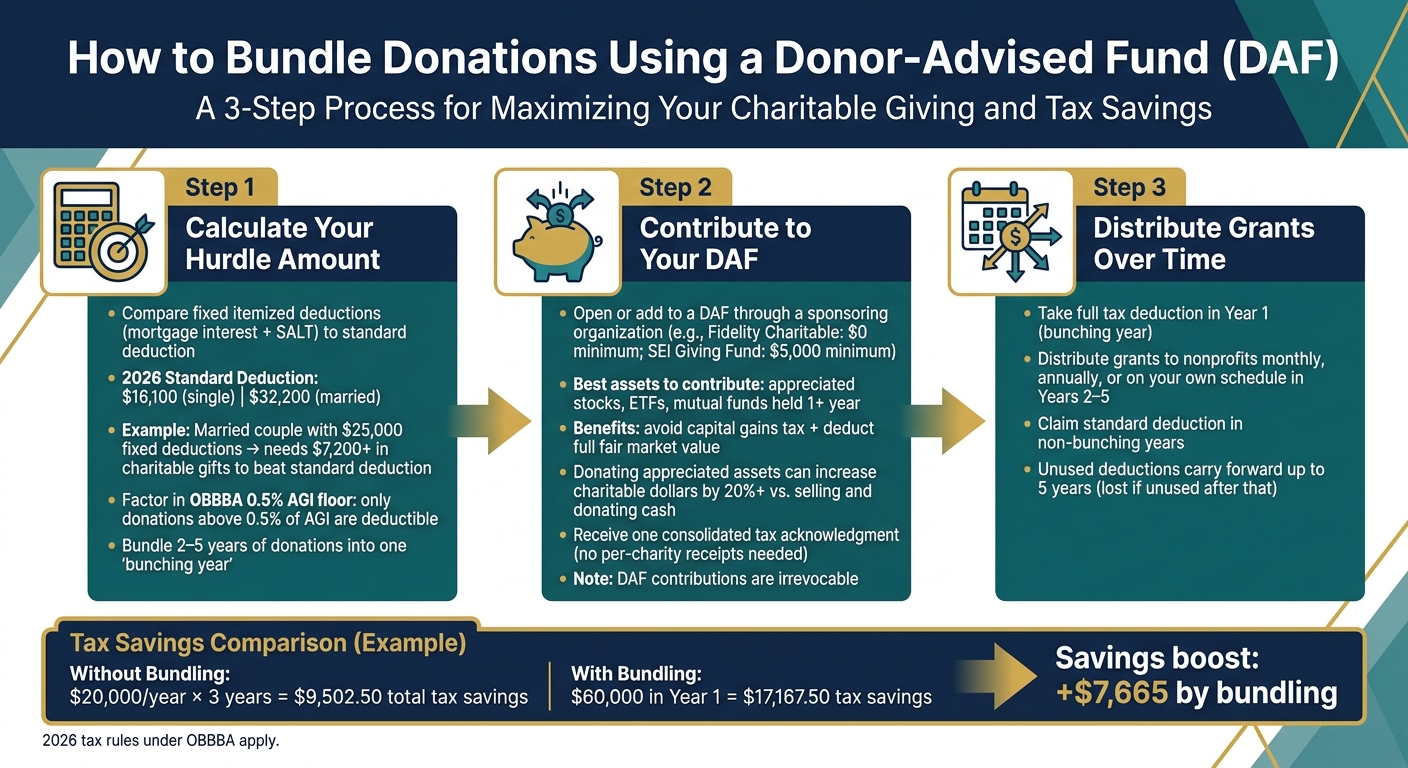
How to Bundle Donations with a DAF: Step-by-Step Tax Strategy
Now that you’ve got a handle on tax thresholds and AGI limits, let’s walk through how to use a donor-advised fund (DAF) to bundle your donations effectively.
Step 1: Determine Your Donation Goal
Start by calculating your fixed itemized deductions (like mortgage interest and SALT) and comparing them to the 2026 standard deduction ($16,100 for singles and $32,200 for married filers) [1]. The gap between these numbers is your "hurdle amount" - the minimum you’d need to donate in a single year to make itemizing your deductions worthwhile.
For example, if a married couple has $25,000 in fixed deductions, they’d need to contribute over $7,200 to charity just to match the standard deduction. Bundling two to five years’ worth of donations into one larger contribution can help you clear that hurdle more easily [1][2].
Don’t forget about the OBBBA’s 0.5% AGI floor: only donations above this threshold are deductible, so you’ll need to factor that into your calculation as well [2].
Once you’ve figured out your target donation amount, you’re ready to set up or add to your DAF to make this contribution.
Step 2: Fund Your Donor-Advised Fund
With your donation goal in mind, open a DAF or add to an existing one through a sponsoring organization - a public charity that manages the account for you. Some sponsors, like Fidelity Charitable, have no minimum contribution requirement, while others, such as the SEI Giving Fund, require at least $5,000 [1][7][8].
When deciding what to contribute, consider donating appreciated assets like stocks, ETFs, or mutual funds that you’ve held for over a year. This strategy lets you avoid capital gains tax and claim a deduction for the asset’s full market value. In many cases, this can increase the amount available for charity by more than 20% compared to selling the asset and donating the cash instead [6].
"By controlling the timing of the DAF contribution, donors can manage the timing of their own tax deductions while planning for future grantmaking to qualified charities." - National Philanthropic Trust [6]
Another benefit of using a DAF is simplified tax documentation. Instead of keeping receipts from every charity you support, you only need a written acknowledgment from your sponsoring organization [7]. Keep in mind, though, that contributions to a DAF are irrevocable [8].
Once your DAF is funded, you can create a plan to distribute grants over time to maximize your charitable impact.
Step 3: Plan Multi-Year Grants
One of the biggest perks of a DAF is the flexibility to separate when you take your tax deduction from when you distribute funds to charities. After making a large contribution to your DAF in your bundling year, you can recommend grants to nonprofits on a schedule that works for you - whether that’s monthly, annually, or at another interval - during the years you’re not adding new funds [1][3].
For instance, you could contribute a lump sum in Year 1 to itemize deductions, then distribute grants steadily in later years while claiming the standard deduction. As Zach Reuter, CFP at Johnson Bixby, explains:
"With a DAF you make a large, tax-deductible contribution to the account in your 'bunching year,' and then grant the money to charities over time - monthly, annually, or whenever it fits your giving rhythm." [3]
This approach aligns perfectly with the bundling strategy discussed here, helping you balance tax benefits with consistent, long-term giving. It’s especially effective during high-income years - like when you sell a business, receive a large bonus, or convert a Roth IRA - when offsetting taxable income can be particularly advantageous [6][8].
Benefits and Considerations of DAF-Supported Bundling
Financial and Tax Benefits
Contributing to a donor-advised fund (DAF) offers some compelling financial perks. First, you can claim the full tax deduction in the year you make the contribution, even as the assets in the fund grow tax-free for future giving [1][2]. If you donate appreciated securities - like stocks or ETFs held for more than a year - you unlock three major benefits: no capital gains taxes on the asset's growth, a deduction based on the full market value, and the flexibility to decide when and where to grant the funds later [2].
Practical Limitations and Risks
While the tax benefits of DAF bundling are clear, there are some important caveats to keep in mind. Once you contribute to a DAF, the assets are irrevocable - they belong to the fund permanently and cannot be reclaimed for personal use [1][2]. Additionally, there are limits on how much you can deduct in a single year: deductions for appreciated securities are usually capped at 30% of your adjusted gross income (AGI), while cash contributions are capped at 60% [2].
For high earners in the 37% tax bracket, a looming change in 2026 will reduce the maximum tax benefit on charitable gifts to 35% [2]. On top of that, most DAF sponsors charge administrative fees, which can quietly chip away at the overall impact of your contributions [1].
When DAF Bundling Works Best
DAF bundling shines brightest in high-income years. It’s particularly effective when your income spikes - like when you exercise stock options, receive a large bonus, or complete a Roth conversion - because offsetting taxable income becomes a priority [1][2]. It’s also ideal for donors whose fixed deductions, such as SALT or mortgage interest, fall just short of the standard deduction threshold. Bundling can help push those deductions over the line, making itemizing worthwhile [1][3].
For individuals in their peak earning years before retirement, bundling into a DAF offers an additional advantage. It allows you to lock in deductions at a higher tax rate now, while giving you the flexibility to distribute funds during retirement, when your income and tax rates might be lower [1]. For example, contributing $60,000 in a single year instead of spreading $20,000 annually over three years could boost tax savings from $9,502.50 to $17,167.50 [1].
"Bunching doesn't mean you have to stop supporting your favorite charities annually. You can maintain giving consistency with a donor-advised fund." - Fidelity Charitable [1]
For those experiencing high-income years, DAF bundling efficiently maximizes tax deductions while preserving the freedom to distribute grants on your own timeline.
Tools and Strategies for Managing Bundled Giving
Tracking and Reporting Your Donations
One of the key perks of using a Donor-Advised Fund (DAF) for bundling is how much easier it makes recordkeeping. With a DAF, you only need to keep track of your contribution documentation. The sponsoring organization takes care of the rest - verifying recipients, processing grants, and providing consolidated tax statements [7].
An online dashboard lets you review your account history and confirm that any unused charitable deductions - available for carryforward up to five years [2] - are still accessible.
Starting in 2026, the One Big Beautiful Bill Act (OBBBA) will change deduction rules. Only donations exceeding 0.5% of your Adjusted Gross Income (AGI) will be deductible. For example, if your AGI is $500,000, the first $2,500 of donations won’t count toward your deduction [2]. Keeping tabs on your AGI and aligning it with your giving schedule ensures you don’t overestimate your tax benefits.
"With a Giving Account, bookkeeping has never been easier. You can view your Giving Account history and statements online at any time. You can even keep track of donations you've made outside of Fidelity Charitable, so all your giving is organized in one place." - Fidelity Charitable [7]
This simplified approach to recordkeeping also makes it easier to use additional tools for evaluating non-cash donations.
Using Deductible.me to Manage Your Giving
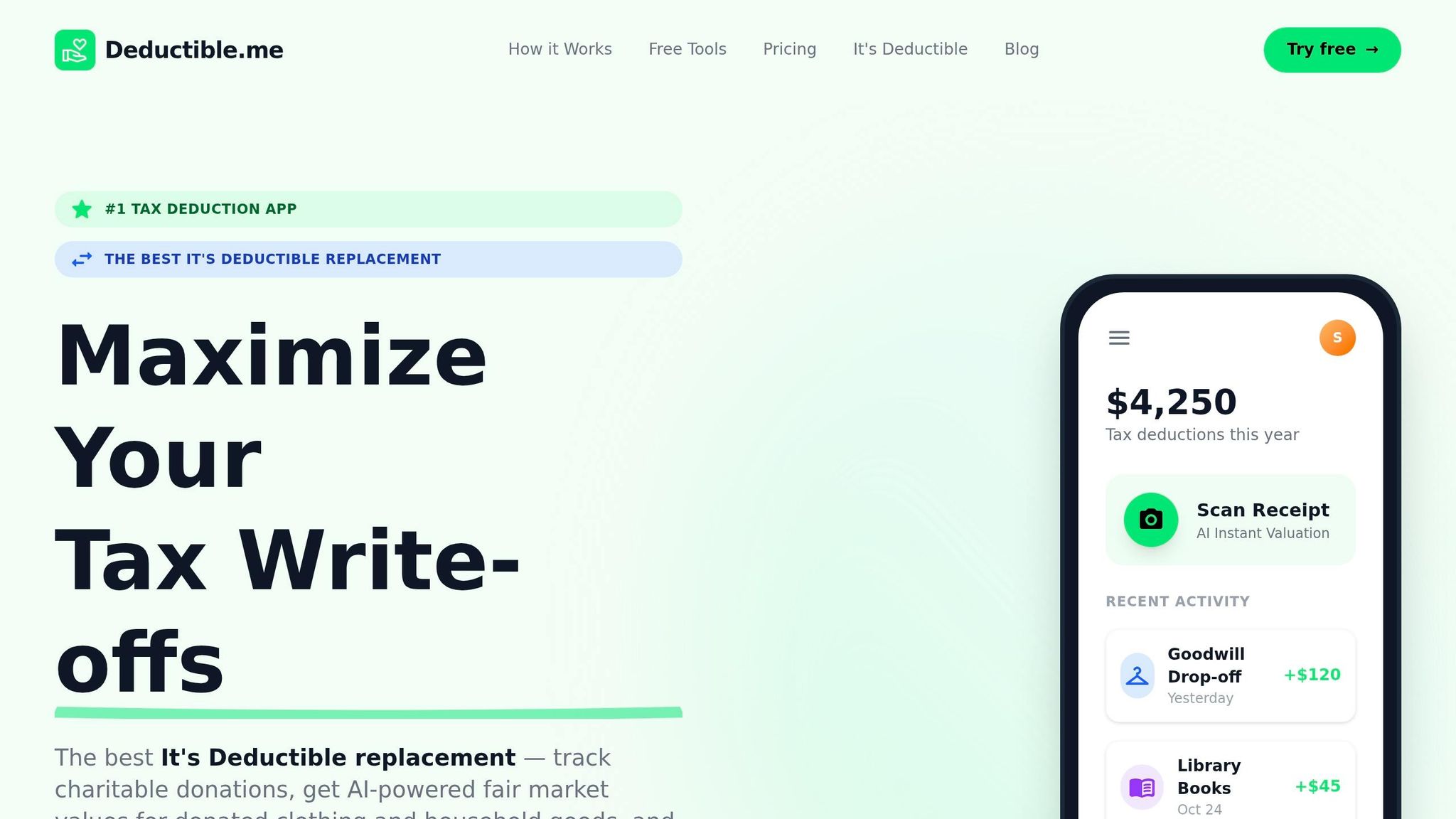
If you’re donating more than just cash and securities - like goods that need accurate valuation - tools such as Deductible.me can simplify the process. This platform is designed to help donors manage diverse contributions while staying organized and compliant.
Deductible.me uses AI-powered valuation to estimate the fair market value of donated items, which aligns with IRS requirements for non-cash contributions. It also provides Form 8283-ready documentation, so you’re covered when filing taxes. For those pursuing a multi-year bundling strategy, the app’s annual giving goal tracking ensures you stay on target - not just for what you’re giving this year, but across the entire plan.
For just $2/month, the Premium plan offers unlimited donation tracking, advanced analytics, and enhanced receipt management - perfect for donors managing a structured, long-term giving strategy.
Conclusion: Using Donor-Advised Funds to Simplify Bundling
Donor-Advised Funds (DAFs) make bundling donations a straightforward way to maximize the impact of your charitable giving without increasing the total amount you contribute. By grouping several years of donations into one larger contribution, you can surpass the 2026 standard deduction thresholds - $16,100 for single filers and $32,200 for married couples filing jointly - and take advantage of tax savings that aren’t available with annual giving[1].
This method gives you flexibility. You can claim the tax deduction in the year you make the contribution to your DAF, while spreading out your donations to charities over time. It’s a win-win: you optimize your tax benefits while continuing to support the causes you care about on your own schedule. If you include appreciated securities in your DAF contributions, the benefits are even greater. You avoid capital gains taxes and can deduct the full fair market value of the securities - a combination that can lead to notable savings over the years[2].
With the new OBBBA regulations now in place, careful planning is more important than ever. A well-thought-out bundling strategy, supported by accurate records and proper valuation of non-cash donations, ensures you can give consistently and take full advantage of the deductions available.
FAQs
How do I know if bundling will beat the 2026 standard deduction for me?
To figure out if bundling donations will save you more than the 2026 standard deduction, add up all your itemized deductions, including charitable contributions. Then, compare that total to the $33,750 standard deduction for married couples filing jointly. If your combined, bundled donations surpass this amount, bundling could lead to larger tax savings.
How does the 0.5% AGI rule change what I can deduct in 2026?
Starting in 2026, if you itemize your deductions, charitable contributions will only be deductible if they exceed 0.5% of your adjusted gross income (AGI). This shift means the threshold for deducting donations will be higher, potentially limiting the amount you can claim. To make the most of your tax benefits, consider strategies like bundling donations, where you combine multiple years' worth of contributions into a single tax year. This approach could help you surpass the new AGI threshold and maximize your deductions.
What should I donate to a DAF - cash or appreciated stocks?
Donating appreciated stocks to a Donor-Advised Fund (DAF) can often be a smarter tax move. By doing this, you sidestep capital gains taxes and can deduct the full fair market value of the stocks on your taxes. On the other hand, cash donations lack the added benefit of avoiding capital gains taxes.