Donor-Advised Funds: IRS Compliance Tips
Donor-Advised Funds (DAFs) are a popular way to manage charitable giving while offering tax benefits. However, staying compliant with IRS rules is crucial to avoid penalties and ensure your deductions are valid. Here's what you need to know:
- Key Benefits of DAFs: Immediate tax deduction for contributions, tax-free growth of assets, and the ability to recommend grants to charities later.
- Compliance Importance: Missteps, like improper deductions or personal financial gain, can trigger excise taxes (20% for improper distributions, 5% for fund managers) or even loss of tax-exempt status for the sponsoring organization.
- Deduction Limits: Cash gifts are limited to 60% of your Adjusted Gross Income (AGI), while appreciated property is capped at 30%. Excess contributions can be carried forward for up to five years.
- Documentation Requirements: Contributions over $250 require a Contemporaneous Written Acknowledgment (CWA). Non-cash donations over $500 need Form 8283, and those exceeding $5,000 require a qualified appraisal.
- Grant Restrictions: Funds can only go to IRS-qualified 501(c)(3) charities. Prohibited uses include personal benefits, tickets to events, or political contributions.
Pro Tip: Tools like Deductible.me can help track contributions, manage documentation, and monitor AGI limits to keep you on track.
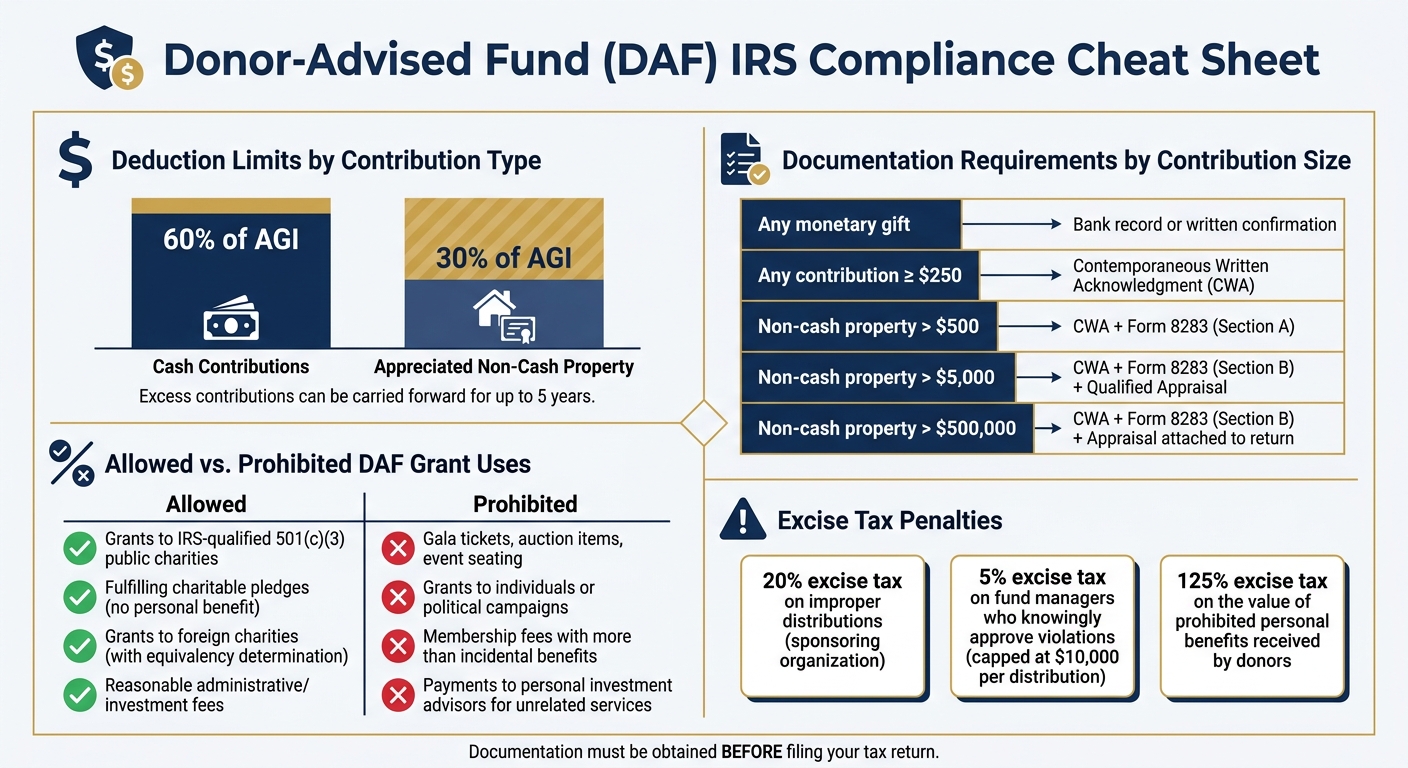
DAF IRS Compliance: Documentation Requirements & Deduction Limits at a Glance
Donor Advised Funds: How to Give More & Pay Less in Taxes
sbb-itb-e723420
IRS Rules for Contributing to a DAF
To meet IRS requirements, you must follow specific rules about contribution timing and documentation.
When Can You Claim a Deduction?
You can claim a deduction for your contribution if it is completed by December 31 of the tax year. For instance, a check mailed on December 30 qualifies, but a wire transfer initiated on December 31 that doesn’t clear until January does not count for the prior year’s deduction[5][7].
Your deduction is only valid if the recipient organization is recognized as a sponsoring organization under Section 170(c). This typically includes public charities like Fidelity Charitable or Schwab Charitable. Contributions to entities that don’t meet this qualification won’t be deductible[5].
There are limits to how much you can deduct based on your Adjusted Gross Income (AGI). Cash contributions are limited to 60% of your AGI, while contributions of appreciated non-cash property are capped at 30% of your AGI. If your contribution exceeds these limits, you can usually carry the excess forward for up to five years[7].
Proper documentation is also essential to substantiate your deductions.
What Records Do You Need for DAF Contributions?
Accurate records are critical to support your deduction. For any monetary gift, you’ll need either a bank record or a written acknowledgment from the sponsoring organization. This document must include the charity's name, the date of the contribution, and the amount[6]. Even an email confirmation from the DAF sponsor can fulfill this requirement.
"No deduction is allowed under sections 170(a) and 170(f)... unless the donor substantiates the deduction with a bank record... or a written communication... from the donee showing the name of the donee, the date of the contribution, and the amount of the contribution." - 26 CFR § 1.170A-15 [6]
For contributions of $250 or more, you’ll also need a Contemporaneous Written Acknowledgment (CWA) from the sponsoring organization. This acknowledgment must indicate whether any goods or services were received in return for the donation, and if so, provide a good faith estimate of their value[6][9].
Here’s a quick overview of the documentation requirements based on the type and size of your contribution:
| Contribution Type | Amount | Required Documentation |
|---|---|---|
| Monetary (Cash/Check/EFT) | Any amount | Bank record or written confirmation [6] |
| Any contribution | $250 or more | Contemporaneous Written Acknowledgment (CWA) [6] |
| Non-cash property | Over $500 | CWA + Form 8283 (Section A) [8] |
| Non-cash property | Over $5,000 | CWA + Qualified Appraisal + Form 8283 (Section B) [8] |
| Non-cash property | Over $500,000 | CWA + Form 8283 (Section B) + Attached Qualified Appraisal [8] |
You must have all necessary documentation before filing your tax return or by the return’s due date (including extensions), whichever comes first[6][9]. Waiting until an IRS audit to gather a CWA is not allowed.
"The donor is responsible for requesting and obtaining the written acknowledgement from the donee." - Internal Revenue Service [4]
Don’t wait for the sponsoring organization to automatically send you all the required documents. Be proactive - especially for large or non-cash contributions - and confirm that you’ve received a complete CWA. Proper documentation ensures your deduction is secure.
DAF Grant Restrictions and Prohibited Benefits
The rules governing Donor-Advised Fund (DAF) grants are crucial for staying compliant with IRS regulations. Once you contribute to a DAF, your control over how funds are distributed is limited. The IRS sets strict guidelines on what grants are permissible and what benefits donors can receive.
Can a DAF Be Used to Fulfill a Pledge?
Yes, but there are specific conditions. According to IRS Notice 2017-73, a DAF can be used to fulfill a personal pledge, but donors cannot claim another tax deduction since the initial contribution already provided that benefit. Additionally, the sponsoring organization must avoid referencing the specific pledge when disbursing the funds, although it can identify you as the donor advisor [10].
"The use of a DAF to fulfill a personal pledge payment would not be treated as a 'more than incidental benefit' under section 4967... if [specific] requirements are satisfied." - RSM US [10]
When making a pledge, ensure the language doesn't imply that the commitment depends on the DAF sponsor's approval. This distinction is important for how the charity records the pledge, maintaining the separation necessary for compliance and ensuring the funds are solely used for charitable purposes.
What Benefits Are Donors Not Allowed to Receive?
The IRS enforces a standard that prohibits donors from receiving benefits exceeding nominal value from DAF grants. If a grant results in tangible perks for you, your family, or anyone you designate, it’s likely not allowed [2][11]. Examples of prohibited benefits include gala tickets, priority seating at athletic events, auction items, and membership perks beyond basic recognition.
Donors must cover any expenses that result in personal benefits out of pocket. Receiving prohibited benefits can lead to an excise tax of up to 125% of the benefit's value [12].
"Any use of DAF assets that provides more than an incidental benefit to a donor, donor-advisor or related person would be deemed a distribution that would generally be considered a taxable distribution." - Ropes & Gray LLP [11]
However, token items like keychains or mugs, along with intangible recognition such as listing your name in a program, are considered incidental and won’t disqualify a grant.
Allowed vs. Prohibited Uses of DAF Funds
To stay compliant, it’s essential to understand the clear distinctions between permissible and prohibited uses of DAF funds. Here’s a breakdown:
| Allowed Uses | Prohibited Uses |
|---|---|
| Grants to IRS-qualified 501(c)(3) public charities [12] | Grants to individuals (e.g., direct emergency aid for a specific person) [11] |
| Fulfilling charitable pledges (provided no personal benefit is received) [12] | Buying tickets for galas, auctions, or athletic events [12] |
| Grants to foreign charities (with equivalency determination) [11] | Membership fees offering more than incidental benefits [12] |
| Grants to private non-operating foundations (if expenditure responsibility is met) [11] | Lobbying or political campaign contributions [11] |
| Reasonable administrative and investment fees related to grants [11] | Payments to a donor's personal investment advisor for unrelated services [11] |
It’s worth noting that if a personal investment advisor manages your DAF and is compensated from its assets for unrelated services, this is considered a prohibited benefit under Section 4958(c)(2).
Sponsoring organizations that approve a taxable distribution face a 20% excise tax. Fund managers who knowingly authorize such distributions may also face a 5% excise tax, capped at $10,000 per distribution [2][11].
Grantmaking Rules and Eligible Recipients
Understanding the rules around grantmaking and who qualifies to receive a grant from a donor-advised fund (DAF) is essential for ensuring compliance and proper use of funds.
Who Can Receive a DAF Grant?
DAF grants can only be directed to IRS-qualified 501(c)(3) public charities. This includes a wide range of organizations such as houses of worship, universities, food banks, and homeless shelters. These entities meet the criteria for charitable purposes under U.S. tax law.
On the other hand, grants cannot be made to private foundations, political organizations, crowdfunding campaigns, or individuals. As Fidelity Charitable explains:
"Donor-advised fund dollars are to be used strictly for charitable purposes, such as general scholarship programs at your alma mater or contributions to your local church, synagogue, or mosque." [3]
To ensure compliance, it's important to verify the recipient's eligibility. The IRS Tax Exempt Organization Search tool can help confirm whether an organization qualifies. Sponsoring organizations also check the IRS Business Master File to confirm the nonprofit's status as a public charity under Section 509(a) [13][1].
After confirming eligibility, the sponsoring organization takes over, reviewing the grant recommendation to ensure it aligns with all guidelines.
How Are Grant Recommendations Reviewed?
When you recommend a grant from your DAF, it’s important to remember that your recommendation is advisory. The sponsoring organization legally controls the funds and must approve every grant to ensure it complies with IRS regulations.
"The public charity sponsoring your account will conduct due diligence to ensure the funds granted go to an IRS-qualified public charity and are used for charitable purposes." - Fidelity Charitable [3]
The review process includes verifying the recipient’s IRS status, ensuring no prohibited personal benefits are involved, and, in some cases, applying expenditure responsibility. This additional step is often required for grants to non-standard entities, like certain foreign organizations, to confirm the funds are used as intended. Sponsoring organizations also monitor for "step transactions", where multiple grants could collectively create a prohibited benefit, even if each individual grant appears compliant.
In 2025, Fidelity Charitable processed over 3 million donor-recommended grants for nearly 227,000 nonprofits [3]. This high volume highlights how streamlined the process has become for major sponsoring organizations. However, every grant still undergoes rigorous compliance checks to ensure adherence to the rules.
Recordkeeping and Reporting Requirements
Keeping accurate records for your Donor-Advised Fund (DAF) deductions is essential. Not only does this safeguard your tax deduction, but it also ensures you're in compliance with IRS rules. Without proper documentation, even valid contributions can be denied.
What Documents Should You Keep?
The type of records you need depends on the kind and amount of your contribution. For any monetary gift, you must retain a bank record (like a canceled check, bank statement, or credit card statement) or a written acknowledgment from your DAF sponsor. This acknowledgment should include the organization's name, the donation date, and the amount contributed.
The IRS has made this requirement clear:
"Written records prepared by the donor (such as check registers or personal notations) are no longer sufficient to support charitable contributions." - Internal Revenue Service [4]
For a Contribution Acknowledgment (CWA), the statement must confirm the amount donated, describe any non-cash property given, and specify whether you received any goods or services in return. For most DAF contributions, the acknowledgment will state, "no goods or services were provided" [4].
If you're donating appreciated non-cash assets valued over $500, you'll need to file Form 8283, which includes details about the asset and its valuation. For non-cash contributions exceeding $5,000, a qualified appraisal is typically required. The only exception to this rule is for publicly traded securities [4][14].
| Contribution Type | Value Threshold | Required Documentation |
|---|---|---|
| Non-cash | Over $500 | CWA + Form 8283 (Section A) [8][14] |
| Non-cash | Over $5,000 | CWA + Form 8283 (Section B) + Qualified Appraisal [4][8] |
| Non-cash | Over $500,000 | CWA + Form 8283 (Section B) + Appraisal attached to return [8] |
Quick Tip: Organize these documents well before tax season to avoid last-minute stress.
How to Get Ready for Tax Filing
Good recordkeeping is just the first step - timely preparation is equally important. Make sure to obtain your CWA before filing your tax return. Keep in mind, DAF deductions can only be claimed if you itemize on Schedule A (Form 1040). If you opt for the standard deduction, you won’t be able to claim these contributions, regardless of the amount donated.
Here are a few key points to remember:
- Cash contributions: Deductible up to 60% of your Adjusted Gross Income (AGI).
- Appreciated non-cash assets (held for more than one year): Deductible up to 30% of AGI [14].
- If your contributions exceed these limits, you can carry forward the excess deduction for up to five years [14].
For securities, the donation date is the transfer date, which is also used for valuation. The Fair Market Value (FMV) is calculated by averaging the high and low trading prices on that date [14]. Make a note of these details right away to simplify your filing process later.
Using Deductible.me to Stay on Top of DAF Compliance
Once you've established your recordkeeping system, Deductible.me can help you stay organized and compliant with your Donor-Advised Fund (DAF) responsibilities throughout the year. Here’s how this app simplifies contribution tracking and helps you set clear annual giving goals.
How Deductible.me Simplifies DAF Contribution Tracking
DAF compliance hinges on properly distinguishing between contributions to your fund (which are immediately deductible) and grants made to charities [15][16]. Deductible.me automates the process of collecting and organizing the necessary documentation, saving you time and effort.
For non-cash donations, the app also assists with Form 8283 preparation. It flags donations over $500 that require this form and identifies those exceeding $5,000, which call for a qualified appraisal [17][18]. This automation ensures you're meeting all IRS requirements without the stress of manual tracking.
Setting and Tracking Giving Goals with Deductible.me
In addition to tracking contributions, Deductible.me helps you manage your annual giving goals, which is crucial for avoiding AGI-based deduction limits. With the Premium plan (just $2/month), you can monitor your progress toward these goals - a handy feature for donors planning multi-year giving strategies.
This becomes even more relevant as we approach 2026, when a new 0.5% AGI floor takes effect. Under this rule, only donations exceeding 0.5% of your AGI will be deductible [17][19]. For instance, a donor with an annual income of $1 million would see no tax benefit from the first $5,000 in charitable contributions [19].
The app also helps you track your contributions against the 60% AGI limit for cash donations and the 30% limit for securities. If you exceed these limits, Deductible.me keeps tabs on any carryover amounts, which can be applied for up to five years [16][18]. To stay on schedule, you can even set recurring reminders for making contributions throughout the year.
Conclusion and Key Takeaways
Following IRS guidelines for donor-advised fund (DAF) contributions, grantmaking, and recordkeeping is essential to secure tax benefits. Tax deductions are granted at the time of contribution, but once you donate, legal control shifts to the sponsoring organization[1]. To claim deductions properly, you'll need to keep accurate records and meet IRS requirements.
For contributions of $250 or more, ensure you have the necessary documentation before filing taxes[4]. Deduction limits include 60% of adjusted gross income (AGI) for cash contributions and 30% for appreciated property, with a five-year carryforward option. Non-cash donations exceeding $5,000 also require a qualified appraisal[4].
When it comes to grantmaking, DAF funds must go to eligible 501(c)(3) public charities. Using grants for personal pledges or benefits can lead to excise taxes under sections 4966 or 4958[1][13], making compliance critical.
To stay organized, gather bank statements, written acknowledgments, and appraisal documents well before tax season. The IRS emphasizes:
"Written records prepared by the donor (such as check registers or personal notations) are no longer sufficient to support charitable contributions."[4]
For a smoother process, tools like Deductible.me can help. Their Premium plan, at just $2/month, offers unlimited donation tracking, advanced receipt management, and features to monitor your annual giving goals - all designed to simplify compliance and maximize deductions.
FAQs
What counts as “completed” when funding a DAF before December 31?
When making a contribution to a Donor-Advised Fund (DAF), the process is considered complete once the funds are irrevocably transferred to the sponsoring organization. This can be done through methods such as a wire transfer, a check postmarked by December 31, or other approved methods. Be sure the transfer is fully processed before the end of the year to secure your tax deduction.
Can I use my DAF to cover a gala ticket or membership perks?
You can't use your donor-advised fund (DAF) to cover gala tickets or membership perks if those perks offer more than a minimal benefit. However, you can recommend a grant for general support, but only if you decline any associated perks. Make sure all DAF grants follow IRS rules to keep your tax benefits intact.
What’s the easiest way to track AGI limits, carryovers, and required forms for DAF gifts?
Staying on top of the rules for Donor-Advised Fund (DAF) gifts requires keeping detailed records of your donations. This includes saving acknowledgment letters and documenting the types of assets donated.
Here’s what to watch for:
- AGI Limits: Contributions are capped based on your Adjusted Gross Income (AGI). Cash donations can be deducted up to 60% of your AGI, while the limit for appreciated assets is 30%. Keep an eye on these thresholds to avoid exceeding them.
- Carryovers: If your contributions surpass the AGI limits, the excess can be carried forward for up to five years. Make a note of these carryovers to maximize your deductions in future tax years.
- Required Forms: For non-cash donations exceeding $500, you’ll need to file IRS Form 8283 to stay compliant.
Using tools like Deductible.me can make tracking easier and help ensure you meet IRS requirements. These tools can simplify the process, keeping your records organized and accurate.