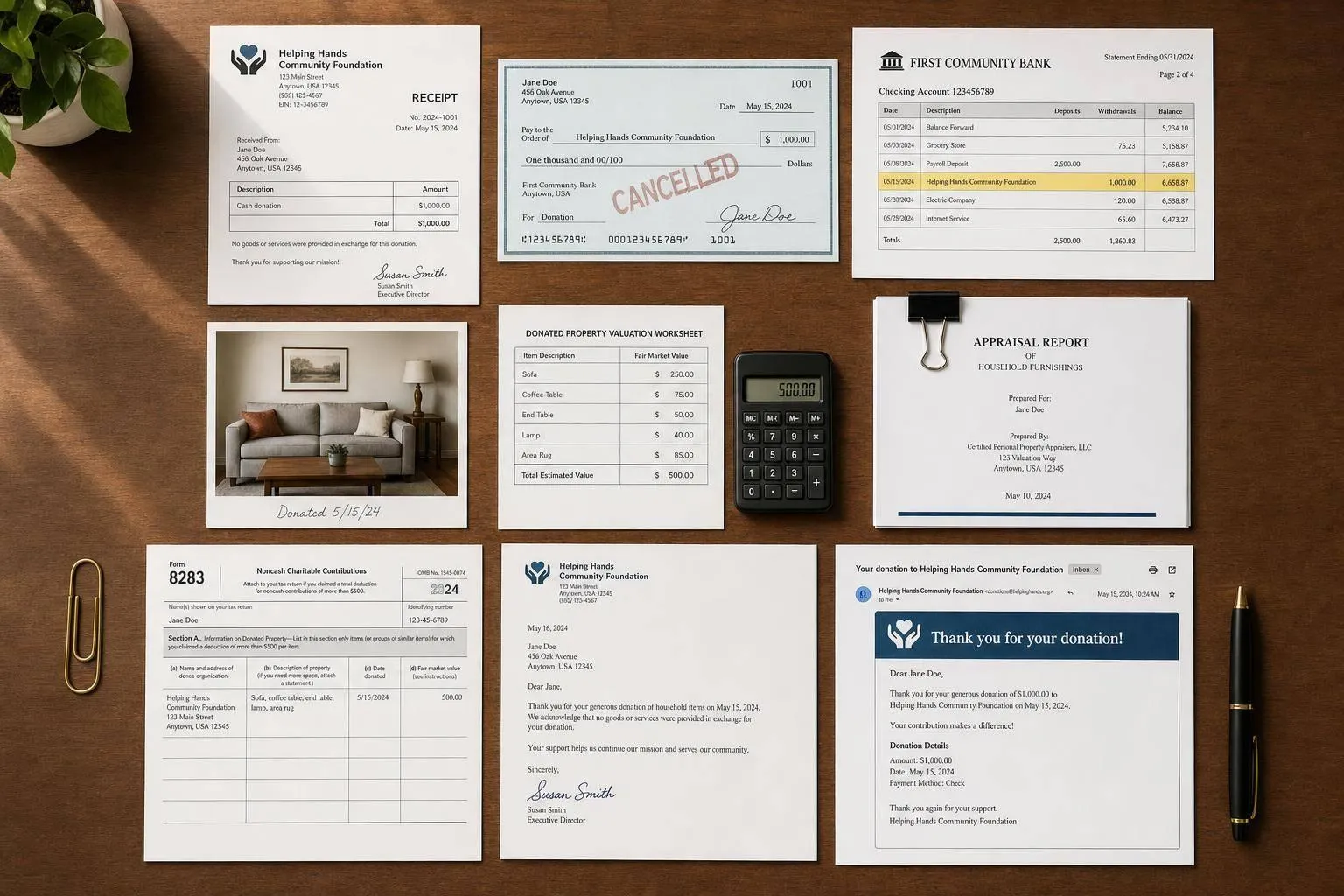
Age 59½ is a retirement rule, not a charity paperwork rule. If I claim a charitable deduction, the IRS looks at the gift type, the dollar amount, and whether I crossed a filing threshold like $250, $500, $5,000, or $500,000.
Here’s the short version: if I donate cash, I keep payment proof and, for gifts of $250 or more, a written acknowledgment from the charity. If I donate property, I also keep an item list, date records, value support, photos when needed, Form 8283 once total noncash gifts go over $500, and an appraisal for many claims over $5,000.
The 9 records covered are:
- Bank or financial-account records
- Charity receipts and donation confirmations
- Contemporaneous written acknowledgments
- Donation-date records
- Itemized noncash donation inventory
- Fair-market-value notes
- Photographs and condition records
- Qualified appraisals and appraiser records
- Form 8283 and tax-return records
The main risk is simple: if one required record is missing, the IRS can deny the deduction even if the donation happened.
How to Track Charitable Donations for Tax Season (Do This Before You File)
Quick comparison
| Record | When I need it | Main point |
|---|---|---|
| Bank/account record | Any cash gift | Shows charity, date, and amount |
| Charity receipt | Most gifts | Shows the charity received the gift |
| Written acknowledgment | Single gift of $250+ | Must say if I got goods or services |
| Date record | Every gift | Tells me which tax year gets the deduction |
| Itemized inventory | Noncash gifts | Lists what I donated |
| FMV notes | Noncash gifts | Supports the amount I claim |
| Photos/condition notes | Many noncash gifts | Shows condition on the donation date |
| Qualified appraisal | Many noncash claims over $5,000 | Independent value support |
| Form 8283 | Total noncash gifts over $500 | IRS summary form for noncash gifts |
So if I want the deduction to hold up, I treat donation records and value records as two separate files - and I save both at the time I give.
Why recordkeeping matters before tax time
Substantiation means the records that back up your deduction if the IRS takes a look. Those records need to show the gift, the date, the value, and the recipient. If the paperwork is missing or incomplete, the IRS can deny the deduction even if the donation was 100% real.[5][14]
The rules get tighter as the gift amount goes up. For example, a $275 gift tied to a charity dinner needs records that separate the deductible amount from the value of the meal.[12][13] Miss one required detail, and the deduction can fall apart.
That’s why it helps to save records as you make each gift, not months later during tax season. Dates, item descriptions, condition, and charity names are a lot harder to piece together after the fact, especially if you made several donations over the year. Keeping that information at the time of the gift gives you fewer holes in your file and a cleaner paper trail when you’re ready to file.
Save each record as you give. First: bank or financial-account records.
1. Bank or Financial-Account Records
For every cash donation - whether you write a check, use a card, or send an ACH transfer - the IRS wants proof from your financial account plus the charity’s receipt.[11][14] That can be a bank statement, canceled check, credit-card statement, ACH confirmation, or charity receipt. Keep the bank record with the charity receipt.
The record needs to show three things: the charity’s name, the date, and the amount. On its own, a payment record isn’t enough. Pair it with the charity receipt so the documentation is complete. The charity’s receipt fills in the missing proof.
Match the record to how you paid:
- For checks, keep a canceled check or bank statement.
- For card donations, keep a credit-card statement.
- For ACH transfers, keep the ACH confirmation.
The IRS also accepts a scanned image of both sides of a canceled check from your bank.[12][11] If you gave by credit card, save the full statement page or transaction detail so the charity name, date, and amount are easy to see.
For gifts of $250 or more, keep both the bank record and a contemporaneous written acknowledgment from the charity.[6] In some cases, one document can cover both rules, but only if it includes every required detail.[6] For donations at that level, that receipt is a must-have.
A simple filing habit can save a lot of stress later. Save the original file from your bank, card issuer, or payment app, name it by date and charity - something like 2026-04-15_CharityName_$250_card.pdf - and store backups in two secure places. That way, if you ever need to show your records, everything is right where it should be.
2. Charity Receipts and Donation Confirmations
Once you have the payment record, pair it with the charity’s acknowledgment. That second document matters because the IRS rules change based on the type of gift and the amount.
For cash gifts under $250, the basic rule is pretty simple: keep a bank record, credit card record, or a receipt that shows the charity’s name, the date, and the amount.[5][13] That’s enough for this level of donation.
For a single contribution of $250 or more, the bar is higher. You need a contemporaneous written acknowledgment from the charity.[5][13] In plain English, that means a written note, email, or PDF from the organization that confirms the donation and says whether you got any goods or services in return.
If you did receive goods or services, the acknowledgment must describe them and give an estimate of their value. Say you bought a gala ticket and it included a $100 meal. In that case, only the amount above that value is generally deductible.[14][19] If you received nothing in return, the acknowledgment should state that.
For noncash gifts, the receipt should describe the donated property, but it should not assign a value.[13][18] That part is on you. The donor has to support the fair-market value claimed, so your own records should back up the number you report.[13][18]
“Contemporaneous” has a timing rule too. You must have the acknowledgment before you file your return or by the return due date, whichever comes first.[6][12] That’s why it helps to ask for acknowledgments right after each donation, save the original email or PDF, and keep it with the matching bank or credit card record.
A simple file name can save a lot of hassle later. Something like 2026-09-28-CharityName-$400-cash-receipt.pdf works well. Then match each receipt to the date you made the donation so nothing slips through the cracks.
Deductible.me can help you organize receipts and match each acknowledgment to the right donation.
3. Contemporaneous Written Acknowledgments
The receipt isn’t enough for larger donations. If you make any single gift of $250 or more, the IRS says you need a contemporaneous written acknowledgment from the charity. A bank statement by itself doesn’t cut it.[1] You must have this record by the tax return due date, including extensions, or before you file, whichever comes first.
Why does this matter? Because it gives the IRS something it can check. Without it, a donation deduction can fall apart even if you did make the gift.
The acknowledgment should include:
- The charity’s name
- The date of the donation
- The cash amount or a description of the property donated
- Whether you received any goods or services in return, and if you did, a good-faith estimate of their value[1]
For noncash gifts, the charity should describe the property but not assign a dollar value to it.[13]
One small but important tip: keep the original email or PDF. Don’t rely on a screenshot. If anything is missing, ask the charity for a corrected version before you file.
Next, keep the date of the gift itself separate from the acknowledgment.
4. Donation-Date Records
The donation date is not a small detail. It decides which tax year gets the deduction.
Once you have the acknowledgment, pin down the gift date and save proof of it. For any monetary gift, keep a bank or payment record that shows the charity, the amount, and the date.
Use the date the gift was completed. Don’t use the date you meant to give, planned to give, or the date a receipt showed up later.
A few common cases trip people up:
- A credit card donation counts on the day the charge posts, even if you pay the card bill later.
- For a mailed check, keep proof showing when it was mailed or delivered.
- For stock, use the date title passed to the charity based on the transfer method used.
- For dropped-off property, use the date the charity took possession.
Year-end gifts need extra care. A December 31 donation and a January 1 donation fall into two different tax years, so your records should make that plain. If you give online at the end of the year, save the posted confirmation in that year’s tax file.
Use these rules to match each record to the right tax year:
| Donation value | Key date record needed |
|---|---|
| Any monetary gift | Bank or payment record showing charity, amount, and date[14] |
| $250 or more (cash or property) | Keep the acknowledgment with the gift date shown.[6] |
| Noncash gifts totaling more than $500 | Form 8283 with a specific Date contributed for each item or group[10][20] |
| Single noncash item or group over $5,000 | Form 8283 Section B plus qualified appraisal, both tied to the contribution date[21] |
On Form 8283, list each donation date separately. Don’t plug in one annual date for everything.[20][7] If you want a simpler way to track this, tools like Deductible.me can help you log each donation date, receipt, and related details in one place, then export Form 8283-ready reports when it’s time to file.
5. Itemized Noncash Donation Inventory
After you log the donation date, the next step is the itemized inventory.
For noncash gifts, keep a line-item inventory for each donated item or each group of similar items. A vague note like “household goods” isn’t enough.[5][11]
For each entry, include:
- a specific description
- quantity
- condition
- date
- charity name and address
- estimated FMV
Put each item’s core details in one record so the description, date, receipt, and charity name stay together in the same file. Keep your valuation backup separate. The next record is where you document FMV.
Match the detail in your inventory to the size of the deduction. Bigger donations call for Form 8283 and, at higher amounts, a qualified appraisal.
Group similar items together. Don’t split one donation into smaller entries just to stay under a filing threshold.[5][21][7]
It also helps to use a consistent file name for each donation record. Deductible.me can store photos, values, and charity details in one place and export IRS-ready reports.
Store the inventory with your receipts, then link it to your valuation notes.
6. Fair-Market-Value and Valuation Notes
Your inventory tells the IRS what you donated. Your valuation notes back up what it was worth. Those are two separate records, and the IRS treats them that way. After you finish the inventory, the next step is to document the value you plan to claim.
Fair market value, or FMV, is the price an item would sell for between a willing buyer and a willing seller when both know the facts and neither is being pushed into the deal.[22][5] For donated property, FMV should match the item’s condition on the donation date. It is not based on what you paid for it, what it would cost to buy new, or what it means to you personally.
Your valuation notes should spell out the basics clearly:
- what the item is
- how many were donated
- brand or model
- age
- condition
- original cost, if you know it
- ownership history
- donation date
- the method used to estimate FMV
You should also keep the backup for that estimate with the note. That can include comparable sales, marketplace listings, auction results, dealer quotes, replacement-cost information, or an expert opinion. A used laptop is a good example. You’d want the make, model, age, condition, donation date, and proof from similar sales.[5][6]
The proof you need depends on the item’s value and condition. If a single clothing or household item is not in good used condition or better, you generally need a qualified appraisal and Form 8283, Section B, once the claimed deduction goes over $500.[7][24] For any item or group of similar items valued above $5,000, a qualified appraisal from a qualified appraiser is generally required.[7][15] If the donated property is valued at more than $500,000, you generally must attach the qualified appraisal to your federal tax return.[15][23] Photos and condition records can help back up these notes.
A charity receipt shows that the organization received your donation. It does not prove FMV. That’s why valuation notes should stay separate from the receipt. Make sure the notes include the donation date, item description, condition, valuation method, and the market evidence you relied on.
Store valuation notes, photos, receipts, and appraisals together. Deductible.me can keep valuation notes, receipts, photos, and appraisal records linked to each donation. Keep those records with photos and condition notes so the valuation file stays complete.
7. Photographs and Condition Documentation
Photographs show an item’s condition at the time of donation. They don’t replace receipts or appraisals. Form 8283 asks for a brief summary of the overall physical condition of donated tangible property, and a clear photo can help back up that description.[10][15] Use photos alongside your condition note and valuation file.
Take photos immediately before or at the time of donation, before anything is moved, cleaned, repaired, taken apart, or thrown away. Get several angles and close-up details, including:
- Front, back, and sides
- Labels and serial numbers
- Damage, stains, wear, and repairs
- Missing parts
Your written condition note should line up with what the photos show. For example: 2018 DSLR camera, fully functional, minor scratches on body, no cracks, includes original lens and battery. Stick with specific, objective wording. Skip vague labels like good condition.
Condition records matter most for clothing, household goods, and other tangible property where IRS rules depend on the item’s state. Clothing and household goods generally must be in good used condition or better to qualify for a deduction.[7] If a single object is valued at $20,000 or more, the IRS may ask for a photograph. The image should be large and clear enough to fully show the object, and the IRS prefers an 8-by-10-inch color photograph or a high-resolution digital image.[15]
Store the photos with the receipt, condition note, and valuation record. For digital storage, name each file with the donation date, item number, and a short description, such as 2026-09-28_Donation01_OakTable_front.jpg. Keep the original files and back them up in two places, like encrypted cloud storage and a local drive. Deductible.me lets you attach photos to each donation record and keep them linked to receipts and appraisal files.
8. Qualified Appraisals and Appraiser Records
For high-value noncash gifts, the IRS wants more than photos or a few notes. It wants a qualified appraisal. That means an independent valuation report prepared by a qualified appraiser. Form 8283 is just the summary you attach to your tax return.[7]
If you claim a noncash contribution worth more than $5,000, you generally need a qualified appraisal and must fill out Form 8283, Section B.[7][22] This threshold can apply to a single item or a group of similar items. That includes things like artwork, jewelry, collectibles, land, and some vehicles. If your claimed value is more than $500,000, you generally must attach the full appraisal to your return.[7][22] Cash and publicly traded securities are usually exempt.[5]
Once your claimed value goes past $5,000, two things matter: timing and records.
The appraisal must be dated no earlier than 60 days before the gift, and it must be finished by your tax return due date, including extensions.[25] So don’t wait until after the donation to start looking for an appraiser. Hire the appraiser before you donate.
The report should include:
- A description of the property
- Its condition
- The contribution date
- The valuation date
- The claimed fair market value
- The valuation method used[25]
Your appraiser must have verifiable education and experience with that type of property, and the appraiser cannot be the charity receiving the gift.[25][16] You should also keep the signed report, the appraiser’s credentials, contact details, and the engagement letter. One more thing: avoid percentage-based fees. They can create independence problems.
Deductible.me can help organize the file, but the signed appraisal is the record the IRS requires.
Next: the Form 8283 records that appraisal on your tax return.
9. Form 8283 and Tax-Return Documentation
Form 8283 is the IRS appraisal summary for noncash charitable contributions. In most cases, you must attach it to your federal tax return when your total noncash deductions for the year are more than $500.[17] That limit looks at the combined total of all noncash donations for the year, not just one item.
The form has two sections, and each one applies in a different range.
- Section A usually covers noncash deductions over $500 but not more than $5,000 per item or group of similar items.
- Section B usually applies when a single item or a group of similar items is worth more than $5,000. It calls for a qualified appraisal, along with signatures from the appraiser and the charity.[7][5]
There’s one point people often miss: the charity’s signature in Section B does not mean the organization agrees with your value. It only confirms that it received the property described on the date listed.[16] And if your claimed noncash deduction is more than $500,000, you must attach the qualified appraisal to your return too.[6]
Section A should be backed by records that show the charity’s legal name and address, a description of the donated property, the date you got it, how you got it, the date you donated it, any cost or other basis when required, and the claimed fair market value plus the valuation method.[7][15] Section B needs those same core details, plus the appraiser’s qualifications, the valuation method, the valuation date, and the signed declaration.[5][7]
It helps to keep the full paper trail together instead of hunting for files later. For each noncash donation, keep:
- the filed return or tax software PDF
- Form 8283
- the charity’s contemporaneous written acknowledgment when required
- the appraisal when required
- ownership or purchase records
- valuation worksheets
- photographs
- related correspondence[14][12]
A simple setup works well: one folder for each tax year, then a subfolder for each donation. You can use a file name like 2026-04-15-Charity-Property-Form8283B.pdf so everything is easy to spot at a glance.[2]
Deductible.me can help you organize item descriptions, donation dates, valuation details, and images into IRS-focused reports.[4] But the signed form, the appraisal, and the charity acknowledgment are still the records the IRS wants to see. An app can help you stay organized, but it doesn’t replace those original documents.
IRS substantiation thresholds at a glance
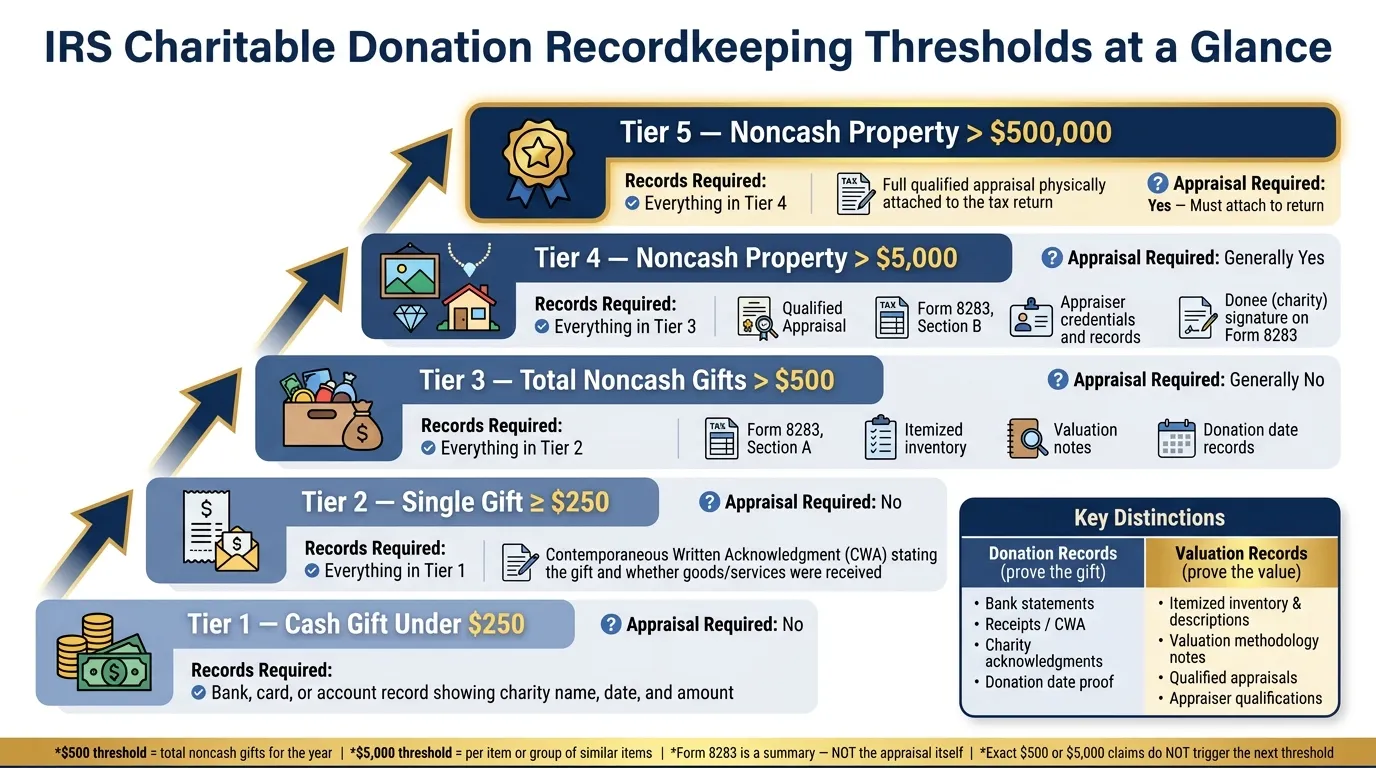
IRS record rules change based on the type of gift and the amount. The main breakpoints are $250, $500, $5,000, and $500,000. And each new threshold adds more paperwork. It doesn’t replace what came before.[7][5][6]
Use the chart below to match each donation to the lowest IRS rule that applies.
| Donation situation | Principal records to keep | Appraisal required? |
|---|---|---|
| Cash gift under $250 | Bank, card, or account record showing the charity, date, and amount | No |
| Single cash or noncash gift of $250 or more | CWA stating the gift and whether goods or services were received | No, not solely because it reaches $250 |
| Total noncash deductions over $500 | Form 8283, Section A, plus inventory, valuation notes, date, and acknowledgment | Generally no |
| Noncash property claimed above $5,000 per item or group of similar items | CWA, qualified appraisal, Form 8283, Section B, appraiser records, and donee signature | Generally yes |
| Noncash property claimed above $500,000 | All records above, plus the appraisal attached to the return | Generally yes |
A couple of details matter here.
- The $500 threshold applies to your total noncash gifts for the year.
- The $5,000 threshold applies to each item or group of similar items.[7][10]
Also, Form 8283 is a summary of the donation. It is not the appraisal itself.[7][15]
One more point that trips people up: an exact $500 claim or exact $5,000 claim does not move you into the next threshold. But the $250 CWA rule can still apply.[7][5][17]
Next comes the difference between proof of giving and proof of value.
Records vs. valuation: what is the difference?
Once you know the threshold, sort your paperwork into two buckets. One bucket is for donation records. These show that you gave the item away. The other is for valuation records. These support the amount you claim on your tax return.
That split matters more than it may seem. If those two jobs get blurred together, things can get messy fast if the IRS looks at the deduction.
An inventory entry shows what the item was. It does not prove what it was worth. A receipt shows the charity received the item, but the donor still has to support the item’s fair market value.
Here’s a simple way to sort the file:
| Document | Primary role |
|---|---|
| Itemized inventory | Proves what was donated |
| Charity receipt or acknowledgment | Proves receipt and date |
| Photographs and condition notes | Show condition, not value |
| Comparable sales or pricing guides | Support FMV |
| Valuation notes and methodology | Explain the value claim |
| Qualified appraisal | Independent FMV support |
| Form 8283 | Reports the donation to the IRS |
A receipt and photos can show that a donated set was received. But the value you claim still needs support from things like comparable sales and condition notes.
The IRS defines fair market value (FMV) as the price a willing buyer would pay a willing seller when neither is under pressure to act and both have reasonable knowledge of the relevant facts.[5] FMV should match the date of the contribution. What you paid for the item in the past does not prove its current FMV.
A good rule of thumb: keep two folders for each noncash donation.
- One folder for identity and transaction records: inventory, receipt, acknowledgment, and photographs
- One folder for value records: comparable sales, pricing-guide excerpts, condition notes, and any needed appraisal
Tie each value note to a specific inventory item with a plain label, such as “Item 4 - Canon EOS camera with 50mm lens.” That way, nothing floats around without a clear match.
Deductible.me can help you keep both buckets organized, so proof of donation and proof of value stay separate.
How digital tools help you organize donation records
Once you know what the IRS wants, keep one digital file for each donation. That file should include the charity name, date, gift type, amount or item description, and the matching receipt or acknowledgment. If the gift was noncash, add valuation notes too.
A simple setup goes a long way. Scan paper receipts as soon as you get them, and save email acknowledgments in a secure archive. Use the same naming format every time, like 2026-09-28_Goodwill_clothing_$180. That may sound a little boring, but it saves a lot of hassle later.
The IRS accepts electronic records as substantiation, including scanned receipts, bank records, credit-card statements, and email acknowledgments from charities.[11][12] But there’s one catch: an app entry by itself is not enough. It does not replace the actual receipt, acknowledgment, or bank record.
If you want one place for the whole paper trail, Deductible.me can store:
- Receipt images
- Charity acknowledgments
- Item photographs
- Donation dates
- Valuation notes
Its IRS-ready reports can pull together item descriptions, fair-market values, dates, and donee details for tax preparation.[3] Keeping one file per donation also makes the $250, $500, and $5,000 rules much easier to follow.
Treat any AI value as a draft note, not proof. Before you file, export a year-end archive and save copies outside the app. That setup makes it easier to catch missing receipts, dates, or valuation notes before filing.
Common mistakes that put deductions at risk
A donation can be valid and still fall apart if one key record is missing. That’s the frustrating part. In a lot of cases, the gift itself isn’t the problem. The paperwork is.
These are the five mistakes that most often sink an otherwise solid donation file.
Relying only on a screenshot. A screenshot can help you stay organized, but it does not replace IRS proof. It may leave out the charity name, the amount, or the date. Save the original email receipt or the account statement instead.[8][14]
Missing the $250 acknowledgment rule. One contribution of $250 or more needs a contemporaneous written acknowledgment from the qualified organization.[6][9] A bank statement by itself does not meet this rule. The acknowledgment must state whether you received any goods or services and, if you did, give their estimated value. You must have it by the earlier of the date you file your return or the return’s due date, including extensions.[14]
Claiming noncash value without support. A nice round number with nothing behind it is weak support. Write down the item, quantity, condition, brand or model, and the source you used to value it.[9][23] Fair market value is not the original purchase price, and it is not a guess.
Using the wrong donation date. The date decides which tax year gets the deduction. Use the actual transfer date, not the date the receipt shows up.
Treating Form 8283 as the appraisal. Form 8283 is only a summary. Gifts over $5,000 usually need both Form 8283 and a separate qualified appraisal.[6][7][15]
Conclusion
The IRS doesn’t care about your age. It cares about whether you can back up the gift. The substantiation rules stay the same no matter how old you are. What matters is the gift itself, when you made it, what it was worth, and who received it.
Your records do three things: prove the gift, prove the date, and prove the value. Bank records and charity receipts show that the contribution happened. Acknowledgment letters, donation-date records, and Form 8283 tie the gift to the correct tax year. Inventories, photographs, valuation notes, and qualified appraisals support the amount you claimed. Delivery proof does not prove value.
Save each record on the day you donate. Deductible.me can help you keep receipts, dates, photos, and valuation notes in one place. But no app can stand in for the source documents themselves, especially a qualified appraisal when the law requires one.[7][14] Keep a single tax-year file with the source documents you’ll attach or point to when you file.
FAQs
Do I need both a bank record and a charity receipt?
For cash donations under $250, no. A bank record or a written statement from the charity is enough.
For donations of $250 or more, you must have a written acknowledgment from the charity.
Deductible.me can help by logging donations and storing digital receipts, so your records stay organized and IRS-compliant.
When is Form 8283 required for noncash donations?
You must file Form 8283 with your tax return if your total noncash donations for the year are more than $500.
That total includes the combined value of all noncash property you donated during the tax year, including groups of similar items.
Use Section A for items, or similar groups of items, valued at $501 to $5,000.
Use Section B for any single item, or group of similar items, valued at more than $5,000.
What if I donated property but don’t have an appraisal?
If the donated property is worth $5,000 or less, you usually don’t need a formal appraisal, as long as it’s in good used condition or better.
What should you keep on file? A few basic records:
- The donation date
- A description of the item
- How you figured out its fair market value
There’s one big exception. If the item isn’t in good condition, you’ll need a qualified appraisal for deductions over $500.
And if any single item - or a group of similar items - is worth more than $5,000, a qualified appraisal is also required.