
If your charitable deduction is larger than your yearly IRS limit, the extra amount does not vanish - you may carry it forward for up to five years in most cases.
Here’s the short version: I would use a contribution carryover to spread a big deduction across future tax years, use more of it in high-income years, apply older carryovers before they expire, keep the original records, and report the amount on Schedule A each year.
The key rules are simple:
- Cash gifts to public charities are often limited to 60% of AGI
- Long-term appreciated property is often limited to 30% of AGI
- Current-year gifts come first
- Oldest carryovers come next
- You must itemize on Schedule A
- Most carryovers expire after 5 years
- Qualified conservation gifts can last 15 years
That means a donor with $100,000 of AGI and an $80,000 cash gift may deduct $60,000 now and carry $20,000 into later years.
| Use | What I’d do | Why it matters |
|---|---|---|
| Spread a large gift | Claim part now, carry the rest | Helps avoid lost deductions |
| Use high-income years | Apply carryovers when AGI is higher | A higher AGI means a larger deduction limit |
| Use oldest amounts first | Track gift year and expiration | Helps stop older carryovers from expiring |
| Keep records | Save receipts, Form 8283, and appraisals | Later-year claims still depend on original proof |
| File it right | Recalculate each year on Schedule A | The allowed amount can change with AGI |
In short, I’d treat a carryover like a deduction with a deadline: track it, sort it by type, use the oldest balance first, and claim it before time runs out.
Charitable Contribution Percentage Limits and Carryforwards | CPA TCP
Carryover Rules at a Glance
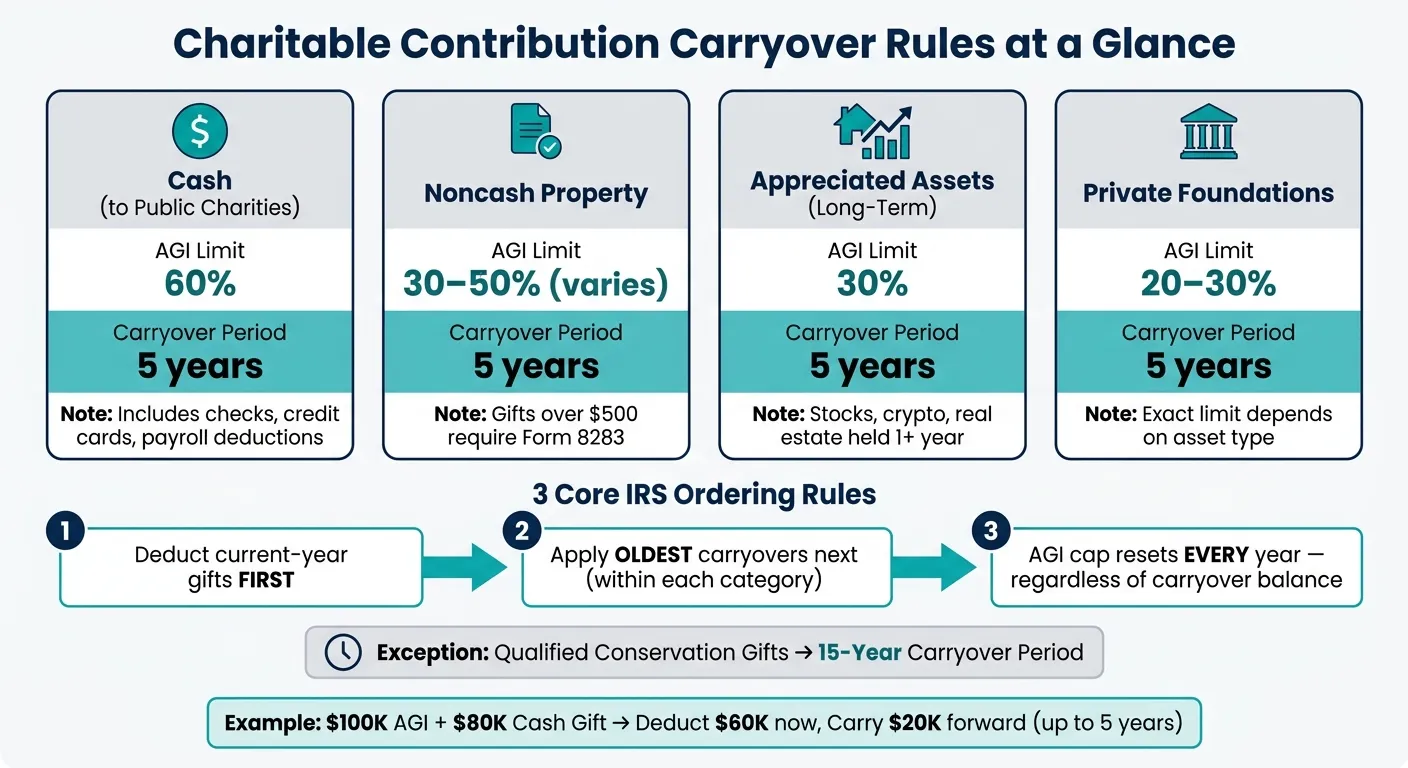
Three rules drive how carryovers work: current-year gifts go first, oldest carryovers go next, and each year’s AGI limit still applies. That’s the basic order the IRS uses, and it matters more than people think.
Deduct current-year gifts first. The IRS says you must use this year’s donations before you apply any carryover amounts from prior years [1].
Within each category, use the oldest carryover first. That order matters because unused amounts can expire after five years [1].
Each year, the AGI cap resets, no matter how much carryover remains. So even if you’re sitting on a large carryover balance, you can deduct only up to the allowed percentage of that year’s AGI [1].
The table below shows the most common limits and carryover windows:
| Contribution Type | Typical AGI Limit | Carryover Period | Key Notes |
|---|---|---|---|
| Cash (to public charities) | 60% | 5 years | Includes checks, credit cards, and payroll deductions [1]. |
| Noncash property | Usually 30% or 50%, depending on property and recipient | 5 years | Non-cash donations over $500 require Form 8283 [1]. |
| Appreciated Assets (long-term) | 30% | 5 years | Includes stocks, cryptocurrency, and real estate held more than one year [1]. |
| Private Foundations | 20%–30% | 5 years | The exact limit depends on the asset type and foundation status [1]. |
Keep Form 8283, appraisals, and receipts in your tax records for later years [1][2].
1. Spreading Out Deductions After a Large One-Time Gift
A big one-time gift can do more than lower taxes for a single year. It can also spread the deduction across several tax years.
Here’s why that matters: if your donation is more than the annual deduction limit, the extra amount doesn’t disappear right away. It carries forward. But there’s a catch - any unused amount expires after the carryover period. [1]
A simple example makes this easier to see. Say you have $100,000 in AGI and donate $80,000 in cash to a public charity. Cash gifts to public charities are generally limited to 60% of AGI, so you could deduct $60,000 in the first year and carry the remaining $20,000 into later years. [1]
That’s why timing matters so much, especially if your income goes up or down from one year to the next. Each year you claim the carryover, the deduction is figured again using that year’s AGI. [1]
You’ll also want to hang on to the original paperwork for the full carryover period, including:
- the receipt
- the acknowledgment
- the appraisal records
That later-year deduction depends on the records from the original gift. [1] [2]
To claim the remaining balance the right way each year, track it on the IRS worksheet and then report it on Schedule A. [1]
2. Using Higher-Income Years to Absorb More Carryover
If a big gift leaves you with unused deductions, a higher-income year gives you the fastest path to use more of them. The idea is simple: when your AGI goes up, the deduction cap goes up too. That gives you more room to deduct carryovers from prior years.
Here’s a plain example. If your AGI goes from $100,000 to $200,000, the 60% cash-gift cap goes from $60,000 to $120,000. That extra room can let you use much more of a prior carryover. [1]
The same logic applies to appreciated stock and other long-term property, but the cap is usually 30% of AGI. Say you made a $100,000 stock gift in a year when your AGI was $100,000. You could deduct $30,000 that year and carry over the remaining $70,000. If your AGI then jumps to $250,000 the next year, the 30% limit rises to $75,000. That means you could use the full remaining carryover in that one year. [1]
One detail matters a lot here: the original gift type still controls the cap in later years. A cash gift stays under the cash-gift limit. A gift of appreciated stock stays under the property limit. Higher income changes the dollar amount you can deduct, but not the percentage cap.
That’s why high-income years can be so useful. A large bonus, a stock option exercise, or a business sale can open up enough deduction room to use older carryovers before the five-year window runs out. Once you know which years give you more room, the next move is to use carryovers in the right order.
3. Applying the Oldest Carryovers First Under IRS Ordering Rules
After you figure out that you have room to use carryovers, the next step is simple: use them in the right sequence. Under IRS ordering rules, current-year gifts come first. After that, you apply the oldest carryovers first within each limit category.
Here’s the part that trips people up: a carryover keeps its original category. So if the donation started as a cash gift, it stays in the cash category. If it started as appreciated stock, it stays in that category. You don’t mix them together.
When carryovers stretch across multiple years or involve different gift types, use the IRS Publication 526 worksheets to figure out the right order and the unused carryover balance.[1]
A simple tracking log can save a lot of trouble later. Keep track of:
- gift year
- gift type
- limit category
- remaining carryover amount
That record helps you avoid losing older carryovers before the five-year window runs out. It also makes later-year filing and expiration tracking much easier.
4. Keeping Noncash and Appraisal Records for Future-Year Deductions
Keep the original records now so you can claim the carryover later. If you take the deduction in future years, the IRS can ask for proof then too. And the same original backup still needs to support each later-year claim. That paper trail matters even more when you’re using the carryover years after the gift was made.
So hold on to the original receipt, written acknowledgment, Form 8283, and any qualified appraisal for the full five-year carryover period. Keep any extra IRS forms that show how you figured the carryover amount as well.
Records that protect a later-year deduction:
- Under $250: Bank record, credit card statement, or charity receipt
- $250–$500: Contemporaneous written acknowledgment from the charity
- Over $500: Form 8283 filed with your return
- Over $5,000: Qualified appraisal and Form 8283, Section B
You also need to determine the value of a noncash gift and document fair market value. If the original appraisal is missing, the carryover can be disallowed.
One simple way to stay on top of this is to set up a folder for each donation year. Save the receipt, Form 8283, the appraisal report, and a running log that shows how much of the carryover you’ve already used.
Once those records are in order, the next step is reporting the carryover the right way each year.
5. Reporting Carryovers Correctly on Schedule A Each Year
Once your records are set, the filing part is pretty straightforward: recalculate the balance and carry it to Schedule A each year.
Report charitable contributions and carryovers on Schedule A (Form 1040). You can claim a carryover only for years when you itemize.
Use the IRS Publication 526 worksheets to figure out how much of the carryover you can use for that year. Then enter the allowed amount on the Schedule A line for prior-year carryovers.[1][2]
You need to recalculate the carryover every year using that year’s AGI and the original contribution category. That step matters because the amount you can use may change from year to year as your AGI changes.
If your carryover includes noncash gifts, keep Form 8283 and any required appraisal records in your tax file.[2]
Here’s a simple yearly checklist:
- Confirm the contribution category and the original AGI limit.
- Calculate the remaining carryover balance and check the expiration deadline.[1]
- Complete the Publication 526 worksheets and enter the allowed amount on Schedule A.
- Keep the return, worksheet, and carryover log with your tax file.
That last part matters more than it seems. If you save the worksheet and return with the rest of your tax records, next year starts with the right balance instead of a guessing game.
Recordkeeping, Documentation, and Helpful Tools
Carryovers can stick around for years. So your paperwork needs to stick around too.
A simple rule helps here: keep one file for each gift. Later deductions depend on the records from the year of the original donation. If those records are missing, you may lose the carryover when you finally have enough room to use it.
Here’s what the IRS expects based on the size of the gift:
| Donation Amount | Required Documentation | IRS Form |
|---|---|---|
| Under $250 | Bank record, canceled check, or charity receipt | None |
| $250–$500 | Contemporaneous written acknowledgment from the charity | None |
| Over $500 (noncash) | Written acknowledgment plus cost basis and fair market value records | Form 8283, Section A |
| Over $5,000 (single noncash item or group) | Qualified appraisal plus signed acknowledgment | Form 8283, Section B |
This part matters more than many people think. A missing or incomplete acknowledgment can cause the deduction to be denied, along with any carryover tied to it.
For noncash gifts, keep Form 8283 and the appraisal with the original gift records for the full carryover period. Think of it like keeping the “birth certificate” of the deduction. Every later-year claim traces back to that first set of documents.
It also helps to keep a simple carryover log. Track:
- Original contribution date
- Recipient organization
- Type of gift
- Original deduction amount
- Amount used each year
- Remaining balance
- Expiration year
- Any AGI changes
Digital tracking can cut filing mistakes. Deductible.me can store receipts, track valuations, and monitor carryover balances across tax years.
Example Table: Carryover Ordering and Expiration Timeline
This example follows the IRS rule: use current-year gifts first, then apply carryovers starting with the oldest one. The table below shows how that oldest-first order works, along with when each carryover runs out.
| Gift Year | Contribution Category | Excess Amount | Amount Used in Prior Years | Remaining Balance (Start of 2026) | Final Expiration Year |
|---|---|---|---|---|---|
| 2021 | Cash (60% Limit) | $12,000 | $10,000 | $2,000 | 2026 |
| 2022 | Non-Cash (50% Limit) | $5,000 | $0 | $5,000 | 2027 |
| 2023 | Appreciated Stock (30% Limit) | $8,000 | $0 | $8,000 | 2028 |
| 2025 | Cash (60% Limit) | $3,000 | $0 | $3,000 | 2030 |
A simple year-by-year log can save you a lot of trouble here. It helps you see what needs to be used first and what still has time left. Start with the oldest balance, then move to newer carryovers only after the older amount is fully used.
Take the 2021 carryover. Only $2,000 is left, and 2026 is its final year. That means the $2,000 from 2021 must be used in 2026 before any amount from the 2025 balance.
Here’s how that plays out. If a donor’s cash deduction limit in 2026 is $5,000, the first $2,000 goes to the 2021 carryover. After that, the remaining $3,000 can go to the 2025 carryover.
If AGI drops, the amount you can use may shrink fast. When that happens, newer carryovers may sit untouched while older ones take priority. Any unused balance still carries forward, but each one keeps its own deadline.
The Final Expiration Year column is the one to watch. It shows which carryover is closest to running out. If a carryover is in its last usable year, put it at the top of your Schedule A checklist. That timeline helps you decide which amount to report first on Schedule A.
Conclusion
The rule is simple: carryovers only work when you track them one year at a time. Keep tabs on the original percentage category, check your AGI each year, use older carryovers first, and complete Schedule A the right way.
Review IRS Publication 526 every filing season, and update your carryover worksheet so you know exactly what’s left, which category it falls under, and when it expires. Good records make the yearly Schedule A claim much easier. Keep receipts, acknowledgments, Form 8283, and appraisals through the final carryover year and audit window.[1]
If you donate noncash items on a regular basis, Deductible.me can help you log donations, value items with AI-powered valuations, and organize carryover records. Go back through your last few Schedule A returns, confirm each carryover balance, and note every expiration year. Then track the balance, claim what you can each year, and clear the carryover before it expires.
FAQs
What happens if I do not itemize deductions?
If you don’t itemize on Schedule A, you can’t take a tax deduction for charitable contributions.
For most taxpayers, itemizing only pays off when your total qualifying expenses are higher than the standard deduction for your filing status. That usually includes things like:
- Charitable donations
- State and local taxes
- Mortgage interest
- Qualifying medical costs
If those write-offs don’t add up to more than your standard deduction, itemizing usually doesn’t make sense.
Can I use a carryover if my income drops next year?
Yes. If your donation is more than your allowed limit for the year, the IRS will usually let you carry the extra charitable deduction forward for up to five years, even if your income drops next year.
To claim it, keep solid records. That means receipts, fair market value (FMV) support for noncash donations, and Form 8283 if your noncash donations go over $500.
How do I know when a carryover will expire?
Charitable contribution carryovers usually expire five years after the tax year when the excess donation was made.
That means good recordkeeping matters. To see when each carryover amount runs out, keep clear records of your donation history and any unused amounts from prior years. Deductible.me can help you organize your yearly donations and supporting documents.