
Charitable Giving Limits Pre- and Post-CARES Act
The CARES Act, introduced in 2020, temporarily changed how charitable donations were treated for tax purposes. Here's what you need to know:
-
Before the CARES Act:
- Only itemizers could deduct donations.
- Cash contributions were capped at 60% of AGI for individuals and 10% of taxable income for corporations.
- Noncash contributions had stricter limits based on the type of property donated.
-
After the CARES Act (2020-2021):
- Non-itemizers could deduct up to $300 for cash donations.
- Individuals could deduct cash gifts up to 100% of AGI (with an election).
- Corporate cash contribution limits increased to 25% of taxable income.
- Noncash donation rules remained unchanged.
These changes incentivized cash donations but excluded donor-advised funds, private foundations, and noncash assets. While the provisions expired after 2021, they left a short-term impact on donor behavior and tax planning strategies.
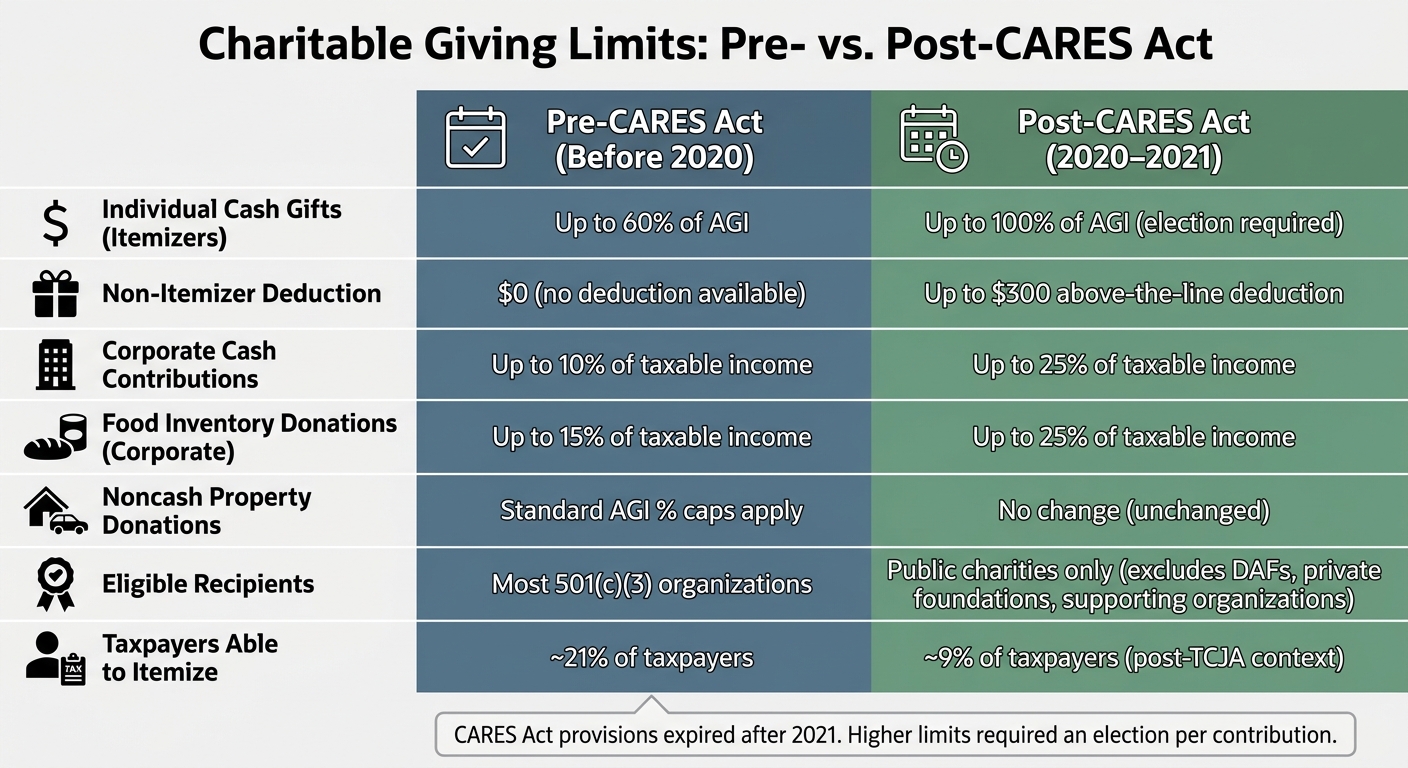
Charitable Giving Limits: Pre- vs. Post-CARES Act
IRS News - How the CARES Act changes deducting charitable contributions
sbb-itb-e723420
1. Pre-CARES Act Charitable Giving Limits
Before 2020, charitable deduction rules were primarily shaped by the Tax Cuts and Jobs Act (TCJA) of 2017. While the TCJA significantly increased the standard deduction, it also led to a drop in the number of taxpayers claiming charitable deductions - from about 21% to just 9% [6]. This change meant that many taxpayers, no longer itemizing deductions, missed out on the tax benefits of donating. Below are the specific rules and limits for individual, noncash, and corporate giving during this period.
Deduction Eligibility Rules
Only taxpayers who itemized deductions on Schedule A could deduct charitable contributions. Those who took the standard deduction had no option to claim a charitable deduction [1].
Individual Cash Gift Limits
For taxpayers who itemized, cash donations to public charities were deductible up to 60% of adjusted gross income (AGI). Donations to private nonoperating foundations had a lower limit of 30% of AGI [6][7].
Noncash Donation Limits
Noncash donations had their own set of rules:
- For property held for one year or less (ordinary income property), deductions were limited to the cost basis rather than the fair market value [3].
- For appreciated long-term capital gain property (held longer than one year), donors could generally deduct the full fair market value. However, these deductions were capped at 30% of AGI for public charities and 20% of AGI for private nonoperating foundations [6][7].
Corporate Giving Limits
Corporations faced stricter limits compared to individuals. C corporations could deduct cash contributions up to 10% of taxable income [6][10]. For food inventory donations, a separate enhanced deduction applied, capped at 15% of taxable income [6][9].
Carryforward Treatment
If contributions exceeded the allowable limits, taxpayers could carry forward the excess for up to five years, as long as they continued to itemize deductions in subsequent years.
2. Post-CARES Act Charitable Giving Limits
The CARES Act, signed into law in March 2020, brought sweeping updates to charitable giving rules - some of the most impactful changes in decades. As Matthew Rak, Esq., Partner at Leech Tishman, explained:
"The CARES Act has relaxed many long-standing tax deduction limits for charitable giving." [4]
Initially designed for the 2020 tax year, these changes were later extended through 2021 under the Consolidated Appropriations Act, 2021.
Deduction Eligibility Rules
For taxpayers who opt for the standard deduction, the CARES Act introduced an above-the-line deduction of up to $300 for qualifying cash donations to public charities. This was a notable shift, especially since about 90% of taxpayers use the standard deduction [2]. However, contributions to donor-advised funds (DAFs), private foundations, or supporting organizations were excluded from this benefit.
Individual Cash Gift Limits
For itemizers, the limit on cash contributions increased from 60% of AGI to 100% of AGI for 2020 [4][5]. Importantly, this higher limit wasn’t automatic - taxpayers needed to elect it for each qualifying contribution [2][8]. Donations of noncash property didn’t qualify for this adjustment and continued to follow the standard rules.
Corporate Giving Limits
C corporations also saw a boost, with the limit on cash contributions rising from 10% to 25% of taxable income. Additionally, the deduction cap for food inventory contributions increased from 15% to 25% [4][5]. Like individual taxpayers, corporations had to actively elect these higher limits - they weren’t applied by default.
While these changes provided greater flexibility for cash donations, noncash contributions remained subject to pre-existing valuation and deduction guidelines.
Noncash Donation Limits
The CARES Act focused exclusively on cash contributions, leaving the rules for noncash donations unchanged [5]. This meant the AGI percentage caps for noncash gifts stayed the same as they were before the legislation.
Carryforward Treatment
The CARES Act also introduced updates to carryforward rules. While the five-year carryforward provision remained intact, Section 2205 clarified that cash contributions elected at the 100% AGI limit wouldn’t count against prior-year carryover limits [8]. This allowed taxpayers to maximize deductions for new cash contributions while still fully deducting older carryovers in the same year - potentially reducing taxable income to zero. As Marcy Lantz, CPA, highlighted in The Tax Adviser:
"Qualified contributions are disregarded for purposes of the limitation in Sec. 170(b), which applies to current-year percentage limitations, and the limitation in Sec. 170(d), which applies to carryovers of excess contributions from prior years." [8]
Keeping track of these rules and elections can be complex. Tools like Deductible.me simplify the process by offering IRS-compliant reporting and Form 8283-ready documentation, ensuring your records are organized and audit-ready.
| Contribution Type | Pre-CARES Act | Post-CARES Act (2020–2021) |
|---|---|---|
| Individual Cash (Itemized) | 60% of AGI | 100% of AGI |
| Non-itemized Individual Cash | $0 | Up to $300 above-the-line |
| Corporate Cash | 10% of taxable income | 25% of taxable income |
| Food Inventory | 15% of taxable income | 25% of taxable income |
| Noncash Property | Unchanged | No change |
These updates reflect a clear focus on encouraging cash contributions, offering both immediate and strategic tax planning opportunities for individuals and corporations alike.
Pros and Cons
The CARES Act rules bring both opportunities and challenges, depending on the donor's circumstances and goals. Here's a closer look at how these changes play out in practice.
Advantage for High-Income Donors: High-income individuals gained a significant benefit under the post-CARES Act rules. These changes allow them to potentially eliminate their federal income tax liability in a single year by making large cash donations. As Thompson Coburn LLP explained:
"A taxpayer can actually eliminate any taxable income tax this year by making sufficiently large cash charitable contributions." [11]
Corporate Benefits: Corporations also saw a timely boost. The previous 10% limit on charitable deductions could have restricted businesses during an economic downturn. Matthew Rak, Partner at Leech Tishman, pointed out:
"With many businesses expected to incur reduced taxable income for 2020, the former 10% limit would have hampered the ability to take a current deduction for charitable gifting." [4]
Relief for Non-Itemizers: The introduction of the $300 above-the-line deduction offered a modest benefit to nearly 90% of non-itemizers, who previously couldn't claim charitable deductions. However, a study found that this change would likely result in only about $100 million in new charitable giving, as most donors already contribute more than $300 annually. [6]
Post-CARES Act Limitations: Despite the benefits, there are notable restrictions. The increased limits apply only to cash contributions - not to appreciated assets like securities or real estate. Donating appreciated stock, for example, allows donors to avoid capital gains taxes, making this exclusion a drawback for some. Furthermore, the higher limits exclude contributions to donor-advised funds (DAFs), supporting organizations, and private foundations. This limits options for those who prefer structured, long-term giving strategies. These restrictions highlight the trade-offs donors must consider when planning their contributions.
| Factor | Pre-CARES Act | Post-CARES Act (2020–2021) |
|---|---|---|
| Individual cash limit | 60% of AGI | 100% of AGI |
| Non-itemizer benefit | None | Up to $300 above-the-line |
| Corporate cash limit | 10% of taxable income | 25% of taxable income |
| Eligible asset types | Cash and noncash assets | Increased limits for cash only |
| Eligible recipients | Most 501(c)(3) organizations | Public charities only (excludes DAFs/private foundations) |
| Complexity | Straightforward | Requires election per contribution |
The table summarizes the changes, while practical challenges add another layer of complexity.
Practical Considerations: One key hurdle involves the election requirement for each contribution under the higher limits, adding an extra step for taxpayers to navigate. This can complicate the filing process, especially for those making multiple donations.
Conclusion
The CARES Act brought significant changes to charitable giving rules for both individuals and corporations. It temporarily increased cash contribution limits and introduced a small above-the-line deduction for non-itemizers - something entirely new at the time. By comparing the rules before and after the CARES Act, it becomes clear how these changes influenced donor behavior, highlighting the importance of both the type of asset donated and the organization receiving the gift in determining potential tax benefits. Although these provisions expired after 2021, they left a lasting impact on how donors think about tax-efficient giving.
For those who took advantage of these temporary benefits, keeping detailed and accurate records was - and remains - key. Tools like Deductible.me make it easier to track donations and ensure compliance with IRS reporting standards. By using such tools, donors can optimize their deductions and make sure every contribution aligns with their tax planning goals in an ever-changing landscape.
FAQs
How do I know if my donation qualifies as a “cash contribution” for these limits?
To count as a cash contribution, your donation must be made using cash, a check, or a monetary transfer directed to a qualified public charity. These organizations can include religious, charitable, educational, scientific, or literary groups that fall under section 170(b)(1)(A) of the Internal Revenue Code. However, donations made to donor-advised funds, private foundations, or supporting organizations are not eligible. Tools like Deductible.me can assist in verifying that your contributions meet these criteria.
What does it mean to “elect” the 100% of AGI limit for a cash gift?
Electing the 100% of adjusted gross income (AGI) limit allows you to increase the deduction cap for eligible cash donations to public charities to match your entire AGI. You make this choice for each contribution when completing Form 1040 or 1040-SR. However, keep in mind that this limit is reduced dollar-for-dollar by other charitable deductions, giving donors the opportunity to substantially lower their taxable income.
How do carryforwards work if I donated more than the limit in prior years?
If your donations go beyond the annual percentage limits set for your Adjusted Gross Income (AGI), don’t worry - you can carry the excess forward for up to five years. Contributions made in the current year are applied first, and any carryforward amounts are deducted afterward, still following the usual percentage limits. Tools like Deductible.me can simplify tracking these balances, helping you make the most of your tax benefits over time.