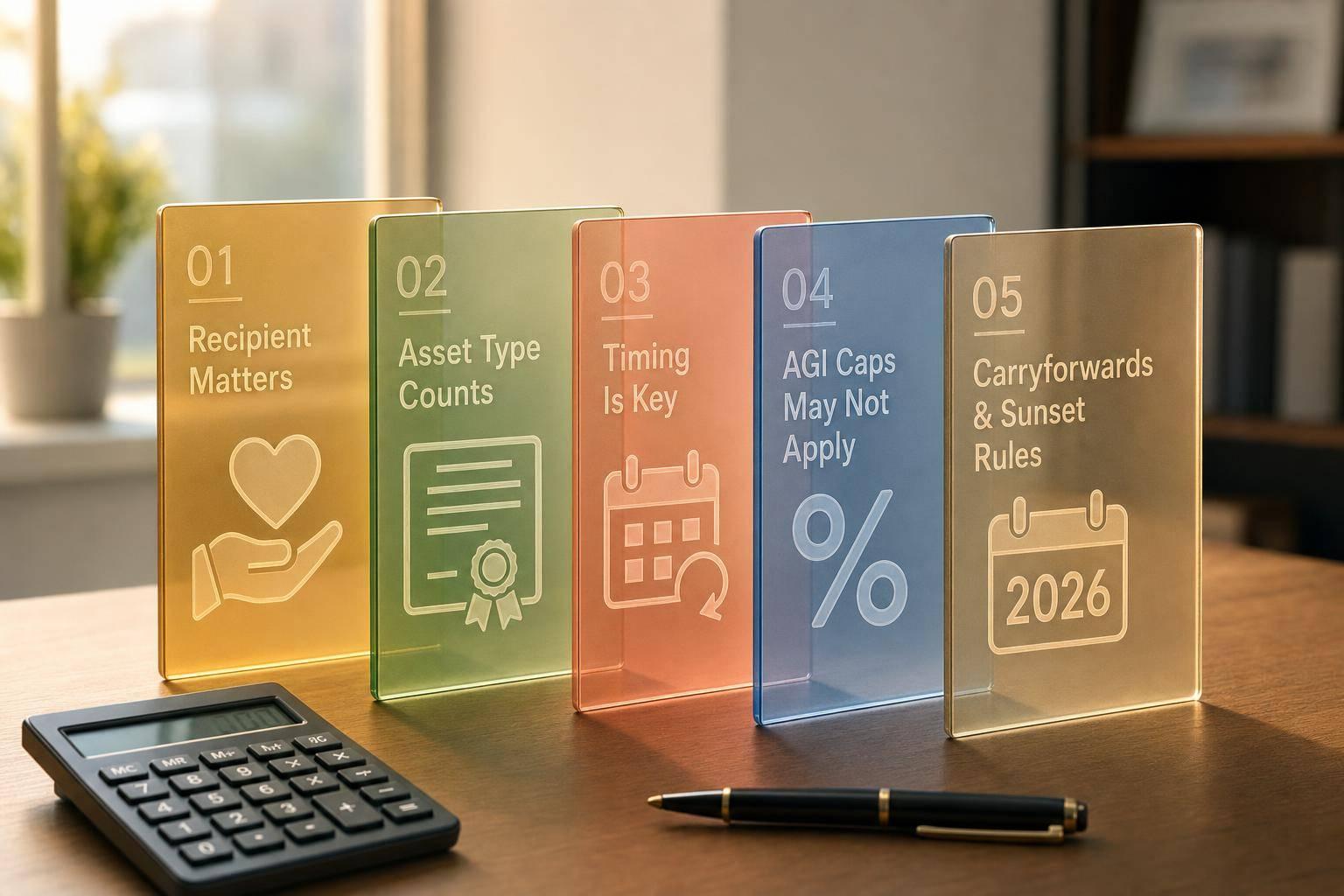
5 Exceptions to Charitable Contribution Limits Explained
Your charitable deduction is not unlimited - and in 2026, the cap can change from 20% to 100% of AGI depending on the gift. If I were skimming this topic, I’d focus on five rules: 60% limits for cash to public charities, special elections for appreciated property, 5-year carryforwards, 15-year conservation carryforwards, and lower limits for private foundations.
Here’s the short version:
- Cash to public charities: usually deductible up to 60% of AGI
- Appreciated long-term property to public charities: usually 30% of AGI at FMV
- Basis election for that property: can move the limit to 50% of AGI
- Excess deductions: usually carry forward for 5 years
- Qualified conservation contributions: up to 50% of AGI, or 100% for some farmers and ranchers, with a 15-year carryforward
- Private foundations and similar groups: often lower caps, such as 30% for cash and 20% for long-term gain property
- 2026 extra rules: itemizers can deduct only the part above 0.5% of AGI, and non-itemizers may deduct up to $1,000 ($2,000 if married filing jointly) for cash gifts to public charities
This means who gets the gift, what you give, and when you claim it can change the result by a lot. I’d also watch the paperwork: gifts of $250+ need a written acknowledgment, and noncash gifts over $5,000 often need an appraisal and Form 8283.
Quick Comparison
| Rule | Main limit | Extra rule |
|---|---|---|
| Cash to public charity | 60% of AGI | 5-year carryforward if unused |
| Appreciated property to public charity | 30% of AGI | Can elect basis and use 50% limit |
| Cash to private foundation | 30% of AGI | No public-charity cash limit |
| Long-term gain property to private foundation | 20% of AGI | Often basis, not FMV |
| Conservation contribution | 50% of AGI | 100% for some farmers/ranchers; 15-year carryforward |
If I had to sum up the article in one line, it would be this: the “limit” on charitable deductions is a set of different rules, not one single cap.
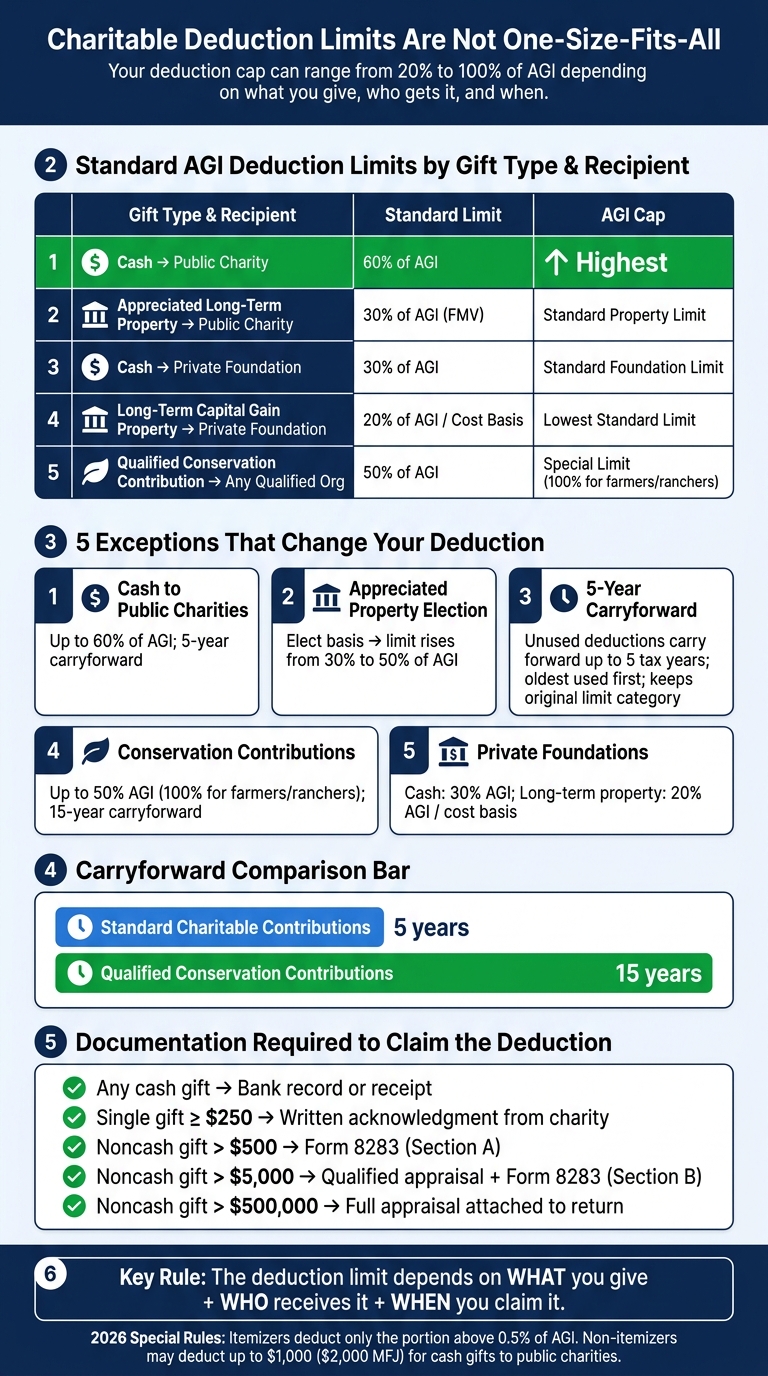
Charitable Contribution Deduction Limits by Gift Type & Recipient (2026)
Don't Donate Another Dollar Without Watching This
sbb-itb-e723420
Standard Charitable Contribution Limits: A Quick Refresher
The IRS usually limits charitable deductions to a share of your AGI, also called your contribution base. For 2026, the limits look like this.[1][6]
| Donation Type | Recipient | AGI Limit |
|---|---|---|
| Cash | Public charity | 60% |
| Appreciated long-term capital gain property | Public charity | 30% |
| Cash or ordinary property | Private foundation | 30% |
| Appreciated long-term capital gain property | Private foundation | 20% |
There are also two 2026 rules that can change how much you’re able to deduct. First, if you itemize, you can deduct only the part of your contributions that goes above 0.5% of AGI.[1][8] Second, under §170(p), non-itemizers can claim an above-the-line deduction for cash gifts to public charities of up to $1,000, or $2,000 for married couples filing jointly.[1][8]
Those are the ground rules. The five exceptions below adjust them based on the kind of gift and who receives it. Exception 1 begins with cash gifts to public charities, since those get the highest standard cap.
1. Higher AGI Limits for Cash Gifts to Public Charities
Cash gifts to public charities are subject to the 60% AGI limit. In this context, "cash" includes checks, credit and debit card payments, bank transfers, and payment apps [13][1]
Qualifying organizations include churches, schools, nonprofit hospitals, medical research organizations, and government entities. To confirm that an organization is a public charity, use the IRS Tax Exempt Organization Search tool [5][6]
Example: With $200,000 of AGI, a taxpayer can deduct up to $120,000 in cash gifts to public charities in 2026.
If your cash gifts to public charities go over the 60% cap, the extra amount carries forward for up to five tax years. The IRS uses older carryovers first, and current-year gifts are usually deducted before any carryforward amounts [5][12][1]
Timing matters here. A check mailed on December 31 counts for that tax year. The same goes for a credit card charge made that day. For any single gift of $250 or more, keep a contemporaneous written acknowledgment from the charity [5][6][12][1][7]
Appreciated property is subject to a different limit.
2. Special Elections for Appreciated Capital Gain Property
Cash gifts are pretty simple. Appreciated long-term capital gain property gives you a choice.
If you donate property like stocks, bonds, or real estate that you've held for more than one year, you can usually deduct its fair market value. But that deduction is subject to a 30% of AGI limit when the gift goes to a public charity[2][15].
You can also choose to deduct the property's adjusted basis instead of its fair market value. If you make that election, the AGI limit goes up from 30% to 50%[2][15].
That option tends to make more sense when the asset hasn't gone up much in value. If the asset has appreciated a lot, giving up the fair market value deduction can cost you too much on the write-off[2][15].
One catch: once you file this election, it applies to all capital gain property donated to public charities during that tax year[2][15]. It isn't a pick-and-choose move. You must use it for all capital gain property donated to public charities that year.
If your deduction still goes over the limit, you can carry the extra amount forward for up to five years.
3. Five-Year Carryforward for Excess Charitable Contributions
If your charitable deduction gets trimmed because of AGI limits, the unused part doesn’t just vanish. You can carry it forward for up to five tax years after the year of the original gift[2][16]. Think of it as a backup window for deductions you couldn’t use right away.
Here’s the part that trips people up: order matters. Use current-year contributions first. After that, use carryforwards, starting with the oldest ones[2][16].
That rule gets even more important because carryforwards keep their original limit category. So if you donated appreciated stock and that gift fell under the 30% AGI limit, the carryforward stays in that 30% bucket in later years. It does not switch to the 60% limit that can apply to cash gifts[2][16]. This can make a big difference when an older carryforward is getting close to its expiration date.
Big new donations can also create a squeeze. A large current-year gift may use up your deduction room and leave older carryforwards stranded before the five-year period runs out. In the final year of a carryforward, it often helps to keep new gifts lower so the older deduction has room to be used.
One more catch: the five-year clock keeps running even if you claim the standard deduction in those years[2][16]. And if the gift is a conservation contribution, special rules apply.
4. Qualified Conservation Contribution Rules
Qualified conservation contributions are a separate exception under Section 170. They come with higher deduction limits and a longer carryforward period.
A qualified conservation contribution is a gift of a qualifying real estate interest - like a perpetual conservation easement - made to a qualified organization exclusively for conservation purposes [3][18]. Those purposes can include protecting farmland, preserving a natural habitat, or preserving open space or historically important land areas and certified historic structures [18]. The organization that receives the gift must be able to enforce the easement [18].
For most conservation gifts, the deduction is capped at 50% of AGI. But qualifying farmers and ranchers can deduct up to 100% of AGI if the land remains in agricultural or livestock use [1].
There’s also more room to use the deduction over time. Conservation deductions can carry forward for up to 15 years [1]. That matters when the deduction is large and can’t be used all at once.
If the contribution is worth more than $5,000, you’ll need a qualified appraisal. It must be completed no earlier than 60 days before the contribution date and no later than the tax return due date. You also need signed Section B of Form 8283 [4][19].
One more thing: the IRS pays close attention to these deals, especially syndicated conservation easements.
The rules can be generous, but the deduction still turns on two basics: who receives the gift and what type of asset is donated.
5. Lower Limits for Private Foundations and Non-50% Organizations
Once you move past the higher limits for public charities, the ceiling drops for private foundations and other non-50% organizations. That includes groups like veterans' organizations, fraternal societies, and nonprofit cemeteries. On large donations, that difference can hit hard.
For cash and ordinary income property, the deduction limit is 30% of AGI. For long-term capital gain property, the limit drops to 20% of AGI [1][6].
The valuation rule is also tighter. If you give long-term capital gain property to a public charity, you can usually deduct its fair market value (FMV). But if you give that same type of property to a private foundation, the deduction is usually limited to your cost basis. There is one key exception: qualified appreciated stock - publicly traded shares held for more than one year - can still get fair market value treatment, even if you donate it to a private foundation [1].
Here’s the side-by-side view:
| Gift Type | Public Charity | Private Foundation |
|---|---|---|
| Cash | 60% of AGI | 30% of AGI |
| Long-term Capital Gain Property | 30% of AGI / FMV | 20% of AGI / Cost Basis |
| Qualified appreciated stock | 30% of AGI / FMV | 20% of AGI / FMV |
The contrast stands out even more when you put cash gifts next to property gifts. The next comparison shows how those limits change based on both the gift type and the recipient.
Cash Gifts to Public Charities vs. Private Foundations
Cash gifts to public charities come with a higher deduction cap than cash gifts to private foundations.
Here’s the key split: cash gifts to public charities are deductible up to 60% of AGI, while cash gifts to private foundations are capped at 30% of AGI [1][6].
That gap can matter a lot, especially for people making large year-end donations. A gift to a church, school, or hospital usually gets more favorable tax treatment than the same cash gift made to a family foundation.
In 2026, non-itemizers also get a small break. They can deduct up to $1,000, or $2,000 for joint filers, for cash gifts made directly to public charities [7][9]. That rule does not apply to gifts made to private foundations or donor-advised funds [1][11].
| Feature | Cash to Public Charity | Cash to Private Foundation |
|---|---|---|
| AGI Deduction Limit | 60% of AGI [1][6] | 30% of AGI [1][6] |
| Common Examples | Churches, schools, hospitals | Family foundations, private grant-making foundations |
| 2026 Non-Itemizer Deduction | Eligible (up to $1,000/$2,000) [7][9] | Not eligible [1][11] |
Cash gifts are pretty simple. Appreciated property is where things start to shift, because both the deduction limit and the value you can claim may change.
Property Donation Limits and Elections by Organization Type
Property gifts make things a bit less straightforward. The deduction limit depends on both the asset you give and the type of organization that gets it[1][6].
The big dividing line is simple: does the recipient qualify for 50% limit treatment?
| Gift Type | Recipient Organization | AGI Limit | Basis-reduction election? |
|---|---|---|---|
| Appreciated Securities (FMV) | Public Charity / Supporting Organization | 30% | Yes (increases limit to 50%) |
| Appreciated Securities (FMV) | Private Foundation (publicly traded stock only) | 20% | No |
| Other Capital Gain Property | Public Charity / Supporting Organization | 30% | Yes (increases limit to 50%) |
| Other Capital Gain Property | Private Foundation / Non-50% Organization | 20% (basis only) | No |
The basis-reduction election is available only for gifts to 50% limit organizations, which includes public charities and supporting organizations[15][4]. If you choose that election, you don’t get to apply it asset by asset. It applies to all capital gain property you donate during that tax year[15].
Private foundations are a different story. They don’t allow the basis-reduction election. In most cases, capital gain property gifts to a private foundation are limited to basis, with publicly traded stock standing out as the main exception[1][15].
Non-50% organizations, such as veterans' groups and fraternal societies, usually fall under the same 20% property limits, and the basis-reduction election is not available there either[10][6].
If your property gift goes over the annual limit, the unused amount doesn’t just vanish. That’s where carryforward rules come in - they decide when you can claim the rest of the deduction.
How the Five-Year Carryforward Works
If a gift goes over the AGI cap, you usually don't lose the extra deduction. Instead, the unused amount carries forward for up to five tax years.
Here's the key idea: current-year gifts use that year's AGI limit first. If there's any deduction room left after that, you can use carryforwards. And when you have more than one carryforward, the IRS uses the oldest amounts first. That rule can matter a lot when gifts from different years are all competing for the same space on your return.
A carryforward also keeps the same limit category as the original gift. So a 30% carryforward stays a 30% carryforward later on. It does not turn into a 60% cash deduction in a future year. This tends to matter most when someone has both cash gifts and property gifts in their tax history.
Two limits matter here:
- The five-year clock keeps running even if you take the standard deduction in those years.
- Carryforwards do not pass to heirs or to an estate at death, so donors with large unused balances may want to use them sooner rather than later [2][16].
Deductible.me can help track receipts and unused carryforwards so older amounts don't expire unused.
Conservation gifts follow different limits and a longer carryforward period.
Key Rules for Conservation Gifts
Conservation gifts are the main exception to the usual 5-year carryforward rule. They get a higher AGI limit and a longer carryforward period than standard charitable contributions.
| Feature | Qualified Conservation Contribution |
|---|---|
| AGI Limit (Individuals) | 50% standard; 100% for qualified farmers and ranchers [1][3] |
| Carryforward Duration | 15 years [1][2] |
| Valuation Method | Value equals the land's FMV before the easement minus its FMV after the restriction [20] |
| Appraisal Threshold | Qualified appraisal required for gifts over $5,000 [3][4] |
| 2026 AGI Floor | 0.5% of AGI (itemizers) [9] |
That longer window can make a big difference when the deduction is larger than what you can use under one year's AGI limit. If part of the deduction doesn't fit this year, you may still have more time to use it later.
Valuation is one of the biggest parts of a conservation gift. The IRS looks closely at conservation valuations, and if the value is overstated, the cost can be steep. A claimed value that is 200% or more of the correct amount can trigger a 40% gross valuation misstatement penalty [17].
For conservation easements, the value is based on a before-and-after test: the land's fair market value before the easement, minus its fair market value after the restriction [20]. That's why a qualified appraiser matters. The numbers need to be well supported, and the before-and-after values should be documented with care.
And because these deductions rise or fall on proof, recordkeeping matters just as much as the gift itself.
Documentation Tips for Claiming These Exceptions
These exceptions only hold up if you can prove them. Good records make or break the deduction.
For cash gifts, keep a bank record or a receipt. If a single gift is $250 or more, you need a contemporaneous written acknowledgment before you file. The proof you need changes based on the gift amount and whether the gift was cash or noncash.
| Contribution Type | Documentation Required | IRS Form Needed |
|---|---|---|
| Any cash amount | Bank record or receipt with name, date, and amount | Schedule A (if itemizing) |
| Single gift ≥ $250 | Contemporaneous Written Acknowledgment (CWA) | Schedule A |
| Non-cash > $500 | CWA + records of cost basis and FMV | Form 8283, Section A |
| Non-cash > $5,000 | Qualified appraisal + CWA | Form 8283, Section B |
| Non-cash > $500,000 | Qualified appraisal + CWA, full appraisal attached to return | Form 8283, Section B |
Noncash gifts come with tighter proof rules. Once the value goes over $500, file Form 8283. If the gift is worth more than $5,000, attach a qualified appraisal and complete Section B. The charity should not assign a value to the gift - valuation is the donor's responsibility [21].
Carryforwards need close tracking too. Keep each one tied to its tax year and deduction category, so older amounts - the ones nearest the five-year limit and still in their original deduction category - get used first before they expire [1][22].
Deductible.me can help track receipts, valuations, Form 8283 data, and carryforwards.
A simple filing system helps a lot here. Sort records by year, gift type, and deduction category so each claim is easy to back up if the IRS asks for proof.
Conclusion
Charitable contribution limits depend on what you give, who gets it, and when you give it. The five exceptions covered here - higher cash limits, property elections, carryforwards, conservation rules, and lower limits for some recipients - can change both your deduction for the current tax year and any amount you carry into later years.
To get the best tax result, line up the gift type, recipient, value, and timing. When those pieces fit together, the deduction often works out better.
If you have carryforwards from 2025, pay close attention here: there are still conflicting interpretations about whether the new 0.5% floor applies to those amounts [14]. Deductible.me can help you keep track of receipts, valuations, and carryforwards.
FAQs
How do I know if a charity is public or private?
Use the IRS Tax Exempt Organization Search (TEOS) database to check whether an organization is a public charity or a private foundation.
You can also look at an organization’s Form 990-PF filings, which are public for private foundations. Deductible.me can help you track charity details and keep your records organized.
When should I choose basis instead of fair market value?
Use basis instead of fair market value in four cases:
- Property that would produce ordinary income or short-term capital gain if sold
- Tangible personal property used for a purpose unrelated to the charity’s mission
- Capital gain property given to a private non-operating foundation
- When you elect the basis-only deduction limit
Need help sorting that out? Deductible.me can help with valuation and IRS-compliant reporting.
What happens if my carryforward expires?
If you don’t use your charitable contribution carryforward within the five-year limit, that deduction is gone for good.
And here’s the part people often miss: the five-year clock keeps ticking whether you itemize deductions or take the standard deduction in a given year.
Deductible.me can help you keep tabs on those carryforward deadlines and stay on top of your annual giving goals.