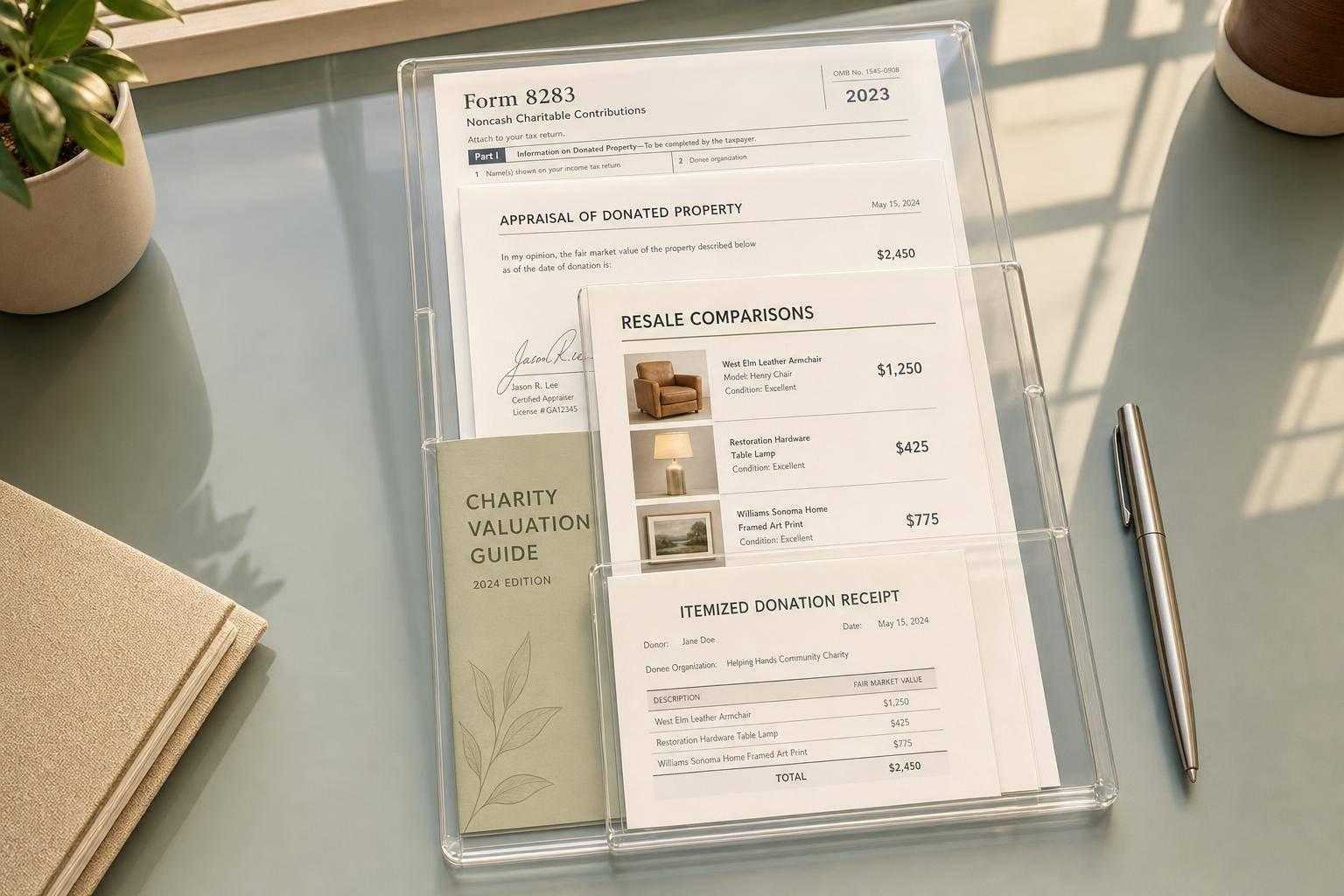
Best Sources for Donation Value Evidence
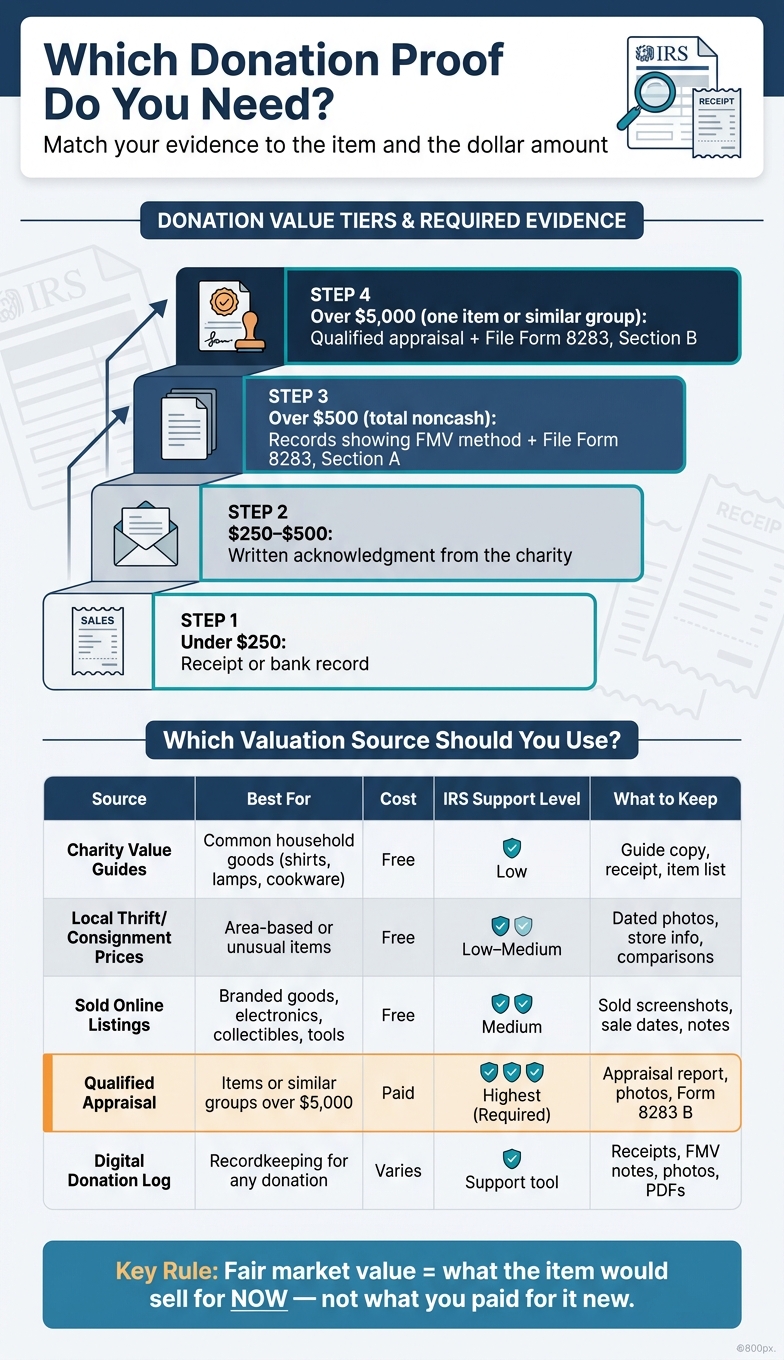
If I want to defend a noncash donation deduction, I match my proof to the item and the dollar amount. For basic clothes and home goods, I use a charity value guide. For branded or model-specific items, I use sold resale comps. For donations above $5,000, I need a qualified appraisal and Form 8283, Section B.
Here’s the short version:
- Under $250: I keep a receipt or bank record.
- $250 to $500: I keep a written acknowledgment from the charity.
- Over $500 total in noncash donations: I keep records showing how I set the fair market value and file Form 8283, Section A.
- Over $5,000 for one item or a group of similar items: I get a qualified appraisal and file Form 8283, Section B.
- For clothing and household goods: the IRS usually wants items in good used condition or better.
- The key rule: fair market value means what the item would sell for now - not what I paid for it new.
What I use depends on the donation:
- Charity guides: best for everyday goods like shirts, cookware, lamps, and basic furniture
- Local thrift or consignment prices: best when local demand affects price
- Sold online listings: best for electronics, tools, branded clothing, collectibles, and model-specific goods
- Appraisals: best when the item is high-dollar or hard to price with comps
- Digital logs: best for keeping receipts, photos, screenshots, and forms in one place
Donation Proof Requirements by Dollar Amount & Item Type
IRS Form 8283 walkthrough (Noncash Charitable Contributions)
sbb-itb-e723420
Quick Comparison
| Source | Best for | Cost | IRS support level | What I keep |
|---|---|---|---|---|
| Charity value guides | Common household goods | Free | Low | Guide copy, receipt, item list |
| Local thrift/consignment prices | Area-based pricing | Free | Low to medium | Dated photos, store info, comparisons |
| Sold online listings | Branded and model-specific items | Free | Medium | Sold screenshots, sale dates, notes |
| Qualified appraisal | Items or similar groups over $5,000 | Paid | Highest | Appraisal report, photos, Form 8283 |
| Digital donation log | Recordkeeping for any donation | Varies | Support tool | Receipts, FMV notes, photos, PDFs |
About 1 in 3 U.S. taxpayers take the standard deduction in a way that makes itemizing less common than it once was, so when I do claim noncash donations, my records need to be tight. The simplest rule in this guide is also the one that matters most: use the lightest proof that still fits the item, the condition, and the amount claimed.
Charity Value Guides and Thrift Store Pricing
For everyday donations, charity value guides are a fast way to get started. They can support your fair market value estimate, but they shouldn't replace your own records. Two of the most-used guides come from The Salvation Army and Goodwill. Both give low-to-high FMV ranges for common household items.[5][2]
Goodwill and The Salvation Army Value Ranges for Common Household Items
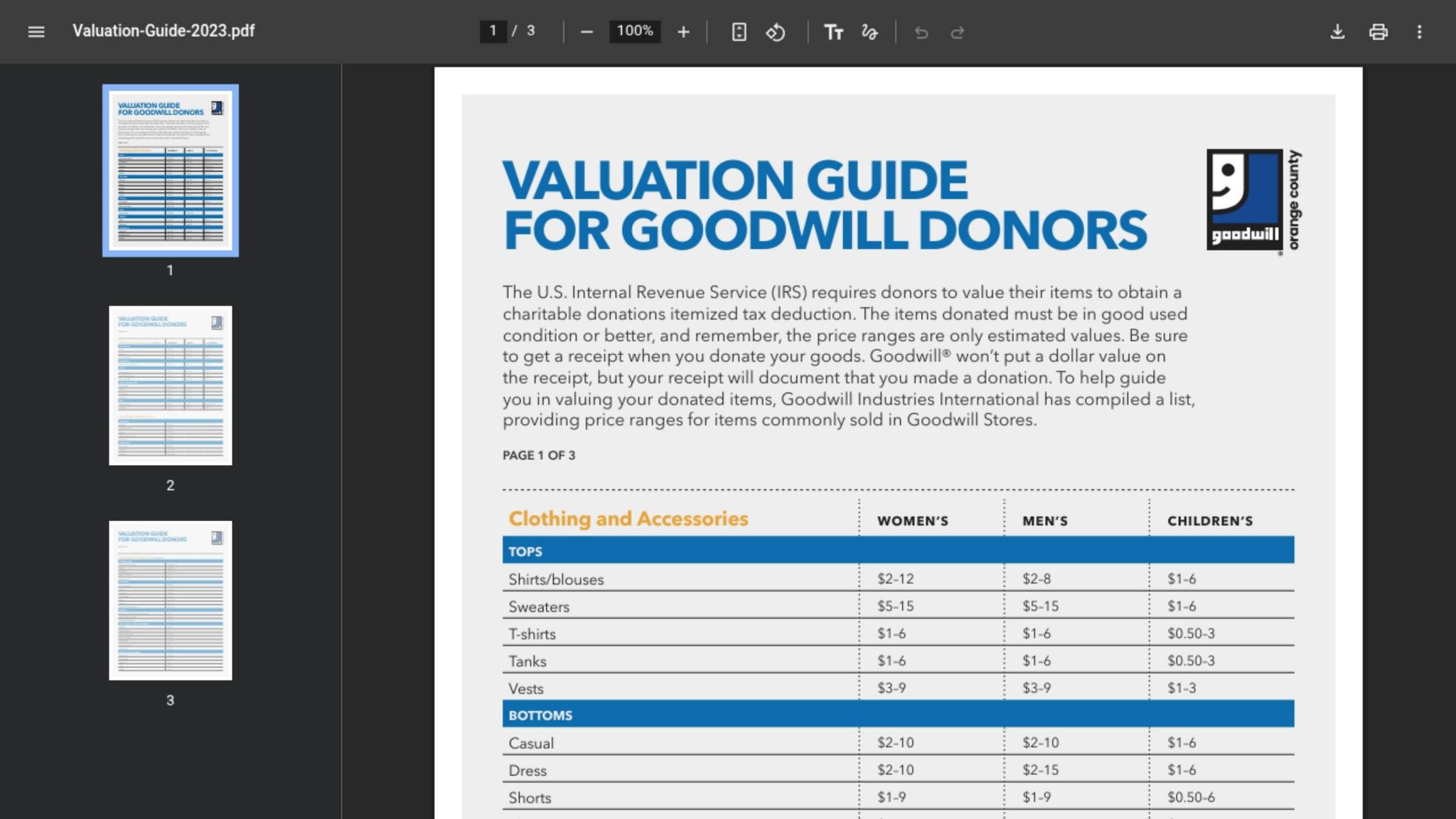
These guides list a range, not a fixed number. That matters. A worn men's shirt and a like-new one don't land in the same spot, even if they're in the same category. Save the version of the guide you used, because the ranges can change from year to year.[2][3]
Here are typical FMV ranges for common donated items:
| Item | Low | High | Typical |
|---|---|---|---|
| Men's Shirt | $3.00 | $12.00 | $5.00 |
| Women's Blouse | $3.00 | $12.00 | $5.00 |
| Jeans / Pants | $4.00 | $20.00 | $8.00 |
| Winter Coat | $10.00 | $60.00 | $25.00 |
| Shoes (pair) | $3.00 | $30.00 | $10.00 |
| Sofa / Couch | $40.00 | $400.00 | $100–$120 |
| Dresser | $25.00 | $200.00 | $70.00 |
| Lamp | $5.00 | $78.00 | $15.00 |
| Microwave | $10.00 | $50.00 | $20.00 |
| Cookware (each) | $2.00 | $20.00 | $6.00 |
| Toys (each) | $2.00 | $30.00 | $8.00 |
Some ranges are pretty wide. A sofa at $40.00 to $400.00 is a good example. In cases like that, you need a clear reason for where your item fits in the range. Condition, brand, age, and local demand all matter. If you're stuck, the Typical amount is often a solid middle-ground choice.[2][3]
Local Thrift and Consignment Prices as Current Market Proof
When a national guide feels too broad, local pricing can help narrow things down.
Local thrift and consignment prices can work as current market proof, especially for unusual items or goods that sell for more in your area. The key is documentation. Save dated photos, note the store name, and record the condition of the item you're using for comparison. That gives you something concrete to point to if your value is ever questioned.[6]
If shelf prices at local stores still don't make the value clear, sold online listings are the next step up in proof.[6]
Charity Guides vs. Local Thrift Pricing: A Side-by-Side Look
| Feature | Charity Value Guides | Local Thrift/Consignment Pricing |
|---|---|---|
| Item Coverage | Broad; covers standard categories (clothing, basic furniture) | Specific; reflects unique or high-demand local items |
| Ease of Use | High; pre-calculated ranges available online | Moderate; requires visiting stores or checking local tags |
| Records needed | Low; save a copy of the guide | High; requires dated photos, store names, and item comparisons |
| Specificity | General; uses national averages | High; reflects actual local market FMV |
| Best Use Case | Common goods - T-shirts, basic chairs, small toys | Items where local demand drives prices above national averages |
Use local pricing when a guide range is too broad for the item.
Online Resale Data and Comparable Sales
When charity guides and thrift tags don't give you a clear number, sold online listings are the next move. They're especially useful for model-specific items like branded clothing, electronics, tools, collectibles, and furniture. Why? Because a certain brand or model can sell for more than a flat charity guide suggests. The key is simple: use sold prices, not asking prices.
How to Use Sold Listings from Resale Marketplaces
On marketplaces like eBay, Poshmark, Mercari, Chairish, and Reverb, check sold listings when you can. Try to match the item as closely as possible by brand, model, size, age, and condition.
When you find a close match, save a screenshot that clearly shows the final sale price in U.S. dollars and the sale date. Then add a short note saying why it's a fair comp. For example:
"Same brand, same model, good condition, sold within 60 days."
That short note matters. It turns a plain screenshot into support for your records. Keep the screenshot, sale date, and comparison note together.
For bulky or regional items, local sold comps are often a better fit.
When Local Marketplace and Used-Dealer Sales Are More Useful
Use local sold comps for bulky items, seasonal goods, and anything where shipping would skew the price. A treadmill sold on OfferUp in your city tells you more about what a local buyer would pay than a national listing padded by shipping.
A good rule is to use at least three sold comps and record the median or a conservative average. Having more than one local comp makes your file easier to support if anyone takes a closer look.
Donation Guides vs. Resale Comparables: A Side-by-Side Look
| Feature | Charity Guides | Sold Online Listings | Local Resale Pricing |
|---|---|---|---|
| Price Volatility | Low (Fixed annual ranges) | High (Fluctuates by brand/demand) | Medium |
| Documentation Required | Itemized list and dated receipt | Screenshots of sold price and date | Multiple local listings and averages |
| Ideal Item Types | Basic clothing, linens, kitchenware | Branded goods, electronics, collectibles, tools | Bulky furniture, strollers, exercise equipment |
Use resale comps when an item has a brand or model that a charity guide can't price well. This extra paperwork becomes even more useful once total non-cash donations go over $500 in a year, when IRS Form 8283 comes into play [1][2]. If comparable sales still don't narrow down the value, a qualified appraisal is the stronger record.
Qualified Appraisals and Expert Opinions for High-Value Donations
For routine donations, guides usually do the job. For mid-range items, resale comps often work well. But once those comps stop giving you a value you can defend, it's time to move to a qualified appraisal for items or groups worth more than $5,000.
Expert opinions can help back up a number. Still, at this level, they do not meet IRS rules on their own.
When a Qualified Appraisal Is the Right Choice
A qualified appraisal is required for any single non-cash item, or similar group of items, valued at more than $5,000 [1][2]. This often comes up with fine art, jewelry, antiques, coin or stamp collections, and collector vehicles.
And here's the part people sometimes miss: the rule can apply to groups of similar items too. So if you donate a collection of books, coins, or stamps, the full group can cross the $5,000 line even when no single piece does [1][2].
For these donations, you'll need to complete Form 8283, Section B and have the appraiser sign it [1][2]. The IRS wants a formal valuation from an independent professional who has the right credentials for that type of property. In most cases, the appraisal must be completed no earlier than 60 days before the donation date [1].
What to Keep from an Appraisal Report
Once the appraisal is done, keep the report, signature, and photos together. Think of it as one file you can pull up later if anyone asks questions.
- Full appraisal report with the item description, condition, valuation method, and date
- Appraiser credentials showing IRS-qualified status
- Signed Form 8283, Section B
- Photos of the item taken near the donation date [2]
Store all of this with the rest of your donation records.
Informal Evidence vs. Qualified Appraisal: A Side-by-Side Look
| Feature | Thrift/Charity Guides | Resale Comps | Qualified Appraisal |
|---|---|---|---|
| Typical Cost | Free | Free | Professional fee |
| IRS Weight | Low | Moderate | Highest (required over $5,000) |
| Item Complexity | Clothing, basic furniture | Electronics, designer goods | Art, jewelry, antiques, collections |
| Audit Protection | Basic | Moderate | Maximum |
| Records Needed | Itemized list + receipt | Screenshots of sold listings | Full report + appraiser credentials + Form 8283, Section B |
Digital Donation Logs That Keep All Evidence in One Place
A digital donation log keeps receipts, resale screenshots, appraisal PDFs, and photos in one searchable place. It doesn’t set value. It keeps the proof behind that value in order.
This matters most if you donate often or make frequent donation runs. Once donations start piling up, loose screenshots and paper receipts can turn into a mess fast.
What to Store in a Donation Log
Each entry should include charity name, donation date, item description, quantity, condition, and FMV. Add photos to show the items existed and what shape they were in. Then keep the receipt along with the valuation note or screenshot that supports the number.
A running log also helps you see when your total moves past IRS reporting thresholds.
At its core, a good log does one job well: it keeps all your proof in one place.
How Deductible.me Helps Organize Valuation Evidence
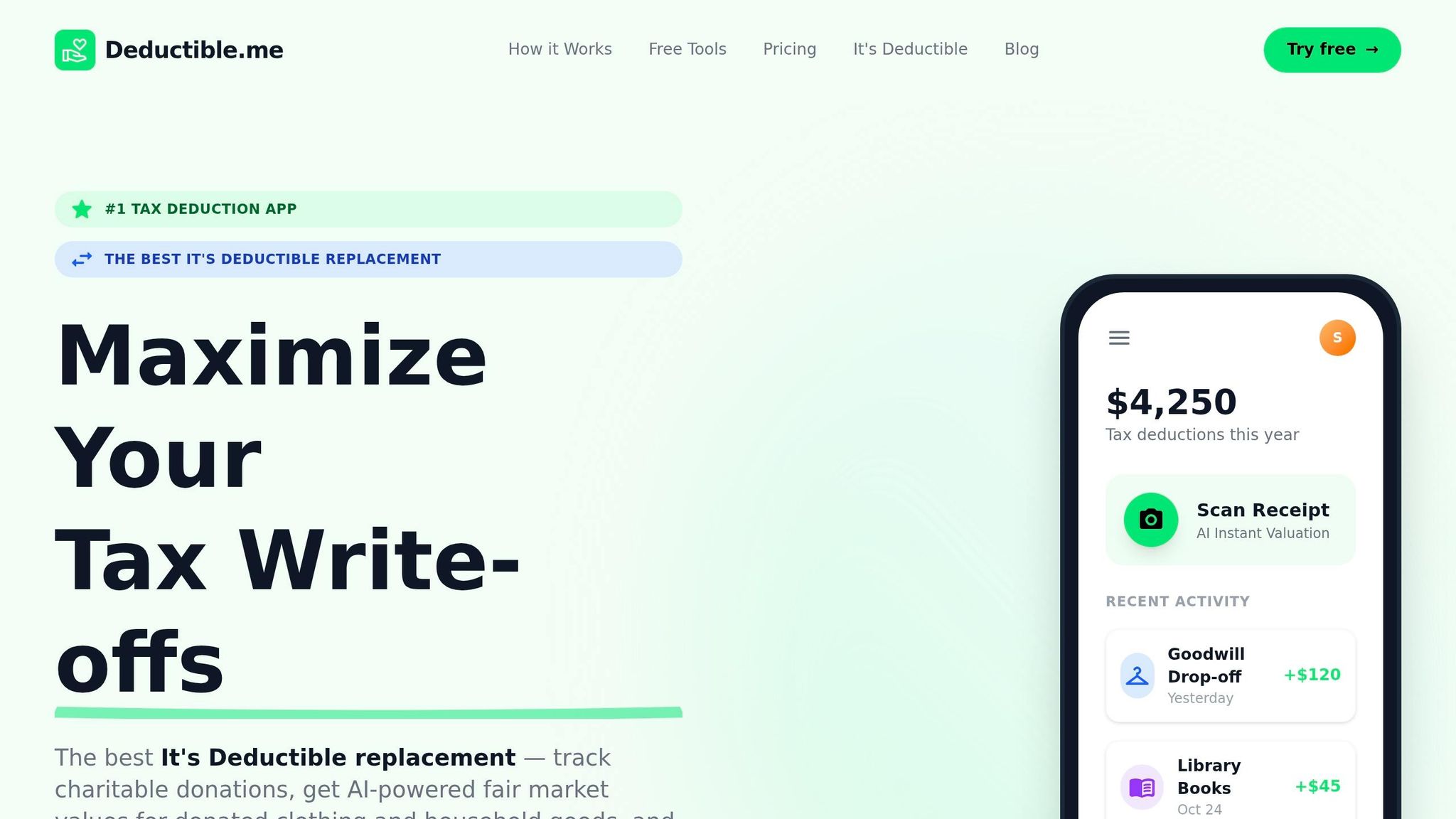
Deductible.me is built for this workflow. It identifies donated items, helps estimate FMV using current resale data, stores receipts and photos, and flags annual reporting thresholds. When it’s time to file, it exports a Form 8283-ready PDF that you can hand to your accountant or upload to your tax software [4].
Use the lightest evidence that still supports the item’s condition, market, and value.
Conclusion: Match Your Evidence to the Item and the Dollar Amount
Match the evidence to the item and the amount: guides for everyday goods, resale comps for items that are harder to price, appraisals for high-value property, and a digital log to keep it all organized. The best evidence is the simplest option that fits the item.
FAQs
How do I choose between a value guide and sold comps?
Use the source that best supports fair market value - what a willing buyer would pay at a thrift store or resale marketplace.
Value guides work well for fast, standard pricing based on typical resale data. Sold comps are a better fit for one-off or higher-priced items because they show current sale prices for similar goods. Deductible.me can also help by using AI, live resale data, and IRS guidelines to produce a valuation you can back up.
What counts as a group of similar items over $5,000?
If you donate one item, or a group of similar items, with a total value above $5,000, the IRS will usually require a qualified appraisal and Form 8283, Section B.
Deductible.me can help you keep your charitable records in order. Still, it’s smart to check with a tax advisor to confirm that your donation meets current IRS rules.
What should I save to prove fair market value?
Keep a dated, itemized list of everything you donate. Also save the charity’s dated receipt and photos that show each item’s condition when you gave it away.
If the total value is more than $500, you’ll need to file IRS Form 8283. Deductible.me can help by storing your photos and receipts, giving you AI-powered valuations, and creating IRS-compliant Form 8283 reports.