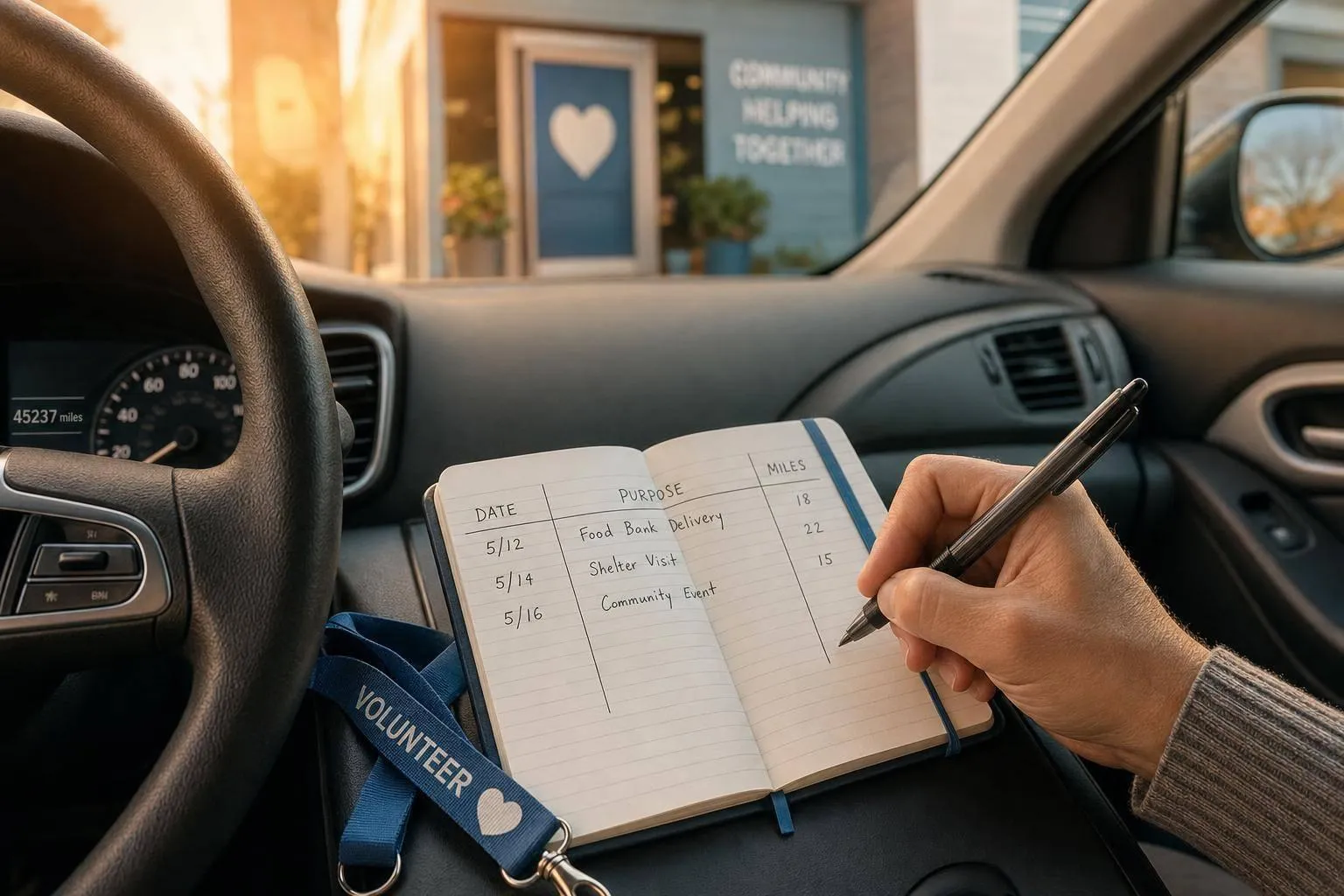
If I want to deduct volunteer mileage in 2026, I can only count unreimbursed miles driven for a qualified 501(c)(3) charity, and the rate is $0.14 per mile. I also need to itemize deductions and keep a log with the date, purpose, and miles for each trip.
Here’s the short version:
- Count only service trips tied directly to volunteer work
- Do not count regular trips from home to a volunteer site, personal stops, or social/fundraising events
- Leave out reimbursed miles
- Add parking and tolls from qualifying trips if I paid them myself
- Record trips right away and match them with emails, schedules, or receipts
- Keep records for 3 years after filing
One small detail trips people up: not every charity-related drive counts. For example, driving supplies to a food bank may count, but driving from home to my usual volunteer location does not.
| What matters | Rule |
|---|---|
| 2026 rate | $0.14 per mile |
| Organization type | Qualified 501(c)(3) |
| Record needed | Date, trip purpose, miles |
| Reimbursed trips | Not deductible |
| Parking and tolls | Can be added if tied to a qualifying trip |
| Record retention | 3 years after filing |
So when I track volunteer mileage, I keep it simple: check the trip, log it the same day, total only eligible miles, and save proof with my tax records.
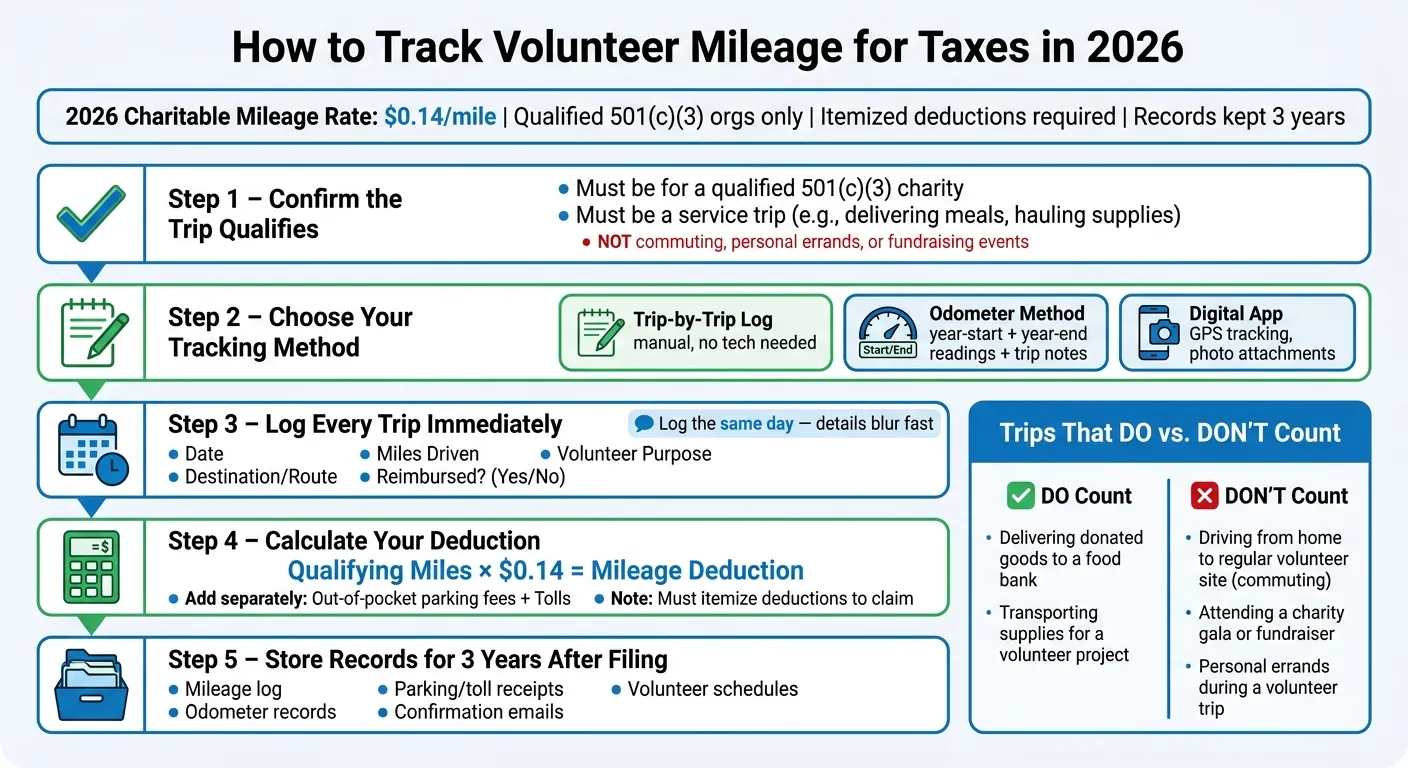
Charitable Mileage: What You Can Deduct & How It Works
Confirm Each Trip Qualifies Before You Log It
Before you log even one mile, do a quick gut check: does this trip actually count? That small step keeps your records clean and helps you avoid writing down miles you can’t claim.
Check the Organization and the Volunteer Purpose
Write down the charity’s legal name and the volunteer task connected to the drive. Use the organization’s legal name as it appears in its official records.
Then make sure the trip was for the volunteer work itself - for example, delivering meals or hauling supplies. It helps to keep the proof that shows why you drove, like:
- the trip email
- the volunteer schedule
- the assignment note
That way, if you ever need to look back, the reason for the trip is right there.
Separate Service Miles from Commuting, Personal, and Event Trips
Here’s where people often trip up: not every drive tied to a charity counts. Service miles need to stay separate from commuting, personal stops, and trips to fundraisers or social events.
| Trip Type | Qualifies? |
|---|---|
| Driving to deliver donated goods for a food bank | ✅ Yes |
| Driving to transport supplies for a volunteer project | ✅ Yes |
| Driving from home to a regular volunteer location (commuting) | ❌ No |
| Attending a charity gala or fundraising dinner | ❌ No |
| Personal errand made during a volunteer trip | ❌ No |
If a trip has a mixed purpose, only the miles directly connected to the charitable service count. So if you drove for volunteer work but made a personal stop along the way, that side trip doesn’t belong in the log.
Only trips that pass this test should go into your mileage record.
Leave Reimbursed Miles Out of Your Deduction
If you were paid back for the miles, leave them out of your deduction. The same rule applies even if the trip itself would have counted otherwise.
You should also keep receipts for out-of-pocket parking and tolls from qualifying trips.
Once a trip passes the test, log it right away using the tracking method you’ve picked.
Pick a Mileage-Tracking Method and Keep Complete Records
Pick a system you’ll actually use every time. That’s the part that matters most.
If you log trips the same day, details are less likely to slip through the cracks. And when tax time rolls around, your totals are much easier to check.
Trip-by-Trip Log, Odometer Method, or Digital Mileage Record
Each method can work. The difference comes down to how much detail you want, how often you drive for charity, and how likely you are to keep up with the process.
| Method | What It Captures | Main Advantage | Limits |
|---|---|---|---|
| Trip-by-Trip Log | Individual entries for every charitable drive. | No technology required; easy to keep in a glove box. | High risk of manual error or loss; tedious to calculate annual totals. |
| Odometer Method | Year-start and year-end odometer readings plus trip-level notes. | Provides precise data on total vehicle use for the year. | Does not prove charitable purpose of specific miles without trip notes. |
| Digital App Record | GPS tracking or manual entry with photo attachments. | Real-time tracking and easy export for tax software. | Requires consistent app usage and phone access. |
A simple rule: if you use odometer readings, pair them with trip notes. Readings by themselves are not enough to show the charitable purpose of the miles.
No matter which method you choose, each charitable trip needs the same basic proof.
What to Record for Every Charitable Trip
Every entry should include the same core details:
- Destination or route
- Beginning and ending odometer readings, if you’re using the odometer method
- Whether the trip was reimbursed
Log the trip as soon as you finish driving. Wait too long, and the small details start to blur.
Link Receipts, Emails, and Schedules to Each Entry
Your mileage log is stronger when it’s backed up by documents.
For each trip, attach a parking receipt, toll receipt, volunteer schedule, or confirmation email from the organization. Deductible.me lets you attach receipt photos to each entry and export your mileage history for tax time. That makes it easier to total deductible miles and support them when you file.
Calculate Your Deduction and Check Your Log
Once you’ve logged each qualifying trip, add up the miles and compare the entries with your source records. If your records are in order, the deduction comes down to simple math. The big thing is to keep charitable miles separate from every other type of driving.
Apply the 2026 Charitable Mileage Rate
Multiply your qualifying charitable miles by $0.14 per mile to figure out your deduction. If you paid parking fees or tolls during those trips, you can deduct those separately and add them to the total.
Keep Charitable Miles Separate from Other Driving Categories
Put charitable miles in their own category. Don’t mix them with commuting, business, medical, or personal driving. And don’t use both the mileage rate and actual vehicle expenses for the same miles.
Reconcile Your Totals Against Supporting Records
Before you file, compare your mileage log with the records that back it up, such as:
- your calendar
- volunteer schedules
- emails
- parking receipts
- toll records
This check can help you spot missing trips or duplicate entries. If a trip doesn’t line up with a volunteer record, review it before filing. It also helps to reconcile your log monthly so small errors don’t pile up. If something looks off, flag it now and fix it while the details are still fresh.
Build Your Year-End File and Store Records for Your Tax Return
Create a Year-End Mileage Summary
At year-end, pull your support file together. Put every qualifying trip into one summary, and make sure each entry includes the date, the charity’s name, the volunteer purpose, and the mileage.
Then check your log against your beginning and ending odometer readings for the year. It’s a simple gut check: do the totals line up, or does something look off?
Leave out any reimbursed trips or entries you can’t support. Then add any separately documented parking fees and tolls to your total.
Save Records with the Rest of Your Tax Documents
Keep your mileage summary, odometer records, receipt photos, and charity information in one place with the rest of your tax return documents. That way, when it’s time to file, you’re not digging through your phone, glove box, and email inbox all at once.
Deductible.me lets you export a PDF summary for your CPA or tax return software [1][2].
Keep these records for three years after filing. That’s the standard window for IRS substantiation requests [1].
With everything stored together, tax filing gets faster and a lot less messy.
Conclusion: How to Stay on Top of Volunteer Mileage All Year
Stay consistent throughout the year, and your year-end package - summary, receipts, odometer records, and support files - will be ready when tax season shows up.
FAQs
What if one trip includes both volunteer work and a personal stop?
You need to keep these two parts separate to stay in line with IRS rules. Only claim mileage for the part of the trip that directly ties to your charitable work.
Track the volunteer portion on its own, apart from any personal errands. Write down the purpose, destination, and exact mileage for that part of the trip. That makes your records easier to manage and helps if you’re ever asked to back them up in an audit.
Can I deduct volunteer mileage if I do not itemize?
No. You can’t deduct volunteer mileage if you don’t itemize your deductions.
Charitable contribution deductions, including the standard mileage rate for volunteer work, are only allowed if you itemize on your federal income tax return instead of taking the standard deduction.
What proof should I keep with my mileage log?
Keep a detailed log of every charitable trip. For each one, record:
- Date
- Destination
- Trip purpose
- Total miles
It also helps to write down your odometer reading at the start and end of each tax year. If you use Deductible.me, you can attach receipt photos to each entry.
Keep these records for at least three years.