
If I donate long-term stock directly to a qualified charity, I can often skip capital gains tax on the growth and still deduct the stock’s market value. That can mean a larger tax write-off than giving cash after I sell.
Here’s the short version:
- Held more than 1 year: I may deduct the fair market value
- Held 1 year or less: I usually deduct cost basis only
- Direct transfer matters: If I sell first, I may owe capital gains tax
- AGI cap: The deduction for long-term stock is generally limited to 30% of AGI
- Carryforward: Any unused deduction can usually roll forward for up to 5 years
- Paperwork: Gifts of $250+ need a written acknowledgment, and Form 8283 is usually required for total noncash gifts over $500
A simple example: if I donate $60,000 in long-term stock and my AGI is $150,000, I can generally deduct up to $45,000 this year, because 30% of $150,000 = $45,000. The rest may carry forward.
| Situation | Tax result |
|---|---|
| Donate long-term appreciated stock directly | No capital gains tax on the gain; deduction may be FMV |
| Donate short-term stock directly | No capital gains tax on the gain; deduction is usually basis |
| Sell stock, then donate cash | Capital gains tax may apply before the gift |
In other words, the tax win comes from what I donate, how long I held it, and whether the shares move straight to the charity.
If You Own Stock and Give to Charity (Watch This First)
How the deduction amount is calculated
Once you’ve confirmed the stock went up in value, the next step is figuring out what the IRS lets you deduct. That amount comes down to three things: the stock’s fair market value, how long you held it, and your AGI limit for the year.
How fair market value is set for publicly traded stock
For publicly traded shares, the IRS says fair market value (FMV) is the average of the stock’s high and low trading prices on the transfer date. And here’s the part that trips people up: the contribution date is the day the shares land in the charity’s account.
That means the transfer date isn’t just paperwork. It sets the value used for your deduction, so make sure you record it. Publicly traded stock also doesn’t need a qualified appraisal, even when the gift is more than $5,000 [3].
Long-term vs. short-term shares: what changes
Your holding period has a big effect on the deduction. In plain English, long-term shares can qualify for a deduction based on full fair market value, while short-term shares usually only qualify for a deduction based on cost basis. In both cases, you can still avoid the capital gain.
| Long-Term (held > 1 year) | Short-Term (held ≤ 1 year) | |
|---|---|---|
| Deduction amount | Full fair market value | Cost basis only |
| AGI deduction limit | 30% of AGI [1] | Generally 50% of AGI [1] |
| Capital gains tax avoided | Yes | Yes |
So if you’re thinking about donating shares you bought less than a year ago, check your brokerage statement first. A few days can make a big difference in the size of the deduction.
AGI limits and the 5-year carryforward rule
Even with long-term stock, the IRS puts a cap on how much you can deduct in one tax year: 30% of your adjusted gross income (AGI) [1]. If the donation goes over that limit, the unused part can generally carry forward for up to five years [1].
Here’s what that looks like in practice: if you donate $60,000 in stock and your AGI is $150,000, your deduction for the current year would be capped at $45,000. The remaining amount carries forward [1].
One more thing: this only helps if you itemize deductions on Schedule A.
After the deduction is clear, the next step is transferring the shares correctly.
How to donate stock: a step-by-step guide
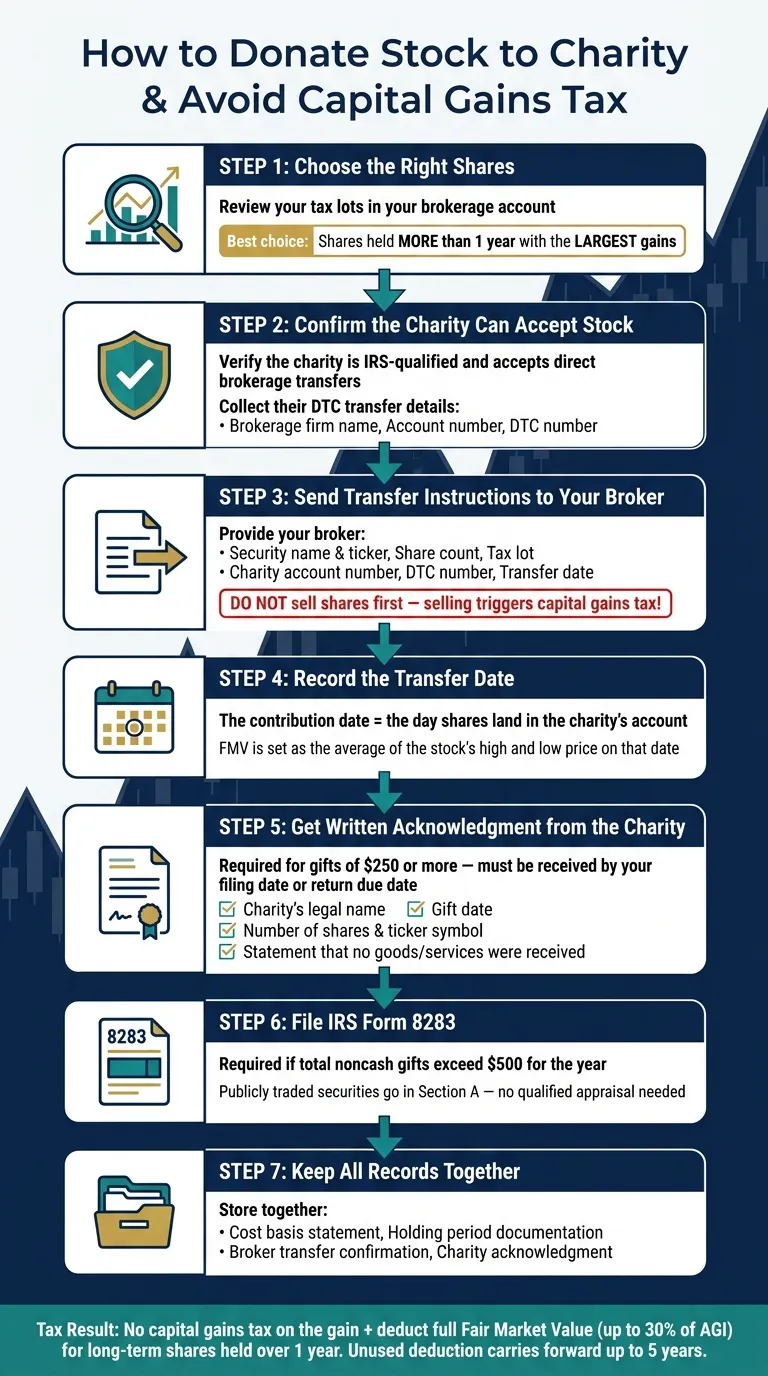
Pick the right shares and confirm the charity can accept them
Start in your brokerage account and review your tax lots. Those are the purchase records for each batch of shares.
In most cases, you’ll want to choose shares you’ve held for more than one year and that have the largest gains. After you decide which shares to donate, transfer them directly from your brokerage account to the charity.
Before you send anything, make sure the recipient is a qualified charity. Then ask whether it can accept direct brokerage transfers. You’ll also need its DTC transfer details:
- Brokerage firm name
- Account number
- DTC number
Give your broker the transfer instructions
Once you have the charity’s details, send the instructions to your broker. Include the security name, ticker symbol, share count, tax lot to transfer, charity account number, DTC number, and transfer date.
Don’t sell the shares first. If you sell before donating, you trigger capital gains tax. To get the tax break, the shares must move straight from your account to the charity’s account [1].
Get written acknowledgment from the charity
After the transfer goes through, make sure your tax records are in order. Follow up with the charity and ask for a written acknowledgment.
For donations of $250 or more, the IRS requires this by the earlier of your filing date or your return due date [4].
The acknowledgment should include:
- The charity’s legal name
- The gift date
- The number of shares and ticker symbol
- A statement that no goods or services were received
The charity reports what shares were donated, and you determine the value for tax reporting. Keep that acknowledgment with your brokerage transfer confirmation so you have support for your deduction claim at tax time.
Tax forms, records, and year-end planning
Form 8283 and the records you need to keep
Once the transfer is done, you’re down to the admin side of things: filing the right form and keeping your backup documents in one place.
If your total noncash gifts for the year are more than $500, you need to file IRS Form 8283 with your tax return. Publicly traded securities belong in Section A, and they don’t need a qualified appraisal, even when the gift is worth more than $5,000 [3].
To back up your deduction, keep these records together:
- Cost basis statement showing what you originally paid
- Holding period documentation showing you owned the shares for more than one year
- Broker transfer confirmation with the transfer date and number of shares
- Charity acknowledgment
You’ll also need to itemize on Schedule A to claim the deduction [1].
Why timing affects your deduction
After the paperwork is lined up, timing becomes the next thing to watch. Making the gift near year-end can help you estimate your income and see how close you are to the 30% AGI cap [1]. If a large donation puts you over that limit, you can carry the unused amount forward for up to five more tax years [1].
Timing can also help with portfolio rebalancing. Say one stock has grown so much that it now takes up too much of your portfolio. Donating those shares lets you cut that concentration without selling them first, which means you avoid the capital gains tax a sale would create [1].
Using Deductible.me to stay organized
If you donate stock more than once in a while, it helps to keep everything in one spot. Deductible.me lets you store broker confirmations, keep charity acknowledgments together, track annual giving goals, and generate IRS-compliant reports for Form 8283 [2].
Conclusion: How to cut capital gains tax with stock donations
If you donate long-term appreciated stock straight to a qualified charity, you may avoid capital gains tax on the gain and, in most cases, deduct the shares’ full fair market value [1]. There is a limit, though: the deduction is generally capped at 30% of your AGI, and any amount you can’t use this year can usually carry forward for up to five more tax years [1].
After you’ve got the tax angle down, the next step is simple: handle the transfer the right way. Send your broker clear transfer instructions, and make sure you get a written acknowledgment from the charity for gifts of $250 or more by the earlier of your filing date or your return due date [4]. If your total noncash gifts for the year go over $500, attach Form 8283, Section A to your tax return [3].
Paperwork matters here. Keeping broker confirmations, charity receipts, and cost basis records in one organized place can make the deduction much easier to claim and back up. A tool like Deductible.me can help with Form 8283 reporting and year-round tracking [2].
FAQs
What if my stock lost value?
If your stock has gone down in value, it’s often smarter to sell the shares first and then donate the cash.
Why? Because selling the stock lets you claim a capital loss. That loss can offset other capital gains or up to $3,000 of ordinary income.
If you itemize on Schedule A, you can usually deduct the full cash donation too.
By contrast, if you donate the shares directly, you usually miss out on that capital loss. In plain English: you may be leaving a tax break on the table.
Can I donate mutual funds or ETFs too?
Yes. Mutual funds and ETFs are usually treated the same way as individual stocks when you donate them to a qualified charity.
If you’ve held the shares for more than one year, you can usually deduct their fair market value and avoid paying capital gains tax on the appreciation. You’ll report the gift on Form 8283, and you’ll need to coordinate the transfer with both your broker and the charity.
What if the charity sells the stock right away?
It usually doesn’t matter.
If you donate long-term appreciated shares directly to a qualified 501(c)(3) charity, your deduction is generally based on the stock’s fair market value at the time of the donation, no matter when the charity sells it.
Because you gave the stock itself instead of selling it first, you can generally avoid capital gains tax on the appreciation.
Keep the charity’s contemporaneous written acknowledgment with your tax records.