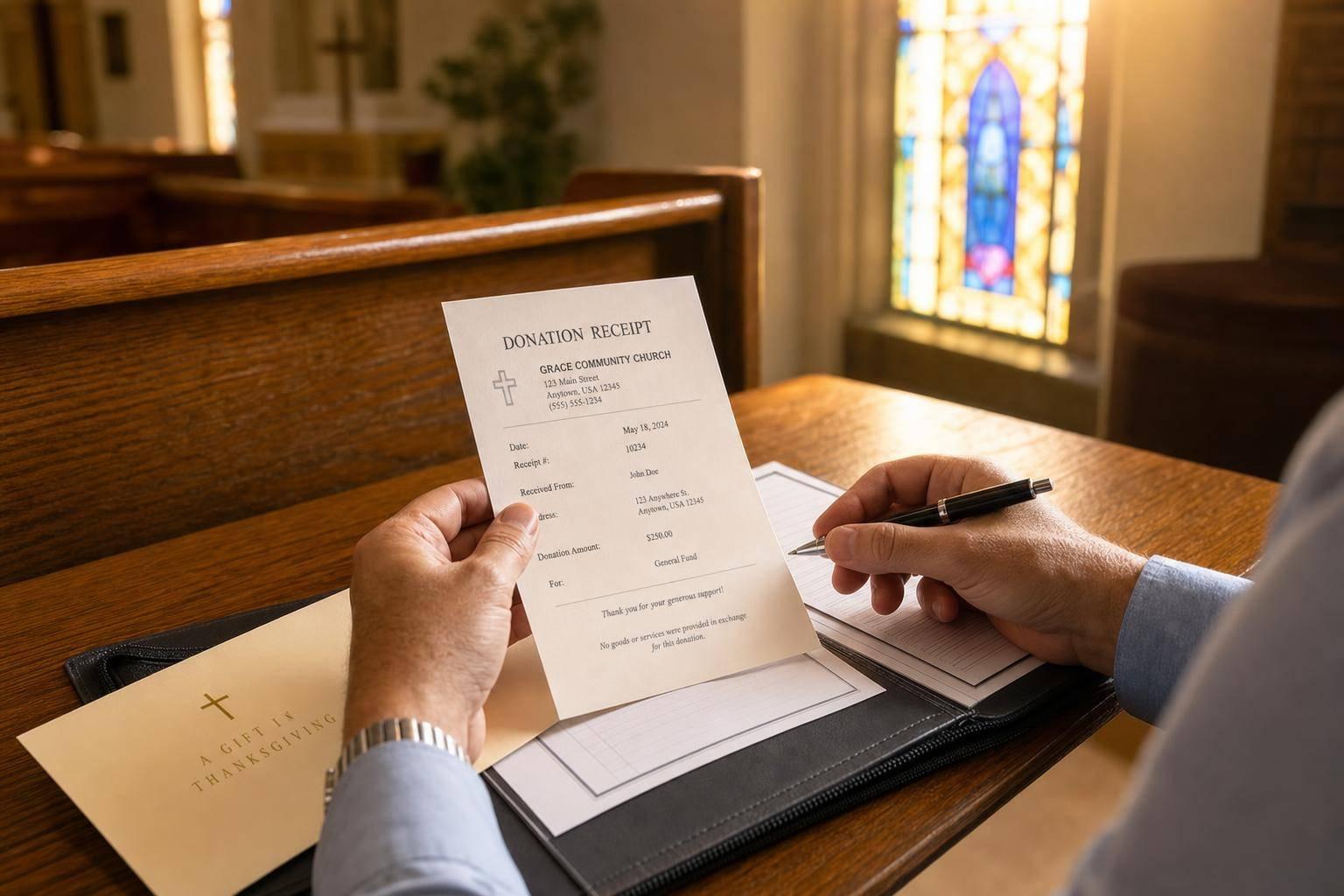
Are Church Donations Tax Deductible?
Yes - in most cases, I can deduct church donations on my federal tax return, but only if I follow IRS rules.
The short version is simple:
- I usually need to itemize on Schedule A
- My gift must go to a qualified church
- I must give it by December 31
- I can deduct only the part where I got nothing back or paid more than what I received
- I need the right records, especially for gifts of $250 or more
- Cash gifts, tithes, online giving, and some noncash gifts may count
- Gifts meant for one specific person usually do not count
- My volunteer time does not count, but some out-of-pocket costs may
There’s also a 2026 rule many people will want to note: even if I do not itemize, I may still be able to deduct up to $1,000 in cash gifts, or $2,000 if filing jointly, for gifts to eligible groups.
A few numbers matter:
- Cash gifts are generally limited to 60% of AGI
- Some noncash gifts are limited to 50% or 30% of AGI
- Noncash gifts over $500 call for Form 8283
- Noncash gifts over $5,000 usually need an appraisal
- Volunteer driving is deductible at 14¢ per mile
The main risk is paperwork. Even when a church gift would otherwise count, the IRS can deny the deduction if I do not have bank records, receipts, or the written acknowledgment the rules call for.
This article boils down the rules so I can tell what counts, what does not, and what proof I need before I file.
Church Donations & Tax Deductions: What You MUST Know!
sbb-itb-e723420
IRS rules for claiming a church donation deduction
Even when a church qualifies, the IRS still has a few guardrails. In plain terms, three things decide whether your church gift is deductible: how you file, when you give, and whether you got something back in return.
You must itemize deductions on Schedule A
To deduct charitable contributions, including church tithes, you generally need to itemize deductions on Schedule A. If you take the standard deduction, there’s a narrow exception for 2026: you may still deduct up to $1,000 in cash contributions, or $2,000 if you file jointly, when the gift goes to certain qualified organizations [1].
That carveout applies only to cash gifts. It does not apply to donated property or goods.
If you do itemize, charitable deductions are subject to an AGI floor, and any unused amount may carry forward [2].
The gift must go to a qualified church and be paid within the tax year
Your contribution must go to a qualified organization, such as a church, and it must be completed by December 31 of the tax year you want to claim [5][6].
That date matters more than people think. The deduction belongs to the year the gift is completed. So if a church gift is mailed, charged, or otherwise completed by December 31, it counts for that tax year [3].
You cannot receive a substantial benefit in return
If you receive goods or services in return, you can deduct only the amount that exceeds their fair market value [1][4].
Here’s the IRS-style math: if you pay $65 for a church dinner dance ticket and the fair market value of the dinner and entertainment is $25, only $40 is deductible [4].
And if your payment is more than $75, the church must provide a written estimate of the value you received [3].
Those rules decide whether a gift qualifies. The next step is figuring out which church donations count.
Which church donations are deductible and which are not
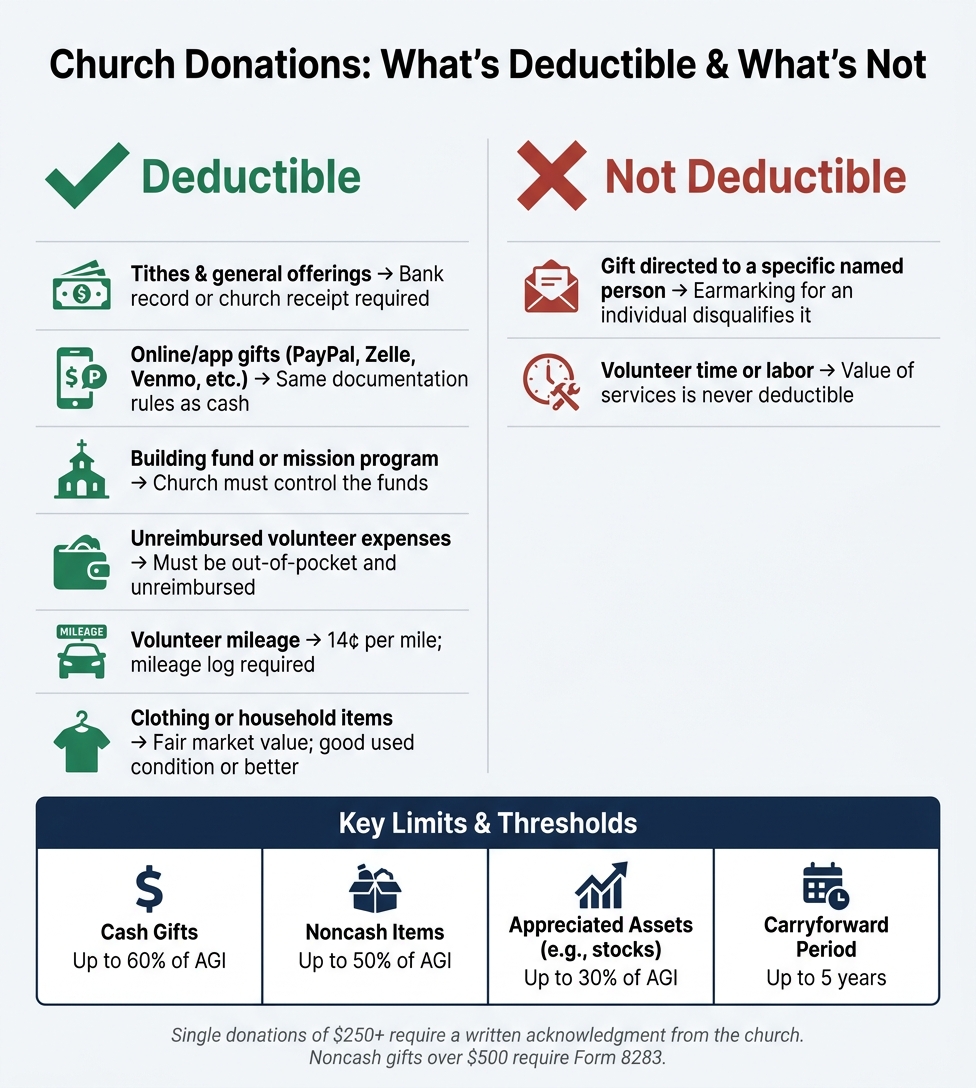
Church Donations: What's Deductible & What's Not (IRS Rules)
Tithes, offerings, and online donations
After a church gift passes the IRS rules, the next step is simple: what kind of gift was it?
Cash donations are usually deductible when they go to a qualified church, you don’t get much of anything back in return, and you keep the right records. That includes tithes and offerings paid by:
The same timing rule applies to all cash gifts. If the donation is completed in a given tax year, that’s the year you claim it.
Restricted gifts, mission funds, and gifts for specific individuals
Some church gifts come with directions attached, and that’s where things can get tricky.
A donation to a church building fund or mission program is still deductible if the church keeps control of the money [3]. But if you direct the gift to a specific named person, the IRS usually treats it differently. A gift earmarked for one individual is generally not deductible [1][3].
If you want to help someone through the church and still stay within the tax rules, give to the church’s general benevolence fund or mission fund instead of naming the person yourself.
Noncash donations and volunteer expenses
Noncash gifts can count too. Donated property like clothing, furniture, or equipment is usually deductible at fair market value, as long as the items are in good used condition or better [7][4].
If your total noncash donations for the year go over $500, you must file Form 8283 with your tax return [4][1].
Volunteer time is a different story. The value of your time or labor is never deductible [3][7]. You can’t put a dollar amount on hours spent teaching Sunday school, fixing a church roof, or helping at an event and write that off.
What you can deduct are unreimbursed expenses tied directly to that volunteer work. That can include supplies bought for a church project, required uniforms that aren’t suitable for daily wear, and some travel costs. If you drive for volunteer work, the IRS charitable mileage rate is 14 cents per mile [3][7].
Keep a mileage log with the date, destination, and purpose of each trip. If that record is missing, the IRS can deny the deduction.
Here’s a quick breakdown:
| Gift or Payment Type | Deductible? | Rule |
|---|---|---|
| Tithes & general offerings | Yes | Bank record or church receipt required |
| Online/app gifts (PayPal, Zelle, etc.) | Yes | Same documentation rules as cash |
| Building fund or mission program | Yes | Church must control the funds |
| Gift directed to a specific person | No | Earmarking for an individual disqualifies it |
| Volunteer time or labor | No | Value of services is never deductible |
| Unreimbursed volunteer expenses | Yes | Must be out-of-pocket and unreimbursed |
| Volunteer mileage | Yes | 14¢ per mile; mileage log required |
| Clothing or household items | Yes | Fair market value; good used condition or better |
Records, limits, and tax forms for church donations
Receipts and written acknowledgments the IRS requires
Once a church gift qualifies, the next step is proof.
This is where a lot of people get tripped up. A donation may count in theory, but without the right records, the deduction can fall apart. The IRS wants documentation.
For any monetary gift - whether by check, credit card, or online transfer - you need either a bank record, such as a statement, canceled check, or credit card record, or a written communication from the church that shows the organization’s name, the date, and the amount [1][2].
There’s a stricter rule once a single donation hits $250 or more. At that point, a bank record by itself doesn’t cut it. You need a written acknowledgment from the church stating the amount of cash given or describing any property donated, and confirming whether the church provided any goods or services in exchange. If you did receive goods or services, you can deduct only the amount above their fair market value [1][4].
Many churches send a year-end giving statement in January. Hold onto it before you file, and check that it includes the needed goods-and-services language.
Loose cash can be tough to prove later. For larger gifts, it’s smarter to give by check, bank transfer, or online payment.
AGI limits, carryforwards, and Form 8283 for noncash gifts
Records are only one part of the rule. Annual deduction caps still matter.
Cash gifts to churches are generally deductible up to 60% of AGI [8][2][5]. If you give more than that in a single year, the extra amount can usually be carried forward for up to the next five tax years [8][10][5].
Noncash gifts face lower caps. Donated items like clothing or furniture are usually limited to 50% of AGI, while long-term appreciated assets, such as stocks, are generally limited to 30% of AGI [8][9][10].
For noncash donations, the paperwork gets heavier as the value goes up:
| Donation Value | Documentation Required | Form/Action Needed |
|---|---|---|
| Under $250 | Bank record or written communication from the church | None [1][2] |
| $250 – $500 | Written acknowledgment from the church | None [1][8] |
| $501 – $5,000 | Written acknowledgment from the church | Form 8283, Section A [1][9] |
| Over $5,000 | Written acknowledgment + qualified appraisal | Form 8283, Section B [1][9] |
| Over $500,000 | Written acknowledgment + qualified appraisal | Form 8283, Section B + attach appraisal [1] |
A qualified appraisal must be prepared, signed, and dated by a qualified appraiser no earlier than 60 days before the contribution date [11]. For noncash donations over $500,000, that appraisal must be physically attached to your tax return.
How Deductible.me helps you track church donations
Deductible.me can help you store receipts, track noncash values, and generate Form 8283-ready reports.
Conclusion: The key test for deducting church donations
After the rules on eligibility, timing, and recordkeeping, the bottom line is pretty simple: a church donation is deductible only if the church qualifies, the gift is complete by December 31, you don't get a substantial benefit in return, and you keep the required records [1][2][3].
This is where many people trip up. Documentation is the most common reason a valid church gift gets denied. The donation itself may be fine, but if the paperwork is missing or incomplete, the deduction can fall apart.
If you receive goods or services, you can deduct only the amount above fair market value. And if a gift is earmarked for one person, it's usually not deductible unless the church controls the funds [1][3][4].
For noncash gifts over $5,000, you need a qualified appraisal and Form 8283, Section B [1][4].
If the church qualifies, the gift is complete by year-end, and your records are in order, the deduction will usually stand.
FAQs
Can I deduct church donations if I take the standard deduction?
Yes. Starting with the 2026 tax year, taxpayers who take the standard deduction can claim an above-the-line deduction for cash charitable contributions.
The deduction is capped at $1,000 for single filers and $2,000 for married filing jointly. It applies to cash gifts made to qualifying 501(c)(3) public charities, including most churches. It does not apply to non-cash property donations.
What proof do I need for church donations?
To claim a tax deduction for church donations, you need to keep the right records.
For cash gifts under $250, keep one of these:
- A bank record
- A canceled check
- A written note from the church that shows the church’s name, the date, and the amount
For any single contribution of $250 or more, get a written acknowledgment from the church before you file your tax return.
That acknowledgment must:
- State the amount
- Describe any goods or services you received
- Include a good faith estimate of their value
Are church donations to help one person deductible?
No. Donations earmarked for a specific individual usually aren’t tax-deductible.
For a contribution to qualify, it generally must go to a qualified charitable organization. The church also needs to keep full administrative and accounting control of the funds, so the money is used to support the church’s exempt mission.