If you give to charity every year but still take the standard deduction, bunching gifts into a donor-advised fund can help you get a tax deduction that you might otherwise miss.
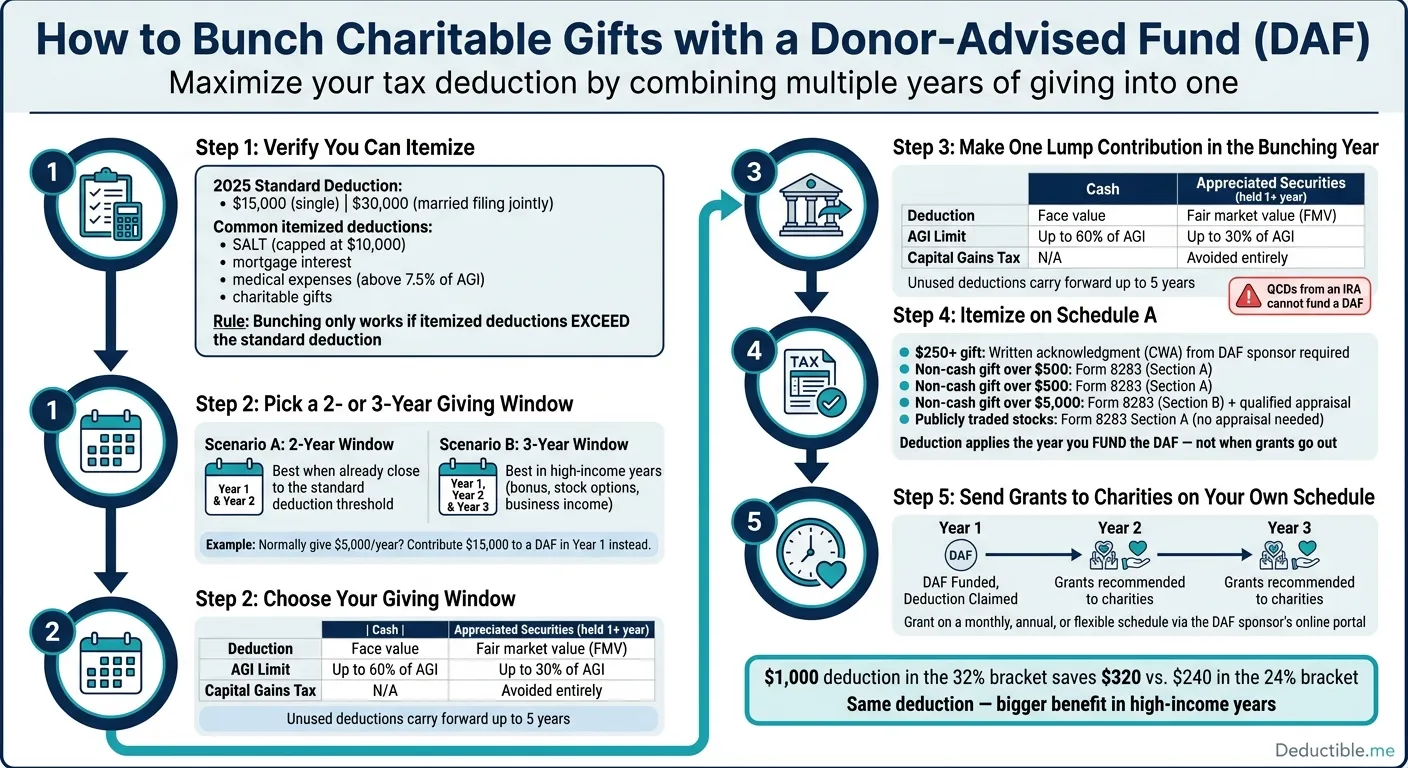
Here’s the short version: I combine 2 to 3 years of planned donations into one tax year, claim the deduction when I fund the DAF, and then send grants to charities over time. For 2025, the standard deduction is $15,000 for single filers and $30,000 for married couples filing jointly, so this move works only if itemizing beats those amounts.
What matters most:
- I get the deduction when I contribute to the DAF, not when grants go to charities.
- Bunching tends to work best if my other itemized deductions already put me close to the standard deduction.
- I can fund the DAF with cash or long-term appreciated stock.
- Cash gifts are generally deductible up to 60% of AGI.
- Long-term appreciated securities are generally deductible up to 30% of AGI.
- If I give appreciated stock held more than 1 year, I may deduct fair market value and avoid capital gains tax on the gain.
- QCDs from an IRA cannot fund a DAF.
- For gifts of $250 or more, I need a written acknowledgment from the DAF sponsor.
- For some non-cash gifts, I may also need Form 8283 and, in some cases, a qualified appraisal.
A simple example: if I usually give $5,000 a year, I might contribute $15,000 to a DAF in one year, itemize that year, and then recommend grants over the next three years.
This approach is less about changing where I give and more about changing when I take the deduction.
When Bunching Makes Sense
Itemized Deductions vs. the Standard Deduction
Before you fund a DAF, make sure bunching will actually get you past the standard deduction. If it doesn’t, the move may not do much for you.
Bunching works only when your itemized deductions are higher than the standard deduction. For 2025, that means going above $15,000 for single filers or $30,000 for married couples filing jointly [1].
Itemized deductions often come from:
- SALT
- Mortgage interest
- Medical expenses
- Charitable gifts
There are a couple of limits to keep in mind. SALT is capped at $10,000, and medical expenses count only to the extent they go above 7.5% of AGI [1].
So if your other deductions already put you close to the line, run the numbers and see how much charitable giving would push you over it [1].
Situations Where Bunching May Help Most
Bunching can matter more in high-income years because the deduction offsets income taxed at a higher marginal rate. Same deduction, different result.
For example, a $1,000 deduction saves $320 in the 32% bracket versus $240 in the 24% bracket [1].
That’s why certain years tend to stand out. Common triggers include a year-end bonus, a stock-option exercise, or a strong business income year [1]. The last high-earning years before retirement can also be a good time to look at this, since deductions often do more for you while your marginal rate is still higher.
Choosing a 2- or 3-Year Giving Window You Can Fund
Start with two simple numbers: what you usually give each year, and how far your other deductions are from the standard deduction.
A 2-year window often works for donors who are already pretty close to the threshold. A 3-year window can make more sense in a high-income year when you want to offset a bigger tax bill.
The setup is simple: fund the DAF in one year, then recommend grants over time [3].
If your yearly giving falls just under the standard deduction, bunching two years into one may push your deduction high enough to itemize, while your grants still go out through the DAF on your usual schedule [1].
Once you pick the window, the next move is to fund the DAF in the year that counts most.
How to Set Up the Bunching Year
Combine 2 to 3 Years of Planned Gifts into One DAF Contribution
After you pick your giving window, fund the DAF in the year that matters most. The idea is simple: take what you usually give each year and multiply it by two or three. That total becomes your one DAF contribution for the bunching year. You get one deduction year, then keep grantmaking at a steady pace later.
For example, if you usually give $5,000 a year, you could put $15,000 into a DAF in year one instead of spreading those gifts across three years. The deduction applies in the year you fund the account.
Before you make the contribution, figure out your gap. Add your fixed itemized deductions, like SALT, which is capped at $10,000, plus mortgage interest. Then subtract that total from the standard deduction for your filing status. What’s left is the amount you need to get past the standard deduction. Your bunched contribution should be more than that gap [1].
Choosing What to Contribute: Cash or Long-Term Appreciated Securities
Cash is the easiest option. But if you want a better tax outcome, long-term appreciated securities can do more work for you.
If you own stocks, mutual funds, or other securities that you’ve held for more than one year, you can give those straight to a DAF. That can help in two ways at once: you may deduct the fair market value, and you avoid capital gains tax on the appreciation [1].
There is one catch. The AGI limit is lower.
- Cash contributions are deductible up to 60% of AGI [1]
- Long-term appreciated securities are deductible up to 30% of AGI [1]
If you’re bunching a large gift, check that limit before funding the DAF. Anything above the cap is not lost. You can carry it forward for up to five years [1].
| Feature | Cash | Appreciated Securities (held more than 1 year) |
|---|---|---|
| Deduction amount | Face value | Fair market value (FMV) |
| AGI limit | Up to 60% of AGI [1] | Up to 30% of AGI [1] |
| Capital gains tax | N/A | Avoided entirely |
One more rule matters here: QCDs from an IRA cannot be used to fund a DAF under current IRS rules, even though the 2026 QCD limit is $111,000 [3].
Next, make sure you have the records the IRS wants.
IRS Reporting and Documentation Requirements
The deduction only counts if you document it the right way. To claim it, you need to itemize on Schedule A.
For any contribution of $250 or more, you need a contemporaneous written acknowledgment, or CWA, from the DAF sponsor. You must get it before you file your tax return or before the return’s due date, whichever comes first [2]. The letter should also say that no goods or services were provided in exchange for the gift.
| Donation type | Required documentation | IRS form |
|---|---|---|
| Under $250 | Bank record, credit card statement, or receipt | None (keep for records) |
| $250–$500 | Contemporaneous written acknowledgment (CWA) | None (keep for records) |
| Over $500 (non-cash) | CWA + description of property and FMV method | Form 8283, Section A |
| Publicly traded stocks (any value) | CWA + fair market value | Form 8283, Section A |
| Over $5,000 (non-cash, non-securities) | CWA + qualified appraisal + signatures | Form 8283, Section B |
Publicly traded securities go on Section A of Form 8283 no matter the value, and they do not need a qualified appraisal [4]. Section B is for non-security property worth more than $5,000, and that section does require a signed appraisal from a qualified appraiser [4].
Charitable Contributions (Part 1) | Bunching | DAF | QCD | Giving
How to Grant from the DAF Over Time
Once the contribution is in the DAF, the next move is deciding when to send grants out. You can pace those grants in a way that fits your giving style. The key point is simple: the tax deduction happens in the year you fund the DAF, not the year the grants go out.
Recommending Grants on a Monthly, Annual, or Flexible Schedule
Most DAF sponsors let you submit grant recommendations through an online portal. You can usually set them up on a monthly schedule, an annual schedule, or just send them whenever you want [1].
That gives you a lot of room. If you pre-funded several years of giving in one tax year, you can still support the same charities over time instead of sending everything at once.
Separating the Deduction Year from the Grant Schedule
This is where people sometimes get tripped up. The grant schedule can be flexible, but the deduction year cannot. The deduction belongs to the year you made the contribution to the DAF, not the year the charity receives the grant [1].
So once the assets are inside the DAF, you can pause and recommend grants later, when it fits your cash flow, your budget, or the causes you want to support.
Using Tracking Tools to Stay Organized
Because the contribution and the grants may happen in different years, it helps to keep a simple record. Deductible.me can track annual giving goals and grant history [5].
It’s also smart to keep:
That way, if you ever need to check what was given, when it was sent, or which year the deduction applied to, you’re not digging through old emails.
Key Tax Rules, Limits, and Next Steps
AGI Limits, Carryforwards, and DAF Rules to Know
Before you fund a DAF, check the tax limits and recordkeeping rules that control your deduction.
Cash gifts to a DAF are generally deductible up to 60% of AGI. Long-term appreciated assets are generally deductible up to 30% of AGI. If you can’t use the full deduction in the current year, unused amounts usually carry forward for five years [1].
| Contribution Type | AGI Deduction Limit |
|---|---|
| Cash to DAF sponsor | 60% |
| Long-term appreciated assets (stocks, etc.) | 30% |
One more rule matters here: QCDs cannot fund a DAF [3].
If your contribution goes past these limits, or if your itemized deductions still don’t beat the standard deduction, the tax upside gets smaller.
Common Mistakes to Avoid Before Funding a DAF
Do not fund a DAF until itemizing clearly beats the standard deduction. Your other deductions, like SALT, mortgage interest, and qualifying medical expenses, shape whether bunching gets you past that mark [1].
A few mistakes can trip people up:
- No acknowledgment letter for gifts of $250+. You need a contemporaneous written acknowledgment from the DAF sponsor before you file your return, including a statement that no goods or services were provided in exchange [2].
- No appraisal for non-cash property over $5,000. Non-cash assets other than publicly traded securities require a qualified appraisal and Section B of IRS Form 8283 [4]. These records protect the bunching year’s deduction, not the later grants.
- Treating grant timing as the deduction year. The deduction belongs to the year you fund the DAF, not the year the grant leaves it [1].
Think of it this way: the tax event happens when money or assets go into the DAF, not when the charity gets the grant.
Conclusion: Is Bunching Gifts with a DAF Right for You?
The sequence is pretty simple: fund the DAF once, claim the deduction in that year, then recommend grants to charities over time on your own schedule [1].
That split only works if you itemize, keep the required records, and account for AGI limits before you transfer anything. Deductible.me can track annual giving goals, charitable records, and grant timing across years when contributions and grants do not line up on the same calendar. Before choosing a bunching year, run the numbers on your expected deductions and giving timeline to confirm the strategy works for you.
FAQs
How do I know if bunching will beat the standard deduction?
Compare your expected itemized deductions - charitable gifts, mortgage interest, state and local taxes, and qualifying medical expenses - with the standard deduction for your filing status.
For 2025, the standard deduction is $15,000 for single filers and $30,000 for married couples filing jointly.
If your total usually lands just under those limits, bunching two years of charitable gifts into one tax year can push you over the line and let you itemize. That can be a smart move when your deductions are close, not quite there, and you don’t want to leave money on the table.
Should I fund my DAF with cash or appreciated stock?
Often, appreciated stock can be more tax-efficient than cash. If you donate long-term appreciated assets to a donor-advised fund, you can usually deduct the fair market value and avoid capital gains tax that may apply if you sold the stock yourself.
Cash gifts are usually deductible up to 60% of adjusted gross income. Long-term appreciated assets are usually capped at 30%.
What records do I need to claim the deduction?
Keep records based on the donation type and amount:
- Cash under $250: a bank record, credit card statement, or receipt
- $250 or more: a contemporaneous written acknowledgment from the charity
- Non-cash over $500 total: IRS Form 8283
- A single item or similar items over $5,000: a qualified appraisal and Section B of Form 8283 with required signatures
Deductible.me can help you track donation dates, values, and charity details. It can also generate IRS-compliant Form 8283 reports.